End of COVID public health emergency will bring changes to U.S. hospitals, nursing homes, addiction treatment and more

The Biden administration’s decision to end the COVID-19 public health emergency in May will institute sweeping changes across the health care system that go far beyond many people having to pay more for COVID tests.

In response to the pandemic, the federal government in 2020 suspended many of its rules on how care is delivered. That transformed essentially every corner of American health care — from hospitals and nursing homes to public health and treatment for people recovering from addiction.

Now, as the government prepares to reverse some of those steps, here’s a glimpse at ways patients will be affected:

Training rules for nursing home staff get stricter

The end of the emergency means nursing homes will have to meet higher standards for training workers.

Advocates for nursing home residents are eager to see the old, tougher training requirements reinstated, but the industry says that move could worsen staffing shortages plaguing facilities nationwide.

In the early days of the pandemic, to help nursing homes function under the virus’s onslaught, the federal government relaxed training requirements. The Centers for Medicare & Medicaid Services instituted a national policy saying nursing homes needn’t follow regulations requiring nurse aides to undergo at least 75 hours of state-approved training. Normally, a nursing home couldn’t employ aides for more than four months unless they met those requirements.

Last year, CMS decided the relaxed training rules would no longer apply nationwide, but states and facilities could ask for permission to be held to the lower standards. As of March, 17 states had such exemptions, according to CMS — Georgia, Indiana, Louisiana, Maryland, Massachusetts, Minnesota, Mississippi, New Jersey, New York, Oklahoma, Pennsylvania, Rhode Island, South Carolina, Tennessee, Texas, Vermont, and Washington — as did 356 individual nursing homes in Arizona, California, Delaware, Florida, Illinois, Iowa, Kansas, Kentucky, Michigan, Nebraska, New Hampshire, North Carolina, Ohio, Oregon, Virginia, Wisconsin, and Washington, D.C.

Nurse aides often provide the most direct and labor-intensive care for residents, including bathing and other hygiene-related tasks, feeding, monitoring vital signs, and keeping rooms clean. Research has shown that nursing homes with staffing instability maintain a lower quality of care.

Advocates for nursing home residents are pleased the training exceptions will end but fear that the quality of care could nevertheless deteriorate. That’s because CMS has signaled that, after the looser standards expire, some of the hours that nurse aides logged during the pandemic could count toward their 75 hours of required training. On-the-job experience, however, is not necessarily a sound substitute for the training workers missed, advocates argue.

Adequate training of aides is crucial so “they know what they’re doing before they provide care, for their own good as well as for the residents,” said Toby Edelman, a senior policy attorney for the Center for Medicare Advocacy.

The American Health Care Association, the largest nursing home lobbying group, released a December survey finding that roughly 4 in 5 facilities were dealing with moderate to high levels of staff shortages.

Treatment threatened for people recovering from addiction

A looming rollback of broader access to buprenorphine, an important medication for people in recovery from opioid addiction, is alarming patients and doctors.

During the public health emergency, the Drug Enforcement Administration said providers could prescribe certain controlled substances virtually or over the phone without first conducting an in-person medical evaluation. One of those drugs, buprenorphine, is an opioid that can prevent debilitating withdrawal symptoms for people trying to recover from addiction to other opioids. Research has shown using it more than halves the risk of overdose.

Amid a national epidemic of opioid addiction, if the expanded policy for buprenorphine ends, “thousands of people are going to die,” said Ryan Hampton, an activist who is in recovery.

The DEA in late February proposed regulations that would partly roll back the prescribing of controlled substances through telemedicine. A clinician could use telemedicine to order an initial 30-day supply of medications such as buprenorphine, Ambien, Valium, and Xanax, but patients would need an in-person evaluation to get a refill.

For another group of drugs, including Adderall, Ritalin, and oxycodone, the DEA proposal would institute tighter controls. Patients seeking those medications would need to see a doctor in person for an initial prescription.

David Herzberg, a historian of drugs at the University at Buffalo, said the DEA’s approach reflects a fundamental challenge in developing drug policy: meeting the needs of people who rely on a drug that can be abused without making that drug too readily available to others.

The DEA, he added, is “clearly seriously wrestling with this problem.”

Hospitals return to normal, somewhat

During the pandemic, CMS has tried to limit problems that could arise if there weren’t enough health care workers to treat patients — especially before there were COVID vaccines when workers were at greater risk of getting sick.

For example, CMS allowed hospitals to make broader use of nurse practitioners and physician assistants when caring for Medicare patients. And new physicians not yet credentialed to work at a particular hospital — for example, because governing bodies lacked time to conduct their reviews — could nonetheless practice there.

Other changes during the public health emergency were meant to shore up hospital capacity. Critical access hospitals, small hospitals located in rural areas, didn’t have to comply with federal rules for Medicare stating they were limited to 25 inpatient beds and patients’ stays could not exceed 96 hours, on average.

Once the emergency ends, those exceptions will disappear.

Hospitals are trying to persuade federal officials to maintain multiple COVID-era policies beyond the emergency or work with Congress to change the law.

Surveillance of infectious diseases splinters

The way state and local public health departments monitor the spread of disease will change after the emergency ends, because the Department of Health and Human Services won’t be able to require labs to report COVID testing data.

Without a uniform, federal requirement, how states and counties track the spread of the coronavirus will vary. In addition, though hospitals will still provide COVID data to the federal government, they may do so less frequently. 

Public health departments are still getting their arms around the scope of the changes, said Janet Hamilton, executive director of the Council of State and Territorial Epidemiologists.

In some ways, the end of the emergency provides public health officials an opportunity to rethink COVID surveillance. Compared with the pandemic’s early days, when at-home tests were unavailable and people relied heavily on labs to determine whether they were infected, testing data from labs now reveals less about how the virus is spreading.

Public health officials don’t think “getting all test results from all lab tests is potentially the right strategy anymore,” Hamilton said. Flu surveillance provides a potential alternative model: For influenza, public health departments seek test results from a sampling of labs.

“We’re still trying to work out what’s the best, consistent strategy. And I don’t think we have that yet,” Hamilton said.


KHN (Kaiser Health News) is a national newsroom that produces in-depth journalism about health issues. Together with Policy Analysis and Polling, KHN is one of the three major operating programs at KFF (Kaiser Family Foundation). KFF is an endowed nonprofit organization providing information on health issues to the nation.
COVID-19 pandemic expected to end this year ‘as a public health emergency,’ says World Health Organization

The director of the Entire world Well being Group (WHO) announced on Friday that he is “confident” the COVID-19 pandemic will conclusion in 2023.

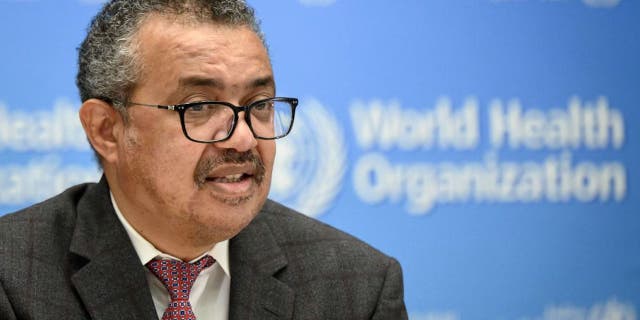
Director-Standard Dr. Tedros Adhanom Ghebreyesus made the reviews to reporters at a media briefing in Geneva.

“We are definitely in a much better place now than we have been at any time in the course of the pandemic,” Dr. Ghebreyesus claimed. 

He mentioned that in the past 4 months, the weekly range of documented fatalities has been reduce than it was just before the pandemic was declared in March 2020.

More mature People in america REJECT Extra VACCINES, Choose As a substitute FOR ‘NATURAL Healing,’ Claims REPORT

“I am assured that this yr, we will be able to say that COVID-19 is around as a community well being unexpected emergency of global issue,” he extra.

COVID-19 instances and fatalities proceed to pattern downward all over the world. 

COVID-19 pandemic expected to end this year ‘as a public health emergency,’ says World Health Organization

Globe Wellness Corporation (WHO) Director-Basic Tedros Adhanom Ghebreyesus announced on Friday he is “assured” the COVID-19 pandemic will conclusion in 2023. (iStock)

As of March 6, weekly fatalities stood at 5,048 globally.

That’s a lower of additional than 26{bf0515afdcaddba073662ceb89fbb62b6b1bf123143c0e06b788e1946e8c353f} from the prior 7 days — and down from a peak of 102,000 deaths in January 2021, for every info from WHO.

Weekly instances of COVID-19 are down to 812,255 globally, a 21.65{bf0515afdcaddba073662ceb89fbb62b6b1bf123143c0e06b788e1946e8c353f} lessen above the prior 7 days. They peaked at 44.3 million in December 2022.

“Very last week, there were even now a lot more than 5,000 noted deaths.”

In the U.S., as of March 15, weekly scenarios were down to 149,955, right after peaking at 5.6 million on Jan. 19, 2022, for every knowledge from the Facilities for Disease Manage and Avoidance (CDC). 

COVID VACCINE UPDATE: Food and drug administration AUTHORIZES PFIZER BOOSTER FOR SOME Young children Underneath AGE 5

Weekly deaths in the region were at 1,706, down from an all-time peak of 23,478 on Jan. 13, 2021 and one more surge of 17,357 on Feb. 2, 2022. 

‘We are not there yet’

Having said that, even with its optimistic prediction, the WHO is not really ready to announce the conclude of the pandemic at this exact minute in time.

“We are not there however. Past week, there were nonetheless additional than 5,000 documented fatalities,” Dr. Ghebreyesus mentioned in the course of the briefing. 

“That is 5,000 too numerous for a ailment that can be prevented and dealt with.”

In the U.S., as of March 15, weekly cases were down to 149,955, after peaking at 5.6 million on Jan. 19, 2022. 

In the U.S., as of March 15, weekly circumstances were down to 149,955, right after peaking at 5.6 million on Jan. 19, 2022.  (iStock)

Dr. Ghebreyesus also pressured the want to decide how the pandemic started.

“Previous Sunday, WHO was designed conscious of knowledge released on the GISAID databases in late January, and taken down yet again recently,” he explained. 

“The information, from the Chinese Center for Illness Management and Prevention, relates to samples taken at the Huanan marketplace in Wuhan in 2020.”

Dr. Ghebreyesus claimed that whilst this distinct knowledge did not offer a “definitive reply” to the pandemic’s origins, all information is crucial in acquiring that intention.

Exceptional TICK-BORN BABESIOSIS Condition ON THE Increase IN NORTHEASTERN US, Claims CDC — Here’s WHY

“These facts could have — and really should have — been shared 3 decades ago,” he ongoing. “We keep on to call on China to be transparent in sharing knowledge, and to carry out the needed investigations and share the final results. Comprehending how the pandemic started remains both of those a moral and scientific crucial.”

“We are surely in a considerably greater situation now than we have been at any time all through the pandemic.”

Dr. Marc Siegel, medical professor of medicine at NYU Langone Medical Centre in New York Metropolis and a Fox Information professional medical contributor, stated this weekend that he inquiries the WHO’s hesitancy to signal the conclusion of the international crisis irrespective of the weekly COVID loss of life depend staying reduced than pre-pandemic.

Weekly COVID-19 cases and deaths have been trending consistently downward both in the U.S. and globally. 

Weekly COVID-19 scenarios and deaths have been trending continually downward both in the U.S. and globally.  (iStock)

“Under the heavy impact of China, WHO leadership actions have been erratic at greatest, delaying contacting it a pandemic for practically two months soon after it was spreading greatly and failing at acquiring China to be open and transparent about origins,” Dr. Siegel told Fox Information Electronic in an interview.

Click on Listed here TO Sign UP FOR OUR Wellbeing Publication

“The pandemic has revealed WHO at the highest ranges to be woefully inadequate.”

In January 2023, President Joe Biden introduced that he would end the COVID crisis on May perhaps 11. 

Click on Listed here TO GET THE FOX Information Application

He had earlier declared the pandemic to be “over” in September 2022.

Patient Burnout Is a Simmering Public Health Crisis

You haven’t been feeling well lately. You’re more tired than usual, a bit sluggish. You wonder if there’s something wrong with your diet. Or maybe you’re anemic? You call your primary-­care doctor’s office to schedule an appointment. They inform you the next available appointment is in three weeks.

So, you wait.

And then you wait some more.

And then, when you arrive on the day of your appointment, you wait even more.

You fill out the mountain of required paperwork, but the doctor still isn’t ready to see you. You flip through a magazine for a while, then scroll through your phone until you’re finally called. You wait a little longer in a scratchy paper gown, then talk to your physician—if you can call it talking, since she’s mostly staring at a computer screen—for all of 10 minutes before you’re back out in the lobby with a lab order to have your blood tested.

Then you call to set up your blood test, and the waiting process starts over.

A few weeks after you get your results, a bill arrives in the mail. You’re charged hundreds of dollars for the blood work. The appointment was over in minutes, but your bank account will feel the effects for a long time.


More from TIME


Going to the doctor may never be a fun experience, but surely it can be better than it is right now. In 2019, even before the COVID-19 pandemic rocked the foundations of health care, an Ipsos survey found that 43{bf0515afdcaddba073662ceb89fbb62b6b1bf123143c0e06b788e1946e8c353f} of Americans were unsatisfied with their medical system, far more than the 22{bf0515afdcaddba073662ceb89fbb62b6b1bf123143c0e06b788e1946e8c353f} of people in the U.K. and 26{bf0515afdcaddba073662ceb89fbb62b6b1bf123143c0e06b788e1946e8c353f} of people in Canada who were unsatisfied with theirs. By 2022, three years into the pandemic, just 12{bf0515afdcaddba073662ceb89fbb62b6b1bf123143c0e06b788e1946e8c353f} of U.S. adults said health care was handled “extremely” or “very” well in the U.S., according to a poll from the Associated Press–NORC Center for Public Affairs Research.

Americans pay a premium for the care they rate so poorly. The U.S. spends more per capita on health care than any other developed country in the world but has subpar health outcomes. Average life expectancy is lower in the U.S. than in other wealthy nations, and about 60{bf0515afdcaddba073662ceb89fbb62b6b1bf123143c0e06b788e1946e8c353f} of U.S. adults have a chronic disease. About 10{bf0515afdcaddba073662ceb89fbb62b6b1bf123143c0e06b788e1946e8c353f} of the population doesn’t have health insurance.

And the customer service sucks. U.S. patients are tired of waiting weeks or months for appointments that are over in minutes. They’re tired of high prices and surprise bills. They’re tired of providers who treat them like electronic health record entries, rather than people.

That could dissuade them from getting medical care at all—and if that happens, America may get a whole lot sicker than it already is. Patients are, in a phrase, burned out.


Primary care is supposed to be the bedrock of the U.S. medical system. In theory, patients get annual physicals so doctors can assess their overall health and detect any red flags (or refer them to specialists who can) before those warning signs become full-blown chronic disease. While experts debate whether everyone needs a checkup each year, studies show that on balance, patients who regularly see a physician tend to be healthier and live longer than those who don’t.

Yet about a quarter of American adults don’t have a primary-care provider, and, as of 2021, almost 20{bf0515afdcaddba073662ceb89fbb62b6b1bf123143c0e06b788e1946e8c353f} hadn’t seen any doctor during the past year. There are many barriers: it can take weeks to get an appointment, particularly in more rural areas where fewer doctors practice, and visits can be costly even for people with insurance. Research shows that during the past year, financial strain caused about 40{bf0515afdcaddba073662ceb89fbb62b6b1bf123143c0e06b788e1946e8c353f} of U.S. adults to delay or go without medical care.

Plus, people just don’t like going. A third of participants in one 2015 study said they had avoided going to the doctor because they found it unpleasant, citing factors like rude or inattentive providers, long wait times, and difficulty finding a convenient appointment. Many people also skipped appointments during the COVID-19 pandemic, largely because of office closures and fears of the virus—but one study found that people were more likely to forgo doctor’s visits during the pandemic if they’d had previous poor experiences with health care. People of color, women, and people who are overweight frequently report feeling mistreated by their doctors.

Jen Russon, a 48-year-old English teacher and mother of two from Florida, says she can’t remember a single positive experience she’s had with a doctor. She struggles to square the $400 her family pays in monthly insurance costs with what she characterizes as a rushed and underwhelming care experience that pales in comparison with the attention her pets get at the veterinarian. “I wish we could see our vet instead, because they really spend a lot of time” with their patients, she says.

Part of the problem may go back to the way doctors are trained, says Jennifer Taber, an associate professor of psychological sciences at Kent State University and a co-author of the 2015 study on doctor avoidance. U.S. medical schools do an excellent job of teaching students how to practice medicine. But, she argues, they aren’t always as good at preparing students to be doctors, with all the interpersonal complexity that entails. “Patients won’t necessarily want to go back to doctors they don’t like,” she says. Even small gestures, like making eye contact with or leaning toward a patient as they speak, can help build a strong rapport, Taber says.

The pandemic certainly hasn’t improved bedside manner. It’s pushed nearly every element of medical care to the brink and prompted some providers to leave the profession entirely, worsening existing personnel shortages and contributing to an epidemic of physician burnout. According to one recent survey, 30{bf0515afdcaddba073662ceb89fbb62b6b1bf123143c0e06b788e1946e8c353f} of U.S. physicians said they felt burned out in late 2022, and about as many said they’d considered leaving the profession in the previous six months.

Physician burnout only adds to patient burnout, says Dr. Bengt Arnetz, a professor at the Michigan State University College of Human Medicine who researches how to improve primary care. “Providers feel stressed, burned out, less empathetic. A lot of times they don’t engage the patient, and the patient wants to be engaged,” Arnetz says.

But these problems didn’t start with the pandemic, says Lori Knutson, executive director of the Whole Health Institute, a nonprofit focused on improving health care delivery. “We should all be honest,” she says, “about the fact that health care has been slowly imploding for a period of time.”


It’s impossible to explain problems with U.S. health care without talking about insurance. U.S. patients pay more out of pocket for health care than people in other wealthy, developed countries, most of which offer some form of universal health coverage.

The insurance system is also endlessly confusing, says Dr. Ateev Mehrotra, a professor of health care policy at Harvard Medical School. Doctors may not know how much the tests they’re recommending cost, particularly when every patient has a different type and level of coverage, so surprise bills are common—and so hard to understand that patients often have to spend hours on the phone seeking clarity from their insurance providers. One 2020 study estimated that dealing with insurance companies costs the U.S. more than $20 billion annually in lost productivity.

How doctors get paid affects the patient experience too. Many health systems pay physicians based on how many appointments and procedures they squeeze in, which rewards lightning-fast visits over those that are “about the whole person and not just what’s wrong with them,” Knutson says. This system can also incentivize doctors to recommend tests and procedures that aren’t strictly necessary, which leads to extra costs and hassle for patients and added strain on the health care system.

Here, too, insurance is part of the problem. Doctors in primary care or family medicine often make significantly less than specialists, in part because their services are reimbursed at lower rates. That dissuades some medical-school graduates—particularly those saddled with debts—from entering general medicine, which contributes to shortages in the medical fields patients are most likely to need on a regular basis. When there aren’t enough doctors to go around, appointments get scarcer and physicians become overworked, rushing from appointment to appointment and drowning in paperwork.

Some simple solutions exist. In a study published in 2020, Arnetz and his colleagues analyzed what happened when one small medical clinic made minor tweaks to its operations, such as reassigning some of the main provider’s administrative duties to nurses or medical assistants and adding short team meetings to delegate tasks for the day. After two weeks, the clinic scored higher than a comparison clinic on measures of efficiency, contributing to better patient and provider satisfaction.

Traditional medical offices could also take cues from the services patients are increasingly gravitating toward, says Pearl McElfish, who researches health services at the University of Arkansas for Medical Sciences. Patients who can afford it are flocking to startups offering perks like same-day appointments and flat-rate monthly memberships. And one 2018 study co-authored by Mehrotra found that visits to urgent-care clinics, where patients can walk in instead of waiting for weeks, increased by more than 100{bf0515afdcaddba073662ceb89fbb62b6b1bf123143c0e06b788e1946e8c353f} from 2008 to 2015 among privately insured U.S. adults. (During roughly the same period, primary-care visits dropped 24{bf0515afdcaddba073662ceb89fbb62b6b1bf123143c0e06b788e1946e8c353f}.) During the pandemic, urgent-care centers only became more popular—as did telehealth.

“Currently [the traditional system] isn’t meeting the needs of many patients,” Mehrotra says. “Patients are voting with their feet and going to these other care sites.”

The trouble with convenience-first medical care, however, is that it’s often issue-specific. If you go in to get a flu shot, you’ll get that vaccine and then be on your way. The clinician is unlikely to make sure you’re up to date on your other shots or perform recommended screenings—the kind of preventive care that can fend off bigger issues down the line. On the other hand, these newer options can “put pressure on existing providers to be a bit more patient-centric,” Mehrotra says.

Traditional medical offices could make some changes right away, without waiting for big structural overhauls, he says. They could offer “walk-in only” hours to treat people without appointments, text patients when the doctor is ready to see them, and include clear explanations on bills so patients understand what they’re paying for. Even small shifts like these could make significant differences to patients.

The stakes are high. Ashley, who is 35 and asked to use only her first name to protect her privacy, has a gene mutation that heightens her risk of breast cancer and is supposed to get an annual mammogram and two ultrasounds per year. But she has to move frequently for her job in academia and hasn’t had her tests done in four years because she got so fed up with the arduous process of finding new doctors, transferring medical records, and dealing with insurance every time she moves. “The barriers were enough that I just kept putting it off,” she says.

Burned-out patients may retreat from the institutions that made them feel that way. Ashley says she’s considering a preventive double mastectomy—a surgery she may have needed anyway because of her genetic predisposition, but one made more appealing by her desire to stop dealing with “pain in the butt” medical appointments. Russon, from Florida, says she’s felt tempted to cancel her family’s insurance and go to the doctor only when absolutely necessary, though she’s never acted on the urge. Other patients, however, may walk away from the health care system entirely. It may not be the wisest or healthiest response, but it’s a human one.

More Must-Reads From TIME


Write to Jamie Ducharme at jamie.ducharme@time.com.

With public health on the line, here’s how local health departments are fighting misinformation


Oklahoma City
KHN
 — 

By the summer of 2021, Phil Maytubby, deputy CEO of the health department here, was concerned to see the numbers of people getting vaccinated against covid-19 slipping after an initially robust response. With doubt, fear, and misinformation running rampant nationwide — both online and offline — he knew the agency needed to rethink its messaging strategy.

So, the health department conducted something called an online “sentiment search,” which gauges how certain words are perceived on social media. The tool found that many people in Oklahoma City didn’t like the word “vaccinate” — a term featured prominently in the health department’s marketing campaign.

“If you don’t know how your message is resonating with the public,” Maytubby said, “you’re shooting in the dark.”

Across the country, health officials have been trying to combat misinformation and restore trust within their communities these past few years, a period when many people haven’t put full faith in their state and local health departments. Agencies are using Twitter, for example, to appeal to niche audiences, such as NFL fans in Kansas City and Star Wars enthusiasts in Alabama. They’re collaborating with influencers and celebrities such as Stephen Colbert and Akbar Gbajabiamila to extend their reach.

Some of these efforts have paid off. By now, more than 80{bf0515afdcaddba073662ceb89fbb62b6b1bf123143c0e06b788e1946e8c353f} of U.S. residents have received at least one shot of a covid vaccine.

But data suggests that the skepticism and misinformation surrounding covid vaccines now threatens other public health priorities. Flu vaccine coverage among children in mid-December was about the same as December 2021, but it was 3.7 percentage points lower compared with late 2020, according to the Centers for Disease Control and Prevention. The decrease in flu vaccination coverage among pregnant women was even more dramatic over the last two years: 18 percentage points lower.

Other common childhood vaccination rates are down, too, compared with pre-pandemic levels. Nationally, 35{bf0515afdcaddba073662ceb89fbb62b6b1bf123143c0e06b788e1946e8c353f} of all American parents oppose requiring children to be vaccinated for measles, mumps, and rubella before entering school, up from 23{bf0515afdcaddba073662ceb89fbb62b6b1bf123143c0e06b788e1946e8c353f} in 2019, according to a KFF survey released Dec. 16. Suspicion swirling around once-trusted vaccines, as well as fatigue from so many shots, is likely to blame.

Part of the problem comes down to a lack of investment that eroded the public health system before the pandemic began. An analysis conducted by KHN and The Associated Press found local health department spending dropped by 18{bf0515afdcaddba073662ceb89fbb62b6b1bf123143c0e06b788e1946e8c353f} per capita between 2010 and 2020. State and local health agencies also lost nearly 40,000 jobs between the 2008 recession and the emergence of the pandemic.

This made their response to a once-in-a-century public health crisis challenging and often inadequate. For example, during covid’s early days, many local health departments used fax machines to report covid case counts.

“We were not as flexible as we are now,” said Dr. Brannon Traxler, director of public health at the South Carolina Department of Health and Environmental Control.

At the start of the pandemic, Traxler said, only two people worked on the media relations and public outreach team at South Carolina’s health department. Now, the team has eight.

The agency has changed its communication strategies in other ways, too. Last year was the first year, for example, that South Carolina published data on flu vaccinations every two weeks, with the goal of raising awareness about the effectiveness of the shots. In South Carolina, not even one-quarter of adults and children eligible for a flu shot had been vaccinated by early December, even as flu cases and hospitalizations climbed. The flu vaccine rate across all age groups in the U.S. was 51.4{bf0515afdcaddba073662ceb89fbb62b6b1bf123143c0e06b788e1946e8c353f} last season.

Those who have opted out of both the covid and flu shots seem to be correlated, Traxler said.

Vaccine clinics operated by public health departments, like this one in Oklahoma County in November 2021, are a critical part of protecting public health.

“We’re really just trying to dispel misinformation that’s out there,” Traxler said. To that end, the health department has partnered with local leaders and groups to encourage vaccinations. Agency staffers have also become more comfortable talking to the press, she said, to better communicate with the public.

But some public health experts argue that agencies are still failing on messaging. Scientific words such as “mRNA technology,” “bivalent vaccine,” and “monoclonal antibodies” are used a lot in public health even though many people find them difficult to understand.

A study published by JAMA found that covid-related language used by state-level agencies was often more complex than an eighth-grade reading level and harder to understand than the language commonly used by the CDC.

“We have to communicate complex ideas to the public, and this is where we fail,” said Brian Castrucci, CEO of the de Beaumont Foundation, a charitable group focused on strengthening public health. “We have to own the fact that our communication missteps created the environment where disinformation flourished.”

Most Americans support public health, Castrucci said. At the same time, a small but vocal minority pushes an anti-science agenda and has been effective in sowing seeds of distrust, he said.

The more than 3,000 public health departments nationwide stand to benefit from a unified message, he said. In late 2020, the foundation, working with other public health groups, established the Public Health Communications Collaborative to amplify easy-to-understand information about vaccines.

“The good guys need to be just as well organized as those who seek to do harm to the nation,” he said. “One would think we would learn from this.”

Meanwhile, a report published in October by the Pew Research Center found 57{bf0515afdcaddba073662ceb89fbb62b6b1bf123143c0e06b788e1946e8c353f} of U.S. adults believe “false and misleading information about the coronavirus and vaccines has contributed a lot to problems the country” has faced amid the pandemic.

“I was leery like everyone else,” said Davie Baker, 61, an Oklahoma City woman who owns a business that sells window treatments. When the shots became widely available in 2021, she thought they had been developed too quickly, and she worried about some of the things she’d read online about side effects. A pharmacist at Sam’s Club changed her mind.

“She just kind of educated me on what the shot was really about,” Baker said. “She cleared up some things for me.”

Baker signed up for her first covid shot in May 2021, around the same time the health department in Oklahoma City noticed the number of vaccines administered daily was starting to decline.

The department updated its marketing campaign in early 2022. Instead of using the word “vaccinate” to encourage more people to get their covid shots — the term the agency’s social media analytics revealed people didn’t like — the new campaign urged people to “Choose Today!”

“People don’t trust like they used to,” Maytubby said. “They want to make up their own minds and make their own decisions.” The word “choose” acknowledged this preference, he said.

Maytubby thinks the “Choose Today!” campaign worked. A survey of 502 adults in Oklahoma City conducted during the first half of 2022 found fewer than 20{bf0515afdcaddba073662ceb89fbb62b6b1bf123143c0e06b788e1946e8c353f} of respondents reacted negatively or very negatively to a sample of “Choose Today!” advertisements. And an estimated 86.5{bf0515afdcaddba073662ceb89fbb62b6b1bf123143c0e06b788e1946e8c353f} of adults in Oklahoma City have received at least one dose of a covid vaccine — a rate higher than the state average of about 73{bf0515afdcaddba073662ceb89fbb62b6b1bf123143c0e06b788e1946e8c353f}.

Other factors are likely at play that have helped bolster Oklahoma City’s vaccine numbers. In the same survey of Oklahoma City adults, some people who were recently vaccinated said family members or church leaders urged them to get the vaccine, or they knew someone who had died from covid. One person said money was the motivation — they received $900 from their employer for getting the covid vaccine.

Meanwhile, the war against misinformation and disinformation wages on. Childhood vaccination rates for the immunizations students typically need to enter kindergarten are down 4.5{bf0515afdcaddba073662ceb89fbb62b6b1bf123143c0e06b788e1946e8c353f} in Oklahoma County since the 2017-18 academic year as parents increasingly seek exemptions to the requirements.

That worries Maytubby. He said the primary tactic among those trying to sow distrust about vaccinations has been to cast doubt — about everything from the science to their safety.

“In that aspect, they’ve been pretty successful,” Maytubby said. “Misinformation has changed everything.”

Youth ambassadors train for a future in public health : Shots

Youth ambassadors train for a future in public health : Shots

Bithaniya Fieseha, a high school senior, graduates from the Youth Public Health Ambassador program run by the Fairfax County Health Department at West Springfield High School in Fairfax County, Va.

Will Schermerhorn/Fairfax County Health Department


hide caption

toggle caption

Will Schermerhorn/Fairfax County Health Department


Bithaniya Fieseha, a high school senior, graduates from the Youth Public Health Ambassador program run by the Fairfax County Health Department at West Springfield High School in Fairfax County, Va.

Will Schermerhorn/Fairfax County Health Department

Of all the things she could have done on her summer vacation, Bithaniya Fieseha, a senior at West Springfield High School in Fairfax County, Va., decided to study chronic disease, mental health and contact tracing. Some of her friends didn’t understand the appeal.

“I feel like people are like, ‘You wasted your summer,’ ” she says. “But I enjoyed it. I really enjoyed meeting up with everyone, going through the struggle.”

She practiced taking temperatures, weight and blood pressure readings on her family. Fieseha topped it off with an internship at a local health clinic.

Her hard work paid off. On a recent Saturday morning, Fieseha became one of 14 high school students to graduate from the Youth Public Health Ambassador program run by the Fairfax County Health Department. It trains teenagers from underserved communities to become health workers and prepares them for potential careers in public health. The coursework was designed by the Morehouse School of Medicine.

“I think this program gives us a voice because, as minorities, we’re able to see those disparities” in our own surroundings, says Nayla Bonilla, a junior at Justice High School, “I saw that there were so many different avenues into medicine and things we can do in the future that can help our communities thrive.”

The training aims to help shore up the public health workforce, which is in bad shape as the COVID-19 pandemic enters its fourth year. A wave of retirements is expected to further strain health departments over the next few years.

“We need to not only attract people into the fields of healthcare and public health, but we need to attract people of color,” says Dr. Gloria Addo-Ayensu, director of the Fairfax County Health Department, “We need people from our Black and Brown communities to engage in the field so they are able to explain to their communities what health is all about.”

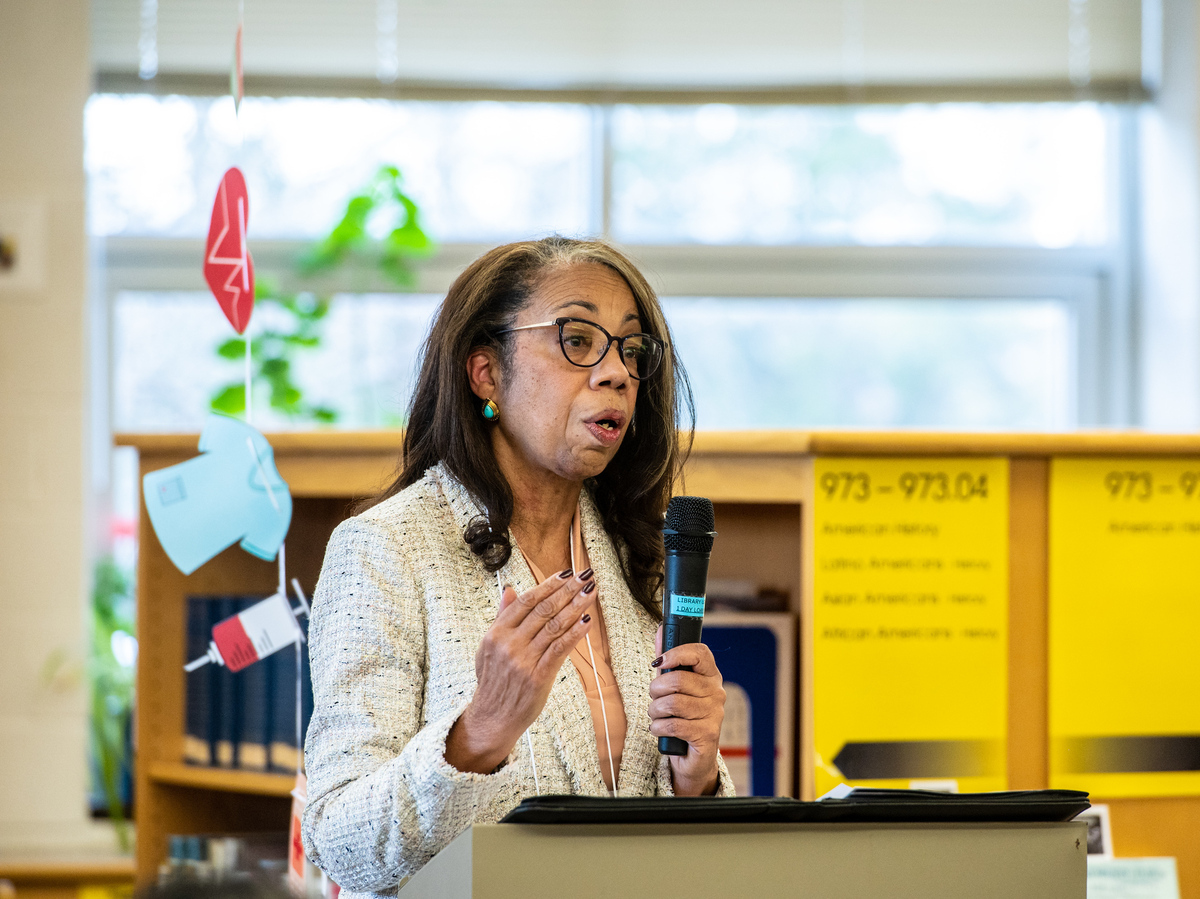
Dr. Gloria Addo-Ayensu, director of the Fairfax County Health Department, spoke with students graduating from the Public Health Youth Ambassador Program at the John Lewis High School library.

Will Schermerhorn/Fairfax County Health Department


hide caption

toggle caption

Will Schermerhorn/Fairfax County Health Department


Dr. Gloria Addo-Ayensu, director of the Fairfax County Health Department, spoke with students graduating from the Public Health Youth Ambassador Program at the John Lewis High School library.

Will Schermerhorn/Fairfax County Health Department

Training gives teens a leg up on future health careers

The health department is working with Edu-Futuro, a local nonprofit, to recruit students with an interest in medicine from Fairfax high schools and help start their career paths.

“At the end of the day, it’s that they successfully enroll in a college or a postsecondary institution, where they will be able to get a degree in a health-related career – and then four years later, they get their first professional job,” says Jorge Figueredo, Edu-Futuro’s director.

Jorge Figueredo, director at the nonprofit Edu-Futuro, tells students that the Youth Ambassador Program sets them on a path to careers in health.

Will Schermerhorn/Fairfax County Health Department


hide caption

toggle caption

Will Schermerhorn/Fairfax County Health Department


Jorge Figueredo, director at the nonprofit Edu-Futuro, tells students that the Youth Ambassador Program sets them on a path to careers in health.

Will Schermerhorn/Fairfax County Health Department

The program focuses on Hispanic, African-American and African students from low-income families. In Fairfax County, as in much of the country, these racial and ethnic minority groups were hardest hit by COVID.

“There were some real challenges around health literacy,” says Anthony Mingo, director of community health development at the Fairfax County Health Department. Mixed messages at the start of the pandemic blended with historical mistrust in medical institutions. “It created a miserable stew of misinformation,” he says.

Anthony Mingo (center), from the Fairfax Health Department, implored students to consider careers that serve their communities, flanked by Jorge Figueredo from Edu-Futuro (left) and program manager Andrea Scott (right).

Will Schermerhorn/Fairfax County Health Department


hide caption

toggle caption

Will Schermerhorn/Fairfax County Health Department


Anthony Mingo (center), from the Fairfax Health Department, implored students to consider careers that serve their communities, flanked by Jorge Figueredo from Edu-Futuro (left) and program manager Andrea Scott (right).

Will Schermerhorn/Fairfax County Health Department

The new youth ambassadors are fired up about public health. Fieseha found the links between environment and health illuminating. “If you don’t have access to a grocery store, you’re more willing to buy [fast food] because that is the closest food source you have, which contributes to diabetes and high blood pressure,” she says. “How we access our food, how we make income – we don’t realize how much of an impact that makes to our mental health and our physical health.”

Learning about some shady episodes from the history of medicine helped Bonilla understand how the medical field lost trust with some groups.

“[The lessons] were talking about the history of ethical considerations, which I really hadn’t thought about, like the cancer cells from a patient that were used without their consent,” she says, “And it just made me think how minority groups were really taken advantage of for medical research.”

Bonilla plans to organize a health fair to address health disparities; she thinks she might become a pediatrician, to better serve Spanish-speaking kids and parents. Fieseha plans to start an urban garden at her school and wants to become a global advocate for HIV/AIDS in Africa and particularly Ethiopia, where her family is from.

Federal funding to boost health literacy

Both are among the first graduates in the pilot program, which expects to have trained ninety students as health workers by next summer. With a budget of around $240,000, according to the health department, it’s a small sliver in a two-year, $3.8 million Fairfax County-wide project to improve access to COVID information and boost health literacy among vulnerable groups.

The federal government is providing the funding. Fairfax County is one of 73 local governments to receive a grant under a $250 million initiative from the Department of Health and Human Services last year. Each grantee is trying out its own approaches to improve health understanding in their communities, says Roslyn Holliday Moore, deputy program director for HHS’s Office of Minority Health.

Roslyn Holliday Moore, from the U.S. Department of Health and Human Services, says the Youth Public Health Ambassador Program can be adapted to other places.

Will Schermerhorn/Fairfax County Health Department


hide caption

toggle caption

Will Schermerhorn/Fairfax County Health Department


Roslyn Holliday Moore, from the U.S. Department of Health and Human Services, says the Youth Public Health Ambassador Program can be adapted to other places.

Will Schermerhorn/Fairfax County Health Department

The hope is that projects, like Fairfax County’s Youth Ambassador training, can be adapted elsewhere. “For those who are looking at whether people are able to trust, sustain the trust, engage others, this is more than successful,” Holliday Moore says, “And it’s not hard to replicate.”

Holliday Moore addresses a small crowd of parents and students gathered at a high school library for a graduation ceremony. “Do not give up, stay the course,” she says. “You are creating a future here.”

Afterward, there is applause and tears of joy. A Peruvian dance champion performs a traditional dance. An assistant principal sings a line from Bob Marley’s Three Little Birds and assures students he isn’t worried about a thing — with them at the helm.

After some long, bleak pandemic years, everyone in the room is glad to be celebrating teens getting their start in public health.

Christopher Thompson, assistant principal at the John R. Lewis High School, tells students that he’s confident in a future where they’re in charge.

Will Schermerhorn/Fairfax County Health Department


hide caption

toggle caption

Will Schermerhorn/Fairfax County Health Department


Christopher Thompson, assistant principal at the John R. Lewis High School, tells students that he’s confident in a future where they’re in charge.

Will Schermerhorn/Fairfax County Health Department

These states tried an Obamacare public option. It hasn’t worked as planned.

In Nevada, officials experience an uphill struggle implementing a policy the state’s incoming Republican governor named “bullshit” — and the condition is previously proposing easing targets for insurers to account for bigger-than-envisioned healthcare inflation.

And in Washington condition, which was the very first to go a general public choice in 2019, enrollment remains paltry, and whilst the price of the well being coverage plans has diminished, condition wellness officials mentioned the procedures readily available are however as well costly.

“It’s nonetheless got a methods to go,” explained Washington state Rep. Eileen Cody (D), who sponsored the state’s general public choice bill. “It’s not just what I had envisioned — I’ll put it that way.”

With Republicans set to choose control of the Residence in January, progressive plans to develop on Obamacare at the federal level are likely nowhere, leaving it to condition lawmakers to inch towards Democrats’ intention of common health coverage. The rocky implementation of the general public option strategies in these 3 western states illustrates the challenges the remaining faces in executing so as blue point out ambitions run up towards a highly effective well being treatment marketplace accustomed to having its way.

“The unfortunate fact is that there is seriously major forces and seriously potent forces that want to see the status quo go on to exist, and the standing quo does not let for some of these far more progressive improvements that just take out earnings and take out some of the substantial reimbursement costs that we’ve been seeing,” stated Liz Hagan, director of coverage alternatives at the progressive team United States of Treatment, which advocates for states passing community option guidelines. “A lot of the arguments and pushback have led to some of these general public alternatives becoming extra of a general public-personal partnership, or general public solution-style programs.”

Insurance plan companies, which have lengthy viewed the general public possibility as an existential risk, and personal sector advocates go on to argue that the policy is not living up to its targets and, instead, will harm the nation’s health and fitness insurance policy landscape — and, with it, people’s skill to access economical wellbeing treatment and a strong network of suppliers.

“They’re cost controls. Which is what they are. And they’ll have the very same outcome that we have experienced in price controls for generations, which is a diminished availability of the controlled commodities, whether or not they are professional medical products and services or wheat or everything else,” stated Robert Moffit, a senior analysis fellow in the Center for Wellness and Welfare Coverage at the conservative Heritage Basis. “I consider the probability of them getting profitable, making a price regulate method operate, is nil.”

The community selection envisioned by liberals in the course of the Obamacare debate was a governing administration-operate coverage program that would compete in the non-public sector. Which is not what Colorado, Nevada and Washington are carrying out. Rather, they are using their regulatory authority to influence what private insurance policies providers provide.

Democrats watch this new general public possibility idea as a person device between quite a few — including reinsurance packages, point out subsidies, charge critique plans, and protection expansions to undocumented immigrants — to develop well being insurance policies obtain.

But expenditures have not come down ample yet to make a genuine dent in affordability or in the costs of uninsured and underinsured.

“I do not know that any point out has hit upon the magical remedy which is heading to provide prices down,” said Sabrina Corlette, study professor, founder, and co-director of the Centre on Health Insurance policy Reforms at Georgetown University’s McCourt Faculty of General public Policy.

Even though the procedures haven’t still attained the type of sweeping alter that proponents experienced hoped, Democratic lawmakers are continuing to drive thoughts aimed at increasing protection.

Following calendar year, Minnesota — with its recently elected Democratic trifecta — is expected to once more look at a proposal to develop MinnesotaCare, an Obamacare system that subsidizes minimal-money folks who make far too much money to qualify for Medicaid. The proposal would open up MinnesotaCare, which is administered by non-public coverage providers, to all citizens no matter of income with rates on a sliding scale.

And, just after an unsuccessful Medicaid purchase-in force in 2019, New Mexico Collectively for Wellness Treatment, a coalition of progressive and wellbeing care advocacy groups, are chatting with lawmakers and the governor’s business office about their proposal to allow for all New Mexicans to enroll in Medicaid irrespective of their revenue. Advocates claimed the proposal necessitates the point out inquiring CMS to foot a huge section of the monthly bill through a point out system amendment.

“We imagine that health care must be publicly funded, contain everybody and not be dependent on work,” stated Elianne Farhat, govt director of the progressive group TakeAction Minnesota.

How it is effective

Underneath Colorado’s regulation, all wellness insurers supplying person and little group options need to have at the very least a single general public option approach. That program is demanded to decrease premiums 5 percent every 12 months — with an allowance for inflation — above a few years though also furnishing a additional robust established of rewards to enrollees, like minimized out-of-pocket prices, co-pays as an alternative of co-insurance coverage, and a provider community the state deems to be culturally responsive.

Most ideas unsuccessful to meet this year’s 5 p.c focus on, which Corlette, the Georgetown professor, described as a “shot throughout the bow” to the point out.

Denver Well being, a local nonprofit insurance company, was, nevertheless, able to cut down premiums on the trade by about 2.6 {bf0515afdcaddba073662ceb89fbb62b6b1bf123143c0e06b788e1946e8c353f}, while Kaiser Permanente’s stayed approximately flat, offering some proof to supporters of the public possibility that it is starting to have the wished-for result.

But Amanda Massey, executive director of the Colorado Association of Health and fitness Options, a trade team symbolizing insurers, dismissed Denver Overall health as a “very distinctive example” and mentioned that supplying the robust coverage necessary of Colorado Option options and cutting costs is not possible.

“Certainly, [insurers are] trying to do every little thing they can to lower the charges, but I consider we have to be really considerate about making sure that carriers can even now be solvent and cover the fees of their statements,” Massey said.

Whilst there are no penalties this yr for failing to meet the targets, insurers will be demanded to lower their premiums an further 5 p.c next calendar year. If they never, the state Division of Insurance plan can hold a public listening to and set reimbursement fees for vendors that will enable insurers fulfill the top quality reduction targets.

General public alternative proponents argue that even if they have not been ready to reduce expenses as a lot as expected, they’re able to provide buyers greater price designs with additional strong positive aspects and networks that are a lot more culturally responsive.

Kyle Brown, deputy commissioner of affordability programs at the Colorado Division of Insurance policy, stated the previous marketplace strategies weren’t working for folks and the point out needed to check out some thing new.

“We’re extremely optimistic for the reason that we have now witnessed a positive impact on Colorado’s market,” he mentioned. “Plans are now competing and modifying the way they selling price their ideas.”

Washington state is operating its third open up enrollment with the public selection, and condition wellbeing officers hope that new state subsidies for persons who make up to 250 per cent of the federal poverty stage will increase uptake. Only about 7,000 of the practically 240,000 people who enrolled in individual designs by means of the state’s wellbeing insurance plan trade selected community choice strategies for 2022.

Laura Kate Zaichkin, senior coverage adviser at the Washington Well being Reward Trade, said premiums for public choice plans — which are in the very low $400s for every thirty day period in advance of subsidies — are “still much too higher,” even though the condition caps provider reimbursement charges at 160 per cent of what Medicare pays. She claimed that though providers have achieved that cap “pretty continually,” that isn’t translating to lower rates.

The state’s hospitals, meanwhile, are concerned by a new company participation requirement aimed at addressing the simple fact that five of the state’s 39 counties really do not have general public selection strategies out there for invest in. The new need mandates clinic techniques agreement with at least 1 community alternative provider in counties where there at present is no public option approach.

Ashlen Robust, senior director of government affairs at the Washington Condition Clinic Affiliation, claimed the new mandate successfully usually takes absent their negotiating electric power.

“There’s this thought at times that hospitals are producing money and there’s income to be had somewhere, and there actually isn’t proper now,” Strong said. “It’s a really tough condition and any prospect where by payers are paying out a lot less, it just tends to make it even extra challenging. Which is why we’re involved.”

In Nevada, overall health officers are established to meet Tuesday to contemplate reducing legislatively-set premium reduction targets from 20 {bf0515afdcaddba073662ceb89fbb62b6b1bf123143c0e06b788e1946e8c353f} to 16 percent around four decades — a determination state officials stated is needed to replicate the recent spike in healthcare inflation. The condition this month released an examination from the actuarial and consulting firm Milliman that located general public solution designs, which will be obtainable setting up in 2026, will meet up with that 16 {bf0515afdcaddba073662ceb89fbb62b6b1bf123143c0e06b788e1946e8c353f} concentrate on by 2029.

“Obviously we have got a lengthy way to go, but I consider that is a good phase in the ideal direction and a terrific 1st stage,” mentioned state Senate The vast majority Leader Nicole Cannizzaro, the Democratic lawmaker who released the community possibility laws in 2021. “Even [16 percent] is one thing I’m happy of and I believe will make a variance.”

The community possibility, even so, is projected to make only a smaller dent in the state’s uninsured rate — insuring about 8,500 excess folks on the particular person industry by 2029, if the point out works by using federal bucks saved as a result of the quality reductions to decrease the prices of options, in accordance to the actuarial investigation. Approximately 115,000 individuals are enrolled in unique market programs, though practically 300,000 folks in the state are uninsured.

The health and fitness care industry continues to be staunchly opposed to the strategy. Holly Silvestri, spokesperson for Nevada’s Overall health Care Foreseeable future, an arm of the national business Partnership for America’s Well being Treatment Potential, which is made up of some of the most significant gamers in the health and fitness treatment industry, known as it “a political remedy seeking for a problem” and explained the group will force to repeal the regulation “and instead create on and make improvements to what is now doing the job in our health and fitness care process.”

“If we really do not choose a action back again and slow down, this unproven and risky policy could hurt the quite individuals it intends to support,” Silvestri claimed.

Gov.-elect Joe Lombardo has not reported whether he will prioritize dismantling the new law. A spokesperson for the Republican did not answer to multiple requests for comment.

Cannizzaro said she is not intrigued in “discussion of repeal of something that is the legislation of Nevada.”

“We’re just hopeful that a governor-elect who ran underneath the strategy that he is heading to uphold the regulation of the state of Nevada is heading to do just that with the general public possibility,” Cannizzaro claimed. “I’ve each self esteem that the governor will make positive that he is executing the law. A failure to do so would naturally be a various discussion.”