A Guide to Becoming a Clinical Research Nurse

A Guide to Becoming a Clinical Research Nurse

Courtesy of Getty Images

Maybe you’re a nurse who would also like to be more involved in the clinical research process. Or maybe you’re a nurse who also wants to ensure the highest standard of care for patients in research trials. 

If either of these things are true for you, then you might have what it takes to become a clinical research nurse. 

Clinical research nurses are an integral part of the research process. They are essentially the managers of the most important part of any medical research: the trial patients themselves. 

The role can be very rewarding, both mentally and financially. It’s not without its challenges, however, and that is something everyone who wants to be a  clinical research nurse should take into account.

To help with this decision, BioSpace has outlined the role of a clinical research nurse, its ups and downs, and what it takes to become part of this crucial role.

What is a Clinical Research Nurse?

A clinical research nurse is responsible for the direct care of patients who are participants in clinical trials. These trials could involve anything from testing new treatments to researching novel approaches to human health.

The clinical research nurse is responsible for administering treatment, collecting data from test results and ensuring that the care, best interests and confidentiality of their patients are maintained at all times. 

In this way, the role seems similar to that of a traditional nurse. There are a few key differences, however. The role of the clinical research nurse also involves: 

  1. Greater involvement in the research process. A clinical research nurse may be involved in designing the actual clinical trial. He or she may also be asked to help design patient protocols for future trials as well. The clinical research nurse may also be involved in the initial screening process for selecting patients for trials. 

  2. An understanding of how clinical research works. A clinical research nurse requires in-depth knowledge of the clinical research process itself. This means he or she must understand how trials are designed, how treatments are administered and how conclusions are drawn from the results. 

  3. Maintaining confidentiality of both the patient and the project. In addition to maintaining the confidentiality of their patients, the clinical research nurse must also maintain the confidentiality of the entire research project as well. 

Clinical research nurses may work out of typical nursing settings, such as hospitals and long-term care facilities. However, they are just as likely to work out of biotech laboratories or university research centers. Depending on the type of study, their patients may be day patients or inpatients at various care centers. 

Pros of Becoming a Clinical Research Nurse

  1. It’s an integral role in developing better patient care. Clinical research nurses are involved with more than the care of their patients. They’re also helping to develop new treatments and better research that could one day help future patients. For this reason, clinical research nurses usually find their work very rewarding.  

  1. Compensation is competitive. Clinical research nurses often receive higher salaries than traditional nurses. While the median annual salary of a registered nurse in the US is $ 93,089, the median annual salary of a clinical research nurse is $116,2992.  

  1. The need for clinical research nurses will continue to grow. As the US population ages, the need for more medical research will increase.  This means the need for more clinical research nurses will increase as well.  Anyone with the qualifications to become a clinical research nurse should have no trouble finding work. 

Cons of Becoming a Clinical Research Nurse

  1. Patient advocacy may be a source of stress. In clinical research situations, the pressure may be on to ensure the research can be completed on time. In these cases, the clinical research nurse may need to step up and speak on behalf of their patients. 

  2. Drugs administered are not always FDA-approved. Because clinical research nurses work in clinical trials, many of the drugs they administer to patients may be experimental. Someone who is not comfortable with this may want to consider a different career. 

Regardless of the impact on the study itself, the clinical research nurse’s patients must be their top priority. If patient advocacy is not a source of stress for you, then this should be of little to no issue. 

Necessary Skills and Experience

The basic requirements of a clinical research nurse are similar to traditional nurses. A bachelor’s degree in nursing, biology or a similar discipline is required. Most job postings require a current state license as a registered nurse as well. 

Many clinical research centers require at least some experience in a research setting. This can be gained by applying for roles as a clinical research assistant first. Once enough experience is gained in this type of role, nurses can apply for clinical research nursing positions. 

Nurses may also want to consider earning a master’s of science in nursing in order to qualify for top-paying clinical research nursing positions. 

Clinical research companies also look for several crucial soft skills. Good communication skills, the ability to be well-organized at all times and an innate sense of ethics are all important in a clinical nursing role. 

Taking the Next Step

If you’re a caring and compassionate nurse who also has a strong desire to improve medical care for the future, then a role as a clinical research nurse may be the perfect fit for you. 

If you’re ready to start applying, be sure to check out BioSpace’s current job postings for clinical research nurses.

Despite long Covid risks, employees consider cutting health benefits

Tech startup company Fast Chief Communications Officer Jason Alderman (R) talks with an employee on the first day working in the office on March 24, 2021 in San Francisco, California.

Justin Sullivan | Getty Images

Inflation has stretched household budgets near their limit. As a result, most people have reined in discretionary spending, even when it comes to health and wellness.

But just as many Americans want to scale back, U.S. health officials are expecting another pandemic wave this winter and new research underscores the importance of having comprehensive medical benefits.

Although the Biden administration is looking at ending the public health emergency over the next few months, many who get sick but survive Covid suffer from enduring health problems, studies show. And currently, as many as 23 million Americans have what’s considered long Covid, according to recent estimates from the U.S. Department of Health and Human Services.

With open enrollment season in full swing, this is an opportunity to reevaluate your coverage, said Gary Claxton, senior vice president at the Kaiser Family Foundation, a nonprofit organization focused on national health issues.

More from Your Health, Your Money

Here’s a look at more stories on the complexities and implications of long Covid:

Employees spend 18 minutes, on average, reviewing their benefit selections during open enrollment, according to Rob Grubka, CEO of Health Solutions for Voya Financial. “They spend more time deciding what to watch on Netflix.”

But this year brings added uncertainty, he said. “Between rising inflation, Covid and long Covid, we underestimate how different things may look in the future.”

At the same time, more than a quarter of employees have postponed wellness visits and screenings and consider cost the most important factor in determining their benefit choices for next year, according to benefits platform Elevate. 

Employees are making choices to keep themselves afloat, said Brian Cosgray, Elevate’s CEO and co-founder. Unfortunately, some are engaging in trade-offs — like foregoing needed medical care — that could cause problems down the road, he added.

To balance your overall health and the long-term risks of illness as well as financial constraints, Claxton suggests reassessing your employer-sponsored health insurance during open enrollment, which typically runs through early December.

Almost 159 million Americans rely on employer-sponsored health insurance coverage. Here are four key considerations with open enrollment season underway:

1. Health insurance plans

For starters, consider what your health coverage costs you.

Annual family premiums for employer-sponsored health insurance — the amount it costs each year for insurance, often divided into 12 monthly payments — average $22,463 this year, up slightly from a year ago, according to the Kaiser Family Foundation.

On average, workers contribute $6,106 toward the cost of a family premium, with employers pick up the rest.

However, more workers have a deductible — the amount you pay before insurance kicks in — and that deductible is also rising. In 2022, the average single deductible was $1,763, more than double what it was a decade ago.

But “don’t just look at the monthly cost of your health insurance,” Cosgray advised. “Most employers offer a few health-plan options,” he added, such as a high-deductible plan with a health savings account or a more traditional PPO.

“If you expect your health-care costs to be low for the coming year, a high deductible health-care plan paired with an HSA could be a good way to save money,” he said. “However, if you have chronic health conditions in your household and typically hit your deductible, a traditional plan paired with [a flexible spending account] may save you more over the course of a year, even if the plan’s monthly cost is higher,” Cosgray said.

“If you are going to take the high-deductible plan, you have to be able to pay the deductible if someone gets sick,” Claxton added. “The plan maybe cheaper but what if you can’t afford to use it?” Most people can’t even afford a $500 expense, he noted. “If you go to the hospital the likelihood that your out-of-pocket costs are at least $500 are pretty high.”

There are often employer-offered resources designed to help pick between benefit offerings, which can include webinars and dedicated benefits professionals. 

“Many health plans now have great tools to help you manage your choices based on what you anticipate your health-care costs to be,” advised Thomas Belmont, health and benefits practice leader at Gallagher.

“That will help guide you.”

2. Health savings accounts

Despite long Covid risks, employees consider cutting health benefits

3. Life insurance and disability insurance policies

To be sure, the pandemic brought a greater awareness of financial risks associated with a critical illness.

Employer-issued life insurance policies typically amount to a year’s worth of salary, often less, but that may be a fraction of what you need to protect young children or other dependents.

Consider what’s the right amount for you and your family, then weigh whether you want to buy additional coverage, or supplemental insurance, through your workplace group plan or shop for your own individual term life insurance policy, a move many advisors recommend, although this may also require more medical information, including a physical exam and blood work.

The same goes for disability insurance, which can help replace a portion of your paycheck if you get sick and are unable to work.

There are two basic kinds: Short-term disability generally replaces 60{bf0515afdcaddba073662ceb89fbb62b6b1bf123143c0e06b788e1946e8c353f} to 70{bf0515afdcaddba073662ceb89fbb62b6b1bf123143c0e06b788e1946e8c353f} of your base salary and premiums are often paid by your employer. Long-term disability, which ordinarily kicks in after three months to six months, typically replaces 40{bf0515afdcaddba073662ceb89fbb62b6b1bf123143c0e06b788e1946e8c353f} to 60{bf0515afdcaddba073662ceb89fbb62b6b1bf123143c0e06b788e1946e8c353f} of your income.

Other voluntary benefits offered through an employer can provide additional protection, including hospital indemnity insurance, critical illness coverage and accident insurance.

“As we go into next year and the additional financial pressures, make sure you are protecting your income,” Belmont said.

4. Wellness benefits

Build a Better Breakfast With These Eggcellent Tips

Not trying to throw shade at cereal, we’ve all enjoyed a big ole’ bowl with nice, cold milk but there are quicker and better breakfast options. Remember those bowls with built-in straws so you could sip the sugar-filled milk that the cereal created? I do. It might have done your tastebuds good, but your health, not so much.

Breakfast, (Break-the-fast) is an important meal; it’s the first thing you’re feeding your body after a night of fasting while it repairs torn muscle fibers and rejuvenates cells. It’s the energy that will fuel your morning and provide your body with much-needed nutrients. For avid exercisers, this bumps your morning meal to top priority when it comes to consuming clean fuel.

End the better breakfast struggles with fit chef Joshua Bailey If you’ve struggled with putting health first at breakfast time, or aren’t really sure how to, Joshua Bailey chef and personal trainer is a breakfast-building pro who lays the groundwork for you for creating flavor-packed, nutritious morning meals.

Bailey takes pride in prioritizing making a healthy breakfast to start his day.” I always try to include a source of protein, carbohydrate, and greens, while my go-to breakfast usually consists of eggs, oatmeal, and a protein shake,” says Bailey.

“Quick breakfast options such as cereal tend to be very high in added sugar and contain absolutely no nutritional value,” he adds. That doesn’t mean you have to give it up forever, it just simply shouldn’t be your everyday meal.

“I would be lying if I said I didn’t occasionally enjoy a bowl of cereal myself,” says Bailey, but try and be aware of how often you include it in your diet.

So skip the cereal, as Bailey offers several simple yet effective tips that will take all the guesswork out of building your morning fuel.

Simple Swaps, Simple Breakfasts, Simply Healthy

Building a better breakfast all comes down to incorporating simple swaps and choosing high-quality ingredients. “Making simple swaps and being conscious of what ingredients you are adding to your food when cooking can make all the difference,” says Bailey. An example of this looks like swapping pre-made sugar-filled oats with plain steel-cut oats and dressing them with healthy toppings like sliced almonds and berries. When choosing breakfast foods, “It is important to make choices based on your body and your personal goals,” Bailey says. Now, let’s get to the building.

Better Breakfast Eggs

Build a Better Breakfast With These Eggcellent Tips
Jörg Mikus / EyeEm / Getty

Protein and nutrient-packed enjoyed by millions. While the yolk hosts strong nutritional value, to lower unnecessary fat content, Bailey suggests limiting yolks, depending on how many eggs you normally consume). “I make the conscious choice to only use one egg yolk in order to eliminate unnecessary fat intake from eating eight egg yolks,” he says.

Opting for organic, free-range eggs is also a way to up your egg health. Supporting local farmers is a great way to boost your morning nutrients while supporting your community.

When cooking the eggs, try using cooking spray instead of butter, to once again avoid excess fats.

Better Breakfast Meats

Way to cook bacon for a better breakfast
Chris Clor / Getty

Because breakfast meats tend to be very high in sodium, Bailey steers clear of them and suggests you try make alternative adjustments as much as possible. If you want to include a slice of morning meat, opt for low-sodium turkey bacon instead. This way, your experience pops of flavor minus more fat, excess sodium, and calories.

If you have lean protein leftovers from dinner like chicken or steak, cubing the meat and tossing them in the pan with the eggs makes for a tasty protein addition without sacrificing health.

Better Breakfast Oatmeal

Blueberry-Oatmeal-For-Superfood-Breakfast
Vladislav Noseek / Shutterstock

Sure, those ready-made oats packed with sugar may taste delicious, but are probably not the best choice if you’ve got fitness goals to achieve (and you probably already know this. Bailey recommends eating traditional, unflavored oats topped with a small amount of brown sugar and a very light drizzle of maple syrup. This way you’re giving your tastebuds a treat without overdoing the sugar content.

A bowl of plain oats is a blank slate and there are many clean toppings at your service. Berries, nuts, nut butter, and spices like cinnamon and nutmeg make for a flavorful bowl. “Oats are a complex carb that will keep you full longer and your body absorbs more nutrients from complex carbohydrates,” Bailey says. So, build your bowl with your favorite toppings and you’re good to go!

Better Breakfast Protein Shakes & Smoothies

Fit and happy girl making a smoothie with a blender
Westend61 / Getty

The fantastic thing about protein shakes and smoothies is the amount of nutrients like antioxidants, vitamins, and minerals you can add to one glass. Bailey’s morning protein shake normally includes fruits and veggies which can lack in many diets.

“My go-to shake includes Strawberries, blueberries, and bananas. Spinach, peanut butter, almond milk, protein powder, and the occasional scoop of reds and greens,” Bailey says.

Depending on what you include in your shake, the drink alone could serve as a breakfast by itself. Opting for protein, fats, and carbs is the goal.

Better Breakfast Bars

Protein-Bars-With-Nuts-And-Dried-Fruit
Elena Shashkina / Shutterstock

For mornings that don’t go as planned, there are bars that are a clean, grab-and-go option. Kickstart your morning (especially when running late), with this plant-based, soft and chewy breakfast bar. With 8g of plant-based protein, BC30 probiotics to support immune health, 14g of whole grains, and 4g of prebiotic fiber, The Complete KickStart is filled with goodness to start your day off right!

Building a better breakfast will build better health. All you need to do is be diligent about consuming clean, whole ingredients while swapping out the not-so-healthy ones. One breakfast at a time.

How RGB-IR Cameras can enhance medical devices

Diagnostic and therapeutic accuracy has significantly increased as a result of the usage of cameras in the medical device industry. Camera-enabled medical devices, such as retina scanners, automated blood analyzers, digital microscopes, and skin scanners, have greatly decreased medical personnel’s workload and improved the overall patient experience.

Advances in embedded vision and camera technology have largely contributed to this transformation, with new cameras supporting many current medical applications. RGB-IR cameras have been a game changer due to their ability to record IR and visible light data with the same camera without color corruption.

This article discusses how RGB-IR cameras, which can capture images that adhere to the stringent requirements of current medical procedures, improve the performance of medical devices.

RGB-IR cameras and their growing popularity in the medical industry

Before examining how RGB-IR cameras benefit medical and life science applications, it is important to comprehend what they are and how they operate.

Sensors that collect visible and infrared light in the same frame are used in camera modules. This frequently resulted in a deterioration in image quality due to a process known as color corruption. This occurs when the IR data interpolates with the color (or RGB) data and affects the color fidelity of the resulting image.

Two approaches have commonly been employed to address this challenge:

  1. Capture RGB and IR data with two cameras
  2. Using an IR cut filter during the day to prevent IR light from falling on the sensor

In the first case, the system gets bulkier and more difficult to manage. However, the IR-cut filter solves this problem.

The IR cut filter is attached to the lens and is controlled by a mechanical switch. However, this causes wear and tear, dramatically reducing the camera system’s lifetime.

RGB-IR cameras help in this situation.

Technology

Sensors with distinct RGB and IR pixels are used in RGB-IR cameras. Unlike regular camera sensors with the Bayer BGGR pattern, RGB-IR cameras use a new form of CFA (Color Filter Array) with an extra set of pixels that permits only IR light to pass through.

The CFA configuration of an RGB-IR sensor is as follows:

How RGB-IR Cameras can enhance medical devices

Figure 1. Bayer pattern. Image Credit: e-con Systems

RGB-IR filter pattern.

Figure 2. RGB-IR filter pattern. Image Credit: e-con Systems

This innovative technique allows for the separation of RGB and IR data from the camera output. Numerous medical applications benefit from this, including ophthalmology, fluorescence-guided surgery, and remote patient monitoring.

The following are some of the major advantages RGB-IR cameras provide:

  • Increased imaging capability in day and night conditions for continuous 24/7 image and video capture.
  • Smaller form factor due to eliminating the need for two separate cameras to gather RGB and IR data.
  • Improved camera lifetime due to non-mechanical switching between visible and IR imaging. This would also mean that the medical equipment linked with the camera would have a longer lifespan.
  • A distinct IR channel that helps measure the amount of IR light in the RGB component for intelligent color adjustment.

Designing an embedded camera for RGB-IR imaging

As RGB IR imaging necessitates a distinct CFA, the camera system must be precisely developed. This implies that different camera components, such as the sensor, optics, and ISP, must be capable of receiving and processing images suitable for RGB-IR imaging.

The essential parameters to consider when assessing a camera for RGB-IR imaging in terms of its component features are discussed in this section.

Sensor

The camera sensor must include a pixel array that includes both RGB and IR pixels. Various sensor manufacturers, including onsemi and OmniVision, provide RGB IR sensors with specialized RGB and IR pixels.

The pixel pattern of a sensor with RGB-IR capabilities is shown below:

Pixel array of an RGB-IR sensor.

Figure 3. Pixel array of an RGB-IR sensor. Image Credit: e-con Systems

Optics

Most off-the-shelf lenses on the market include an IR-cut filter to restrict IR light from entering during the day. This is because most cameras still employ mechanical switches to shift between day and night settings.

However, RGB-IR imaging requires a lens with a dual bandpass filter. This ensures that light from the visible and NIR spectrums falls on the sensor.

The transmission diagram for a dual bandpass filter is provided below:

Transmission diagram of a dual bandpass filter.

Figure 4. Transmission diagram of a dual bandpass filter. Image Credit: e-con Systems

ISP

The Image Signal Processor (ISP) is one of the most significant components in an RGB-IR camera since extracting the RGB and IR frames from the data given by the sensor requires considerable ISP-side acumen.

e-con Systems, for example, does this through its proprietary algorithm. The company’s engineers also used their ISP expertise to devise an algorithm to remove IR interference from the RGB channels to achieve the correct colors.

One of its other distinguishing features is the ability to tune the ISP to produce processed RGB and IR frames based on the needs of the host platform.

How RGB-IR Cameras can enhance medical devices

Figure 5. RGB window imaging processing. Image Credit: e-con Systems

How RGB-IR Cameras can enhance medical devices

Figure 6. IR window imaging processing. Image Credit: e-con Systems

Key medical applications where RGB-IR cameras are making a wave of change

Some of the benefits of RGB-IR cameras have already been discussed. The following section details how they impact some of the most popular camera-enabled medical applications.

Remote patient monitoring

Remote Patient Monitoring (RPM) devices have benefited the medical industry by minimizing the need for in-person patient monitoring. Using artificial intelligence, RPM systems are now powerful enough to detect patient falls and movements autonomously. These life-changing devices require cameras to collect images and videos to make all of this feasible.

One of the major features of a remote patient monitoring system is that it must be operational around the clock to enable ongoing patient monitoring. This necessitates that the camera functions flawlessly during the day and night. This is where RGB-IR cameras come in.

They allow the RPM device to take images utilizing IR imaging even at night without requiring two separate cameras or a mechanical switch to activate an IR cut filter.

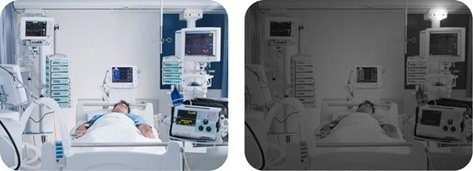
(Left) RGB image during daytime and (Right) IR image during night-time.

Figure 7. (Left) RGB image during daytime and (Right) IR image during night-time. Image Credit: e-con Systems

Image-guided surgery

In surgeries such as laparoscopic cholecystectomy, colorectal surgeries to evaluate bowel viability in hernia cases, mapping of sentinel lymph nodes, etc., fluorescence-guided surgical techniques such as Indocyanine Green (ICG) surgery are used (source: sciencedirect.com).

The dye can become fluorescent when subjected to a wavelength of 750 to 800 nm, which is how ICG surgery works. As a result, the camera utilized must be capable of capturing images in the Near-Infrared (NIR) spectrum.

But why not observe the organs with an RGB camera and an IR light source simultaneously?

The difficulty here is the low spectral resolution. To better grasp this, consider cancer diagnosis as an example application.

In this case, capturing the fluorescent image with a standard RGB camera may not provide enough detail. On the other hand, the IR capabilities of an RGB-IR camera can be utilized to efficiently enhance the cancer diagnosis procedure. At the same time, the RGB data can be used to evaluate any anomalies discovered using the IR output. All of this may be accomplished with a single-camera system.

(Left) RGB image during ICG Surgery and (Right) IR image during ICG Surgery.

Figure 8. (Left) RGB image during ICG Surgery and (Right) IR image during ICG Surgery. Image Credit: e-con Systems

Ophthalmology

The quality of images provided by camera modules inside ophthalmic devices such as fundus cameras and retina scanners substantially influences diagnosis accuracy.

IR imaging is required in these devices to observe sub-retinal characteristics because the deposits appear bright and thicker compared to the optic nerve heads, retinal vessels, and choroidal vessels found in darker regions. Visible light imaging, on the other hand, is essential to ensure that the camera gets the required details of the eye.

This necessitates the use of a single camera that is capable of both visible and IR imaging. As a result, RGB-IR cameras are ideal for such applications. Medical professionals can now efficiently detect and treat eye problems using these new-generation embedded cameras, which provide visible and IR images from the same camera.

Final words

As detailed above, RGB-IR cameras have numerous advantages and are well-suited for various medical applications requiring concurrent RGB and IR imaging. At the same time, specialized NIR cameras are favored for applications that require exceptionally high NIR sensitivity and performance. Before proceeding with camera integration into the device, it is advised that users consult with an imaging professional such as e-con Systems.

About e-con Systems

e-con Systems™ is a leading OEM camera manufacturer with 18+ years of experience and expertise in embedded vision. It focuses on delivering vision and camera solutions to industries such as medical, retail, and industrial. The company’s wide portfolio of products includes MIPI camera modules, USB 3.1 Gen 1 cameras, GMSL cameras, stereo cameras, etc. It has built over 250+ product-based solutions and shipped millions of cameras around the globe. What sets the company apart is its deep expertise in building customized product designs while ensuring rapid prototyping and custom modifications in hardware and software. e-con Systems™ has close partnerships with Sony, ON Semiconductor®, Omnivision, NVIDIA, Xilinx, Socionext™, Cypress, Connect Tech, Toradex, Variscite, Toshiba, Diamond Systems, Avermedia and Texas Instruments.

Giving sight to medical applications:

e-con Systems™ offers end-to-end camera solutions to meet the needs of the medical and healthcare industry. It has a strong foothold in the medical device industry – having empowered clients to integrate unique camera solutions for medical and life science applications in ophthalmology, dentistry, dermatology, laboratory equipment, microscopy, assistive technology, point-of-care technology etc. e-con Systems also has a solid track record of working with the medical device industry leaders such as Thermofisher, Idexx, Perkin Elmer, Amwell, Welch Allyn, Seegene and others.”


Sponsored Content Policy: News-Medical.net publishes articles and related content that may be derived from sources where we have existing commercial relationships, provided such content adds value to the core editorial ethos of News-Medical.Net which is to educate and inform site visitors interested in medical research, science, medical devices and treatments.

Holiday eating stress you out? Here are some helpful tips!

Posted 29 November 2022 at 2:00 pm

Holiday eating stress you out? Here are some helpful tips!

By Chrissy Krueger RN, RD, CDN, CDCES, Diabetes Education & Care Specialist, Oak Orchard Health 

As a Diabetes Educator, at Oak Orchard Health, I hear a lot about the anxiety and stress of overeating during the holidays. Whether it’s Thanksgiving, Christmas, or another seasonal holiday, learning to eat healthy during this time can be a challenge – but you can do it. Keep in mind that each holiday represents just one day, and you can get back on your healthy meal plan the next day. 

Here are a few tips to help you get through the holidays feeling good about yourself.  

Start by preparing in advance. 

If the party is not at your home, consider asking the hostess if you can help by bringing a dish to pass. That dish will be a healthy one for you and delicious for others. That’s your “go-to” dish when you’re feeling hungry or other options are not too appealing. 

Skipping meals before the holiday dinner isn’t a good idea. 

Skipping meals can result in moodiness or irritability. For some, it can also lead to low blood sugar. You should not get yourself so hungry that you will eat anything and everything!  Try to eat regularly throughout the day, maybe smaller meals than usual, but do eat breakfast and lunch. 

Re-think the holidays. 

Why are you gathering? To be with family and friends? Sharing experiences with each other? The point is that holidays aren’t just about food. In fact, after eating your meal, avoid lingering near the holiday spread. Go into another room to mingle.  Also, consider taking a walk with someone you haven’t seen in a while. 

Avoid taking leftovers home. 

Unless a loved one was unable to attend and you want to bring them some treats, avoid bringing leftovers home. If you’re the hostess, don’t make too much food and if you do, have a plan for giving it away to your guests or a local senior center or food shelter.

Don’t give up your healthy lifestyle. 

Often people use Thanksgiving as a reason to start overeating throughout the holiday season. Try to think of each holiday as a one-day event and get back on track with your healthy habits the next day. You’ll feel better!

Heart-healthy portions. 

Whether you have diabetes or not, these are great guidelines on how to fill your plate. A good rule of thumb is that half your plate should contain non-starchy vegetables such as green beans, broccoli, or cauliflower, a quarter of the plate with protein, and a quarter with carbohydrates. Riced cauliflower is very popular and can be substituted for mashed potatoes – or make half the mashed potatoes with real potatoes and the other half with riced cauliflower. Your guests won’t know the difference!

Desserts.

 If you have room for dessert, try to limit your portion sizes. An eighth of a pie or 2” square of cake can be enough. If you’re going to bring a dessert, choose one that has fewer carbohydrates and sugar. People with diabetes can eat desserts but it’s all about the size of the portion. The smaller the better. 

Always carry a glass of water. 

Having a glass of water and sipping it throughout the day will help you avoid picking on food. This will also help to reduce your alcohol consumption. 

No thank you. 

Be comfortable saying no thank you when offered another portion.  Those who truly love you will not change their mind based on how much or what you eat!

Holidays are not just for eating.

 If you’re the hostess, you can plan to do something with your guests like playing games or taking a walk. Plan to have everyone step away from the table and go to another room to play a game like charades or a card game. The more active the better. 

If you do overindulge, don’t beat yourself up about it. Just get back on track. Take a walk the next day and start eating healthy again.  Remember, don’t skip meals either!

If you need help managing diabetes, are interested in nutrition and/or incorporating a healthy lifestyle, contact Oak Orchard Health and ask how to be referred to the nutrition diabetes care specialist. Happy holidays!


Forever chemicals, or PFAS, pose troubling health risks

For decades, chemicals that make life easier — your eggs slide out of the frying pan, stains don’t stick to your sofa, rain bounces off your jackets and boots — have been touted as game changers for our busy modern lives. “Better things for better living … through chemistry,” was the optimistic slogan coined by DuPont, the company that invented the widely used chemical coating Teflon.

But this better living has come at a cost that is getting new attention. These chemicals — dubbed forever chemicals for their ability to last in the environment — are proving to have a lasting impact on human health. A growing body of research links the group of chemicals broadly known as PFAS, short for per- and polyfluoroalkyl substances, to conditions from unhealthy blood lipid levels to pregnancy complications to cancer.

Alarm about the health impacts of these chemicals has sparked a recent flurry of action from U.S. public health and regulatory officials. Warning that PFAS pose a greater health risk than previously thought, the U.S. Environmental Protection Agency in June dramatically lowered its recommended safe levels of the chemicals in drinking water.

“The updated advisory levels are based on new science, including more than 400 recent studies which indicate that negative health effects may occur at extremely low levels, much lower than previously understood,” Radhika Fox, assistant administrator of the EPA’s Office of Water, said in June at the Third National PFAS Conference, held in Wilmington, N.C.

Soon after, the National Academies of Sciences, Engineering and Medicine released the first clinical guidelines quantifying blood concentration levels of PFAS that could put someone’s health at risk. The 300-page report urges clinicians to recommend regular blood tests for anyone exposed to high levels of the chemicals and to provide information on how to limit exposure, such as installing special filters known to reduce PFAS in drinking water.

In the United States alone, by one measure, the tally in medical care costs and lost productivity from PFAS exposure linked to five medical conditions adds up to at least $5.5 billion annually, researchers at New York University reported July 26 in Exposure and Health. Those conditions include low birth weight, childhood obesity, hypothyroidism in women, and kidney and testicular cancers.

“We only looked at two of the more than 9,000 chemicals in the PFAS family, so we’re just seeing the tip of an iceberg,” says Leonardo Trasande, a pediatrician and environmental health expert at NYU Langone Health.

Ubiquitous chemicals

Among those most at risk of exposure are firefighters: PFAS make protective gear more water resistant, and the chemicals are found in a widely used fire suppressant foam. But most people have some measurable level of PFAS in their bodies, according to the U.S. Centers for Disease Control and Prevention. Exposure typically comes from ingesting PFAS-contaminated drinking water or food grown in soil treated with fertilizers made from sewage contaminated with the chemicals (SN: 11/24/18, p. 18). An estimated 2,854 locations across the United States have PFAS contamination.

“People and communities have had significant exposure to these chemicals. If they can ID that they are in an area of significant exposure, they should seek testing through their usual source of care,” says Ned Calonge, an epidemiologist at the Colorado School of Public Health in Aurora who chaired the committee that wrote the National Academies report. The committee linked PFAS exposure to a slightly different list of conditions than the NYU team, finding “sufficient evidence” linking PFAS to four conditions: poor antibody response to vaccination, abnormally high cholesterol levels, decreased infant and fetal growth, and kidney cancer. Evidence was “suggestive” for breast and testicular cancers, as well as thyroid problems and ulcerative colitis, an inflammatory bowel disease.

The report calls for more research into the health effects of PFAS, noting gaps in evidence on everything from neurological issues to bone density. These chemicals have a wide range of impacts on multiple systems in the body, Calonge says. And they’re “ubiquitous in the environment.”

Newer, not safer

PFAS have been produced in the United States since the 1940s. Because they are good at repelling oil and water, holding up at high temperatures and reducing friction, the chemicals became useful for a vast array of products, including carpeting, upholstery, food packaging and even dental floss. Yet, relatively few of the 9,000 or so versions of these synthetic chemicals have been studied for their toxicologic effects.

Many PFAS are now recognized as endocrine disruptors, chemical compounds that interfere with the normal functioning of the endocrine, or hormonal, system. But PFAS have other effects that can boost cancer risk, such as weakened immunity, excessive cell growth and altered gene activity. One study found a greater than twofold increase in kidney cancer risk between people with the highest versus lowest blood levels of one common PFAS called perfluorooctanoic acid, or PFOA, researchers reported in 2021 in the Journal of the National Cancer Institute.

A newer generation of PFAS was assumed to be safer because the chemicals are less likely to accumulate in the body. But these newer compounds are structurally similar to the older ones and can be just as harmful to health as their cousins, Trasande says. These newer molecules “are increasingly being associated with diseases like gestational diabetes. We’re just starting to see the bigger problem that might be at play.”

The EPA’s new drinking water advisory aims to tackle both old and new PFAS. It targets two of the earlier and most commonly found kinds of PFAS in the environment: PFOA and perfluorooctane sulfonic acid, or PFOS. The advisory reduces the level of drinking water contamination below which adverse health effects are not expected from 70 parts per trillion to 0.004 and 0.02 ppt, respectively. Those levels are based on routine exposure to them over a lifetime.

The EPA’s health advisory also provided the first-ever recommendations on two of the newer kinds of PFAS: hexa­fluoropropylene oxide dimer acid and HFPO ammonium salt, collectively known as GenX chemicals, and perfluorobutane sulfonic acid, or PFBS. The agency set the drinking water safety threshold at 10 ppt for GenX chemicals and 2,000 ppt for PFBS. These newer chemicals have similar persistence in the environment, the agency states.

Consumers can ask their municipal water provider for data on PFAS testing in their area. Testing is becoming more common, and providers should be able to list which PFAS they test for. Private wells can be contaminated with PFAS if they are near manufacturers that produce or use the chemicals, as well as airfields where PFAS are used for firefighting, firefighting training areas and some waste disposal sites. People with private wells near one of these facilities can get their water tested. The EPA is giving grants to help underserved small and disadvantaged communities provide household water quality testing and comply with drinking water regulations.

PFAS price tag

Because there are limited available data on the health effects of the newer generation of chemicals, the NYU and National Academies reports focused on the impacts of older PFAS.

First, the NYU team examined PFAS chemicals in blood samples obtained from roughly 5,000 adults and children who participated in the U.S. National Health and Nutrition Examination Survey. Then, based on earlier studies linking PFAS to certain diseases and models that estimate medical costs and lost worker productivity for these illnesses, the team came up with its PFAS price tag.

Childhood obesity, the largest contributor to the overall economic toll of PFAS exposure, costs about $2.7 billion a year, the team estimates, followed by hypothyroidism in women at $1.26 billion. When the researchers considered other PFAS-linked diseases beyond the top five, such as endometriosis, obesity in adults and pneumonia in children, the estimated economic burden rose to as much as $63 billion annually.

Assessing risk

The National Academies report focused in part on how to curb that toll by providing testing guidelines to clinicians to detect high levels of PFAS in the body and try to reduce exposure.

The report provides the first clinical guidelines on how to assess a person’s disease risk. A person with a PFAS blood concentration of less than 2 nanograms per milliliter doesn’t have to worry. But for patients with blood concentrations between 2 and 20 ng/mL, clinicians should screen for conditions like unhealthy levels of fat in the blood, which can lead to heart problems. Such screening is especially important for people more vulnerable to the effects of PFAS exposure, like children, pregnant people and those who are immunocompromised. For anyone who tests above 20 ng/mL, the report encourages routine screenings for some cancers, thyroid problems and ulcerative colitis.

“For almost 20 years, we’ve been able to measure PFAS in people’s blood, but there was no guidance to say what [those measurements] mean,” says National Academies report coauthor Jane Hoppin, who heads the Center for Human Health and the Environment at North Carolina State University in Raleigh. “For the first time, this actually sets some ranges, some guidance for what could be levels of concern, and what kinds of health follow-up might be appropriate.”

She hopes that the recommendations will increase testing availability and make both doctors and patients more aware of these chemicals and their health risks. The report also encourages doctors to work with their patients to figure out where they are being exposed to PFAS and how to mitigate those risks, by cutting down on PFAS-containing products and filtering water.

Activated carbon filters, found in some countertop or pitcher filters, don’t remove PFAS as completely as reverse osmosis filters, researchers at Duke University and North Carolina State reported in 2020. The National Academies report offers a link to NSF, a testing organization that offers technical details on which filters actually filter out PFAS.

Efforts like reducing PFAS in drinking water could help. While EPA’s health advisories are recommendations and not enforceable, Trasande is pleased that the agency acted quickly, particularly on newer chemicals like GenX. But he argues that in light of what we already know and are continuing to learn about the disease burden caused by these chemicals, PFAS should undergo more testing before they are approved. Better yet, they should be regulated by class instead of taking what he calls a whack-a-mole approach.

“Our environmental policy still takes a wait-and-see approach that we should wait 20 to 30 years, which is the time that people take to develop diseases due to chemical exposures,” he says.