Best survival kits and emergency supplies to stay prepared

Emergency preparedness is the ability to survive off of your own food, water and other supplies for a few days, according to Ready.gov, an emergency readiness resource from the Federal Emergency Management Agency (FEMA). This often takes the form of an emergency kit (also known as a survival kit). A kit can make you feel more prepared and ready for an emergency situation. However, nearly half of Americans haven’t started any emergency prep, according to FEMA’s National Household Survey for 2022. If you’re looking to start a household emergency kit, we collected some of the best kits and kit supplies to choose from.

LEARN MORE The best emergency kits of 2023 | The best emergency supplies of 2023 | How to shop for an emergency kit

Our top picks

How we picked the best emergency kits and supplies

Using guidance from reputable agencies like FEMA, the Centers for Diseases Control and Prevention (CDC), and the American Red Cross, we picked four top-rated emergency kits that include most of their suggested items. We specified how many people the kit is designed for, how much the kit weighs and how long the packaged food and water should last on your shelf. We noted what recommended items are missing from each kit. Any quality emergency kit should have at least the following items:

  • First aid kit: Per the American Red Cross recommendations (your kit should suit the size and medical needs of your family and include any necessary medications).
  • Sustenance: Water (one gallon per person per day), food (several days of non-perishable)
  • Hygiene: Moist towelettes, garbage bags
  • Light sources: Flashlight
  • Shelter: Plastic sheeting, emergency blanket(s)
  • Communication: Whistle, battery-powered or hand-crank radio (with NOAA Weather Radio, if possible), cell phone, cell phone charging cables
  • Tools: disposable batteries, duct tape, multi-tool or wrench, can-opener (if kit contains canned food), local maps
  • Protection: N95 masks

We also included top-rated individual emergency supplies you can use to supplement an existing survival kit or build your own from scratch.

The best emergency kits in 2023

These top-rated emergency kits have most of the supplies recommended from agencies like FEAM, the CDC and The American Red Cross.

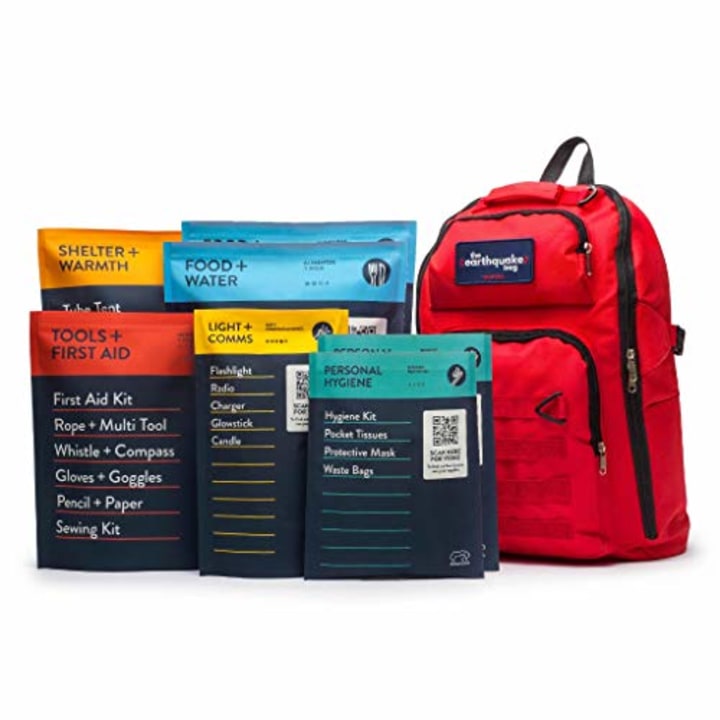
Best overall: Redfora Complete 3 Day Earthquake Bag

This three day emergency kit from Redfora includes a wide variety of items reputable agencies say are essential, plus some additional nice-to-haves based on your individual needs. The contents of the kit, which are housed in a red backpack, are labeled and color coated, and each bag includes a QR code to learn more about its contents.

  • Includes: first-aid kit, hygiene kit (2), pocket tissue pack (2), waste bag, food bars (2, 3600 cal), water pouch (24), water purification tablets (20), pencil, notepad, whistle, rope, multi-tool, safety goggles, sewing kit, gloves, N95 masks (6), candle, bright stick, hand-crank+solar NOAA radio with flashlight and charger, ponchos (2), sleeping bags (2), tube tent, hand warmers (2)
  • Missing: plastic sheeting, disposable batteries, cellphone, charging cables, duct tape, local maps

Redfora Complete 3 Day Earthquake Bag has a 4.7-star rating from over 1,300 reviews on Amazon.

Persons: 2 | Time: 72 hours | Weight: 10.5 lbs | Food/water shelf life: 5 years

Best budget: Ready America 72 Hour Emergency Backpack

If you’re looking for a more affordable backpack option, the Ready America 72 Hour Emergency Kit provides a few useful emergency items for a low price. It is missing more than our other recommendations, but can be a good starting point in building a larger kit, or be placed into a larger go-bag as part of a family emergency kit.

  • Includes: first-aid kit, pocket tissues, food bar (2, 2400 cal), water pouches (12, 4.25 oz), whistle, rope, gloves, dust masks (2), light stick (12 hr), ponchos (2), survival blankets (2)
  • Missing: hygiene kit, flashlight, plastic sheeting, radio, cellphone, charging cables, disposable batteries, duct tape, multi-tool, local maps, N95 masks

The Ready America Emergency Backpack has a 4.7-star rating from over 5,300 reviews on Amazon.

Persons: 2 | Time: 72 hours | Weight: 7.75 lbs | Food/water shelf life: 5 years

Best splurge: JUDY The Protector

Judy’s The Protector kit is meant for a family of six and costs nearly $400. As such, it comes with far more supplies, and is far heavier than our other picks, hence, the orange rolling bag carrier. All of the supplies are packaged in clearly labeled bags and boxes, making it easier to find what you are looking for, according to the brand.

(Judy also sells the more affordable Mover Max kit for a family of four.)

  • Includes: first-aid kit, food bars (15, 410 cal), water pouches (24), quick dry towel, biohazard bag, wet wipes, pocket tissues (2), whistles (2), glow sticks (6), ponchos (6), gloves (1), dust masks (6), hand crank radio+charger+flashlight, duct tape, multitool, multipurpose bags (2), candle, waterproof match pack, hand warmers (6), rescue blankets (6)
  • Missing: plastic sheeting, cellphone, charging cables, disposable batteries, local maps, N95 masks

Persons: 6 | Time: 72 hours | Weight: 23 lbs | Food/water shelf life: 5 years

Best for power-outages: Sustain Supply Comfort2 Emergency Survival Kit

The Sustain Supply Co Comfort2 Emergency Survival Bag is a good kit to buy if you’re especially worried about light and food — the backpack comes with lightsticks, an LED lantern, fire-starting devices, a portable stove, cookware and rehydratable food.

  • Includes: backpack, food rations (12), water (2 liters), survival straws (2), SnapLights (4), knife, LED lantern, first aid kit, emergency blanket (2), wet wipes pack, portable stove, cookware, bowls (2), utensils, whistles (2), InstaFire tinder (2), Ferrocerium rod
  • Missing: plastic sheeting, radio, cellphone, charging cables, disposable batteries, duct tape, multi-tool, local maps, N95 masks

It has a 4.6-star rating from over 900 reviews on Amazon.

Persons: 2 | Time: 72 hours | Weight: 21 lbs | Food/water shelf life: 15 year food, 5 years water

The best emergency supplies in 2023

If you want to add items to a pre-built survival kit, or you’d rather build one of your own, we rounded up these highly rated products that fall into supply categories recommended by Ready.gov and The American Red Cross.

First aid kits

Best soft-case: First Aid Only All-Purpose First Aid Kit (FAO-442)

The First Aid Only All-Purpose Essential Soft-Sided First Aid Kit is a soft pouch that holds around 300 pieces of various first aid supplies, according to First Aid Only. Those include, among other things, adhesive bandages, cold packs and aspirin.

The First Aid Only All-Purpose Essentials Soft-Sided First Aid Kit has a 4.8-star rating from over 68,000 reviews on Amazon.

Best hard-case: Be Smart Get Prepared 110 Piece First Aid Kit

The Be Smart Get Prepared 100 Piece First Aid Kit is a plastic case that holds 100 pieces of first aid supplies — from antiseptic towelettes to wooden finger splints — Be Smart Get Prepared says. Although it has a third of the amount of medical supplies as the first aid kit from First Aid Only, it’s half the price.

The Be Smart Get Prepared 100 Piece First Aid Kit has a 4.7-star rating from over 36,000 reviews on Amazon.

Whistles

Hipat Whistle, 2 Packs Plastic Sports Whistles with Lanyard

These Hipat sports whistles — in both plastic and stainless steel, depending on your preference — come in a two-pack with lanyards to let the whistles hang around your neck when they’re not in use.

These plastic variants have a 4.6 star rating from over 9,900 reviews on Amazon.

Flashlights

GearLight LED Tactical Flashlight

The GearLight LED Tactical Flashlight is powered by three AAA batteries and features a wide-to-narrow beam that the company says will illuminate the way up to 1,000 feet in front of you. It’s the bestselling flashlight on Amazon and comes in a pack of two. It’s also water-resistant.

The GearLight LED Tactical Flashlight has a 4.6-star rating from over 71,000 reviews on Amazon.

Black Diamond Spot 350 Headlamp

When you need light and two free hands, a headlamp is more useful than a flashlight. The Spot 350 from Black Diamond is a multipurpose option powered by three (included) AAA batteries. It offers six different brightness settings, and is fully waterproof.

It has a 4.8-star rating from over 200 reviews on Amazon.

Disposable batteries

AmazonBasics 8-Pack AA High-Performance Alkaline Batteries

The AmazonBasics 8-Pack AA High-Performance Alkaline Batteries offer reliable performance across a wide range of devices, Amazon says — they’re ideal for flashlights, clocks and more. Amazon says they have a 10-year leak-free shelf life. They’re not rechargeable.

The AmazonBasics 4-Pack AA High-Performance Alkaline Batteries have a 4.7-star rating from over 685,000 reviews on Amazon.

AmazonBasics 10-Pack AAA High-Performance Alkaline Batteries

Similar to the AmazonBasics AA batteries, the AmazonBasics 10-Pack AAA High-Performance Alkaline Batteries should work across a similarly wide range of devices and have the same 10-year shelf life, according to Amazon.

The AmazonBasics 10-Pack AAA High-Performance Alkaline Batteries have a 4.7-star rating from over 654,000 reviews on Amazon.

Radio

FosPower 2000mAh NOAA Emergency Weather Radio Portable Power Bank

The FosPower 2000mAh NOAA Emergency Weather Radio Portable Power Bank works as a traditional battery-powered handheld radio but also doubles as a 2000mAh portable power bank for keeping your smartphones and other devices charged if the power is out. You can power your AM/FM radio in a couple different ways, according to FosPower: with three AAA batteries, with the hand-crank lever or via the solar panel. The radio also has a reading light and a flashlight.

The FosPower 2000mAh NOAA Emergency Weather Radio Portable Power Bank has a 4.6-star rating from over 30,000 reviews on Amazon.

Sleeping bags

For adults: REI Co-op HunkerDown 20 Sleeping Bag

This sleeping bag from REI is rated for temperatures as low as 20 degrees Fahrenheit. It has a wrap-around zipper that can be used for ventilation or to open the bag completely and use it as a quilt, according to the brand. At a little over six and a half feet long, this sleeping bag fits most adults.

For kids: REI Co-op Kindercone 25 Sleeping Bag

As recommended in our guide to the best sleeping bags for kids, the REI Co-op Kindercone 25 is rated for temperatures as low as 25 degrees Fahrenheit. It closes with a zipper, and has adjustable cords around the head and hood. At 5 feet long, it is long enough for most younger kids.

Face masks

The American Red Cross recommends putting N95 or surgical masks in your emergency kit, depending on “the types of disasters common to your area.”

3M Aura N95 Respirator

As recommended in our guide to N95 masks, this N95 respirator from 3M is individually packaged and foldable, making it easy to store in a kit. It has a lower profile to accommodate glasses around the nose, according to the brand.

The 3M Aura N95 Respirator has a 4.5-star rating from over 20,000 reviews on Amazon.

Personal Hygiene

In order to stay clean, you’ll need to stock up on moist towelettes, too. There are a bunch of different types available — many of which you’ll find at your local drugstore. If you’re looking for the most highly rated options available online, here are some options.

Wet Ones Antibacterial Hand Wipes

The Wet Ones Antibacterial Hand Wipes are sold in a 10-pack with 20 wipes per pack. They come in a soft pack that’s pretty small — around 8 inches long by 7 inches wide — making them easier to carry around in a kit than a hard, tubular container.

The Wet Ones Antibacterial Hand Wipes have a 4.8-star rating from over 14,000 reviews.

Babyganics Alcohol-Free Hand Sanitizer Wipes

The Babyganics Alcohol-Free Hand Sanitizer Wipes are sold in a four-pack with 20 wipes per pack. Like the Wet Ones highlighted above, Babyganics wipes should kill around 99 percent of germs, according to the brand. Babyganics also says that their wipes are made without parabens, sulfates, phthalates or synthetic fragrances and dyes — plus they’re nonallergenic. Like the Wet Ones Antibacterial Hand Wipes, they come in soft packs (6 inches long by 5 inches wide) that should be simple to stuff next to your other supplies.

The Babyganics have a 4.8-star rating from over 16,000 reviews.

Tools

Lexivon ½-Inch Drive Click Torque Wrench

The Lexivon ½-Inch Drive Click Torque Wrench should be more than capable of handling that simple task. It’s made from steel with a reinforced ratchet gear head, it’s rust- and corrosion-protected and it has easy-to-identify instructions on its body, according to the brand. It also comes in a hard case for storage.

This Lexivon torque wrench has a 4.7-star rating from over 7,000 reviews on Amazon.

KitchenAid Classic Multifunction Can Opener

Emergency supply food is often canned, so having a can opener like this one from KitchenAid is helpful in many kits. It’s made of stainless steel and designed to open all types of cans. It also has ergonomic handles, which should make it comfortable and easy to hold, according to the brand.

The KitchenAid Multifunction Can Opener comes in 14 different colors, so you can choose your favorite — and it has a 4.6-star rating from over 72,000 reviews on Amazon.

Portable batteries and battery packs

Anker 525 Power Bank (PowerCore 20K)

This portable charger can charge devices with both USB-A and USB-C cables, making it a versatile option. With a 20,000mAh battery capacity, it can charge smartphones multiple times over before being depleted, according to the brand.

The Anker 525 has a 4.7-star rating from more than 5,000 reviews on Amazon.

Duct tape

Original Duck Brand

Duct tape is an often omitted supply from pre-made kits, despite its versatility. This roll from Duck Brand is easy to tear and water resistant, according to the brand. It has a 4.6-star rating from over 7,000 reviews on Amazon.

Plastic sheeting

Tapix 6 Mil Poly Sheeting

In the case of an emergency requiring sheltering in place, FEMA recommends sealing “windows, doors and air vents with thick plastic sheeting and duct tape.”

This plastic sheeting from Tapix is a long, heavy duty, 10 by 25 inch roll made of thick 6 Mil plastic.

To use, you’ll want to “cut the plastic sheeting several inches wider than the openings and label each sheet,” before duct taping the plastic down at the corners first and then taping down the rest of the sheet’s edges, according to FEMA.

Fire extinguisher

First Alert HOME1 Rechargeable Standard Home Fire Extinguisher

The First Alert HOME1 Rechargeable Standard Home Fire Extinguisher is made from durable all-metal construction with a commercial-grade metal valve, First Alert says. The First Alert HOME1 is rechargeable, meaning that you can take it to a certified professional to be refilled. It also comes with a 10-year limited warranty.

The First Alert HOME1 Rechargeable Standard Home Fire Extinguisher has a 4.8-star rating from over 41,000 reviews on Amazon.

Local maps

Although you can buy a map of your state off of Amazon without spending too much, you can also head to the U.S. Department of the Interior website and use their map viewer to print out your general location. Store it in a folder to keep at your desk, just in case you end up needing to navigate your town or city’s streets without the help of a GPS.

Either way, without GPS, a compass can help tremendously with navigation and orientation.

The American Red Cross recommends packing a cell phone, personal documents like medication lists, proof of address, passports and more, as well as extra cash. What this will look like in practice depends on you and your household.

How to shop for an emergency kit

By using online guidance from reputable resources like FEMA’s Ready.gov and The American Red Cross, you can get a good idea of what to look for in a survival kit, or even how to make one yourself. Below are some of the most common questions people ask when shopping for an emergency kit.

What do you need for a 72-hour emergency kit?

FEMA’s Ready.gov and the American Red Cross recommend a lot of the same items for an emergency kit. As explained above, we combined their recommendations to form a list of basics recommended for any emergency kit.

Both organizations also list additional and supplemental emergency supplies that may be useful depending on your individual needs, including:

  1. Prescription medications (3-day supply) and medical items
  2. Non-prescription medications such as pain relievers, anti-diarrhea, antacids or laxatives
  3. Prescription eyeglasses and contact lens solution
  4. Infant supplies
  5. Pet food and water
  6. Extra cash
  7. Copies of personal documents (medication list and pertinent medical information, proof of address, deed/lease to home, passports, birth certificates, insurance policies)
  8. Sleeping bags
  9. Towels
  10. Climate appropriate change of clothes and shoes
  11. Work gloves
  12. Scissors
  13. Fire extinguishers
  14. Feminine supplies
  15. Mess kit
  16. Paper and pencils
  17. Entertainment items (books, games, puzzles, etc.)

Is it cheaper to build your own emergency kit?

Most of the time, yes. A lot of the most recommended items in an emergency kit are things you already have in your home: non-perishable food, water, batteries, tools, spare clothes, first-aid supplies, etc. By putting together supplies you already have in a bag you already own, you can build most of your emergency kit yourself, and shop for missing items individually.

Where should I store my emergency kit?

Ready.gov recommends storing your emergency kit in “one or two easy-to-carry containers such as plastic bins or a duffel bag.” It also recommends storing items in airtight plastic bags. Some premade emergency kits come in waterproof bags, like the JUDY Mover Max.

Why trust Select?

Justin Krajeski is a former associate editor for Select.

Harry Rabinowitz is a reporter for Select. For this piece, he researched emergency prep guidelines from reputable agencies like FEMA, the CDC and the American Red Cross. To select recommended products, he referenced professional reviews as well as consumer reviews across storefronts like Amazon, Walmart, Home Depot and more.

Catch up on Select’s in-depth coverage of personal finance, tech and tools, wellness and more, and follow us on Facebook, Instagram and Twitter to stay up to date.

End of COVID emergency will usher in changes in health care

The Biden administration’s selection to stop the COVID-19 public wellbeing unexpected emergency in May will institute sweeping changes across the wellness treatment method that go significantly over and above many folks possessing to pay back extra for COVID checks.

In reaction to the pandemic, the federal authorities in 2020 suspended lots of of its procedures on how care is delivered. That reworked fundamentally every single corner of American well being treatment — from hospitals and nursing homes to general public wellness and cure for folks recovering from habit.

Now, as the government prepares to reverse some of all those measures, here’s a glimpse at means patients will be impacted:

Coaching Regulations for Nursing House Staff Get Stricter

The close of the emergency signifies nursing houses will have to meet up with higher requirements for instruction employees.

Advocates for nursing property residents are keen to see the outdated, tougher instruction prerequisites reinstated, but the marketplace says that go could worsen staffing shortages plaguing services nationwide.

In the early times of the pandemic, to assist nursing houses function underneath the virus’s onslaught, the federal authorities comfortable training demands. The Facilities for Medicare & Medicaid Products and services instituted a nationwide plan declaring nursing properties needn’t follow restrictions necessitating nurse aides to undertake at the very least 75 several hours of condition-accepted schooling. Normally, a nursing dwelling couldn’t utilize aides for additional than four months except they satisfied those people prerequisites.

Final 12 months, CMS decided the comfortable education rules would no lengthier implement nationwide, but states and amenities could ask for authorization to be held to the lessen specifications. As of March, 17 states had these types of exemptions, in accordance to CMS — Georgia, Indiana, Louisiana, Maryland, Massachusetts, Minnesota, Mississippi, New Jersey, New York, Oklahoma, Pennsylvania, Rhode Island, South Carolina, Tennessee, Texas, Vermont, and Washington — as did 356 person nursing households in Arizona, California, Delaware, Florida, Illinois, Iowa, Kansas, Kentucky, Michigan, Nebraska, New Hampshire, North Carolina, Ohio, Oregon, Virginia, Wisconsin, and Washington, D.C.

Nurse aides typically offer the most direct and labor-intense care for people, such as bathing and other cleanliness-linked jobs, feeding, monitoring critical symptoms, and keeping rooms clear. Exploration has demonstrated that nursing residences with staffing instability maintain a reduce high-quality of treatment.

Advocates for nursing property citizens are happy the schooling exceptions will finish but concern that the high-quality of care could yet deteriorate. That is because CMS has signaled that, soon after the looser expectations expire, some of the hrs that nurse aides logged all through the pandemic could rely towards their 75 several hours of essential training. On-the-task experience, however, is not necessarily a sound substitute for the teaching employees skipped, advocates argue.

Suitable education of aides is critical so “they know what they are doing prior to they provide treatment, for their own fantastic as nicely as for the inhabitants,” said Toby Edelman, a senior coverage attorney for the Centre for Medicare Advocacy.

The American Wellbeing Treatment Affiliation, the largest nursing property lobbying group, produced a December survey finding that roughly 4 in 5 services ended up working with moderate to higher ranges of team shortages.

Cure Threatened for Individuals Recovering From Habit

A looming rollback of broader access to buprenorphine, an significant medicine for folks in restoration from opioid habit, is alarming sufferers and medical doctors.

All through the public well being crisis, the Drug Enforcement Administration said providers could prescribe selected controlled substances virtually or more than the telephone with no initial conducting an in-man or woman medical analysis. A person of individuals drugs, buprenorphine, is an opioid that can avoid debilitating withdrawal symptoms for people today seeking to recuperate from dependancy to other opioids. Exploration has demonstrated using it more than halves the possibility of overdose.

Amid a national epidemic of opioid addiction, if the expanded plan for buprenorphine ends, “thousands of persons are likely to die,” said Ryan Hampton, an activist who is in restoration.

The DEA in late February proposed regulations that would partly roll back the prescribing of managed substances via telemedicine. A clinician could use telemedicine to purchase an original 30-working day source of prescription drugs these types of as buprenorphine, Ambien, Valium, and Xanax, but clients would require an in-person analysis to get a refill.

For one more team of medicines, including Adderall, Ritalin, and oxycodone, the DEA proposal would institute tighter controls. Clients looking for all those remedies would need to see a medical professional in particular person for an first prescription.

David Herzberg, a historian of prescription drugs at the College at Buffalo, mentioned the DEA’s strategy reflects a fundamental challenge in creating drug coverage: conference the requires of people today who depend on a drug that can be abused without the need of earning that drug too commonly out there to some others.

The DEA, he additional, is “clearly critically wrestling with this challenge.”

Hospitals Return to Normal, To some degree

All through the pandemic, CMS has tried to restrict troubles that could come up if there weren’t more than enough wellbeing treatment personnel to treat sufferers — specifically just before there have been COVID vaccines when staff ended up at increased risk of getting sick.

For example, CMS authorized hospitals to make broader use of nurse practitioners and medical professional assistants when caring for Medicare clients. And new physicians not yet credentialed to perform at a specific clinic — for instance, mainly because governing bodies lacked time to carry out their evaluations — could even so practice there.

Other adjustments during the community wellbeing emergency were being meant to shore up healthcare facility capacity. Vital obtain hospitals, tiny hospitals situated in rural spots, didn’t have to comply with federal policies for Medicare stating they ended up restricted to 25 inpatient beds and patients’ stays could not exceed 96 hrs, on ordinary.

When the unexpected emergency finishes, those people exceptions will vanish.

Hospitals are striving to persuade federal officials to maintain multiple COVID-period guidelines further than the emergency or operate with Congress to change the law.

Surveillance of Infectious Ailments Splinters

The way point out and community general public wellbeing departments watch the spread of sickness will adjust soon after the unexpected emergency ends, due to the fact the Department of Wellbeing and Human Services will not be ready to demand labs to report COVID tests information.

With out a uniform, federal prerequisite, how states and counties keep track of the unfold of the coronavirus will change. In addition, while hospitals will even now give COVID details to the federal federal government, they may perhaps do so considerably less frequently.

General public health and fitness departments are nevertheless finding their arms all over the scope of the modifications, claimed Janet Hamilton, executive director of the Council of State and Territorial Epidemiologists.

In some ways, the end of the crisis presents public overall health officials an chance to rethink COVID surveillance. As opposed with the pandemic’s early days, when at-property tests had been unavailable and men and women relied intensely on labs to determine regardless of whether they have been infected, screening details from labs now reveals less about how the virus is spreading.

General public wellness officers never imagine “getting all examination outcomes from all lab assessments is potentially the ideal system anymore,” Hamilton claimed. Flu surveillance offers a probable different design: For influenza, public wellness departments look for check effects from a sampling of labs.

“We’re however hoping to operate out what’s the greatest, reliable system. And I really do not imagine we have that nonetheless,” Hamilton stated.

newest tales

The point out of election integrity in the Montana Legislature

Right after returning from this month’s transmittal split, the Joint Choose Committee on Election Safety had just a person lingering merchandise still left on its docket: finalizing a proposal addressing enforcement of point out election rules.


The Viz: Montana’s $14.3 billion budget, for each capita

Just about 1.1 million persons are living in Montana. Dividing that $14.3 billion evenly between us produces a per capita figure of around $13,000 — the sum of paying the existing draft of the state spending budget bill authorizes on behalf of every and each Montana resident for the coming two-12 months budget cycle.


Lawmakers progress funding for Gallatin Higher education

Funding for a new making for Gallatin Higher education was Montana State University’s major precedence heading into the 2023 session. Now, following tension from campus leaders, the job has been included to Home Bill 5, which passed out of committee final week.


End of Covid Emergency Will Usher in Changes Across the US Health System

The Biden administration’s choice to end the covid-19 general public health unexpected emergency in May well will institute sweeping modifications throughout the wellness treatment procedure that go much past quite a few persons having to pay back a lot more for covid exams.

In response to the pandemic, the federal government in 2020 suspended lots of of its guidelines on how care is shipped. That reworked fundamentally each and every corner of American health and fitness care — from hospitals and nursing residences to public wellness and treatment method for folks recovering from dependancy.

Now, as the authorities prepares to reverse some of these techniques, here’s a glimpse at approaches individuals will be affected:

Instruction Guidelines for Nursing House Staff members Get Stricter

The end of the emergency means nursing households will have to meet better requirements for instruction personnel.

Advocates for nursing property people are eager to see the aged, more durable instruction necessities reinstated, but the field claims that shift could worsen staffing shortages plaguing facilities nationwide.

In the early days of the pandemic, to aid nursing households operate less than the virus’s onslaught, the federal govt relaxed training needs. The Facilities for Medicare & Medicaid Solutions instituted a nationwide plan stating nursing households needn’t stick to regulations necessitating nurse aides to go through at minimum 75 hours of condition-accepted education. Commonly, a nursing household couldn’t make use of aides for a lot more than four months except if they met those people requirements.

Past yr, CMS determined the comfortable coaching rules would no extended implement nationwide, but states and facilities could ask for authorization to be held to the reduce requirements. As of March, 17 states experienced such exemptions, in accordance to CMS — Ga, Indiana, Louisiana, Maryland, Massachusetts, Minnesota, Mississippi, New Jersey, New York, Oklahoma, Pennsylvania, Rhode Island, South Carolina, Tennessee, Texas, Vermont, and Washington — as did 356 person nursing residences in Arizona, California, Delaware, Florida, Illinois, Iowa, Kansas, Kentucky, Michigan, Nebraska, New Hampshire, North Carolina, Ohio, Oregon, Virginia, Wisconsin, and Washington, D.C.

Nurse aides generally provide the most direct and labor-intense care for inhabitants, which includes bathing and other cleanliness-linked jobs, feeding, monitoring very important indications, and trying to keep rooms clear. Research has demonstrated that nursing properties with staffing instability manage a lessen high quality of care.

Advocates for nursing dwelling residents are happy the education exceptions will close but panic that the high-quality of treatment could nevertheless deteriorate. That’s for the reason that CMS has signaled that, soon after the looser criteria expire, some of the hrs that nurse aides logged through the pandemic could rely towards their 75 several hours of demanded instruction. On-the-work working experience, however, is not always a seem substitute for the instruction employees skipped, advocates argue.

Satisfactory training of aides is critical so “they know what they’re carrying out before they supply care, for their own superior as nicely as for the inhabitants,” explained Toby Edelman, a senior coverage legal professional for the Center for Medicare Advocacy.

The American Well being Care Affiliation, the largest nursing household lobbying group, launched a December survey finding that approximately 4 in 5 services ended up dealing with average to significant ranges of employees shortages.

Therapy Threatened for Individuals Recovering From Addiction

A looming rollback of broader entry to buprenorphine, an crucial medicine for persons in restoration from opioid addiction, is alarming people and medical practitioners.

Through the general public wellbeing emergency, the Drug Enforcement Administration stated vendors could prescribe specific managed substances just about or around the cellphone without first conducting an in-man or woman medical evaluation. One of individuals medication, buprenorphine, is an opioid that can avert debilitating withdrawal indicators for persons trying to get better from habit to other opioids. Investigate has shown utilizing it a lot more than halves the threat of overdose.

Amid a nationwide epidemic of opioid dependancy, if the expanded policy for buprenorphine ends, “thousands of folks are going to die,” explained Ryan Hampton, an activist who is in recovery.

The DEA in late February proposed restrictions that would partly roll again the prescribing of managed substances by way of telemedicine. A clinician could use telemedicine to purchase an first 30-day provide of medicines this kind of as buprenorphine, Ambien, Valium, and Xanax, but individuals would require an in-human being evaluation to get a refill.

For another team of medicines, such as Adderall, Ritalin, and oxycodone, the DEA proposal would institute tighter controls. Clients looking for individuals prescription drugs would have to have to see a medical professional in person for an preliminary prescription.

David Herzberg, a historian of medication at the University at Buffalo, mentioned the DEA’s strategy reflects a fundamental problem in creating drug policy: assembly the desires of individuals who count on a drug that can be abused without the need of creating that drug far too easily readily available to other individuals.

The DEA, he additional, is “clearly critically wrestling with this issue.”

Hospitals Return to Typical, Fairly

During the pandemic, CMS has tried out to limit troubles that could arise if there weren’t plenty of well being care employees to handle sufferers — especially prior to there ended up covid vaccines when staff ended up at better chance of obtaining sick.

For case in point, CMS permitted hospitals to make broader use of nurse practitioners and health practitioner assistants when caring for Medicare sufferers. And new medical professionals not however credentialed to operate at a certain medical center — for case in point, for the reason that governing bodies lacked time to perform their assessments — could even so practice there.

Other changes all through the community well being crisis were intended to shore up clinic capability. Critical obtain hospitals, little hospitals located in rural spots, did not have to comply with federal regulations for Medicare stating they have been minimal to 25 inpatient beds and patients’ stays could not exceed 96 hours, on normal.

The moment the unexpected emergency ends, those exceptions will disappear.

Hospitals are striving to persuade federal officials to preserve numerous covid-period guidelines over and above the emergency or get the job done with Congress to adjust the legislation.

Surveillance of Infectious Health conditions Splinters

The way point out and local community health and fitness departments keep an eye on the distribute of disorder will adjust after the crisis finishes, for the reason that the Department of Wellbeing and Human Providers won’t be able to need labs to report covid screening facts.

With out a uniform, federal prerequisite, how states and counties observe the unfold of the coronavirus will vary. In addition, even though hospitals will still supply covid info to the federal government, they may do so less commonly.

Public well being departments are however obtaining their arms around the scope of the improvements, mentioned Janet Hamilton, government director of the Council of Condition and Territorial Epidemiologists.

In some strategies, the close of the unexpected emergency provides public health officers an possibility to rethink covid surveillance. In comparison with the pandemic’s early times, when at-home checks ended up unavailable and men and women relied closely on labs to figure out irrespective of whether they ended up infected, testing facts from labs now reveals considerably less about how the virus is spreading.

General public health officers never assume “getting all test outcomes from all lab exams is potentially the appropriate system any longer,” Hamilton reported. Flu surveillance offers a possible option model: For influenza, community health and fitness departments find exam success from a sampling of labs.

“We’re nonetheless striving to get the job done out what is the very best, steady approach. And I never think we have that nonetheless,” Hamilton explained.

Similar Matters

Get in touch with Us

Submit a Tale Suggestion

End of COVID public health emergency will bring changes to U.S. hospitals, nursing homes, addiction treatment and more

The Biden administration’s decision to end the COVID-19 public health emergency in May will institute sweeping changes across the health care system that go far beyond many people having to pay more for COVID tests.

In response to the pandemic, the federal government in 2020 suspended many of its rules on how care is delivered. That transformed essentially every corner of American health care — from hospitals and nursing homes to public health and treatment for people recovering from addiction.

Now, as the government prepares to reverse some of those steps, here’s a glimpse at ways patients will be affected:

Training rules for nursing home staff get stricter

The end of the emergency means nursing homes will have to meet higher standards for training workers.

Advocates for nursing home residents are eager to see the old, tougher training requirements reinstated, but the industry says that move could worsen staffing shortages plaguing facilities nationwide.

In the early days of the pandemic, to help nursing homes function under the virus’s onslaught, the federal government relaxed training requirements. The Centers for Medicare & Medicaid Services instituted a national policy saying nursing homes needn’t follow regulations requiring nurse aides to undergo at least 75 hours of state-approved training. Normally, a nursing home couldn’t employ aides for more than four months unless they met those requirements.

Last year, CMS decided the relaxed training rules would no longer apply nationwide, but states and facilities could ask for permission to be held to the lower standards. As of March, 17 states had such exemptions, according to CMS — Georgia, Indiana, Louisiana, Maryland, Massachusetts, Minnesota, Mississippi, New Jersey, New York, Oklahoma, Pennsylvania, Rhode Island, South Carolina, Tennessee, Texas, Vermont, and Washington — as did 356 individual nursing homes in Arizona, California, Delaware, Florida, Illinois, Iowa, Kansas, Kentucky, Michigan, Nebraska, New Hampshire, North Carolina, Ohio, Oregon, Virginia, Wisconsin, and Washington, D.C.

Nurse aides often provide the most direct and labor-intensive care for residents, including bathing and other hygiene-related tasks, feeding, monitoring vital signs, and keeping rooms clean. Research has shown that nursing homes with staffing instability maintain a lower quality of care.

Advocates for nursing home residents are pleased the training exceptions will end but fear that the quality of care could nevertheless deteriorate. That’s because CMS has signaled that, after the looser standards expire, some of the hours that nurse aides logged during the pandemic could count toward their 75 hours of required training. On-the-job experience, however, is not necessarily a sound substitute for the training workers missed, advocates argue.

Adequate training of aides is crucial so “they know what they’re doing before they provide care, for their own good as well as for the residents,” said Toby Edelman, a senior policy attorney for the Center for Medicare Advocacy.

The American Health Care Association, the largest nursing home lobbying group, released a December survey finding that roughly 4 in 5 facilities were dealing with moderate to high levels of staff shortages.

Treatment threatened for people recovering from addiction

A looming rollback of broader access to buprenorphine, an important medication for people in recovery from opioid addiction, is alarming patients and doctors.

During the public health emergency, the Drug Enforcement Administration said providers could prescribe certain controlled substances virtually or over the phone without first conducting an in-person medical evaluation. One of those drugs, buprenorphine, is an opioid that can prevent debilitating withdrawal symptoms for people trying to recover from addiction to other opioids. Research has shown using it more than halves the risk of overdose.

Amid a national epidemic of opioid addiction, if the expanded policy for buprenorphine ends, “thousands of people are going to die,” said Ryan Hampton, an activist who is in recovery.

The DEA in late February proposed regulations that would partly roll back the prescribing of controlled substances through telemedicine. A clinician could use telemedicine to order an initial 30-day supply of medications such as buprenorphine, Ambien, Valium, and Xanax, but patients would need an in-person evaluation to get a refill.

For another group of drugs, including Adderall, Ritalin, and oxycodone, the DEA proposal would institute tighter controls. Patients seeking those medications would need to see a doctor in person for an initial prescription.

David Herzberg, a historian of drugs at the University at Buffalo, said the DEA’s approach reflects a fundamental challenge in developing drug policy: meeting the needs of people who rely on a drug that can be abused without making that drug too readily available to others.

The DEA, he added, is “clearly seriously wrestling with this problem.”

Hospitals return to normal, somewhat

During the pandemic, CMS has tried to limit problems that could arise if there weren’t enough health care workers to treat patients — especially before there were COVID vaccines when workers were at greater risk of getting sick.

For example, CMS allowed hospitals to make broader use of nurse practitioners and physician assistants when caring for Medicare patients. And new physicians not yet credentialed to work at a particular hospital — for example, because governing bodies lacked time to conduct their reviews — could nonetheless practice there.

Other changes during the public health emergency were meant to shore up hospital capacity. Critical access hospitals, small hospitals located in rural areas, didn’t have to comply with federal rules for Medicare stating they were limited to 25 inpatient beds and patients’ stays could not exceed 96 hours, on average.

Once the emergency ends, those exceptions will disappear.

Hospitals are trying to persuade federal officials to maintain multiple COVID-era policies beyond the emergency or work with Congress to change the law.

Surveillance of infectious diseases splinters

The way state and local public health departments monitor the spread of disease will change after the emergency ends, because the Department of Health and Human Services won’t be able to require labs to report COVID testing data.

Without a uniform, federal requirement, how states and counties track the spread of the coronavirus will vary. In addition, though hospitals will still provide COVID data to the federal government, they may do so less frequently. 

Public health departments are still getting their arms around the scope of the changes, said Janet Hamilton, executive director of the Council of State and Territorial Epidemiologists.

In some ways, the end of the emergency provides public health officials an opportunity to rethink COVID surveillance. Compared with the pandemic’s early days, when at-home tests were unavailable and people relied heavily on labs to determine whether they were infected, testing data from labs now reveals less about how the virus is spreading.

Public health officials don’t think “getting all test results from all lab tests is potentially the right strategy anymore,” Hamilton said. Flu surveillance provides a potential alternative model: For influenza, public health departments seek test results from a sampling of labs.

“We’re still trying to work out what’s the best, consistent strategy. And I don’t think we have that yet,” Hamilton said.


KHN (Kaiser Health News) is a national newsroom that produces in-depth journalism about health issues. Together with Policy Analysis and Polling, KHN is one of the three major operating programs at KFF (Kaiser Family Foundation). KFF is an endowed nonprofit organization providing information on health issues to the nation.

COVID-19 pandemic expected to end this year ‘as a public health emergency,’ says World Health Organization

The director of the Entire world Well being Group (WHO) announced on Friday that he is “confident” the COVID-19 pandemic will conclusion in 2023.

Director-Standard Dr. Tedros Adhanom Ghebreyesus made the reviews to reporters at a media briefing in Geneva.

“We are definitely in a much better place now than we have been at any time in the course of the pandemic,” Dr. Ghebreyesus claimed. 

He mentioned that in the past 4 months, the weekly range of documented fatalities has been reduce than it was just before the pandemic was declared in March 2020.

More mature People in america REJECT Extra VACCINES, Choose As a substitute FOR ‘NATURAL Healing,’ Claims REPORT

“I am assured that this yr, we will be able to say that COVID-19 is around as a community well being unexpected emergency of global issue,” he extra.

COVID-19 instances and fatalities proceed to pattern downward all over the world. 

COVID-19 pandemic expected to end this year ‘as a public health emergency,’ says World Health Organization

Globe Wellness Corporation (WHO) Director-Basic Tedros Adhanom Ghebreyesus announced on Friday he is “assured” the COVID-19 pandemic will conclusion in 2023. (iStock)

As of March 6, weekly fatalities stood at 5,048 globally.

That’s a lower of additional than 26{bf0515afdcaddba073662ceb89fbb62b6b1bf123143c0e06b788e1946e8c353f} from the prior 7 days — and down from a peak of 102,000 deaths in January 2021, for every info from WHO.

Weekly instances of COVID-19 are down to 812,255 globally, a 21.65{bf0515afdcaddba073662ceb89fbb62b6b1bf123143c0e06b788e1946e8c353f} lessen above the prior 7 days. They peaked at 44.3 million in December 2022.

“Very last week, there were even now a lot more than 5,000 noted deaths.”

In the U.S., as of March 15, weekly scenarios were down to 149,955, right after peaking at 5.6 million on Jan. 19, 2022, for every knowledge from the Facilities for Disease Manage and Avoidance (CDC). 

COVID VACCINE UPDATE: Food and drug administration AUTHORIZES PFIZER BOOSTER FOR SOME Young children Underneath AGE 5

Weekly deaths in the region were at 1,706, down from an all-time peak of 23,478 on Jan. 13, 2021 and one more surge of 17,357 on Feb. 2, 2022. 

‘We are not there yet’

Having said that, even with its optimistic prediction, the WHO is not really ready to announce the conclude of the pandemic at this exact minute in time.

“We are not there however. Past week, there were nonetheless additional than 5,000 documented fatalities,” Dr. Ghebreyesus mentioned in the course of the briefing. 

“That is 5,000 too numerous for a ailment that can be prevented and dealt with.”

In the U.S., as of March 15, weekly cases were down to 149,955, after peaking at 5.6 million on Jan. 19, 2022. 

In the U.S., as of March 15, weekly circumstances were down to 149,955, right after peaking at 5.6 million on Jan. 19, 2022.  (iStock)

Dr. Ghebreyesus also pressured the want to decide how the pandemic started.

“Previous Sunday, WHO was designed conscious of knowledge released on the GISAID databases in late January, and taken down yet again recently,” he explained. 

“The information, from the Chinese Center for Illness Management and Prevention, relates to samples taken at the Huanan marketplace in Wuhan in 2020.”

Dr. Ghebreyesus claimed that whilst this distinct knowledge did not offer a “definitive reply” to the pandemic’s origins, all information is crucial in acquiring that intention.

Exceptional TICK-BORN BABESIOSIS Condition ON THE Increase IN NORTHEASTERN US, Claims CDC — Here’s WHY

“These facts could have — and really should have — been shared 3 decades ago,” he ongoing. “We keep on to call on China to be transparent in sharing knowledge, and to carry out the needed investigations and share the final results. Comprehending how the pandemic started remains both of those a moral and scientific crucial.”

“We are surely in a considerably greater situation now than we have been at any time all through the pandemic.”

Dr. Marc Siegel, medical professor of medicine at NYU Langone Medical Centre in New York Metropolis and a Fox Information professional medical contributor, stated this weekend that he inquiries the WHO’s hesitancy to signal the conclusion of the international crisis irrespective of the weekly COVID loss of life depend staying reduced than pre-pandemic.

Weekly COVID-19 cases and deaths have been trending consistently downward both in the U.S. and globally. 

Weekly COVID-19 scenarios and deaths have been trending continually downward both in the U.S. and globally.  (iStock)

“Under the heavy impact of China, WHO leadership actions have been erratic at greatest, delaying contacting it a pandemic for practically two months soon after it was spreading greatly and failing at acquiring China to be open and transparent about origins,” Dr. Siegel told Fox Information Electronic in an interview.

Click on Listed here TO Sign UP FOR OUR Wellbeing Publication

“The pandemic has revealed WHO at the highest ranges to be woefully inadequate.”

In January 2023, President Joe Biden introduced that he would end the COVID crisis on May perhaps 11. 

Click on Listed here TO GET THE FOX Information Application

He had earlier declared the pandemic to be “over” in September 2022.

Children languish in emergency rooms awaiting mental health care

This story includes discussions of suicide. If you or someone you know is in crisis, you can get help from the Suicide and Crisis lifeline by calling or texting 988.


While most kids his age were wrapping up their junior year of high school, Daniel was in a box. 

“It was like I was sitting in a gigantic FedEx box being shipped somewhere,” he said. “But like, add one bed and the door had to be closed at all times.” 

Daniel’s years of mental health struggles, stretching back into his early childhood, came to a head in early 2022. His often-uncontrollable emotional outbursts became unmanageable; he was “unraveling,” his parents said. 

CBS News is only using the first names of former patients interviewed for this story to protect their privacy. 

Fearing Daniel might harm himself, his parents took him to the only place they could: the emergency room. After seven days in the ER, Daniel was discharged; hospital staff felt he was no longer in danger. His parents disagreed.  

“We were like no, no, no, he is so not ready,” his mom Kathe said. “We’ve been waiting and waiting, but he is not ready.” 

Daniel’s therapist even wrote a letter to the hospital saying he wasn’t ready to be released. But the hospital said he needed to go home.  

Ten days later, he was back in the ER — this time at another nearby hospital, where he would stay for 19 days.  

“There’s barely any room in the [hospital] room to walk around,” Daniel, now 18, said. “So I was just sitting on my bed all of the time. I had some rough times there, like it was really difficult to, like, stay put, you know, and that’s what they expected [me] to do.”

Read more: Inside America’s youth mental health crisis 

Instead of the intensive mental health care he needed, Daniel said he got very little help while in the room.  

“Dan, rightfully so, he was like, what am I doing here?” Kathe said. “This is not help. You promised help. Where’s the help?” 

“Severe shortage”

Stories similar to Daniel’s are growing more common in the U.S., fueled by a critical shortage of doctors, therapists and resources to address the needs of kids in crisis. 

In Massachusetts, the number of kids landing in ERs for mental health treatment soared 200{bf0515afdcaddba073662ceb89fbb62b6b1bf123143c0e06b788e1946e8c353f}-400{bf0515afdcaddba073662ceb89fbb62b6b1bf123143c0e06b788e1946e8c353f} during the pandemic. That same trend is reflected across the country: a 2021 study found the number of kids stuck in ERs awaiting treatment tripled between 2019 and 2021. 

“I do think it is very bad,” said Dr. Muniya Khanna, research scientist at Children’s Hospital Philadelphia and a former faculty member at the University of Pennsylvania’s Department of Psychiatry. “Suicide is now the number two leading cause of death in children 10 to 24. And this trajectory is only getting worse after the COVID pandemic. And so, we are absolutely in a crisis.” 

Experts say it’s a demand and supply issue: demand for mental health services has increased after the pandemic and the supply of trained staff hasn’t increased enough to fulfill the needs. 

Forty U.S. states and Puerto Rico all have “severe” shortages of child psychiatrists, according to data from the American Academy of Child and Adolescent Psychiatry (AACAP) analyzed by CBS News. Only the District of Columbia reported having enough child and adolescent psychiatrists to meet AACAP standards.

RELATED: Half of all Texas school districts have no mental health services 

Amid this lack of formal mental health treatment options, ERs have become the last and only option for many families, according to numerous mental health experts interviewed by CBS News.  

“Kids languish for days, weeks, sometimes even over a year in children’s hospitals around the country,” said Zach Zaslow, vice president of advocacy and community health at Children’s Hospital Colorado. “This is not just a Colorado problem, and it happens because there’s nowhere else that’s safe for them to go.” 

In Colorado, Michaela, who grew up in foster homes, told CBS News she tried get a special therapist to address her anger, anxiety and depression nearly a dozen times. 

“I would be crying out for help,” Michaela said. “I would say I need support. And it wouldn’t happen until I came to a point where it was too late to really come back and not make a bad decision that in the end would hurt me.” 

Michaela said she tried to hurt herself, including several suicide attempts, over those years. She said the system in its current form does not do enough for young people until they reach a crisis point. 

“I think it’s really hard to get into a good therapist or just a therapist in general,” Michaela said. “It doesn’t matter if they’re good or bad.”  

Michaela said she had a total of eight ER visits for mental health crises, and often left the ER without seeing a therapist. The few times she did meet with a mental health expert, she said her therapy was cut short. 

“It did cause me to have to go back [to the ER] again like less than a year later just because I didn’t get the help that I needed,” said Michaela. “And I think it was partly because I left too early.”  

Michaela, who is now 20, said she is proud that she’s “beat the odds” and survived. She now sits on a youth advisory board as part of a partnership between the University of Colorado and Children’s Hospital Colorado. 

“It definitely made me feel like all of that pain and suffering that I had to go through wasn’t a waste,” said Michaela. “Because now I can be the voice of power for so many other young people who are stuck in the same situation that I was and give them hope that I didn’t have then.” 

A revolving door at ERs

Experts told CBS News the use of ERs as stopgap mental health treatment measures simply doesn’t work.  

“For anybody who’s been in an emergency department for more than a few hours, it is not an ideal place to be,” said Dr. Kevin Carney, an emergency room physician at Children’s Hospital Colorado.   

Massachusetts General Hospital in Boston, where Daniel stayed for 19 days, acknowledged the problem, saying in a statement to CBS News that “shortages [of proper mental health treatment options] have forced youth in crisis — and their families — to turn to their local emergency departments where ongoing capacity challenges may mean waiting for days or weeks for appropriate inpatient care to become available.” 

For kids in crisis, ER visits can make matters even worse.  

A December 2022 American Academy of Pediatrics study found more than a quarter of children who went to ERs for mental health issues were hospitalized — either in ERs or in mental health facilities — within six months. And about 26.5{bf0515afdcaddba073662ceb89fbb62b6b1bf123143c0e06b788e1946e8c353f} were back in the ER within a week.  

Dr. Sandra DeJong, a psychiatrist and the secretary with the American Psychiatric Association, said if kids don’t get proper care early, their condition can rapidly get worse. 

“My fear is that we really have significant risk for the future,” DeJong said. “Because if we don’t address the needs of particularly young people now, then they are going to grow up to be people who are diminished and don’t have the capacity to function in the way that they could have if they had gotten the treatment.  

“And frankly, they’re going to be expensive to care for because if they go untreated, there are situations that are likely to get worse and then they will need higher intensity care. It’s just not an effective way to approach the problem.” 

Meanwhile, more and more kids find themselves in crisis. Suicide attempts by teen girls jumped more than 51{bf0515afdcaddba073662ceb89fbb62b6b1bf123143c0e06b788e1946e8c353f} between 2019 and 2021, according to a study by the CDC. And a recent study published in the journal JAMA Pediatrics found the number of suicide attempts by overdose reported to poison control centers more than doubled between 2000 and 2020.

The number of kids with mental health issues coming to the ER “has been unrelenting,” said Zaslow.  

“And it’s not acceptable,” he added. “It means ultimately, at the end of the day, that there are kids waiting for those beds every single minute as soon as one frees up.”   

Dr. Taylor Louden, medical director at Cook Children’s Medical Center in Fort Worth, Texas, said that in recent years he’s seen more and more young patients come into his ER for mental health problems. 

“We are seeing even younger and younger kids, 8-, 9-year-olds — ages of my kids,” said Louden. “Some are expressing that they want to hurt themselves that they want to die and it’s really tough to hear.” 

Not only are there more kids showing up in ERs, Louden said, but they’re staying longer, too.  

“No one should ever be in an ER longer than a few hours,” he said. “That means that the system is broken, in my mind.” 


Inside an ER’s psych room

04:04

“It’s not acceptable” 

Numerous experts CBS News interviewed said serious investments are needed to increase the mental health resources available to kids in crisis.  

CBS News went to the person in charge of the system in the U.S.: Health and Human Services Secretary Xavier Becerra, who said “we have to do a lot” to fix the problem. 

“It wasn’t until recently that you could get an insurer who actually gave you access to mental health services,” Becerra said. “And we still have a system where mental health is what you get at a primary care physician when you go to a family doctor.  

“That’s got to change. Mental health, it’s got to be part of primary health, not something where you get a referral to a specialist.”  

When asked about children getting stuck in ERs rather than proper mental health treatment facilities, Becerra said it was “not acceptable.” 

“It’s not care,” Becerra said. “It’s housing them until we can get somebody who could give them professional help. They’re crying out and shame on us that we haven’t prepared.”  

Becerra pointed out that several states and the federal government are investing billions of dollars into mental health care. And last summer, the Biden White House announced $300 million to expand mental health services in schools. 

“That’s where the president last year in the State of the Union and again, double down this year has said, Congress, we’ve got to step up, we’ve got to finish the job of making sure that mental health is treated like any other aspect of health,” Becerra said.  

But doctors Khanna and DeJong both said much of this federal spending comes in the form of one-time grants that will eventually expire.  

“Now it’s really time to start investing time and resources on all levels for making that happen more on a regular basis,” said Khanna. 

Attracting more people to work in youth mental health must be part of the equation, DeJong said.  

“You can build all the beds and clinics in the world,” DeJong said. “But if you don’t have enough people to staff them, which is a real problem right now, we’re not going to meet the needs that we’re facing.”   

Secretary Becerra agreed.  

“You just got to put your money where your mouth is. And President Joe Biden is trying to put his money there,” Becerra said. “We need now the partnership with Congress to make it happen.”  


HHS Secretary Xavier Becerra speaks about youth mental health crisis

06:53

Some aren’t waiting on the federal government to help, instead trying new approaches in attempts to address this crisis and meet young people where they are.   

One of those approaches comes in the form of a youth advisory group at Children’s Hospital Colorado. The advisory group consists of teenagers who regularly meet to give advice to therapists and hospital officials about how to meet the needs of young people. 

Another new approach: construction of a new, first-of-its-kind facility at the Cherry Creek School District outside Denver that will combine a mental health medical facility and a school when it’s completed in the fall of 2023.  

When kids in crisis leave ERs 

Finding help after a hospital stay can be even more challenging. 

The Academy of Pediatrics study found just 31.2{bf0515afdcaddba073662ceb89fbb62b6b1bf123143c0e06b788e1946e8c353f} of children had a mental health follow-up visit within seven days of leaving the hospital and only about half had a mental health follow-up with a specialist within 30 days of leaving the hospital. 

“I think what is very distressing about this mental health crisis that we’re facing is that while we very much take as part of our responsibility to make sure that we are keeping kids safe and stabilizing them when they’re in crisis or have harmed themselves,” Dr. Carney said. “The very hard thing is knowing that at that point I can’t do anything else for that child.” 

Dr. Glenda Wrenn Gordon knows those statistics firsthand: she and her 18-year-old son lived them.  

Wrenn Gordon said even though she’s an Atlanta-area psychiatrist herself, she was surprised by the effort she had to put in to find help for her son in crisis after she got him to the ER. She said she thought she knew what to do, but still found the system of finding and getting care post-hospital visit to be daunting. 

“We moved very quickly through the ER because I knew exactly what to say and how to say it to get us where we needed to go,” she said. “I was extremely frustrated for how hard it was. I was thinking about these other families. What hope do they have and what it must be like?”  

When asked what she fears most if the system is not changed, Wrenn Gordon was blunt. 

“We will continue to bury our children,” she said. 


Atlanta psychiatrist struggles to find help for her son

02:56

If you or someone you know is in crisis, get help from the Suicide and Crisis Lifeline by calling or texting 988. 

In addition, help is available from the National Alliance on Mental Illness, or NAMI. Call the NAMI Helpline at 800-950-6264 or text “HelpLine” to 62640. There are more than 600 local NAMI organizations and affiliates across the country, many of which offer free support and education programs.