LONDON — Racism and discrimination must be acknowledged as public health threats in the fight to address global health disparities, according to a new study.
As part of the four-paper series published in The Lancet medical journal Thursday, researchers from countries around the world, including the U.S., U.K., Brazil and India, carried out a major review of scientific literature and used data from hundreds of articles in recent years.
The tendency among health professionals has been to explain unequal health outcomes on either genetics or economic conditions, according to the study’s authors. But in order to tackle racial health inequities, racism and discrimination themselves should be classified as public health threats globally, the authors say.
“Racism has always been a public health threat,” Alexandre White, assistant professor of sociology and the history of medicine at John Hopkins University School of Medicine, told ABC News. “It has emerged time and time again, especially over the last 10 to 15 years.”
Research into the intersection of race and health disparities has advanced in recent years, particularly in the U.S. According to the U.S. Centers for Disease Control and Prevention almost every two in three pregnancy-related deaths are preventable. A 2020 report found that non-Hispanic Black women experienced a higher pregnancy-related mortality rate — a disparity placing them nearly three times more at risk of dying due to pregnancy-related causes compared to non-Hispanic white women.
The report’s authors also found evidence of disproportionate impact from the pandemic, vaccine inequality and climate change on minority groups.
“This study is tremendously important [as] it sheds light on the fundamental role that racism, xenophobia and forms of discrimination actually play on health, both from a structural level and generational level over time,” White said. “But also fundamentally since the COVID-19 pandemic we’ve seen the ways in which, especially racism and xenophobia, affects who gets sick, how seriously and why.”
The study also reports that racial biases in health care can lead to a stress response — affirming previous studies that found discrimination, whether overt or covert, can lead to chronic stress responses which can affect human neurological and immune systems. That chronic stress response can lead to lower life expectancies and is associated with other health complications such as anxiety, depression and heart disease.
“It’s not only because of racism at the individual interpersonal level,” Dr. Abi Deivanayagam, a public health doctor, researcher, activist and one of the study’s authors, told ABC News. “It’s racism in the way that our society is structured. And that’s very real. And it’s really important that we acknowledge this in a medical journal like The Lancet so that health people recognize that this is something this is our duty of care to patients. And our care really has to go beyond the individual to making sure that our systems are safe for our patients.”
Although discrimination against minority groups comes in different forms around the world according to such factors as race, ethnicity and religion, a pattern of worse health outcomes for minority groups can be seen globally.
According to Deivanayagam, the study has drawn two major conclusions.
“One thing is that there is evidence globally that shows that racism, xenophobia and discrimination affect a range of different health outcomes, and that this is embedded across different levels of society and that it affects people across the course of their lives ranging from COVID-19, to vaccines, to actually getting health care access,” she told ABC News. “The second thing is that we need to get to the root cause of this. And the way we do that as health professionals is to recognize that racism, xenophobia and discrimination are actually a public health threat.”
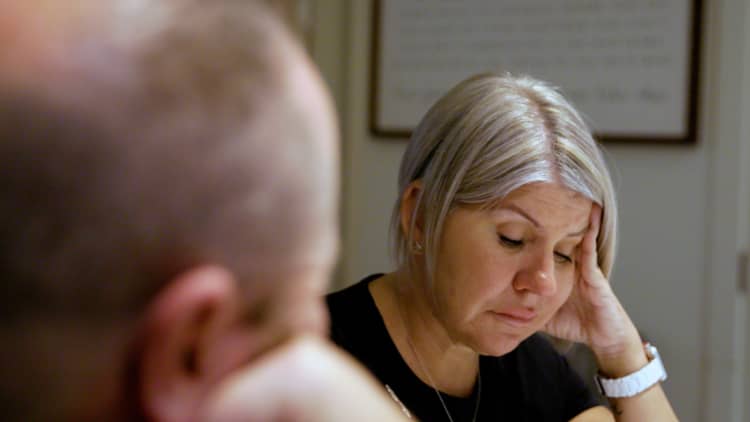
Sam Norpel and her family. Norpel, 48, second from the right, got Covid-19 in December 2021 and hasn’t recovered. This chronic illness, known as long Covid, impacts up to 23 million Americans.
Kirstie Donohue
Sam Norpel used to present regular financial updates to C-suite executives.
Now, unpredictable bouts of broken, staccato speech make that impossible for the former e-commerce executive.
Despite being up to date with vaccines and boosters, Norpel, 48,got Covid-19 in December 2021, when the highly transmissible omicron variant was fueling record U.S. caseloads.
She never got better — and infact, feels worse,with a range of debilitating symptoms that make it impossible to work.
More from Your Health, Your Money
Here’s a look at more stories on the complexities and implications of long Covid:
Her halting speech can be triggered by something as innocuous as cold water or cool air on the skin. Extreme noise sensitivity requires her to wear noise-canceling headphones all day. She’s also endured a low-grade migraine for nearly a year, which can flare up after prolonged screen time.
When it comes to her body and mind, “the computer is just slow,” said Norpel, who lives with her family outside Philadelphia. “Right now, for me, 48 [years old] feels like 78.”
Norpel is one of millions of Americans with long Covid, also known as long-haul Covid, post-Covid or post-acute Covid syndrome. While definitions vary, long Covid is, at its core, a chronic illness with symptoms that persist for months or years after a Covid infection.
Up to 30{bf0515afdcaddba073662ceb89fbb62b6b1bf123143c0e06b788e1946e8c353f} of Americans who get Covid-19 have developed long-haul symptoms, affecting as many as 23 million Americans, according to the U.S. Department of Health and Human Services.
Long Covid could be ‘the next public health disaster’…
Researchers think most Americans have had Covid-19 at this point.
Studies suggest subsequent infections raise the chances of an “adverse” outcome, including hospitalization and death. The virus has killed more than 1 million Americans to date, and some 2,000 more die each week, according to the Centers for Disease Control and Prevention.
Long Covid demonstrates that the virus is taking a lingering, pervasive and perhaps even more insidious toll. Medical experts have called it “the next public health disaster in the making.”
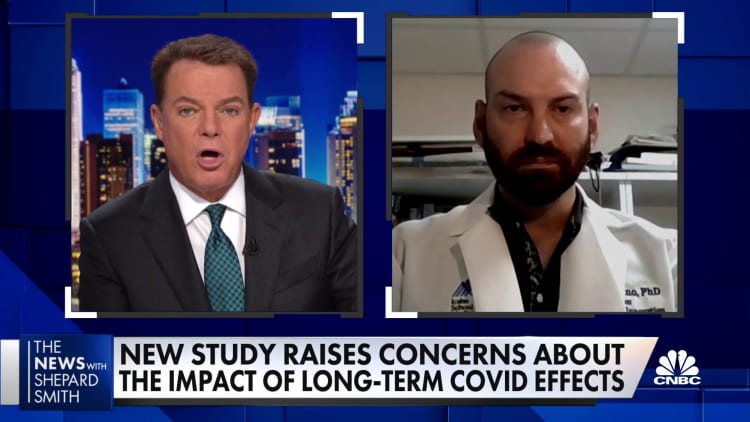
“There are just large numbers of people affected by this,” said Dr. Peter Hotez, co-director of the Center for Vaccine Development at Texas Children’s Hospital and a dean at Baylor College of Medicine.
That number will “only continue to grow” as Covid-19 continues to circulate, HHS said in a recent report.
“This could be game-changing in terms of how we do medical practice, in the same way HIV/AIDs was a game-changer,” Hotez said.
But the tentacles of long Covid reach far beyond its medical impact: from the labor gap to disability benefits, life insurance, household debt, forfeit retirement savings and financial ruin.
This article is the first of a CNBC special report examining long Covid’s destructive impact on individuals, families and the U.S. economy at large.
All told, long Covid is a $3.7 trillion drag on the U.S. economy — about 17{bf0515afdcaddba073662ceb89fbb62b6b1bf123143c0e06b788e1946e8c353f} of our nation’s pre-pandemic economic output, said David Cutler, an economist at Harvard University. The aggregate cost rivals that of the Great Recession, Cutler wrote in a July report.
Cutler revised the $3.7 trillion total upward by $1.1 trillion from an initial report in October 2020, due to the “greater prevalence of long Covid than we had guessed at the time.” Even that revised estimate is conservative: It is based on the 80.5 million confirmed U.S. Covid cases at the time of the analysis, and doesn’t account for future caseloads.
Higher medical spending accounts for $528 billion of the total. But lost earnings and reduced quality of life are other sinister trickle-down effects, which respectively cost Americans $997 billion and $2.2 trillion.
“Long Covid will be around long after the pandemic subsides, impacting our communities, our health care system, our economy and the well-being of future generations,” the HHS report said.
Norpel was the household breadwinner, which allowed her husband to care for their kids. The family has been living on income from a long-term disability policy, a vestige of her old job; the funds replace just a third of her prior pay. Norpel’s husband must now juggle caretaking duties and the necessity of finding work, both for income and health insurance.
The money worries are multitude: the ability to continue funding her daughter’s college education, the odds of raiding retirement accounts or selling their home to subsist. Norpel’s 16-year old son recently wondered if he should get a job to support the family; but he doesn’t even have a driver’s license.
“All of it is just very heartbreaking,” said Norpel, adding that “long Covid changed everything.”
While there are still many unknowns about long Covid — shorthand for its scientific name “post-acute sequelae of Covid,” or PASC — what we do know so far is startling, experts say.
Anyone who’s had Covid-19 can develop the condition. People can get it regardless of the severity of their initial infection or the virus variant, according to the World Health Organization. It affects all age groups, even those who were previously fit and healthy.
Studies suggest women are at higher risk than men; one study found adult females to be twice as likely to have long-haul symptoms. People of color are also more likely to get sick due to the increased likelihood of a Covid-19 infection and less access to high-quality health care; it’s also more common in bisexual and trans people due to reduced care access and the stigma regarding their gender or sexuality, the HHS said in an October report.
However, the medical community hasn’t arrived at an exact definition of long Covid, which complicates diagnosis and treatment.
The definition “depends on who you ask right now,” said Dr. Greg Vanichkachorn, medical director of the Mayo Clinic’s Covid Activity Rehabilitation Program.
Here are some of the points on which opinions diverge:
Cause: Doctors don’t yet know what causes long Covid. They have theories: Perhaps it’s an autoimmune disorder, like lupus or rheumatoid arthritis, whereby the virus is gone but the immune system remains active, attacking healthy cells by mistake; or maybe small blood clots develop in the brain, too small to cause a stroke but big enough to trigger neurologic issues.
Key symptoms: Long Covid has been linked to more than 200 symptoms, according to The Rockefeller Foundation. Shortness of breath, fatigue, and sleep disorders or insomnia are the most common symptoms, according to a recent global meta-analysis published in the Journal of the American Medical Association, a peer-reviewed journal. Others include anxiety, depression, body aches, headache, heart palpitations and “brain fog” — which describes challenges associated with cognition, like thinking, concentration, communication, comprehension, memory and motor function. Some sufferers have organ damage, to the heart, lungs, kidneys, skin and brain.
Duration: There’s no consistent definition of how long symptoms must persist for someone to be considered a long Covid patient. For example, the CDC says a person has long-haul symptoms if they persist beyond (or start after) one month from an initial Covid-19 infection. The WHO generally uses a three-month barometer. Different health clinics may use others still.
What experts do know is that for some, long Covid symptoms can last months or even years. About 15{bf0515afdcaddba073662ceb89fbb62b6b1bf123143c0e06b788e1946e8c353f} of people whose ailments persist three months after infection continued to experience symptoms at least 12 months after infection, according to the meta-analysis.
Meredith Hurst, a paralegal, is one of those people. Hurst caught Covid in November 2020. She was diagnosed with long Covid in December 2021; now, two years after the initial infection, she still hasn’t recovered.
The 42-year-old, who lives in Wilmington, Delaware, is unable to work and is in the process of filing for Social Security Disability Insurance — for which qualification is famously stringent. Brain fog, migraines and fatigue require her to complete the application in pieces; all of her progress, which had been saved in a draft, was recently deleted because too many days had elapsed.
Meanwhile, Hurst is struggling to make ends meet. In addition to Medicaid health benefits, she receives public assistance via food stamps. Her credit cards are “getting maxed out.”
“I don’t know if it’s for the rest of my life or not,” Hurst said of feeling long Covid symptoms.
“It will probably continue this way for me until there is a test, a medication, more research, more education for the public, for doctors,” she added. “This is going to be my experience for a while”
“It doesn’t mean forever,” Hurst said. “But for right now, this is my reality.”
The formal diagnosis code for long Covid used by researchers and physicians is only a year old.
The CDC authorized the code (U09.9) in October 2021. An official diagnosis allows patients to more easily access long Covid-related treatments, file for disability insurance and request accommodations at work, according to the HHS report.
Yet its nebulous nature means there isn’t yet a definitive, yes-or-no lab test for it.
“There’s no diagnostic test,” said Dr. Jeff Parsonnet, an infectious disease physician who started the Post-Acute COVID Syndrome clinic at Dartmouth Hitchcock Medical Center. “It’s really a clinical diagnosis.”
Sometimes that process is straightforward: a confirmed, positive Covid-19 test result, with enough time passing after initial infection and persistent symptoms consistent with hundreds of other long Covid patients may be adequate, Vanichkachorn of the Mayo Clinic said.
But often, by the time Parsonnet sees patients at the Post-Acute COVID Syndrome clinic, they’ve had “all sorts of testing” from a primary care doctor or specialists. That might include pulmonary function tests or chest X-rays to look for heart or lung conditions, for example, magnetic resonance imaging (MRI) to identify brain inflammation or a “tilt table” test to evaluate a possible autonomic disorder.
Frustratingly for patients, such testing often comes back negative, according to medical experts, even as it adds to their financial burden.
“In many cases, the diagnosis is [long Covid] because there’s nothing else to explain the condition,” said Alice Burns, associate director of the Program on Medicaid and the Uninsured at health care nonprofit The Henry J. Kaiser Family Foundation. “It’s the diagnosis when all other diagnoses have been ruled out.”
There are a lot of physicians or care providers who are reluctant to apply a label they see as defined as everything but the kitchen sink.
Diana Güthe
founder of Survivor Corps
That can make some physicians unwilling to entertain long Covid as a reason for health complications.
“There are a lot of physicians or care providers who are reluctant to apply a label they see as defined as everything but the kitchen sink,” said Diana Güthe, founder of Survivor Corps, referring to the litany of symptoms. Survivor Corps is a grassroots Covid advocacy group with about 250,000 members; Güthe herself had and recovered from long Covid.
Donna Pohl, 56, met with a neuromuscular specialist in mid-November to help treat nerve damage that resulted from long Covid. The visit didn’t go well.
“[The specialist] said, ‘Everyone wants to blame Covid,'” said Pohl, who lives in Bettendorf, Iowa, and was diagnosed with long Covid last December. “We are sick, not stupid or crazy.”
People — including family and friends — often write off symptoms as “byproducts of anxiety and depression, or even worse, laziness and an excuse not to work,” the HHS report said.
Neurologists would see Norpel twitch and instead focus just on her migraines, she recalled. One told her to stop reading literature on long Covid when she mentioned the disease during an appointment. “It was like Dr. ‘Mansplaining,'” she said.
She eventually had a consultation in August at the Mayo Clinic, where she was told: “We believe you — you have long Covid.”
“I started crying when the doctors spoke to me,” Norpel said.
The U.S. Food and Drug Administration (FDA) is announcing a virtual public workshop Understanding Risk with Medical Devices. This 2-hour workshop will expand on the basics of risk associated with medical device use by featuring Risk Basics for Medical Devices and Application of Risk Management Principles for Medical Devices. The presentations will be followed by a live question-and-answer session with stakeholders and a panel of CDRH leaders.
Risk Basics for Medical Devices (Joseph Tartal, Deputy Director Division of Industry and Consumer Education)
Understanding risk is a necessity to bring and keep a medical device on the market. These basic concepts will start you on the journey to determine the risk of your medical device, which will increase predictability, aid in appropriate design and manufacturing, and provide clearer premarket submission regulatory expectations. This session will discuss the basics of risk and use a generic example to help establish a fundamental understanding of risk.
Application of Risk Management Principles for Medical Devices (Tonya Wilbon, Branch Chief, Postmarket and Consumer Branch, Division of Industry and Consumer Education)
Medical device manufacturers are required to make risk-based decisions and conduct risk management activities as a part of the design, manufacture, and production of medical devices or in general as part of the quality system. In addition, the regulation of medical devices incorporates risk-based decisions to assure devices are safe and effective. This session will provide an understanding of the application of risk management principles and review of risk information for medical devices.
Each session will include a presentation, followed by a moderated live question-and-answer session with a panel of CDRH leaders. Audience participants are encouraged to email or call with questions during each session.
Participants may choose one or both sessions. Each session will begin at the scheduled time.
1:00 – 2:00 PM ET: Risk Basics for Medical Devices
2:00 – 3:00 PM ET: Application of Risk Management Principles for Medical Devices
ELKO, Nev. — When Elko County commissioners rejected a $500,000 grant from the Centers for Disease Control and Prevention that could have helped the county create a health department or health district, Kayla Hopkins pleaded with them to reconsider.
Hopkins, who has lived for nearly nine years in the sprawling rural county that forms the northeastern corner of Nevada, told the board how she struggled through postpartum depression and needed mental health resources.
“I was unable to get the help that I needed,” Hopkins said during a public meeting in late 2021, adding that she fell into what could be considered a mental breakdown. She said she was sent by air ambulance more than 300 miles away to Carson City, where she received care in a psychiatric facility for 10 days.
“I was away from my family,” Hopkins said. “I was away from my support system here, and I still struggle with mental health, and I still cannot get the help that I need because we just don’t have it here.”
Pleas from Hopkins and others weren’t enough to sway the elected commissioners. Neither were 11 letters from local health leaders urging the board to take the infusion of public health funding. Four of the county’s five commissioners, citing concerns about government overreach and their lack of trust in federal agencies, voted against pursuing the grant. Nearly a year later, as the pandemic grinds toward a third year and with the arrival of monkeypox, the county still is without a public health department to respond.
And the same mistrust of agencies administering grants for public health persists elsewhere.
Elko County, home to about 54,000 people, wasn’t alone in rejecting federal aid aimed at bolstering public health in the past year. Experts say they were surprised and concerned to see the rare local or state leader, swayed by political partisanship, dismiss funding opportunities for historically limited public health systems.
As many conservative leaders and their constituents railed against measures meant to combat Covid — things like masking policies and promoting vaccines — the pandemic revealed long-standing fissures in the country’s public health infrastructure, particularly in rural and underserved communities.
“Partisan politics has poisoned the well to a point that we’re willing to sacrifice the health of our citizens,” said Brian Castrucci, president and CEO of the de Beaumont Foundation, a national nonprofit that advocates for public health policy. “Is the political grandstanding worth it?”
Over the past two years, officials in Idaho, Iowa, and New Hampshire rejected Covid relief money, their decisions often accompanied by political pronouncements about federal government overreach. And officials representing local governments across the country, including Cochise and Pinal counties in Arizona, echoed those moves. A survey of local governments in 15 states conducted by the National League of Cities found more than 200 small governments declined pandemic relief funds, a small percentage of the money available to small governments.
Elko commissioners turned down a workforce grant funded by the CDC, money intended to “establish, expand, and sustain a public health workforce, including school nurses.” The funding would have flowed through the state to the county, allowing it to hire two employees dedicated to public health services for two years.
County workers in charge of researching the grant and pitching it to the board said the idea was to conduct a study in those two years that would help them determine how much it would cost to create a local health department or a health district, involving neighboring counties.
Elko County has not had a public health department since budget woes pushed officials to dissolve it more than 15 years ago.
Adriane Casalotti, chief of government and public affairs for the National Association of County and City Health Officials, said communities across the country have generally clamored for increased funding during the pandemic, which strained already underfunded and understaffed public health infrastructure.
“That being said,” Casalotti said, “in recent months, I’d say, we’ve heard of a handful of health departments that either would not apply for or couldn’t accept … specific grants,” involving Covid vaccines.
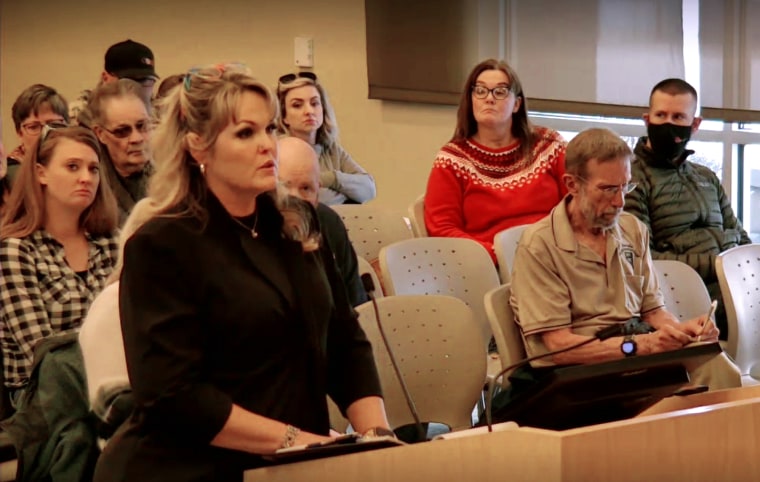
At an Elko County commission meeting in late 2021, then-transit management coordinator Abigail Wheeler pitched the grant to the board and a roomful of residents eager to air their grievances about the CDC and levy claims of federal government overreach, overspending, and corruption regarding the pandemic response.
Wheeler began by asking county commissioners to keep an open mind.
Abigail Wheeler presented a grant from the Centers for Disease Control and Prevention to the Elko County, Nev., commission last year, telling it the funding could help the town create a health department or district and give Elko more local control over public health. The commission disagreed.Elko County via Kaiser Health News
“I am very aware that this is basically the worst timing that this grant could come forward because there’s a lot of distaste over public health because of what’s happened with Covid and our whole community, our whole country, and worldwide,” she said. “We have been beat to death, the fallout of the Covid pandemic.”
Wheeler, now the grants and contracts manager for the county, began by reminding the commissioners that creating a local health department or district was a goal that predated the pandemic and the polarization it triggered.
A 2019 meeting with the state Department of Health and Human Services underscored the need for more local public health infrastructure.
“They’re thinking about things like tuberculosis and measles and restaurant inspections,” Wheeler said. “They’re not thinking about Covid. And they’re saying to themselves, ‘We can’t get to you if you had a TB case. We’re 370 miles away from Elko County.’”
Elko is like a landlocked island, Wheeler said during an interview with KHN. Though smaller in population compared with Clark or Washoe counties in Nevada, Elko spans more than 17,000 square miles, making it the fourth-largest county by area in the contiguous U.S. and the second-largest in Nevada.
“We have to be our own cavalry,” Wheeler said.
Commissioners and community members who opposed the grant said Elko didn’t need more public health resources or a health district or department. They said they were concerned about giving up local autonomy and growing bureaucracy. They also expressed mistrust of the CDC.
“You’re 100{bf0515afdcaddba073662ceb89fbb62b6b1bf123143c0e06b788e1946e8c353f} factual that the timing couldn’t be worse,” said Jon Karr, then the chairman of the commission, during the meeting. Although he said he did not buy into all the conspiracy theories about the CDC that others touted, he added that he did not think CDC officials should be trusted.
Commissioner Rex Steninger said he voted against the grant because he feared the commission would be “subservient” to the new entity. “Grants always have strings attached,” he wrote in an emailed response to questions from KHN. “We do not want the CDC tenacles [sic] reaching in to Elko County.”
Wheeler pointed to the fractured local public health system during the meeting, saying creating a health district or department could help reduce bureaucracy and give the county more control over decisions in state officials’ hands. She said it’s evident the county needs more resources, citing public health response duties she took on in her position as transit manager.
“We’re not public health experts, we’re just people who are willing to step up to the plate and take this on,” Wheeler said, referring to other county employees who helped with the public health response to Covid.
Wheeler was disappointed the county board turned down the grant opportunity, she told KHN in October. She said she would still like to see public health become a function of the county someday.
Since speaking at the meeting nearly a year ago, Hopkins said she found the mental health services she needed locally. But not everyone is as lucky as she is to find the help they need close to home, she said. The county’s decision to reject the CDC grant makes her sad, she said, but she accepts it was the commission’s decision to make.
Other local leaders saw the need for increased public health resources amid the pandemic. The Elko City Council wrote a letter of support for the CDC grant the day before the commission rejected it. “We know for sure it’s not something that the city wants to tackle by ourselves,” said Curtis Calder, city manager. “But if our regional partners want to do it as a partnership, we stand at the ready to assist where we can.”
Other rural Nevada counties have collaborated with the University of Nevada-Reno School of Medicine to create the Central Nevada Health District, serving four counties and a small city near Reno. “If we won’t step up and help ourselves and our constituents, we can’t complain when the State doesn’t provide what we need or expect,” wrote Dr. J.J. Goicoechea, a commissioner in neighboring Eureka County and the interim state veterinarian, in an emailed response to KHN.
Casalotti said there are advantages to having local health departments staffed and run by people who live in the community as opposed to a state government hundreds of miles away.
“One of the things that we’re hopeful that people can learn from the pandemic is that you don’t want to have to build the plane while flying it,” she said. “At some point, you need to take the leap because the next crisis is just around the corner.”
But polarization remains an obstacle, Castrucci said.
“This has become a holy war, this has become a war of right and wrong,” he said. “I don’t know how to get through that to a place where we are prioritizing the health of our nation.”
KHN (Kaiser Health News) is a national newsroom that produces in-depth journalism about health issues. Together with Policy Analysis and Polling, KHN is one of the three major operating programs at KFF (Kaiser Family Foundation). KFF is an endowed nonprofit organization providing information on health issues to the nation.
As covid-19 raged, roughly 4,000 highly skilled epidemiologists, interaction experts, and community overall health nurses have been hired by a nonprofit tied to the Centers for Sickness Manage and Prevention to plug the holes at battered general public overall health departments on the front traces.
But around the previous couple months, the the greater part of the CDC Foundation’s contracts for individuals general public wellbeing workers at regional and state departments have ended as the team has spent practically all of its just about $289 million in covid reduction funding. The CDC Basis, an impartial nonprofit that supports the CDC’s perform, anticipates that no extra than about 800 of its 4,000 hires will ultimately personnel these jurisdictions, spokesperson Pierce Nelson said.
That has left several neighborhood and state health and fitness departments going through staffing shortages as the nation eyes a doable winter uptick in covid situations and grapples with the ongoing risk of monkeypox, exploding caseloads of sexually transmitted infections, and other general public health and fitness issues.
The public well being workforce in the U.S. has been underfunded for a long time — just prior to the begin of the pandemic, only 28{bf0515afdcaddba073662ceb89fbb62b6b1bf123143c0e06b788e1946e8c353f} of community well being departments experienced an epidemiologist or statistician, a 2020 Related Push-KHN investigation identified. Then, immediately after the pandemic commenced, general public overall health officers left in droves as they had been lambasted for instituting covid principles, blamed for the financial downturn, and grappled with burnout.
And even if funding had been out there to retain all 4,000 basis workforce, that would not have fulfilled community well being staffing desires, in accordance to new research in the Journal of Public Overall health Management and Exercise. The study says at least 80,000 new staff are demanded for condition and neighborhood community wellbeing departments to put into action the minimum amount deal of public wellness services.
Having said that, the funding for the basis careers was constantly time-minimal due to the fact it was supposed to assistance the emergency reaction to covid. And while the American public’s covid worries have waned, public wellness specialists alert this is yet an additional example of the failure to adequately fund the general public health sector with once-a-year, guaranteed cash — leaving the region not able to protect against and effectively combat outbreaks.
“So the increase-and-the-bust cycle proceeds irrespective of dropping a million American lives to covid,” reported Brian Castrucci, who co-authored the report and heads the de Beaumont Basis, which advocates for raising assist for the nation’s community overall health. “How quite a few American deaths is it heading to get right up until we take care of this challenge?”
As opposed to the hundreds of inexperienced call tracers hired to abide by up with covid people to stem the unfold amid the surge, this CDC Foundation workforce ordinarily experienced community well being know-how that also could fill preexisting gaps. The foundation’s head, Dr. Judy Monroe, said local and state officials loved the foundation’s potential to lower as a result of selecting pink tape, telling her “it was like the cavalry showed up.”
In Chicago, CDC Basis staff members made up about as a great deal as a tenth of the city’s general public wellbeing workforce, stated Dr. Allison Arwady, commissioner of the city’s community wellbeing department. Despite the fact that she acquired 26 of people 66 workers extended into December, she claimed it’ll hurt to get rid of the rest. They’ve contributed to everything from general public health nursing to communicating the newest direction about the pandemic to Chicagoans.
Cayenne Levorse, a CDC Basis chief who served organize the foundation’s response in Ohio until eventually her deal finished in October, said her 20 workforce experienced to established down not only covid tasks but also helping community well being departments monitor most cancers clusters, rural overall health disparities, and environmental overall health difficulties.
“Those jobs are just sitting there, all that work still left unfinished,” she explained.
Five persons hired for CDC Foundation covid contracts informed KHN they were underneath the perception their contracts would most likely be extended or they would be hired by nearby or state governments acquiring a flood of covid pounds. Only one particular of them had a agreement as of Nov. 8.
Senior epidemiologist Katie Schenk, who has a doctorate in general public wellness, did covid surveillance for the CDC Basis at the Illinois and Washington, D.C., overall health departments. Both contracts ran out, and she was still left without having a work this summer season.
“How do you demonstrate that there is no funding for work in our area when there is clearly so a great deal operate to be completed?” she asked. “It’s to the detriment of the general public wellbeing procedure, which is shedding employees like there’s no tomorrow.”
Someday in November, condition and neighborhood health and fitness officers are anticipating $3 billion in covid reduction dollars qualified at buttressing the community wellbeing workforce. But that funding is coming after most of the CDC Basis contracts have expired and individuals staff have moved on with their lives.
Even though that sum is considerable and will assistance near the 80,000-employee hole, a lot of general public well being officials and industry experts pressured that the money is brief-term and slated to final 5 a long time — which can make positions more durable to fill as candidates seek out job steadiness. It also is divided among the 50 states, U.S. territories, and various large health and fitness departments. And some point out and area officials, this kind of as people in Missouri and Michigan, have refused to shell out covid dollars on community health departments amid the backlash versus the pandemic reaction.
Condition and neighborhood governments often have caps on using the services of complete-time staff members even if federal income is obtainable to do so, Monroe reported. Some localities have shell out freezes or are not willing to invest extra on health officers than on other governing administration employees, producing remarkably competent personnel these as epidemiologists more durable to use, she mentioned. And the CDC Basis salaries and advantages were being occasionally better than what is accessible at community and point out-stage work opportunities, Monroe explained. A lot of of the foundation workers could experience a shell out slash if they preferred to remain on with the community departments.
“You certainly do not go into general public wellbeing to get prosperous,” explained epidemiologist Susan Knoll, who took a personal-sector task as a overall health advisor just after doing work for the CDC Foundation in Ohio. “You get a grant-funded career. And then you’re always on the lookout for a different career.”
Which is “the actuality of how we fund general public health and fitness in this nation,” reported Chrissie Juliano, govt director of the Significant Cities Health Coalition.
“We ramp up, and we ramp down, and we do not consider about routine perform,” she said. “We ought to not as a subject be losing experienced folks who are committed to functioning in public health and fitness. All those are the persons who require to be saved.”
At the very least 38,000 public wellness careers at the point out and community degree ended up misplaced from the 2008 recession via 2019. Then covid strike, and 1 in 5 Us residents misplaced a area general public wellbeing leader amid the political backlash of the initially many years of the pandemic, a 2021 AP-KHN investigation located.
Some of the remaining workforce is eyeing the doorway. The director of North Carolina’s Granville Vance Public Well being office, Lisa Macon Harrison, claimed that even following instituting adaptable advantages, she’s viewing 15{bf0515afdcaddba073662ceb89fbb62b6b1bf123143c0e06b788e1946e8c353f} to 20{bf0515afdcaddba073662ceb89fbb62b6b1bf123143c0e06b788e1946e8c353f} turnover, which she blames on burnout.
Levorse noted that epidemiologists and other staffers with state-of-the-art levels have student loans to pay back off and worry about getting rid of well being insurance plan every time a grant operates out.
The deficiency of a constant resource of funds from yr to yr is jeopardizing health and fitness division systems, Chicago’s Arwady mentioned. She estimates the town will get rid of 86{bf0515afdcaddba073662ceb89fbb62b6b1bf123143c0e06b788e1946e8c353f} of its latest grant funding in two years, placing wastewater monitoring, some of her department’s IT personnel, and community-primarily based outreach on the attainable chopping block.
“We’re not heading to be in a position to do fifty percent a dozen factors that the city of Chicago clearly expects we need to be ready to do. Forget about ‘Can I bring vaccine to your residence?’ It is ‘Can I even stand up, like, a vaccine clinic in your neighborhood?’” she stated. “It’s that degree of how much backwards I’m worried we’re likely to slide.”
Harrison stated she’s seen this all in advance of: A flood of funding for pandemic preparedness came following 9/11, and then the income for staffing went away, leaving departments flat-footed for covid.
Castrucci, of the de Beaumont Basis, rued how the recent funding composition guarantees that the community health sector, which exists to avoid outbreaks and disease, will not be presented the staff to do so right until an crisis arrives.
“You’re mainly indicating, ‘We will wait around for the fireplace to burn right up until we employ the firefighters,’” he mentioned.
Somebody particular to just one of us just marked a large, round-numbered birthday. Adam’s fiancee, Mary, just lately turned 50.
She marked the milestone with a vacation and a party. In contrast to numerous 50th birthday celebrations, though, this 1 did not appear with the mock funereal decorations that have develop into virtually as commonplace at these gatherings as candles and cakes.
Today, these black balloons and streamers are joke-y reminders of the getting older process. But a minimal additional than a century in the past, age 50 genuinely was a time when demise came knocking.
The everyday living expectancy of a boy or girl born in the U.S. in 1900 was 47 years. That figure was partly attributable to higher charges of toddler mortality in some cities, up to 30{bf0515afdcaddba073662ceb89fbb62b6b1bf123143c0e06b788e1946e8c353f} of youngsters died just before achieving their initially birthdays. However even among those who survived, lifetime was much from a wander in the park.
Additional:Visitor column: There are measures that we, as people, can take to assure we get suitable care
With industrialization, much of the country’s inhabitants experienced shifted from rural to urban places. But infrastructure had not nonetheless caught up, so huge swaths of the inhabitants lived in overcrowded situations with inadequate or nonexistent general public h2o supplies and squander-disposal methods.
As a result, viral and bacterial health problems ran rampant. Pneumonia, tuberculosis and diarrhea had been the foremost killers of the time, with each other accounting for practically one-third of all fatalities. If you were being privileged more than enough to achieve 30, you have been center-age.
What a big difference 122 years makes.
Health-related study taught us the function that microorganisms participate in in communicable disorders. This information then served as the basis for a host of advances in general public health and fitness (sewage disposal, drinking water treatment, foodstuff security) and the remedy and prevention of sickness (prevalent vaccination, antibiotics, lots of other therapies).
Collectively, these developments have added a long time to our time on Earth. Currently, a baby born in the U.S. will get to an typical of far more than 76 decades. And a feminine who has just turned 50 (Mary) can assume to live a different 33.5 many years. For comparison’s sake, in 1900, a female who had just turned 30 could be expecting to reside yet another 35 decades.
In other words, 50 is very substantially the new 30.
With lengthened lifespans has occur a big demographic shift in our place. And as we have aged as a inhabitants, it’s opened new avenues of clinical analysis.
At the Oklahoma Healthcare Analysis Foundation, our Ageing and Metabolic rate Analysis Application has skilled its sights not on adding years to our life but, instead, daily life to the a long time we have. “We’re not wanting to make people reside eternally,” reported Dr. Holly Van Remmen, who chairs the software. With her OMRF colleagues, she’s concentrated on “keeping folks more healthy lengthier, so you’re not shelling out your very last decade or two in the doctor’s place of work.”
Their get the job done facilities on learning how current instruments — work out, medications, eating plan — can blunt the effect of getting older. That investigation is yielding some promising clues for helpful interventions. Yet, Van Remmen warns that we shouldn’t “wait for the golden tablet.”
Growing old effectively, she reported, “boils down to widespread perception.” Retain relocating. Manage your interactions with other individuals. Eat appropriate. Go to the medical doctor. If you can test those people bins, or at least most of them, you’ll stand the finest likelihood of trying to keep your head, system and spirit healthy.
Far more:Visitor column: Eradicating risks for Alzheimer’s is inside our command
Dr. Andrew Weyrich is president of the Oklahoma Medical Research Foundation, and Adam Cohen is OMRF’s senior vice president and basic counsel. They can be arrived at at speak to@omrf.org.