Children languish in emergency rooms awaiting mental health care

This story includes discussions of suicide. If you or someone you know is in crisis, you can get help from the Suicide and Crisis lifeline by calling or texting 988.


While most kids his age were wrapping up their junior year of high school, Daniel was in a box. 

“It was like I was sitting in a gigantic FedEx box being shipped somewhere,” he said. “But like, add one bed and the door had to be closed at all times.” 

Daniel’s years of mental health struggles, stretching back into his early childhood, came to a head in early 2022. His often-uncontrollable emotional outbursts became unmanageable; he was “unraveling,” his parents said. 

CBS News is only using the first names of former patients interviewed for this story to protect their privacy. 

Fearing Daniel might harm himself, his parents took him to the only place they could: the emergency room. After seven days in the ER, Daniel was discharged; hospital staff felt he was no longer in danger. His parents disagreed.  

“We were like no, no, no, he is so not ready,” his mom Kathe said. “We’ve been waiting and waiting, but he is not ready.” 

Daniel’s therapist even wrote a letter to the hospital saying he wasn’t ready to be released. But the hospital said he needed to go home.  

Ten days later, he was back in the ER — this time at another nearby hospital, where he would stay for 19 days.  

“There’s barely any room in the [hospital] room to walk around,” Daniel, now 18, said. “So I was just sitting on my bed all of the time. I had some rough times there, like it was really difficult to, like, stay put, you know, and that’s what they expected [me] to do.”

Read more: Inside America’s youth mental health crisis 

Instead of the intensive mental health care he needed, Daniel said he got very little help while in the room.  

“Dan, rightfully so, he was like, what am I doing here?” Kathe said. “This is not help. You promised help. Where’s the help?” 

“Severe shortage”

Stories similar to Daniel’s are growing more common in the U.S., fueled by a critical shortage of doctors, therapists and resources to address the needs of kids in crisis. 

In Massachusetts, the number of kids landing in ERs for mental health treatment soared 200{bf0515afdcaddba073662ceb89fbb62b6b1bf123143c0e06b788e1946e8c353f}-400{bf0515afdcaddba073662ceb89fbb62b6b1bf123143c0e06b788e1946e8c353f} during the pandemic. That same trend is reflected across the country: a 2021 study found the number of kids stuck in ERs awaiting treatment tripled between 2019 and 2021. 

“I do think it is very bad,” said Dr. Muniya Khanna, research scientist at Children’s Hospital Philadelphia and a former faculty member at the University of Pennsylvania’s Department of Psychiatry. “Suicide is now the number two leading cause of death in children 10 to 24. And this trajectory is only getting worse after the COVID pandemic. And so, we are absolutely in a crisis.” 

Experts say it’s a demand and supply issue: demand for mental health services has increased after the pandemic and the supply of trained staff hasn’t increased enough to fulfill the needs. 

Forty U.S. states and Puerto Rico all have “severe” shortages of child psychiatrists, according to data from the American Academy of Child and Adolescent Psychiatry (AACAP) analyzed by CBS News. Only the District of Columbia reported having enough child and adolescent psychiatrists to meet AACAP standards.

RELATED: Half of all Texas school districts have no mental health services 

Amid this lack of formal mental health treatment options, ERs have become the last and only option for many families, according to numerous mental health experts interviewed by CBS News.  

“Kids languish for days, weeks, sometimes even over a year in children’s hospitals around the country,” said Zach Zaslow, vice president of advocacy and community health at Children’s Hospital Colorado. “This is not just a Colorado problem, and it happens because there’s nowhere else that’s safe for them to go.” 

In Colorado, Michaela, who grew up in foster homes, told CBS News she tried get a special therapist to address her anger, anxiety and depression nearly a dozen times. 

“I would be crying out for help,” Michaela said. “I would say I need support. And it wouldn’t happen until I came to a point where it was too late to really come back and not make a bad decision that in the end would hurt me.” 

Michaela said she tried to hurt herself, including several suicide attempts, over those years. She said the system in its current form does not do enough for young people until they reach a crisis point. 

“I think it’s really hard to get into a good therapist or just a therapist in general,” Michaela said. “It doesn’t matter if they’re good or bad.”  

Michaela said she had a total of eight ER visits for mental health crises, and often left the ER without seeing a therapist. The few times she did meet with a mental health expert, she said her therapy was cut short. 

“It did cause me to have to go back [to the ER] again like less than a year later just because I didn’t get the help that I needed,” said Michaela. “And I think it was partly because I left too early.”  

Michaela, who is now 20, said she is proud that she’s “beat the odds” and survived. She now sits on a youth advisory board as part of a partnership between the University of Colorado and Children’s Hospital Colorado. 

“It definitely made me feel like all of that pain and suffering that I had to go through wasn’t a waste,” said Michaela. “Because now I can be the voice of power for so many other young people who are stuck in the same situation that I was and give them hope that I didn’t have then.” 

A revolving door at ERs

Experts told CBS News the use of ERs as stopgap mental health treatment measures simply doesn’t work.  

“For anybody who’s been in an emergency department for more than a few hours, it is not an ideal place to be,” said Dr. Kevin Carney, an emergency room physician at Children’s Hospital Colorado.   

Massachusetts General Hospital in Boston, where Daniel stayed for 19 days, acknowledged the problem, saying in a statement to CBS News that “shortages [of proper mental health treatment options] have forced youth in crisis — and their families — to turn to their local emergency departments where ongoing capacity challenges may mean waiting for days or weeks for appropriate inpatient care to become available.” 

For kids in crisis, ER visits can make matters even worse.  

A December 2022 American Academy of Pediatrics study found more than a quarter of children who went to ERs for mental health issues were hospitalized — either in ERs or in mental health facilities — within six months. And about 26.5{bf0515afdcaddba073662ceb89fbb62b6b1bf123143c0e06b788e1946e8c353f} were back in the ER within a week.  

Dr. Sandra DeJong, a psychiatrist and the secretary with the American Psychiatric Association, said if kids don’t get proper care early, their condition can rapidly get worse. 

“My fear is that we really have significant risk for the future,” DeJong said. “Because if we don’t address the needs of particularly young people now, then they are going to grow up to be people who are diminished and don’t have the capacity to function in the way that they could have if they had gotten the treatment.  

“And frankly, they’re going to be expensive to care for because if they go untreated, there are situations that are likely to get worse and then they will need higher intensity care. It’s just not an effective way to approach the problem.” 

Meanwhile, more and more kids find themselves in crisis. Suicide attempts by teen girls jumped more than 51{bf0515afdcaddba073662ceb89fbb62b6b1bf123143c0e06b788e1946e8c353f} between 2019 and 2021, according to a study by the CDC. And a recent study published in the journal JAMA Pediatrics found the number of suicide attempts by overdose reported to poison control centers more than doubled between 2000 and 2020.

The number of kids with mental health issues coming to the ER “has been unrelenting,” said Zaslow.  

“And it’s not acceptable,” he added. “It means ultimately, at the end of the day, that there are kids waiting for those beds every single minute as soon as one frees up.”   

Dr. Taylor Louden, medical director at Cook Children’s Medical Center in Fort Worth, Texas, said that in recent years he’s seen more and more young patients come into his ER for mental health problems. 

“We are seeing even younger and younger kids, 8-, 9-year-olds — ages of my kids,” said Louden. “Some are expressing that they want to hurt themselves that they want to die and it’s really tough to hear.” 

Not only are there more kids showing up in ERs, Louden said, but they’re staying longer, too.  

“No one should ever be in an ER longer than a few hours,” he said. “That means that the system is broken, in my mind.” 


Inside an ER’s psych room

04:04

“It’s not acceptable” 

Numerous experts CBS News interviewed said serious investments are needed to increase the mental health resources available to kids in crisis.  

CBS News went to the person in charge of the system in the U.S.: Health and Human Services Secretary Xavier Becerra, who said “we have to do a lot” to fix the problem. 

“It wasn’t until recently that you could get an insurer who actually gave you access to mental health services,” Becerra said. “And we still have a system where mental health is what you get at a primary care physician when you go to a family doctor.  

“That’s got to change. Mental health, it’s got to be part of primary health, not something where you get a referral to a specialist.”  

When asked about children getting stuck in ERs rather than proper mental health treatment facilities, Becerra said it was “not acceptable.” 

“It’s not care,” Becerra said. “It’s housing them until we can get somebody who could give them professional help. They’re crying out and shame on us that we haven’t prepared.”  

Becerra pointed out that several states and the federal government are investing billions of dollars into mental health care. And last summer, the Biden White House announced $300 million to expand mental health services in schools. 

“That’s where the president last year in the State of the Union and again, double down this year has said, Congress, we’ve got to step up, we’ve got to finish the job of making sure that mental health is treated like any other aspect of health,” Becerra said.  

But doctors Khanna and DeJong both said much of this federal spending comes in the form of one-time grants that will eventually expire.  

“Now it’s really time to start investing time and resources on all levels for making that happen more on a regular basis,” said Khanna. 

Attracting more people to work in youth mental health must be part of the equation, DeJong said.  

“You can build all the beds and clinics in the world,” DeJong said. “But if you don’t have enough people to staff them, which is a real problem right now, we’re not going to meet the needs that we’re facing.”   

Secretary Becerra agreed.  

“You just got to put your money where your mouth is. And President Joe Biden is trying to put his money there,” Becerra said. “We need now the partnership with Congress to make it happen.”  


HHS Secretary Xavier Becerra speaks about youth mental health crisis

06:53

Some aren’t waiting on the federal government to help, instead trying new approaches in attempts to address this crisis and meet young people where they are.   

One of those approaches comes in the form of a youth advisory group at Children’s Hospital Colorado. The advisory group consists of teenagers who regularly meet to give advice to therapists and hospital officials about how to meet the needs of young people. 

Another new approach: construction of a new, first-of-its-kind facility at the Cherry Creek School District outside Denver that will combine a mental health medical facility and a school when it’s completed in the fall of 2023.  

When kids in crisis leave ERs 

Finding help after a hospital stay can be even more challenging. 

The Academy of Pediatrics study found just 31.2{bf0515afdcaddba073662ceb89fbb62b6b1bf123143c0e06b788e1946e8c353f} of children had a mental health follow-up visit within seven days of leaving the hospital and only about half had a mental health follow-up with a specialist within 30 days of leaving the hospital. 

“I think what is very distressing about this mental health crisis that we’re facing is that while we very much take as part of our responsibility to make sure that we are keeping kids safe and stabilizing them when they’re in crisis or have harmed themselves,” Dr. Carney said. “The very hard thing is knowing that at that point I can’t do anything else for that child.” 

Dr. Glenda Wrenn Gordon knows those statistics firsthand: she and her 18-year-old son lived them.  

Wrenn Gordon said even though she’s an Atlanta-area psychiatrist herself, she was surprised by the effort she had to put in to find help for her son in crisis after she got him to the ER. She said she thought she knew what to do, but still found the system of finding and getting care post-hospital visit to be daunting. 

“We moved very quickly through the ER because I knew exactly what to say and how to say it to get us where we needed to go,” she said. “I was extremely frustrated for how hard it was. I was thinking about these other families. What hope do they have and what it must be like?”  

When asked what she fears most if the system is not changed, Wrenn Gordon was blunt. 

“We will continue to bury our children,” she said. 


Atlanta psychiatrist struggles to find help for her son

02:56

If you or someone you know is in crisis, get help from the Suicide and Crisis Lifeline by calling or texting 988. 

In addition, help is available from the National Alliance on Mental Illness, or NAMI. Call the NAMI Helpline at 800-950-6264 or text “HelpLine” to 62640. There are more than 600 local NAMI organizations and affiliates across the country, many of which offer free support and education programs. 

Doctors Are Disappearing From Emergency Rooms as Hospitals Look to Cut Costs

Pregnant and scared, Natasha Valle went to a Tennova Healthcare hospital in Clarksville, Tennessee, in January 2021 because she was bleeding. She did not know substantially about miscarriage, but this seemed like one particular.

In the unexpected emergency space, she was examined then sent dwelling, she claimed. She went again when her cramping became excruciating. Then dwelling yet again. It finally took 3 visits to the ER on three consecutive days, creating 3 independent bills, before she noticed a physician who seemed at her bloodwork and confirmed her fears.

“At the time I was not considering, ‘Oh, I require to see a medical doctor,’” Valle recalled. “But when you consider about it, it is like, ‘Well — dang — why didn’t I see a physician?’” It’s unclear no matter whether the repeat visits were due to delays in viewing a medical doctor, but the knowledge apprehensive her. And she’s still paying the bills.

The medical center declined to explore Valle’s treatment, citing affected individual privacy. But 17 months just before her three-working day ordeal, Tennova had outsourced its unexpected emergency rooms to American Physician Partners, a clinical staffing business owned by non-public fairness traders. Application employs less doctors in its ERs as one of its value-conserving initiatives to increase earnings, according to a private business document attained by KHN and NPR.

This staffing tactic has permeated hospitals, and particularly crisis rooms, that find to lessen their prime expense: medical doctor labor. Even though diagnosing and managing people was at the time their area, medical doctors are significantly currently being replaced by nurse practitioners and health practitioner assistants, collectively recognised as “midlevel practitioners,” who can accomplish lots of of the identical duties and produce substantially of the exact same revenue for significantly less than 50 percent of the pay back.

“APP has a lot of expense preserving initiatives underway as aspect of the Company’s continuous concentration on cost optimization,” the document states, which include a “shift of staffing” involving medical professionals and midlevel practitioners.

In a assertion to KHN, American Medical professional Companions claimed this approach is a way to ensure all ERs continue to be fully staffed, calling it a “blended model” that lets physicians, nurse practitioners and doctor assistants “to deliver care to their fullest opportunity.”

Critics of this approach say the quest to conserve revenue outcomes in therapy meted out by somebody with considerably considerably less coaching than a health practitioner, leaving clients vulnerable to misdiagnoses, increased professional medical expenses, and insufficient care. And these fears are bolstered by evidence that suggests dropping doctors from ERs may possibly not be great for patients.

A performing paper, posted in Oct by the Nationwide Bureau of Economic Research, analyzed roughly 1.1 million visits to 44 ERs throughout the Veterans Health Administration, wherever nurse practitioners can address clients without the need of oversight from doctors.

Scientists identified that cure by a nurse practitioner resulted on common in a 7{bf0515afdcaddba073662ceb89fbb62b6b1bf123143c0e06b788e1946e8c353f} boost in charge of care and an 11{bf0515afdcaddba073662ceb89fbb62b6b1bf123143c0e06b788e1946e8c353f} raise in size of remain, extending patients’ time in the ER by minutes for slight visits and hrs for more time ones. These gaps widened among the patients with much more severe diagnoses, the study explained, but could be considerably mitigated by nurse practitioners with additional experience.

The study also uncovered that ER patients treated by a nurse practitioner ended up 20{bf0515afdcaddba073662ceb89fbb62b6b1bf123143c0e06b788e1946e8c353f} much more likely to be readmitted to the clinic for a preventable explanation in 30 times, though the general hazard of readmission remained quite small.

Yiqun Chen, who is an assistant professor of economics at the University of Illinois-Chicago and co-authored the examine, explained these results are not an indictment of nurse practitioners in the ER. As a substitute, she reported, she hopes the analyze will manual how to most effective deploy nurse practitioners: in cure of more simple individuals or circumstances when no physician is offered.

“It’s not just a uncomplicated query of if we can substitute physicians with nurse practitioners or not,” Chen explained. “It is dependent on how we use them. If we just use them as impartial vendors, specially … for reasonably challenging patients, it does not seem to be a incredibly good use.”

Chen’s study echoes lesser experiments, like a person from The Harvey L. Neiman Well being Plan Institute that uncovered nonphysician practitioners in ERs ended up connected with a 5.3{bf0515afdcaddba073662ceb89fbb62b6b1bf123143c0e06b788e1946e8c353f} improve in imaging, which could unnecessarily improve charges for sufferers. Separately, a study at the Hattiesburg Clinic in Mississippi located that midlevel practitioners in key care — not in the emergency department — amplified the out-of-pocket fees to individuals while also foremost to even worse efficiency on 9 of 10 good quality-of-care metrics, which include most cancers screenings and vaccination premiums.

But definitive proof stays elusive that replacing ER medical professionals with nonphysicians has a unfavorable impression on sufferers, explained Dr. Cameron Gettel, an assistant professor of emergency medication at Yale. Non-public fairness financial commitment and the use of midlevel practitioners rose in lockstep in the ER, Gettel explained, and in the absence of match-modifying analysis, the sample will possible continue on.

“Worse patient results haven’t really been shown throughout the board,” he claimed. “And I believe till that is demonstrated, then they will keep on to enjoy an raising part.”

For Non-public Equity, Dropping ER Docs Is a ‘Simple Equation’

Personal equity organizations pool cash from rich buyers to get their way into numerous industries, typically slashing investing and looking for to flip enterprises in 3 to seven many years. Whilst this organization model is a established moneymaker on Wall Street, it raises fears in health and fitness treatment, in which critics fret the strain to flip large income will affect everyday living-or-loss of life choices that had been when still left solely to professional medical professionals.

Nearly $1 trillion in personal fairness cash have gone into just about 8,000 wellbeing care transactions more than the previous decade, in accordance to field tracker PitchBook, together with getting into healthcare staffing businesses that lots of hospitals use to take care of their crisis departments.

Two firms dominate the ER staffing marketplace: TeamHealth, bought by private fairness agency Blackstone in 2016, and Envision Healthcare, acquired by KKR in 2018. Trying to undercut these staffing giants is American Medical professional Partners, a fast expanding company that runs ERs in at least 17 states and is 50{bf0515afdcaddba073662ceb89fbb62b6b1bf123143c0e06b788e1946e8c353f} owned by personal fairness agency BBH Cash Companions.

Doctors Are Disappearing From Emergency Rooms as Hospitals Look to Cut Costs
At a two-working day business education put on by American Health practitioner Companions in 2020, main health care officer Dr. Tony Briningstool teaches medical professionals and nurse practitioners how to securely use sedation in the crisis division. As a funds-conserving technique, unexpected emergency rooms are using much less medical doctors and relying in its place on midlevel practitioners. (Blake Farmer for KHN)

These staffing providers have been among the most aggressive in changing medical doctors to slash prices, stated Dr. Robert McNamara, a founder of the American Academy of Emergency Drugs and chair of unexpected emergency medication at Temple University.

“It’s a fairly very simple equation,” McNamara claimed. “Their No. 1 expense is the board-qualified crisis physician. So they are likely to want to hold that cost as very low as possible.”

Not every person sees the trend of private fairness in ER staffing in a damaging light-weight. Jennifer Orozco, president of the American Academy of Medical doctor Associates, which signifies doctor assistants, stated even if the alter — to use a lot more nonphysician providers — is driven by the staffing firms’ wish to make additional revenue, sufferers are even now very well served by a team technique that features nurse practitioners and physician assistants.

“Though I see that change, it is not about revenue at the close of the day,” Orozco claimed. “It’s about the client.”

The “shift” is approximately invisible to patients for the reason that hospitals seldom advertise branding from their ER staffing companies and there is tiny community documentation of private fairness investments.

Dr. Arthur Smolensky, a Tennessee unexpected emergency medicine specialist attempting to evaluate private equity’s intrusion into ERs, stated his overview of healthcare facility work postings and employment contracts in 14 major metropolitan parts discovered that 43{bf0515afdcaddba073662ceb89fbb62b6b1bf123143c0e06b788e1946e8c353f} of ER sufferers have been seen in ERs staffed by businesses with nonphysician proprietors, just about all of whom are personal equity traders.

Smolensky hopes to publish his full examine, expanding to 55 metro locations, later this year. But this study will just quantify what a lot of medical doctors previously know: The ER has transformed. Demoralized by an greater target on profit, and cautious of a looming surplus of unexpected emergency drugs inhabitants because there are less careers to fill, a lot of experienced doctors are leaving the ER on their personal, he reported.

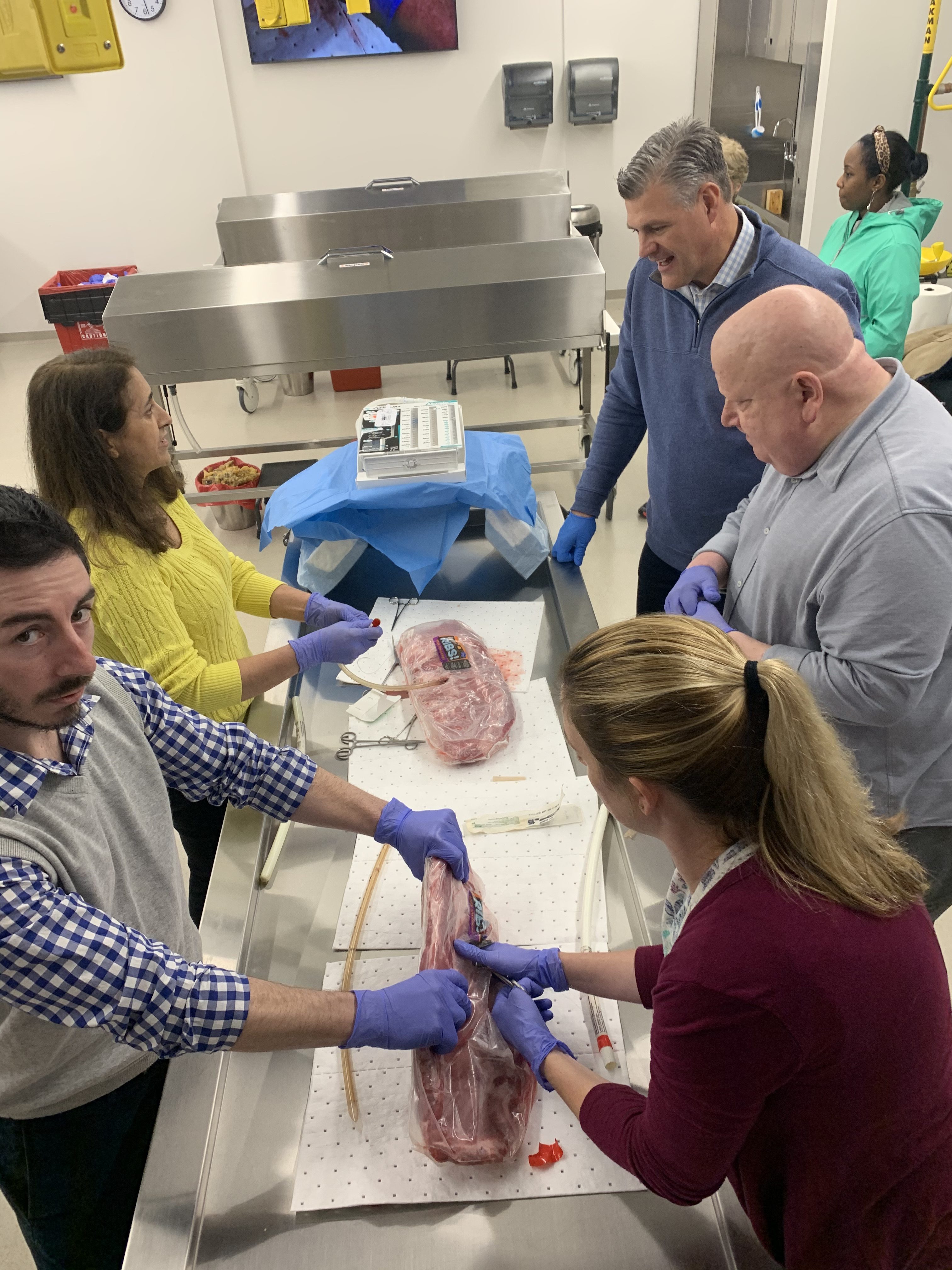
In a lab at Lipscomb University in 2020, nurse practitioners join health professionals in practising how to location a chest tube to correct a collapsed lung by snaking a rubber hose by a rack of pork ribs. The NPs, who function for American Physician Partners, will have to execute the procedure below a doctor’s supervision in advance of remaining allowed to do it on their very own. (Blake Farmer for KHN)

“Most of us didn’t go into medication to supervise an army of men and women that are not as very well skilled as we are,” Smolensky mentioned. “We want to take treatment of patients.”

‘I Guess We’re the Initially Guinea Pigs for Our ER’

Joshua Allen, a nurse practitioner at a modest Kentucky healthcare facility, snaked a rubber hose via a rack of pork ribs to follow inserting a upper body tube to take care of a collapsed lung.

It was 2020, and American Health practitioner Companions was restructuring the ER wherever Allen worked, lowering shifts from two medical professionals to just one. Once Allen had put 10 tubes beneath a doctor’s supervision, he would be allowed to do it on his have.

“I guess we’re the initial guinea pigs for our ER,” he stated. “If we do have a important trauma and numerous victims arrive in, there’s only a single medical professional there. … We need to be organized.”

Allen is a single of many midlevel practitioners discovering perform in crisis departments. Nurse practitioners and health practitioner assistants are among the the fastest-escalating occupations in the country, according to the U.S. Bureau of Labor Studies.

Usually, they have master’s degrees and get various a long time of specialized education but have drastically much less schooling than doctors. Several are permitted to diagnose sufferers and prescribe medication with minor or no supervision from a doctor, even though constraints range by condition.

The Neiman Institute found that the share of ER visits in which a midlevel practitioner was the primary clinician amplified by much more than 172{bf0515afdcaddba073662ceb89fbb62b6b1bf123143c0e06b788e1946e8c353f} concerning 2005 and 2020. A different examine, in the Journal of Unexpected emergency Drugs, reported that if trends keep on there may be equal quantities of midlevel practitioners and physicians in ERs by 2030.

There is tiny secret as to why. Federal info demonstrates unexpected emergency medicine physicians are compensated about $310,000 a calendar year on typical, while nurse practitioners and health practitioner assistants make less than $120,000. Commonly, hospitals can bill for treatment by a midlevel practitioner at 85{bf0515afdcaddba073662ceb89fbb62b6b1bf123143c0e06b788e1946e8c353f} the rate of a health care provider although paying out them considerably less than half as a lot.

Non-public fairness can make hundreds of thousands in the hole.

For example, Visualize after encouraged ERs to make use of “the the very least expensive resource” and address up to 35{bf0515afdcaddba073662ceb89fbb62b6b1bf123143c0e06b788e1946e8c353f} of patients with midlevel practitioners, according to a 2017 PowerPoint presentation. The presentation drew scorn on social media and disappeared from Envision’s web-site.

Visualize declined a request for a telephone interview. In a composed statement to KHN, spokesperson Aliese Polk mentioned the organization does not direct its health practitioner leaders on how to treatment for clients and called the presentation a “concept guide” that does not represent current sights.

American Medical professional Companions touted roughly the exact same staffing system in 2021 in reaction to the No Surprises Act, which threatened the company’s income by outlawing shock clinical expenses. In its private pitch to loan providers, the enterprise approximated it could cut pretty much $6 million by shifting a lot more staffing from medical professionals to midlevel practitioners.

Relevant Matters

Get in touch with Us

Post a Tale Idea