A health insurance alternative left a pastor with a big hospital bill : Shots

A health insurance alternative left a pastor with a big hospital bill : Shots

Jeff and Kareen King received a hospital bill for $160,000 a few weeks after Jeff had a procedure to restore his heart rhythm.

Bram Sable-Smith/KHN


hide caption

toggle caption

Bram Sable-Smith/KHN


Jeff and Kareen King received a hospital bill for $160,000 a few weeks after Jeff had a procedure to restore his heart rhythm.

Bram Sable-Smith/KHN

Kareen King calls it “the ultimate paradox”: The hospital that saved her husband Jeff’s heart also broke it.

What Happened Jeff King, of Lawrence, Kan., needed his heart rhythm restored to normal with a procedure called an ablation — sooner rather than later, his doctor said. Jeff asked the hospital for a cost estimate, but said he didn’t hear back before his scheduled surgery in January 2021 at Stormont Vail Health in Topeka, Kan.

The real pain came when the bill arrived in the mail a few weeks later. The Kings, who were uninsured at the time, were on the hook for nearly all of the cost.

Jeff King, 63, Lawrence, Kan.

Approximate Medical Debt: $160,000

Medical Issue: Heart ablation

Jeff and Kareen King received the bill for $160,000 a few weeks after Jeff had the procedure to restore his heart rhythm. The Kings were initially on the hook for almost all of it.

Instead of signing up for traditional health insurance, the Kings had joined what’s called a “medical cost-sharing plan” with a company called Sedera, which describes its service as a “refreshing non-insurance approach to managing large and unexpected health care costs.” With this alternative to health insurance, members agree to share one another’s expenses. The plans are often faith-based and have surged in popularity in recent years because they can be cheaper than traditional insurance — the Kings said their plan cost $534 a month, plus an additional $118 a month to join a direct primary care medical practice.

But the sharing plans offer fewer protections than insurance and come with provisos. The Kings said their plan did not fully cover preexisting conditions like Jeff’s heart condition for the first two years of coverage — and he needed the surgery after 16 months.

In a statement a Sedera spokesperson said it’s important that members understand the cost-sharing model and membership guidelines. “Sedera members read and agree to these prior to joining,” the statement read.

The Kings have dabbled in all sorts of health coverage in their 42 years of marriage. Jeff’s work as an evangelical pastor in his hometown of Osage City, Kan., almost never provided insurance for the couple or their five children, all of whom are now grown. The exception came during Jeff’s most recent stint leading a congregation, starting in 2015. Kareen remembered feeling “unworthy” of the $1,800 a month the congregation paid for their insurance.

“We certainly had never come up with those kinds of premiums ourselves,” she recalled.

But Jeff decided he had to leave that job in 2018. He said he felt forced out over differences with some of his congregants on eternal damnation (“As a loving parent, I could never punish my child forever”) and gay marriage (“Maybe God is a whole lot more inclusive than we are”).

After Jeff resigned, the Kings briefly bought insurance through the Affordable Care Act marketplace, but later dropped it because they weren’t eligible for subsidies and felt they couldn’t afford it.

That’s when they joined the Sedera plan. They knew the preexisting condition clause was a gamble, but medication had managed Jeff’s heart condition for years, and they didn’t expect he’d need medical procedures to address it.

What’s Broken: Without employer-sponsored insurance or federal subsidies to help fund their coverage, the Kings felt priced out of traditional insurance. But being uninsured left them exposed to hospital charges that ordinary patients typically never see.

Hospital charges are generally understood by health economists to bear little resemblance to the actual prices that are typically paid. Instead, they are more of an opening salvo in the high-stakes negotiations between hospitals trying to get as much money as they can for providing care and insurance companies trying to pay as little as possible.

But patients lack the bargaining power of large insurers, which may cover hundreds of thousands of patients in any given hospital’s catchment area. For patients like Jeff, the main recourse is to go through a hospital’s financial assistance program, although even with that help many patients can’t afford the bills hospitals send them.

Stormont Vail’s assistance program eventually knocked about $107,000 off Jeff’s original bill a few months later. Sedera provided a negotiator to help him haggle over costs.

Stormont Vail provided $19.5 million in financial assistance in tax year 2020 and wrote off about $13 million in bad debt, according to tax filings. Its net revenue from patient services was $838.7 million.

Bill Lane, a Stormont Vail administrator, said that in addition to providing financial assistance, the hospital works with patients facing high bills and offers payment plans with zero interest. Payments are often in the range of 10{bf0515afdcaddba073662ceb89fbb62b6b1bf123143c0e06b788e1946e8c353f} of a person’s monthly income,” Lane said. For some patients the hospital has a “catastrophic discount” program that caps their balance at 30{bf0515afdcaddba073662ceb89fbb62b6b1bf123143c0e06b788e1946e8c353f} of their gross household income. The hospital also works with a local bank to provide loans to patients to pay their bills. And the hospital sometimes sends patient balances to debt collection agencies.

Lane said he generally recommends that patients carry traditional insurance. He also said the hospital offers a “patient estimates module” and suggests patients wait to schedule surgery, if possible, if they want an estimate “to make an informed decision.”

What’s Left: Despite Sedera’s two-year waiting period to cover preexisting conditions, the plan did give Jeff $15,000 to help with his bills. After Jeff paid that to the hospital and then negotiated for several months, his final balance was reduced to $37,859.34 in November 2021.

For his payment plan, Jeff said he was told the hospital would accept no less than $500 per month — the equivalent of an additional mortgage payment for the Kings. Jeff estimates it will take the family more than six years to pay it off.

“I never expected this to not cost me anything,” Jeff said, “but I wasn’t expecting what it turned out to be either.”

The Kings are piecing together the funds to pay what they owe the hospital. A few months after Jeff’s ablation, they sold their home in Osage City — where they raised five children and where Jeff grew up — and bought a smaller house in Lawrence. They had hoped to use that money to build their retirement account, since Jeff’s decades of pastoral work didn’t include a pension or 401(k).

Instead, the home sale is helping pay Jeff’s medical debt. Kareen has part-time jobs, and the couple leveraged their life insurance policy, as well.

Jeff began work as a hospice chaplain — for the extra income, but especially to qualify the couple for health insurance. That meant less time for his passion project, running a nonprofit called Transmuto through which he provides spiritual guidance.

In February, Kareen checked again on whether the couple could afford Affordable Care Act insurance so Jeff could get back to Transmuto full time. Her Google searches for the federal government’s health insurance marketplace (HealthCare.gov) instead unwittingly landed her on websites that sell consumer information to insurance brokers. Speaking to one of those brokers on the phone, she bought what she said she was told was an Aetna plan. But it turned out to be a membership in a cost-sharing plan with a company called Jericho Share, which has received over 160 complaints on the Better Business Bureau website in the past year.

Jericho Share spokesperson Mark Hubbard said in a statement that the organization is “issuing full refunds when there is consumer confusion” and is continuing to “evaluate and update our marketing efforts to increase transparency and awareness.”

Hubbard also said Jericho Share is cooperating with regulators in California and New Hampshire that have questioned whether the organization meets state requirements of a health care sharing ministry. California is also questioning whether Jericho Share has indeed received 501(c)(3) nonprofit status from the IRS.

After canceling that plan and getting their money back, the Kings eventually did sign up for an ACA marketplace plan. Jeff has reduced his hours as a chaplain, freeing up more time for Transmuto. All in all, the couple feels pretty fortunate.

“It’s just so tragic the way our system is,” Jeff said. “It puts so many people into impossible financial straits.

KHN (Kaiser Health News) is a national, editorially independent program of KFF (Kaiser Family Foundation).

Goals for a healthy 2023? Keep them low-key and sustainable : Shots

Goals for a healthy 2023? Keep them low-key and sustainable : Shots
Sometimes the best new year's resolution is quiet time and self care.

It’s 2023, and after the last couple years we’ve all had on this planet, a lot of people are not in the mood for goal-setting. In fact, for many of us, maybe the best advice right now is to just lean back and get better at doing nothing. (Seriously, this is NPR giving you permission to relax. It’s for your own good.)

Still, if you find yourself taking stock of your life and health and looking for ideas to reset, science has your back. Here are a handful of evidence-based suggestions from NPR’s recent health reporting that could help you refresh body and mind.

The best part? These ideas are less about will power and more about finding new motivation for self care. Here’s to feeling better with less self-judgment this year!

1) Set healthy boundaries to protect your energy

In a nod to Shonda Rhimes’ 2016 bestseller Year of Yes, podcast host and Broadway producer Zach Stafford is declaring 2023 his “year of maybe.”

“It is exhausting to say yes to every single thing,” Stafford said on his podcast Vibe Check. “I want to be intentional about everything I do, whether it’s a work project or just getting drinks with someone.”

Many of us could benefit from setting boundaries around how we spend our time and energy, but we often worry about how other people might feel if we say “no thanks.”

Therapist Nedra Glover Tawwab, author of Set Boundaries, Find Peace – talked to NPR’s Life Kit team about navigating this tricky territory. Her tips include:

  • Check for signs, such as a surge in anxiety, that indicate you might need a boundary. 
  • If a friend wants to connect and you’re not in the right headspace, say that and call them back later.
  • Say no to requests that you don’t actually have the time or energy to fulfill.

Maybe 2023 is the year you start teaching others how to treat you.

Food journalist Barry Estabrook did the research and learned that most diets don’t really work in the long term for most people.

Michele Abercrombie/NPR


hide caption

toggle caption

Michele Abercrombie/NPR


Food journalist Barry Estabrook did the research and learned that most diets don’t really work in the long term for most people.

Michele Abercrombie/NPR

2) Skip the fad diet and forge your own path

Every year, there are an abundance of memberships, apps, cookbooks and smoothies available to help us lose weight or get healthier. But do these things work?

After his doctor “read him the riot act” over his high blood pressure and cholesterol, investigative food journalist Barry Estabrook dove into the diet world. He pored over nutrition studies, interviewed weight-loss gurus, and dug into the history of American dieting. He tried a dozen diets over three years and ended up sticking to none.

Estabrook documented his food journey in a book called Just Eat: One Reporter’s Quest for a Weight-Loss Regimen That Works. He eventually lost some weight without gaining it back – after he tuned in to his own particular habits and preferences. He shared some of his takeaways with NPR, such as:

  • Be realistic about your lifestyle. Do you have the time to chop lots of vegetables, or bake bread from scratch? Try changes that don’t require a massive overhaul. 
  • “Lead” your diet instead of following one. Observe how you eat normally and identify a few areas you could adjust.  Estabrook realized he took in a lot of calories through drinking alcohol, so he cut back.
  • Watch what you habitually chow down on. Estabrook noticed he was eating three or four bags of calorie-dense potato chips a week, just because they came with his sandwich.

Learn more about Estabrook’s misadventures, and the ways most diets fail us. And if his approach sounds like too much work, explore how intuitive eating lets you eat exactly what feels right to you.

3) Go ahead, have a little fun

Playing with Legos, roller skating, watching horror films … whatever you’re into, make more time for it in 2023. Last year when NPR asked some of our journalists to write about their hobbies, passions and pursuits, what came out is that these things can be empowering, perspective-shifting and just plain delightful.

Roller skating can bring joy.

Daniel Limpi/Getty Images/EyeEm

Kia Miakka Natisse is the co-host of NPR’s Invisibilia wrote about the liberating pleasure of taking up roller skating as an adult: “I have thrown myself into this hobby wholeheartedly, in a way that surprises me sometimes. It feels a lot like love,” she wrote. And that held true even when she kept falling. “As an adult, I’m not used to feeling that awkward in my body. I got real familiar with picking myself off the floor.”

Be inspired by Kia, or by Meredith Rizzo who discovered that fossil hunting helped stress melt away and put her into a flow state. Find your own thing this year that you do for no other reason besides fun. Because, as NPR reported, taking time for moments of joy can help rewire our brains to be more attuned to positive feelings and give us more of them.

Read more of our I’m really into series and then get out there and so something fun of your own.

4) Get off your butt, with a friend

At a line dancing social event held in Washington D.C., dancers showed off their moves set to hip-hop and R&B music.

Meredith Rizzo/NPR


hide caption

toggle caption

Meredith Rizzo/NPR


At a line dancing social event held in Washington D.C., dancers showed off their moves set to hip-hop and R&B music.

Meredith Rizzo/NPR

Two tough realities about adulthood: It gets harder to make new friends, and to find time for exercise. If you’re like us, you might have joined a handful of day trips with hiking groups looking for company on the trail. But you also may have passed up the opportunity, worrying: Will the pace be too fast or the trail too steep? Will there be anyone my age in the group?

For Black Americans interested in spending time outdoors, those concerns can extend to, “Will there be anyone else who looks like me on the trail?” or “Am I going to have to deal with racism while trying to enjoy nature?” Jessica Newton founded Black Girls Hike, now called Vibe Tribe Adventures, to share the benefits of stress relief and camaraderie with other Black women. As NPR reported, her group and others like it are helping people of color “fit in” out-of-doors.

She’s onto something. Finding a squad – or even just one good friend – can make it easier to get active. It makes it less about will power and more about fun and bonding. Here are a few other ideas to find social connection while getting sweaty:

5) Start a podcast habit

Tuning in to a podcast that makes you happy can be a great way to practice some mellow me-time. Even if you’re a loyal public radio listener, it feels good to take breaks from the news, and tune in to something a little more personal.

Take for instance, NPR’s Life Kit, a podcast based around the belief that everyone needs a little help being human. Episodes run the gamut, from how to use spices to punch up a meat-free meal, to how host a successful theme party, to how to talk to someone who is considering suicide. And they’re all based on interviews with experts, and about 15 to 20 minutes long.

Don’t miss Life Kit’s New Years resolution planner, with 40+ tips and ideas. Listen to the show and subscribe on the NPR One App, or wherever podcasts are found.

Want to try something a little different? Peruse these fifteen binge-worthy podcasts from across the NPR Network.

Youth ambassadors train for a future in public health : Shots

Youth ambassadors train for a future in public health : Shots

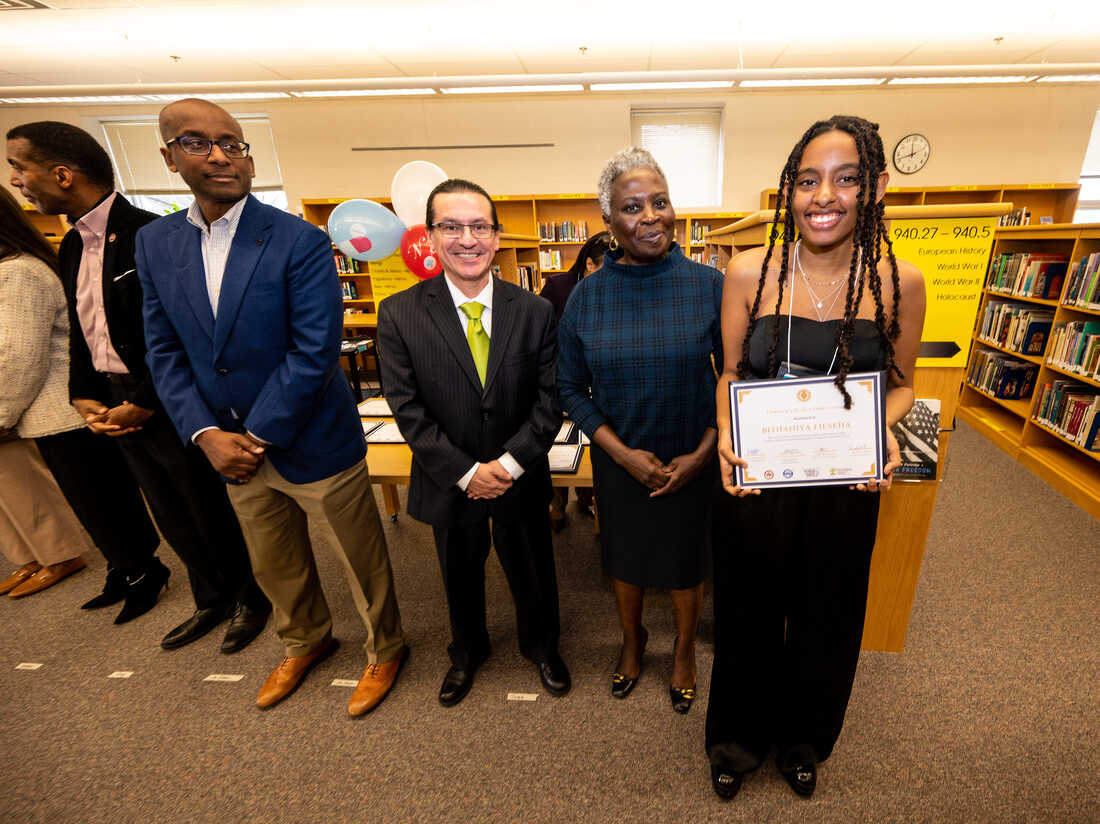
Bithaniya Fieseha, a high school senior, graduates from the Youth Public Health Ambassador program run by the Fairfax County Health Department at West Springfield High School in Fairfax County, Va.

Will Schermerhorn/Fairfax County Health Department


hide caption

toggle caption

Will Schermerhorn/Fairfax County Health Department


Bithaniya Fieseha, a high school senior, graduates from the Youth Public Health Ambassador program run by the Fairfax County Health Department at West Springfield High School in Fairfax County, Va.

Will Schermerhorn/Fairfax County Health Department

Of all the things she could have done on her summer vacation, Bithaniya Fieseha, a senior at West Springfield High School in Fairfax County, Va., decided to study chronic disease, mental health and contact tracing. Some of her friends didn’t understand the appeal.

“I feel like people are like, ‘You wasted your summer,’ ” she says. “But I enjoyed it. I really enjoyed meeting up with everyone, going through the struggle.”

She practiced taking temperatures, weight and blood pressure readings on her family. Fieseha topped it off with an internship at a local health clinic.

Her hard work paid off. On a recent Saturday morning, Fieseha became one of 14 high school students to graduate from the Youth Public Health Ambassador program run by the Fairfax County Health Department. It trains teenagers from underserved communities to become health workers and prepares them for potential careers in public health. The coursework was designed by the Morehouse School of Medicine.

“I think this program gives us a voice because, as minorities, we’re able to see those disparities” in our own surroundings, says Nayla Bonilla, a junior at Justice High School, “I saw that there were so many different avenues into medicine and things we can do in the future that can help our communities thrive.”

The training aims to help shore up the public health workforce, which is in bad shape as the COVID-19 pandemic enters its fourth year. A wave of retirements is expected to further strain health departments over the next few years.

“We need to not only attract people into the fields of healthcare and public health, but we need to attract people of color,” says Dr. Gloria Addo-Ayensu, director of the Fairfax County Health Department, “We need people from our Black and Brown communities to engage in the field so they are able to explain to their communities what health is all about.”

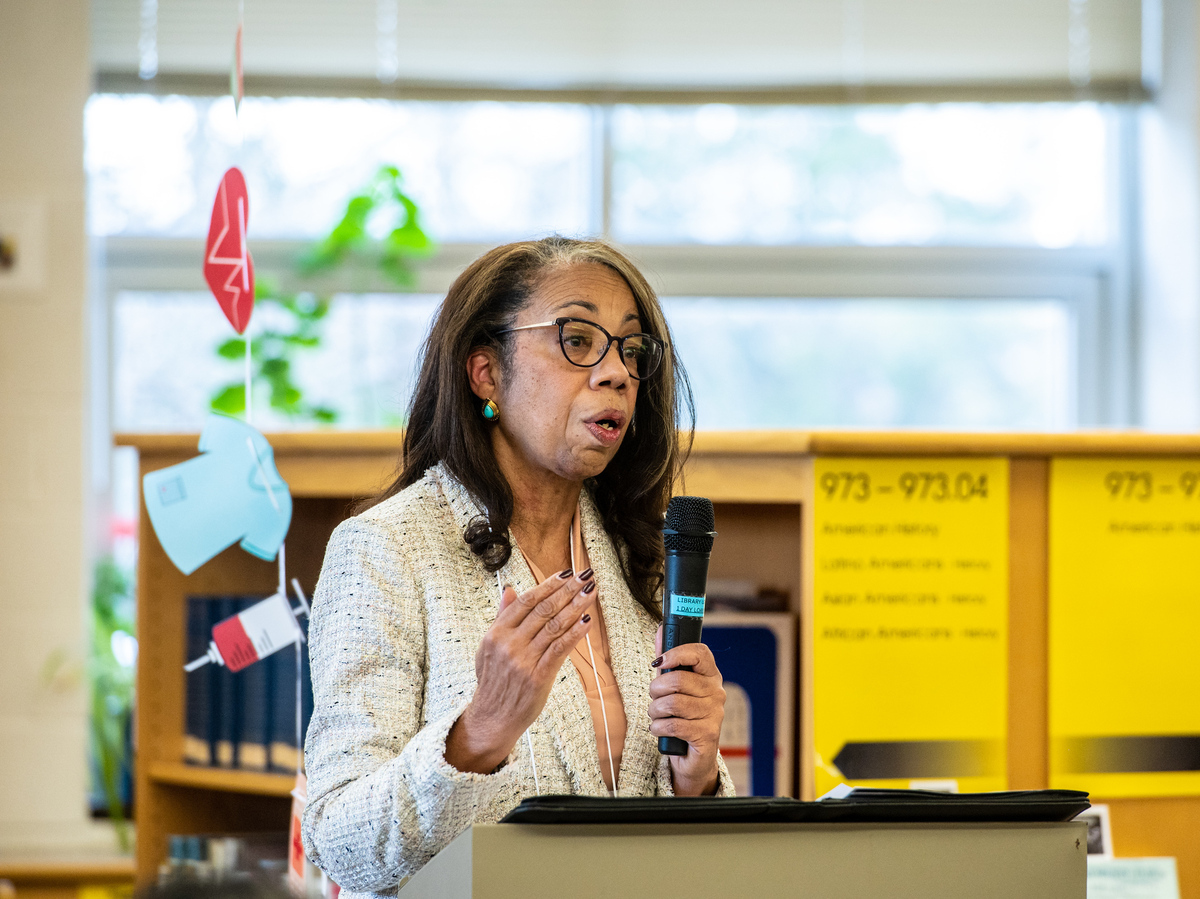
Dr. Gloria Addo-Ayensu, director of the Fairfax County Health Department, spoke with students graduating from the Public Health Youth Ambassador Program at the John Lewis High School library.

Will Schermerhorn/Fairfax County Health Department


hide caption

toggle caption

Will Schermerhorn/Fairfax County Health Department


Dr. Gloria Addo-Ayensu, director of the Fairfax County Health Department, spoke with students graduating from the Public Health Youth Ambassador Program at the John Lewis High School library.

Will Schermerhorn/Fairfax County Health Department

Training gives teens a leg up on future health careers

The health department is working with Edu-Futuro, a local nonprofit, to recruit students with an interest in medicine from Fairfax high schools and help start their career paths.

“At the end of the day, it’s that they successfully enroll in a college or a postsecondary institution, where they will be able to get a degree in a health-related career – and then four years later, they get their first professional job,” says Jorge Figueredo, Edu-Futuro’s director.

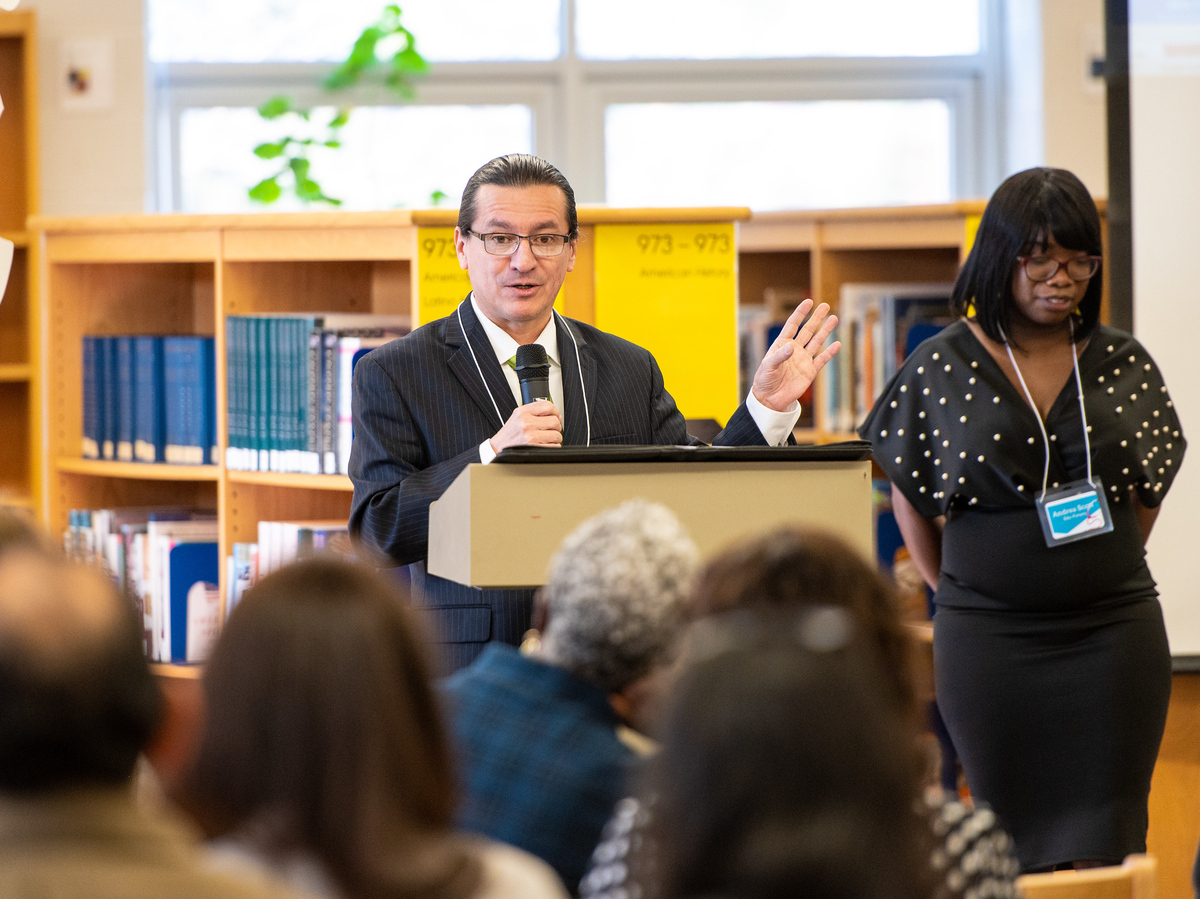
Jorge Figueredo, director at the nonprofit Edu-Futuro, tells students that the Youth Ambassador Program sets them on a path to careers in health.

Will Schermerhorn/Fairfax County Health Department


hide caption

toggle caption

Will Schermerhorn/Fairfax County Health Department


Jorge Figueredo, director at the nonprofit Edu-Futuro, tells students that the Youth Ambassador Program sets them on a path to careers in health.

Will Schermerhorn/Fairfax County Health Department

The program focuses on Hispanic, African-American and African students from low-income families. In Fairfax County, as in much of the country, these racial and ethnic minority groups were hardest hit by COVID.

“There were some real challenges around health literacy,” says Anthony Mingo, director of community health development at the Fairfax County Health Department. Mixed messages at the start of the pandemic blended with historical mistrust in medical institutions. “It created a miserable stew of misinformation,” he says.

Anthony Mingo (center), from the Fairfax Health Department, implored students to consider careers that serve their communities, flanked by Jorge Figueredo from Edu-Futuro (left) and program manager Andrea Scott (right).

Will Schermerhorn/Fairfax County Health Department


hide caption

toggle caption

Will Schermerhorn/Fairfax County Health Department


Anthony Mingo (center), from the Fairfax Health Department, implored students to consider careers that serve their communities, flanked by Jorge Figueredo from Edu-Futuro (left) and program manager Andrea Scott (right).

Will Schermerhorn/Fairfax County Health Department

The new youth ambassadors are fired up about public health. Fieseha found the links between environment and health illuminating. “If you don’t have access to a grocery store, you’re more willing to buy [fast food] because that is the closest food source you have, which contributes to diabetes and high blood pressure,” she says. “How we access our food, how we make income – we don’t realize how much of an impact that makes to our mental health and our physical health.”

Learning about some shady episodes from the history of medicine helped Bonilla understand how the medical field lost trust with some groups.

“[The lessons] were talking about the history of ethical considerations, which I really hadn’t thought about, like the cancer cells from a patient that were used without their consent,” she says, “And it just made me think how minority groups were really taken advantage of for medical research.”

Bonilla plans to organize a health fair to address health disparities; she thinks she might become a pediatrician, to better serve Spanish-speaking kids and parents. Fieseha plans to start an urban garden at her school and wants to become a global advocate for HIV/AIDS in Africa and particularly Ethiopia, where her family is from.

Federal funding to boost health literacy

Both are among the first graduates in the pilot program, which expects to have trained ninety students as health workers by next summer. With a budget of around $240,000, according to the health department, it’s a small sliver in a two-year, $3.8 million Fairfax County-wide project to improve access to COVID information and boost health literacy among vulnerable groups.

The federal government is providing the funding. Fairfax County is one of 73 local governments to receive a grant under a $250 million initiative from the Department of Health and Human Services last year. Each grantee is trying out its own approaches to improve health understanding in their communities, says Roslyn Holliday Moore, deputy program director for HHS’s Office of Minority Health.

Roslyn Holliday Moore, from the U.S. Department of Health and Human Services, says the Youth Public Health Ambassador Program can be adapted to other places.

Will Schermerhorn/Fairfax County Health Department


hide caption

toggle caption

Will Schermerhorn/Fairfax County Health Department


Roslyn Holliday Moore, from the U.S. Department of Health and Human Services, says the Youth Public Health Ambassador Program can be adapted to other places.

Will Schermerhorn/Fairfax County Health Department

The hope is that projects, like Fairfax County’s Youth Ambassador training, can be adapted elsewhere. “For those who are looking at whether people are able to trust, sustain the trust, engage others, this is more than successful,” Holliday Moore says, “And it’s not hard to replicate.”

Holliday Moore addresses a small crowd of parents and students gathered at a high school library for a graduation ceremony. “Do not give up, stay the course,” she says. “You are creating a future here.”

Afterward, there is applause and tears of joy. A Peruvian dance champion performs a traditional dance. An assistant principal sings a line from Bob Marley’s Three Little Birds and assures students he isn’t worried about a thing — with them at the helm.

After some long, bleak pandemic years, everyone in the room is glad to be celebrating teens getting their start in public health.

Christopher Thompson, assistant principal at the John R. Lewis High School, tells students that he’s confident in a future where they’re in charge.

Will Schermerhorn/Fairfax County Health Department


hide caption

toggle caption

Will Schermerhorn/Fairfax County Health Department


Christopher Thompson, assistant principal at the John R. Lewis High School, tells students that he’s confident in a future where they’re in charge.

Will Schermerhorn/Fairfax County Health Department

To prevent medical debt, the U.S. could learn from Germany’s health care system : Shots

To prevent medical debt, the U.S. could learn from Germany’s health care system : Shots

Dr. Eckart Rolshoven examines a patient at his clinic in Püttlingen, a small town in Germany’s Saarland region. Although Germany has a largely private health care system, patients pay nothing out-of-pocket when they come to see him.

Pasquale D’Angiolillo for KHN


hide caption

toggle caption

Pasquale D’Angiolillo for KHN


Dr. Eckart Rolshoven examines a patient at his clinic in Püttlingen, a small town in Germany’s Saarland region. Although Germany has a largely private health care system, patients pay nothing out-of-pocket when they come to see him.

Pasquale D’Angiolillo for KHN

PÜTTLINGEN, Germany — Almost every day, Dr. Eckart Rolshoven sees the long shadow of coal mining in his clinic near the big brownstone church that dominates this small town in Germany’s Saarland.

The region’s last-operating coal shaft, just a few miles away, closed a decade ago, ending centuries of mining in the Saarland, a mostly rural state tucked between the Rhine River and the French border. But the mines left a difficult legacy, as they have in coal regions in the United States, including West Virginia.

Many of Rolshoven’s patients battle lung diseases and chronic pain from years of work underground. “We had an industry with a lot of illnesses,” said Rolshoven, a genial primary care physician who at 71 is nearing the end of a long career.

The Saarland’s residents are sicker than elsewhere in Germany. And like West Virginia, the region faces economic hurdles. For decades, German politicians, business leaders and unions have labored to adjust to the mining industry’s slow demise.

But this is a healthier place than West Virginia in many respects. The region’s residents are less likely to die prematurely, data shows. And on average, they live four years longer than West Virginians.

There is another important difference between this former coal territory and its Appalachian counterpart: West Virginia’s economic struggles have been compounded by medical debt, a burden that affects about 100 million people in the U.S. — in no state more than West Virginia.

In the Saarland, medical debt is practically nonexistent. It’s so rare in Germany that the federal government’s statistical office doesn’t even track it.

The reason isn’t government health care. Germany, like the U.S., has a largely private health care system that relies on private doctors and private insurers. Like Americans, many Germans enroll in a health plan through work, splitting the cost with their employer.

But Germany has long done something the U.S. does not: It strictly limits how much patients have to pay out of their own pockets for a trip to the doctor, the hospital or the pharmacy.

Rolshoven’s patients pay nothing when they see him. That not only bolsters their health, he said. It helps maintain what Rolshoven called social peace. “It’s really important not to have to worry about these problems,” he said.

German health officials, business leaders and economists say the access to affordable health care has also helped the Saarland get back on its feet economically, bolstered by the assurance that workers could get to the doctor.

“Without this, the Saarland would be dead,” said Beatrice Zeiger, managing director of the Arbeitskammer des Saarlandes, a regional labor group. “It’s unthinkable.”

While health costs rise in the U.S., Germany contains them

In West Virginia, whose wooded valleys and decaying industrial plants could be mistaken for the Saarland’s, access to health coverage has been important as the state weathered the decline of its mines.

A decade ago, state leaders moved to expand the Medicaid insurance program through the Affordable Care Act. And as of last year, just 6{bf0515afdcaddba073662ceb89fbb62b6b1bf123143c0e06b788e1946e8c353f} of state residents were uninsured, less than half the rate before the 2010 law.

But growing numbers of West Virginians without government insurance are in private health plans with deductibles that require they pay thousands of dollars out of their own pockets before coverage kicks in.

The typical individual health plan an American gets through work now comes with a more than $1,500 deductible, a particularly big sum in a state like West Virginia where residents often earn less than residents of other states.

That, in turn, is driving medical debt. A quarter of West Virginians with a credit report have medical bills in collections, almost twice the national rate, according to data compiled by the nonprofit Urban Institute. In several counties in the state, the rate is about a third.

And those figures likely understate the problem. Many more people put medical bills on their credit cards, borrow from family or enroll in installment plans with a hospital or other providers to pay off their bills.

“It’s a huge problem here,” said Jessica Ice, executive director of West Virginians for Affordable Health Care. “Folks with medical debt aren’t able to apply for loans to start a business or buy a starter home for their family. It’s really preventing people from climbing up the economic ladder.”

In German health plans, known as sickness funds, there aren’t typically deductibles.

Physician visits are almost always free for patients. Copays for most prescription drugs are capped at 10 euros or less, about $10. And people admitted to the hospital pay only 10 euros a day.

“Access to medical care with minimal costs for patients has been essential,” said Armin Beck, regional director of the Knappschaft Bahn See, of KBS, a health insurance plan whose roots stretch back to the 13th century, when miners set up a mutual aid society to protect one another in case of injuries or accidents. “This has been a foundation of our community,” Beck said.

‘So glad we don’t have to worry’

Along the Saar River in Germany, rusting steelworks and shuttered coal-fired power plants bear testament to the region’s economic struggles. Many towns like Püttlingen carry on in the shadow of hulking mounds of debris — Berghalde, as they are called — the detritus left behind as coal was separated from the rocky earth hauled up from underground.

The now-shuttered Bergwerk Saar coal mine in Germany’s Saarland closed in 2012, ending centuries of mining in the region. Coal from the Saarland helped fuel Germany’s industrialization and once employed tens of thousands of workers.

Pasquale D’Angiolillo for KHN


hide caption

toggle caption

Pasquale D’Angiolillo for KHN


The now-shuttered Bergwerk Saar coal mine in Germany’s Saarland closed in 2012, ending centuries of mining in the region. Coal from the Saarland helped fuel Germany’s industrialization and once employed tens of thousands of workers.

Pasquale D’Angiolillo for KHN

Today, new challenges confront the region. Ford, which has operated a car factory here for decades, plans to shutter the plant in a few years and move production to Spain.

But at Rolshoven’s clinic — a small set of offices tucked into a residential neighborhood — few patients can conceive of the burdens that medical bills put on Americans.

Andrea Fecht, 63, who has diabetes and came to see Rolshoven because recent tests revealed a concerning rise in her blood sugar, estimated she pays 120 euros a year, or about $125, to fill all six of her prescriptions, including her daily insulin.

In the U.S., the average price for insulin alone is nine times that in Germany, according to a recent report from Rand Corp., a research group.

Andreas Mang, a former miner who left the industry 20 years ago after a series of accidents, would likely pay even more out-of-pocket for his family’s drugs. Mang’s wife recently underwent a course of chemotherapy that would cost thousands of dollars if not for Germany’s limits on medical bills, Rolshoven said.

“I can’t imagine what it would be like not to have this support,” Mang said.

Christine Wagner said she’s had a glimpse of what Americans face. Wagner’s 18-year-old son, Jonas, has Down syndrome and has required more than 20 surgeries.

In global Facebook groups with other parents who have children with disabilities, Wagner said she’s amazed to see how much fundraising American parents do to pay family medical bills. “I’m so glad we don’t have to worry about that,” she said. “We have enough to do looking after Jonas.”

Countries where health care is actually affordable

International surveys underscore the difference Wagner observed between her experiences and those of American families.

In one recent study of health care in 11 high-income countries, the nonprofit Commonwealth Fund found that 44{bf0515afdcaddba073662ceb89fbb62b6b1bf123143c0e06b788e1946e8c353f} of Americans had out-of-pocket medical expenses that topped $1,000 in the previous year. Just 16{bf0515afdcaddba073662ceb89fbb62b6b1bf123143c0e06b788e1946e8c353f} of Germans reported paying that much. The rates were even lower in France, at 10{bf0515afdcaddba073662ceb89fbb62b6b1bf123143c0e06b788e1946e8c353f}, and Great Britain, where only 7{bf0515afdcaddba073662ceb89fbb62b6b1bf123143c0e06b788e1946e8c353f} reported similar medical expenses.

U.S. patients were also more than twice as likely as patients in any of the 10 other countries studied to say they had serious problems paying medical bills.

“Many Americans may not understand how affordable health care is for patients in other countries,” said Reginald D. Williams II, who oversees international research at the Commonwealth Fund. “Medical debt is a largely U.S. phenomenon. It just doesn’t happen in other countries.”

Most wealthy countries in Western Europe, East Asia and elsewhere limit patients’ out-of-pocket costs.

In the Netherlands, where patients enroll in private health plans as they do in Germany, insurers typically cover all medical expenses after patients pay a standard deductible of 385 euros, or about $400. Physician visits are fully covered.

In Great Britain, where medical care that is “free at the point of service” has been a foundation of that country’s government-run National Health Service for almost 75 years, there are rarely any doctor or hospital bills.

When the government asked Britons who’d gone into debt about the causes, just 2{bf0515afdcaddba073662ceb89fbb62b6b1bf123143c0e06b788e1946e8c353f} cited paying for medical treatment. A similar share attributed their debt to gambling or another habit.

In the U.S., 41{bf0515afdcaddba073662ceb89fbb62b6b1bf123143c0e06b788e1946e8c353f} of adults currently have debt from medical or dental bills, according to a KFF poll.

How Germany regulates hospital, doctor and drug prices

Germany’s strict limits on medical bills have periodically stoked concerns about patients overusing the health system.

But when health plans tried implementing a copay of 10 euros for physician visits, it was quickly rolled back amid criticism from patients and frustration among doctors, who didn’t like chasing after their patients for bills.

Germany’s limits on how much patients pay out-of-pocket at the doctor’s office have been critical to ensuring people get needed care, especially in a mining region where many battle lung diseases and chronic pain, says Dr. Eckart Rolshoven. “We had an industry with a lot of illnesses,” he says.

Pasquale D’Angiolillo for KHN


hide caption

toggle caption

Pasquale D’Angiolillo for KHN


Germany’s limits on how much patients pay out-of-pocket at the doctor’s office have been critical to ensuring people get needed care, especially in a mining region where many battle lung diseases and chronic pain, says Dr. Eckart Rolshoven. “We had an industry with a lot of illnesses,” he says.

Pasquale D’Angiolillo for KHN

At the hospital in Püttlingen, which is operated by the Knappschaft, Dr. Marion Bolte said asking patients to pay more isn’t worth the risk, even if it might bring in more money.

“It’s better to have 20 unnecessary visits than to have one patient get harmed because they didn’t come to the hospital because they were worried about how much it would cost,” said Bolte, the chief medical officer. “We don’t want patients to worry about money. We want them to worry about getting better.”

Nationally, German patients are less likely than Americans to die from conditions that can be treated with good access to medical care, such as heart attacks, diabetes, pneumonia and some cancers, according to regional data compiled by the Paris-based Organization for Economic Cooperation and Development.

Germans are also less likely than Americans to say they had to wait to see a doctor, surveys show.

Lower-cost health care that protects workers from going into debt has meant fewer concerns for the Saarland’s policymakers, as well. “All that our predecessors had to worry about was creating jobs,” said Oliver Groll, a senior official at IHK Saarland, the regional chamber of commerce. “Health care took care of itself.”

As mining jobs disappeared, the Saarland shifted toward other industries, such as auto manufacturing, which has been a major employer since Ford opened its factory in 1970, sparking the development of a robust auto parts sector. The chamber and other business leaders are now working to lure technology and pharmaceutical jobs to the region.

For Mang, the former miner whose wife had cancer, knowing that medical bills wouldn’t drive him into debt helped give him the peace of mind to switch careers. “I never had to think about how much health care would cost me,” said Mang, who is now a nurse.

Maintaining this system has required that Germany do something else that U.S. policymakers have historically eschewed. Germany, like most wealthy nations, regulates the prices that hospitals, doctors and drugmakers can charge. This regulation occurs through a highly structured system in which insurers negotiate collectively with physician and hospital groups to set prices.

American hospitals and other medical providers for decades have fiercely resisted limits on their prices, spending millions to fight government regulation.

Price regulation can put more financial pressure on providers, who, unlike their American counterparts, can’t just demand higher prices from insurers to bolster their bottom lines.

Mario Schüller, the hospital administrator who runs the Knappschaft hospital in Püttlingen, said hospitals must instead compete to attract patients with better care and better customer service. Those that can’t compete may close, he said.

But Schüller said he wouldn’t want to charge patients more, even if he could.

“If I had to bill patients and then try to collect from them, I’d have to pay for all that,” he said. “We’d need new staff, who would have to get paid. And if we used collections companies, they’d have to be paid, too. It becomes a devil’s bargain.”

KHN (Kaiser Health News) is a national newsroom that produces in-depth journalism about health issues. Together with Policy Analysis and Polling, KHN is one of the three major operating programs at KFF (Kaiser Family Foundation). KFF is an endowed nonprofit organization providing information on health issues to the nation.

How therapists are trying to heal intergenerational trauma : Shots

How therapists are trying to heal intergenerational trauma : Shots
Culturally responsive therapy is a growing trend, as therapists of color try to make counseling more inclusive.

Cambodian American Eden Teng was was born in a refugee camp on the border of Thailand and Cambodia just a few years after the Cambodian genocide. She moved to the U.S. with her mom and aunt when she was 6.

Teng attributes much of her own resilience in transitioning to the U.S. to her exuberant mom, who wore whatever she wanted and wasn’t afraid to defy social norms — even when it was embarrassing for a teenage Teng.

But when she was growing up, Teng also witnessed the negative impacts of historical, racial and intergenerational trauma on her mom’s wellbeing. Teng often felt confused by the way her mom’s emotions could spiral out of control for seemingly no reason, or why why she had so many health problems.

When Teng first encountered psychology in college, she realized that her mother’s past was directly connected to her emotional and physical health. (Scientists are learning that stress and trauma are sometimes linked to chronic illnesses, like hypertension, diabetes and kidney disease.)

It was this realization that compelled Teng to become a therapist; in 2018 she began her graduate studies in Seattle.

But when COVID-19 hit and the Black Lives Matter movement came into full force, with communities of color having a more public conversation about their struggles in the U.S., Teng says she started feeling differently about her training and the profession she’d be entering. She began to notice how dealing with certain issues, including race and immigration, were not given priority in her clinical training — even though she knew how important they are in shaping a life.

“I didn’t feel represented, and I felt that so much of my family’s history just didn’t feel like it was considered,” she says, adding that she was studying under teachers who were predominantly white. “I just felt silenced in my own history [and] my own experience in the work that I was doing.”

Teng’s graduate program isn’t the only one like this. Therapy is a predominantly white field in the U.S. — 80{bf0515afdcaddba073662ceb89fbb62b6b1bf123143c0e06b788e1946e8c353f} of psychologists, 63{bf0515afdcaddba073662ceb89fbb62b6b1bf123143c0e06b788e1946e8c353f} of counselors and 59{bf0515afdcaddba073662ceb89fbb62b6b1bf123143c0e06b788e1946e8c353f} of social workers are white, according to Data USA, a website that constructs visualizations of public federal data.

Many of the founding ideas, techniques and schools of practice of therapy were developed by white scholars or practitioners. As a result, the field has marginalized the experiences of people of color, therapists and patients say. Microaggressions are also pervasive in psychological practice, researchers note, and many immigrants report not attending therapy because of language barriers, a lack of insurance and high costs.

That’s why Teng wanted to take a new approach. For her, that meant joining a growing movement of other counselors hoping to transform the practice of therapy, to make it more accessible and relevant to people of color and — ultimately — to help them find healing.

Embracing a practice of ‘decolonizing therapy’

Teng was initially inspired by people like Dr. Jennifer Mullan, who refer to this work as “decolonizing therapy,” a process of addressing the structural racism and other forms of oppression that keep therapy from serving many marginalized communities.

“I think the best way to describe decolonized therapy is that it is really making space to examine the external pressures, stressors, and layers of oppression that my clients have endured and survived,” Teng says.

She gives the example of microaggressions in the workplace, or job interviews. “There are opportunities that are not given to you because of your identities,” she says, “But if we look at it through the lens of self-esteem, it’s like ‘Something is wrong with you. You just need to think better about yourself,’ right? Like you need to be more positive.”

But for people of color, that framework of just being “more positive” doesn’t always work. It doesn’t account for racism, xenophobia and other forms of discrimination directed toward them. “The challenge,” Teng explains, “is to recognize that how you’re feeling about yourself can also be internalized oppression.”

Teng’s practice in decolonizing therapy digs into family history, helping her clients of color better understand how the historical oppression of their ancestors affects them. She says this is true for people from her own community, who experienced the genocide when the Khmer Rouge regime killed about 2.2 million people. “When we’re talking about Cambodian refugees and immigrants, there’s a history here that is so horrific, rich, and devastating.”

Teng finds children of Cambodian refugees who have been through the genocide can struggle with guilt. “In first-generation or second-generation Cambodian Americans, there’s this experience that your parents have sacrificed or have gone through so much,” she says. “They’ve experienced tremendous loss. And having that sense of their sacrifices, we feel we need to hold that harm and that grief and that pain.”

Holding onto a parent’s pain leads into tricky territory, says Teng. “We also feel that we have to transcend it by being perfect or striving to be so successful that we are becoming millionaires … versus really being with the gentleness of the grief, and the emotions that are being held and passed down.”

Using culturally responsive techniques

To respond to these issues, Teng has developed a few approaches that are different from the way she was trained. First, Teng often brings in the family to her practice.

“This may mean that we involve parents in sessions so that we can hear from their point of view,” she says. “When we’re in that space, there are a lot of opportunities to shed light on the impacts of being a child of immigrants. And through that lens — of being someone like a first generation immigrant — we can discuss the harm that is very much connected to the harm that parents have navigated.”

Teng supports the children and parents in openly discussing experiences like racism and genocide in a secure and validating environment. She says many who survived the genocide, had to suppress their feelings. “And so, when you have the experience of suppressing those [painful] emotions, you’re also suppressing joy and connection, belonging.”

Allowing her clients and their parents to experience the full spectrum of emotions can be healing, she says. “[They] can allow for positive attachments and relationships that feel meaningful.”

Teng also works against the stereotype of the detached therapist-as-expert. She makes clear to her clients that she may not have all of the answers, and prefers to be transparent with her clients about her own intergenerational trauma. “When we can really be with what’s hurting, we know we’re together in this,” she says. “I’m a part of this collective healing journey with my clients.”

Growing acceptance of the role of historical trauma

Like Teng, Ramona Beltran became interested in decolonizing therapy because of the issues she was seeing in her community of origin. She identifies as Xicana of Yaqui and Mexica descent and is a professor of social work at the University of Denver.

When she was at the start of her career, several of her family members passed away before they reached 60 years old and she found herself asking what the links are between her community’s history of trauma and their health.

When Beltran entered a doctorate program to study historical trauma 20 years ago, she wasn’t taken seriously at first, she says — such as when she gave some presentations on the theoretical framework of historical trauma and healing. “I remember this one [presentation] where they forwarded me the feedback, and several people were like, ‘This is political. It’s ideological. It doesn’t count as research. There’s nothing empirical about this. This isn’t like real academic work.'”

Now, Beltran says things have changed, “I teach a whole class on historical trauma and healing, and it’s always one of the classes that gets filled up right away,” she says. “And that, to me, is progress.”

When she was working on her master’s degree in social work, she says, she noticed that all of the evidence-based styles of practice she had learned in grad school weren’t enough.

“They were just like these kind of mainstream approaches to therapy that were generated from, primarily white, primarily middle class families,” Beltran remembers. “And so maybe they would be translated into Spanish, but to me, what I was seeing was that those practices weren’t really generating a lot of healing.”

Now when she teaches, Beltran emphasizes that decolonizing can take different forms, depending on the experience of the therapist and the shared experiences of the community the therapist is trying to reach.

She highlights three key aspects of culturally responsive therapy: building authentic relationships, ensuring community representation, and re-connecting with one’s cultural background. Like Teng, Beltran is especially interested in working with clients to help them see their culture as a form of intergenerational strength, rather than suffering.

A growing need for culturally responsive therapy

While therapists like Beltran and Teng are committed to making therapy more inclusive, communities of color continue to struggle with getting access to therapists. Teng gets a lot of people contacting her who she simply cannot help. “I’m only licensed to see folks in my area, and there are so many that are interested. And it breaks my heart every time, where I’m not able to provide support.”

She notes that this is especially common for clients living in areas with few clinicians available. “I had one from Kansas most recently, who was like, ‘We don’t have any Khmer therapists anywhere in the state.’ But, unfortunately, I’m not able to provide that service.”

Teng knows what it’s like to lack access to therapy. “I myself haven’t had a therapist of my own who practiced the way that I do until most recently,” she says.

But there have been some recent moves in the right direction, Teng says. Organizations like Inclusive Therapists created the BIPOC Therapy Fund to provide financial help for at least four initial sessions for people of color seeking therapy. The Asian Mental Health Collective also created the Lotus Therapy Fund to provide financial support to Asian therapy seekers for eight sessions.

And the largest professional organization of psychologists in the U.S. is also promising to make changes. Last year, the American Psychological Association issued a formal apology for its role in what it called “promoting, perpetuating and failing to challenge racism, racial discrimination and human hierarchy in the U.S.“

The APA promised to support more research centered on non-Western perspectives, provide more access to culturally competent training, and create more opportunities for people of color to enter the field of psychology. This August, the organization committed $1.1 million to a new Racial Equity Fund to carry out these three goals.

Teng says she hopes to see more funds dedicated to helping people of color get access to therapy that recognizes their history and experiences.

“There’s no way that we can just say that we’re going to look at this from a cultural lens without actually looking through the historical, intergenerational lens,” she says. “And so, it has to be comprehensive and interconnected for it to truly honor the human being that is in front of you.”

A long-term care plan helps people with disabilities thrive : Shots

A long-term care plan helps people with disabilities thrive : Shots

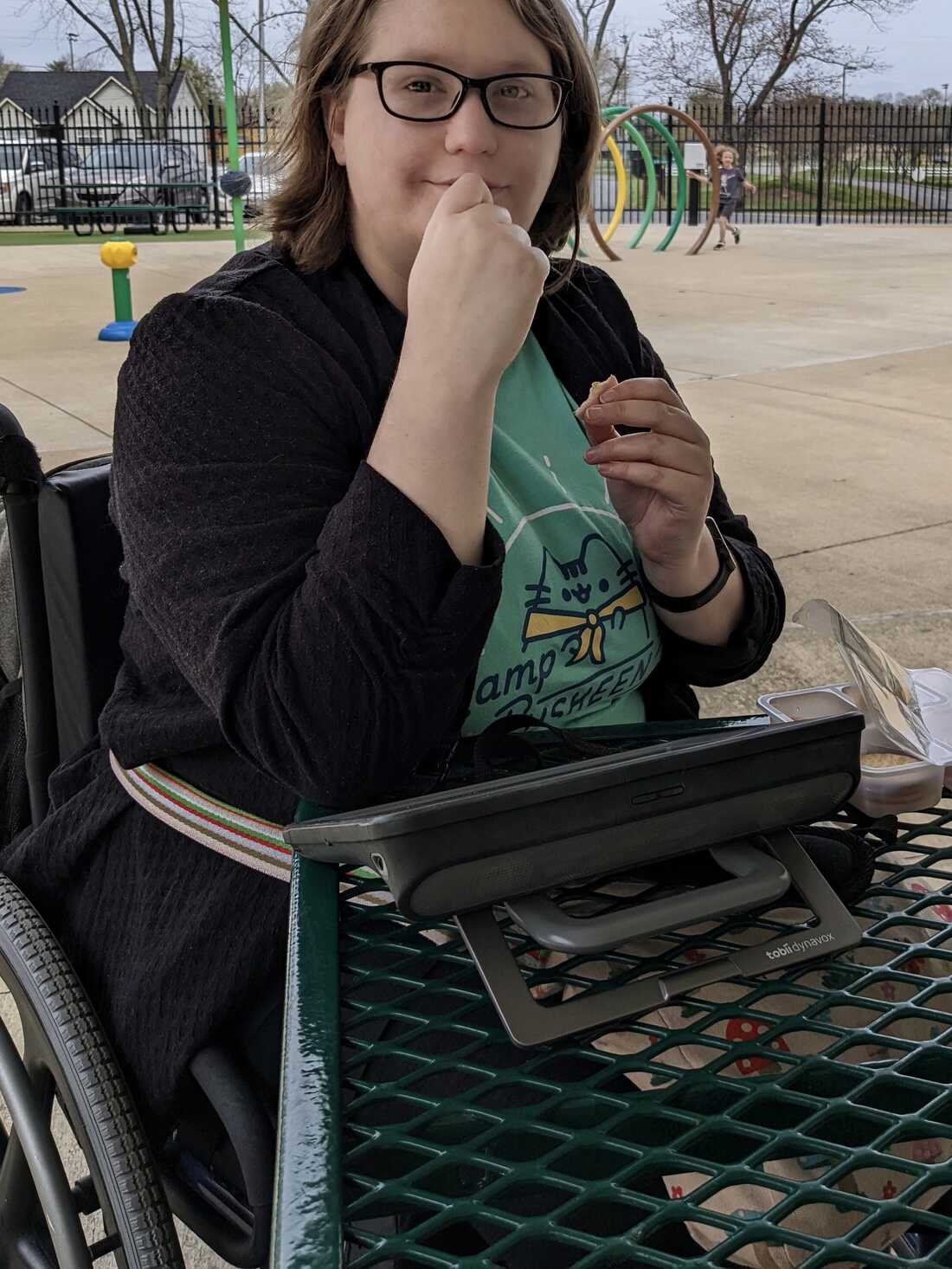
Courtney Johnson, who has autism and multiple chronic illnesses, lives relatively independently. Her grandparents and friends have helped her access social services. Still, she says, “thinking about the future is a bit terrifying to me.”

Tristan Lane


hide caption

toggle caption

Tristan Lane


Courtney Johnson, who has autism and multiple chronic illnesses, lives relatively independently. Her grandparents and friends have helped her access social services. Still, she says, “thinking about the future is a bit terrifying to me.”

Tristan Lane

Thinking about the future makes Courtney Johnson nervous.

The 25-year-old blogger and college student has autism and several chronic illnesses, and with the support of her grandparents and friends, who help her access a complex network of social services, she lives relatively independently in Johnson City, Tenn.

“If something happens to them, I’m not certain what would happen to me, especially because I have difficulty with navigating things that require more red tape,” she says.

Johnson says she hasn’t made plans that would ensure she receives the same level of support in the future. She especially worries about being taken advantage of or being physically harmed if her family and friends can’t help her — experiences she’s had in the past.

“I like being able to know what to expect, and thinking about the future is a bit terrifying to me,” she says.

Johnson’s situation isn’t unique.

25{bf0515afdcaddba073662ceb89fbb62b6b1bf123143c0e06b788e1946e8c353f} of U.S. adults live with a disability

Experts say many people with intellectual and developmental disabilities do not have long-term plans for when family members lose the ability to help them get access to government services or to care for them directly.

Families, researchers, government officials, and advocates worry that the lack of planning — combined with a social safety net that’s full of holes — has set the stage for a crisis in which people with disabilities can no longer live independently in their communities. If that happens, they could end up stuck in nursing homes or state-run institutions.

“There’s just potential for a tremendous human toll on individuals if we don’t solve this problem,” says Peter Berns, CEO of the Arc of the United States, a national disability-rights organization.

About 25{bf0515afdcaddba073662ceb89fbb62b6b1bf123143c0e06b788e1946e8c353f} of adults in the U.S. live with a disability, according to the Centers for Disease Control and Prevention. Nearly 75{bf0515afdcaddba073662ceb89fbb62b6b1bf123143c0e06b788e1946e8c353f} of Americans with disabilities live with a family caregiver, and about 25{bf0515afdcaddba073662ceb89fbb62b6b1bf123143c0e06b788e1946e8c353f} of those caregivers are 60 or older, according to the Center on Developmental Disabilities at the University of Kansas.

Any care plan needs to be ‘a living document, because things change’

But only about half of families that care for a loved one with disabilities have made plans for the future, and an even smaller portion have revisited those plans to ensure they’re up to date, says Meghan Burke, an associate professor of special education at the University of Illinois in Urbana-Champaign.

“Engaging in it once is good, right? But you can’t only engage in it once,” she says. “It’s a living document, because things change, people change, circumstances change.”

Burke’s research has found several barriers to planning for the future: financial constraints, reluctance to have hard conversations, trouble understanding government services. Creating plans for people with disabilities also is a complex process, with many questions for families to answer: What are their relatives’ health needs? What activities do they enjoy? What are their wishes? Where will they live?

Rob Stone was born with a condition that restricts much of his movement. His mother, Jeneva, says her family has been “flummoxed” by the process of planning for the future. They just want to make sure Rob will have a say in where he lives and the care he receives.

rahfoard


hide caption

toggle caption

rahfoard


Rob Stone was born with a condition that restricts much of his movement. His mother, Jeneva, says her family has been “flummoxed” by the process of planning for the future. They just want to make sure Rob will have a say in where he lives and the care he receives.

rahfoard

Burke has firsthand experience answering those questions. Her younger brother has Down syndrome, and she expects to become his primary caregiver in the future — a situation she said is common and spreads the work of caregiving.

“This is an impending intergenerational crisis,” she said. “It’s a crisis for the aging parents, and it’s a crisis for their adult offspring with and without disabilities.”

Nicole Jorwic, chief of advocacy and campaigns for Caring Across Generations, a national caregiver advocacy organization, says the network of state and federal programs for people with disabilities can be “extremely complicated” and is full of holes. She has witnessed those gaps as she has helped her brother, who has autism, get access to services.

“It’s really difficult for families to plan when there isn’t a system that they can rely on,” she says.

Advocates see a chronic underinvestment in Medicaid disability services

Medicaid pays for people to receive services in home and community settings through programs that vary state to state. But Jorwic says there are long waitlists. Data collected and analyzed by KFF shows that queue is made up of hundreds of thousands of people across the country. Even when people qualify, Jorwic adds, hiring someone to help can be difficult because of persistent staff shortages.

Jorwic says more federal money could shorten those waitlists and boost Medicaid reimbursements to health care providers, which could help with workforce recruitment. She blames chronic underinvestment in Medicaid disability services for the lack of available slots and a dearth of workers to help people with disabilities.

“It’s going to be expensive, but this is four decades of funding that should have been done,” she says.

Congress recently put about $12.7 billion toward enhancing state Medicaid programs for home- and community-based services for people with disabilities, but that money will be available only through March 2025. The Build Back Better Act, which died in Congress, would have added $150 billion, and funding was left out of the Inflation Reduction Act, which became law this summer, to the disappointment of advocates.

Jeneva Stone’s family in Bethesda, Md., has been “flummoxed” by the long-term planning process for her 25-year-old son, Rob. He needs complex care because he has dystonia 16, a rare muscle condition that makes moving nearly impossible for him.

“No one will just sit down and tell me what is going to happen to my son,” she says. “You know, what are his options, really?”

A special savings account and plan in place for ‘supported decision-making’

Stone says her family has done some planning, including setting up a special needs trust to help manage Rob’s assets and an ABLE account, a type of savings account for people with disabilities. They’re also working to give Rob’s brother medical and financial power of attorney and to create a supported decision-making arrangement for Rob to make sure he has the final say in his care.

“We’re trying to put that scaffolding in place, primarily to protect Rob’s ability to make his own decisions,” she says.

Alison Barkoff is acting administrator for the Administration for Community Living, part of the U.S. Department of Health and Human Services. Her agency recently released what she called a “first ever” national plan, with hundreds of actions the public and private sectors can take to support family caregivers.

“If we don’t really think and plan, I’m concerned that we could have people ending up in institutions and other types of segregated settings that could and should be able to be supported in the community,” says Barkoff, who notes that those outcomes could violate the civil rights of people with disabilities.

She says her agency is working to address the shortages in the direct care workforce and in the supply of affordable, accessible housing for people with disabilities, as well as the lack of disability-focused training among medical professionals.

Evan Woody has needed round-the-clock care since his brain injury and lives with his parents in Dunwoody, Ga. His father, Philip, says his family has some plans in place for Evan’s future, but one question is still unanswered: Where will Evan live when he can no longer live with his parents?

Philip Woody


hide caption

toggle caption

Philip Woody


Evan Woody has needed round-the-clock care since his brain injury and lives with his parents in Dunwoody, Ga. His father, Philip, says his family has some plans in place for Evan’s future, but one question is still unanswered: Where will Evan live when he can no longer live with his parents?

Philip Woody

But ending up in a nursing home or other institution might not be the worst outcome for some people, says Berns, who points out that people with disabilities are overrepresented in jails and prisons.

A step-by-step guide to coming up with the right plan

Berns’ organization, the Arc offers a step-by-step planning guide and has compiled a directory of local advocates, lawyers, and support organizations to help families. Berns says that making sure people with disabilities have access to services — and the means to pay for them — is only one part of a good plan.

“It’s about social connections,” Berns says. “It’s about employment. It’s about where you live. It’s about your health care and making decisions in your life.”

Philip Woody feels as though he has prepared pretty well for his son’s future. Evan, 23, lives with his parents in Dunwoody, Ga., and needs round-the-clock support after a fall as an infant resulted in a significant brain injury. His parents provide much of his care.

Woody says his family has been saving for years to provide for his son’s future, and Evan recently got off a Medicaid waitlist and is getting support to attend a day program for adults with disabilities. He also has an older sister in Tennessee who wants to be involved in his care.

But two big questions are plaguing Woody: Where will Evan live when he can no longer live at home? And will that setting be one where he can thrive?

“As a parent, you will take care of your child as well as you can for as long as you can,” Woody says. “But then nobody after you pass away will love them or care for them the way that you did.”

KHN (Kaiser Health News) is a national, editorially independent program of the Kaiser Family Foundation (KFF).