The Affordable Care Act has significantly reduced racial disparities in health care access, report says

The Affordable Care Act, passed in 2010 under former President Barack Obama, has expanded health insurance coverage across the U.S. and significantly reduced racial and ethnic disparities in access to health care, according to a new report by the Commonwealth Fund.

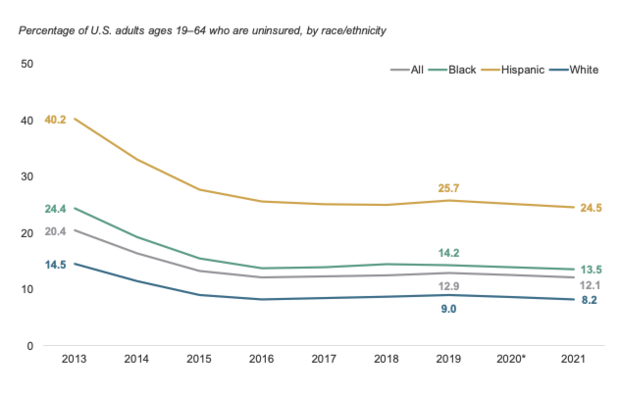
Percentage of U.S. adults ages 19–64 who are uninsured, by race/ethnicity
Coverage inequities between Black, Hispanic, and White adults have narrowed substantially since 2013. All groups reported improvements between 2019 and 2021.

The Commonwealth Fund


“Since its passage in 2010, the Affordable Care Act (ACA) has helped cut the U.S. uninsured rate nearly in half while significantly reducing racial and ethnic disparities in both insurance coverage and access to care — particularly in states that expanded their Medicaid programs,” reads the report.

Data shows that prior to the 2013 implementation of the Medicaid expansion — a provision of the ACA that made more families eligible for Medicaid coverage — 40.2{bf0515afdcaddba073662ceb89fbb62b6b1bf123143c0e06b788e1946e8c353f} of the Hispanic population, 24.4{bf0515afdcaddba073662ceb89fbb62b6b1bf123143c0e06b788e1946e8c353f} of the Black population, and 14.5{bf0515afdcaddba073662ceb89fbb62b6b1bf123143c0e06b788e1946e8c353f} of the White population were uninsured in America. However, by 2021, those numbers dropped significantly to 24.5{bf0515afdcaddba073662ceb89fbb62b6b1bf123143c0e06b788e1946e8c353f}, 13.5{bf0515afdcaddba073662ceb89fbb62b6b1bf123143c0e06b788e1946e8c353f}, and 8.2{bf0515afdcaddba073662ceb89fbb62b6b1bf123143c0e06b788e1946e8c353f}, respectively.

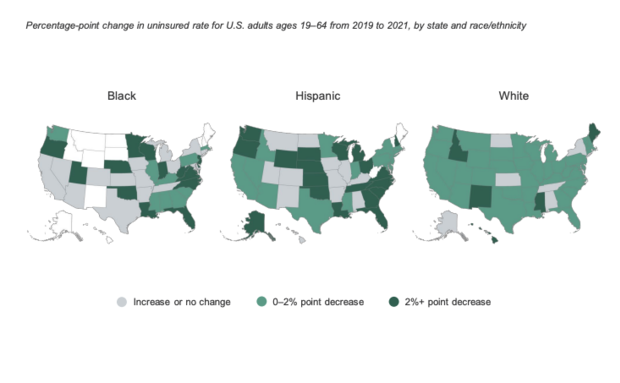
Percentage-point change in uninsured rate for U.S. adults ages 19–64 from 2019 to 2021, by state and race/ethnicity
Uninsured rates for Black and Hispanic adults improved considerably in several states between 2019 and 2021, while White adults experienced modest gains in most regions. 

The Commonwealth Fund


With more than 5 million people gaining coverage between 2020 and 2022 over the course of the pandemic, the overall uninsured rate in the U.S. dropped to just 8{bf0515afdcaddba073662ceb89fbb62b6b1bf123143c0e06b788e1946e8c353f}, a historic low, according to the report.

The report highlights specific ACA successes, including improved coverage rates for Black, Hispanic and White adults.

“The coverage gap between Black and White adults dropped from 9.9 to 5.3 percentage points, while the gap between Hispanic and White adults dropped from 25.7 to 16.3 points,” according to the the study. 

Additionally, the report found that adult uninsured rates for Black, Hispanic, and White people all improved during the first two years of the pandemic across all states — whether they had expanded their Medicare coverage or not —  and that Black and Hispanic adults experienced larger gains in insurance coverage than their White counterparts between from 2019 to 2021.

Nonprofit Chosen BCS aims to ensure all have access to needed medical equipment

BRYAN, Texas (KBTX) – In a recently leased warehouse on Texas Avenue in Bryan, Chosen BCS, a faith-based, community-oriented organization is working to be a lifeline to those in need of durable medical equipment.

The nonprofit is set to open in the next month and has already started to collect new and gently used medical equipment like wheelchairs, canes, walkers, hospital beds, and more, all to distribute to people in need.

Chosen is an international ministry based out of Erie, PA with local distribution and collection sites across the country.

Longtime Brazos County resident Sara Hadley is the director of Chosen BCS Pavilion Texas. Once operational, she says the ministry aims to bridge the gap for people needing medical supplies.

“Medical equipment is essential for the care and well-being of many individuals. Unfortunately, many people cannot afford it or have limited access to it,” says Hadley. “Chosen seeks to offer a beacon of hope and lifeline to those who need medical devices to enable them to live their best life.”

“There are no boxes to check, no income or insurance requirements, or timelines to fulfill. Locally, we distribute everything from gauze to hospital beds to anyone who expresses a need for our staff,” said Hadley.

The Brazos County District 2 Volunteer Fire Department recently made the first donation to Chosen BCS.

“Excited to see Chosen B/CS take what we were doing with our medical supply loan closet to the next level to serve the entire county, and then some,” the district said in a social media post.

Hadley says the hearts this team has for God and His people is the most inspiring and the driving force behind bringing this ministry to the Brazos Valley.

For more information on Chosen BCS and how you can get involved call 979-204-1104

Equipment includes:

  • Canes
  • Crutches
  • Walkers
  • Bedside Commodes
  • Toilet Rails
  • Bed Canes & Bed Rails
  • Wheelchairs
  • Transport Chairs
  • Pulmonary Walkers
  • Knee Scooters
  • Reclining Wheelchairs
  • Shower Chairs & Transfer Benches
  • Toilet Risers
  • Hospital Beds & Mattresses
  • Bedside Tables & Bed Trays
  • Nebulizer Machines and Accessories
  • Incontinence Supplies
  • Blood Pressure Monitors (Home Use, Non-Mercury)
  • Hoyer Lifts, Hoyer Slings, & Sara Lifts
  • Feeding Bags and Tubing
  • Medical Supplies (Gloves, Wipes, Etc.)
  • Diabetic Supplies
  • Wound Care Supplies (Bandages, Gauze, Etc.)
  • Shoes
  • Step Stools
  • Transfer Boards
  • Shower Grab Bars
  • Tub Rails
  • Sock Aids & Shoe Horns
  • Dressing Sticks
  • Reacher/Grabbers
  • Leg Lifters
  • Oxygen Concentrator
  • O2 Carriers
  • Humidifier Machines
  • Portable Ramps
  • Lift Chairs
  • Cushions (Wedge, Egg Crate, Donut, Wheelchair)
  • Colostomy Supplies
  • Other (Please Contact Prior to Dropping Off)

CardieX Subsidiary ATCOR Partners with Power to Advance Patient Recruitment Diversity and Increase Patient Access in Clinical Trials

CardieX’s ATCOR subsidiary and Power together will expand patient-centric approaches to enhance patient diversity in clinical trials

IRVINE, Calif., Feb. 6, 2023 /PRNewswire/ — CardieX Limited, a global health technology company focused on patient-centric healthcare research and improving clinical trial patient outcomes, today announced a partnership between its ATCOR subsidiary and Power, a fast growing patient recruitment marketplace democratizing access to clinical trials for all patients.

The new partnership will allow ATCOR and Power to conduct collaborative research and advance underrepresented patient access to clinical trials and clinical research within Alzheimer’s disease, women’s health, diabetes, and cardiovascular disease.

A primary goal of the partnership is the premiere of new approaches for screening patients with novel inclusion/exclusion criteria across all clinical trial models (conventional, hybrid, and decentralized) to increase both patient access and patient diversity.  The use of digital vascular biomarkers using ATCOR’s SphygmoCor® technology combined with the searchable patient searchable platform of Power will enable an innovative approach to benchmark the future of patient recruitment to enhance patient reported outcomes.

Together, ATCOR and Power will shift the paradigm on clinical trial diversity. Personalized access to treatments starts with patient awareness of available clinical trials through Power’s easy to use patient platform. Combined with an enhanced protocol design that includes ATCOR’s essential digital vascular biomarkers for patient-centric screening, a modern holistic model for inclusion/exclusion criteria across populations is established.  Changing the current patient recruitment process requires both patient empowerment and patient-centric screening to build confidence in the clinical trials process across diverse populations.

The “Pulse”, a new medical device from CardieX subsidiary CONNEQT, will provide advanced arterial health metrics to users from the comfort of their own home. Pulse was developed as a primary decentralized clinical trial device enhancing patient-centric screening and monitoring. The Pulse enables any patient anywhere to be part of clinical trials.  Through the use of digital vascular biomarkers in the protocol, the Pulse enables customized patient recruitment to enhance diversity across populations.

Power has introduced an equal access and easy-to-use recruitment platform to empower patients in their discovery of therapeutic areas with personal meaning.  Making clinical trials accessible and inclusive of today’s socio-economic, geographic, and ethnicity disparities enables patient choice and provides an invitation to be part of the advancement in medical research.

“I am excited to partner with Power to advance patient recruitment diversity.  Our ATCOR and Power partnership brings forward tremendous opportunity to push the boundaries of diversity within clinical trials.  We will open doors for patients ‘anywhere’ to have equal access to clinical research and use our digital vascular biomarkers to enhance inclusion/exclusion criteria.” said Toni R. Hofhine, President of CardieX subsidiary ATCOR Medical.

“Advancing underrepresented populations is essential for improving patient reported outcomes.  The ATCOR and Power partnership will expand patient diversity across all clinical trial models, and I am excited to see the combined technologies engage the patient across some of the most challenging areas in medical research.” said Craig Cooper, Group CEO of the CardieX companies.

“Increasing patient access is key to improving representation in clinical research.  Unfortunately, we don’t adequately understand the structural barriers that are often unintentionally exclusionary to people of colour.  I am excited to see our partnership with ATCOR begin to break down some of these barriers.”  Said Brandon Li, Power cofounder.

The Pulse device will be available for healthcare research and clinical trials in the coming months.

For more information, visit atcormedical.com, conneqthealth.com, and withpower.com.

About CardieX:

CardieX is a health technology company focused on devices & solutions for the world’s largest population health disorders. Its ATCOR subsidiary is a world leader in the monitoring of vascular biomarkers for clinical trials and health care research based on the Company’s “gold standard” SphygmoCor® central blood pressure technology. CardieX’s CONNEQT subsidiary develops and markets medical devices, digital solutions, and wearables for home health, remote patient monitoring, and decentralized clinical trials.

CardieX is listed on the Australian Stock Exchange (ASX:CDX).

About Power:

Power is the go-to destination for patients learning about clinical trials. We make it easy for patients to find and access leading medical research for their unresolved conditions. Power’s patient recruitment marketplace connects clinical trial sites with interested patients who are looking for trials on our platform. In doing this, Power enables equitable access to clinical trials for all patients.

SOURCE CardieX Limited

NHS medtech strategy to boost access to safe, effective and innovative medical devices

People across the British isles are set to advantage from accessibility to safe, helpful and innovative products and medical gadgets as portion of the initial ever health care know-how (‘medtech’) technique released today.

The blueprint for boosting NHS medtech will emphasis on accelerating obtain to progressive systems, this sort of as the newest generation of house dialysis equipment that permit clients to regulate their personal wellness at residence and in their working day to working day lives.

It also sets out actions which need to have to be taken to make certain sufferers can access secure, productive and innovative technological know-how by means of the NHS, which can help diagnose, take care of and supply care much more rapidly, releasing up clinician time. The NHS spends £10 billion a yr on medtech together with syringes, wheelchairs, cardiac pacemakers and health care imaging machines this sort of as x-ray machines.

Making on learnings from the Covid-19 pandemic and the fast growth of health care systems throughout that time these as lateral flow exams and ventilators, this system will be certain the suitable item is out there at the right value and in the correct position. As a end result, sufferers will carry on to have obtain to significant-excellent treatment, along with enhanced patient safety and health and fitness outcomes.

The approach aims to supply worth for revenue, working with the most current info on the success of new technology to guarantee price ranges are realistic for the overall health method. It will also help establish resilient supply chains and make certain the British isles is geared up for future pandemics, just as demand for technological innovation like syringes and ventilators swiftly enhance through the pandemic.

Applying medtech properly will be vital in minimizing waiting lists for therapy triggered by the pandemic as it has the potential to speed up diagnosis and produce new and improved methods to deal with and help clients. For case in point, Covid-19 demonstrated the relevance of quick and exact diagnostic testing and genome sequencing to procedure and share effects and property lateral flow tests confirmed the probable for greater use of diagnostics outside of formal medical options, to aid earlier analysis and no cost up staff time.

Minister of Point out for Wellness Will Quince explained:

&#13

The UK’s impressive spirit shipped revolutionary know-how during the pandemic – from Covid exams and ventilators – and we want to harness this in endorsing chopping-edge healthcare developments to strengthen affected individual care.

&#13
&#13

The NHS spends all-around £10 billion a yr on health-related technological know-how and I’m hunting forward to operating with industry to use this as we aim on lessening hospital stays, improving analysis, protecting against disease and releasing up team time.

&#13
&#13

This new medtech approach will assistance develop a sustainable NHS with people at the centre so men and women can carry on to accessibility the correct care at the appropriate time.”

&#13

The important aims of the technique are to:

    &#13

  • Improve the provide of the ideal gear to provide higher resilience to wellness care worries, these kinds of as pandemics, and boost NHS general performance by means of modernized technological know-how which will permit speedier analysis, remedy and ultimately discharge to absolutely free up medical center beds.
  • &#13

  • Inspire formidable, innovative investigation to safe the UK’s posture as a world wide science superpower and draw in critical financial commitment for the United kingdom financial system and produce careers throughout the region. In 2021, there were now all around 60 unique investigation courses supporting progressive systems, symbolizing more than £1 billion of funding.
  • &#13

  • Improve comprehension and awareness of medtech by clinicians which will guide to additional informed getting on new goods and provide improved value for taxpayer dollars and greater solutions for clients.
  • &#13

  • Make on the Lifestyle Sciences Eyesight to boost collaboration between the NHS, the Countrywide Institute for Health and fitness and Treatment Excellence and the Medicines and Healthcare solutions Regulatory Agency as an innovation associate to make sure sufferers can obtain the correct items safely.
  • &#13

The implementation system to provide on this system will be revealed later this year and will involve a assessment of the £1 billion put in on appliances in principal treatment, new comparison instruments to allow much better conclusion earning when buying which realize the finest final results for people, and collaboration with market to assure availability of crucial solutions to keep patients safe.

Dr Timothy Ferris, nationwide director for transformation at NHS England said:

&#13

Clinical technological know-how has an huge function to play in benefitting sufferers now and in the future.

&#13
&#13

The value of medtech was designed clear in the course of the Covid-19 pandemic and as the NHS moves by way of its recovery, it will enjoy a essential job in addressing the issues we deal with.”

&#13

Dr Sam Roberts of the National Institute for Overall health and Care Excellence mentioned:

&#13

It is necessary that clinicians and patients can obtain the most impactful and price-productive clinical systems, even though MedTech corporations want to be confident that they are creating items which fulfill the requires of clients and the NHS.

&#13
&#13

This technique sets out a apparent vision for the long term. Awesome is psyched to be element of the delivery of this vision, performing with our partners to even further build earth leading processes to provide a sustainable pathway for medical technologies, from innovation to implementation”.

&#13

Peter Ellingworth of the Affiliation of British HealthTech Industries claimed:

&#13

ABHI welcomes the publication of the DHSC MedTech Tactic, and the recognition it provides to the worth of HealthTech in supporting the NHS to provide exceptional treatment for men and women in the British isles. HealthTech performs a beneficial position in enabling enhanced outcomes as a result of modifying client pathways as nicely as efficiency and efficiency gains.

&#13
&#13

It is critical that this tactic supports the ambition of the Existence Sciences Eyesight to develop an remarkable enterprise atmosphere for HealthTech corporations. We glimpse ahead to working intently with the Directorate in the implementation the method.”

&#13

This technique follows action to slice NHS waiting instances as just one of the government’s major 5 priorities, backed by up to £14.1 billion of health and social care funding accessible for the following two a long time, on prime of history funding and the publishing of a new urgent and unexpected emergency treatment recovery program.

Close to one billion people globally are served by health-care facilities with no electricity access or with unreliable electricity

Close to 1 billion people in very low- and decreased-center money nations around the world are served by wellbeing-care amenities with unreliable electricity source or with no electrical power accessibility at all, according to a new report from the Entire world Health and fitness Corporation (WHO), the
Planet Lender, the Global Renewable Power Company (IRENA), and Sustainable Strength for All (SEforAll).
Access to energy is essential for top quality wellness-treatment provision, from providing infants to running emergencies like heart attacks, or supplying lifesaving immunization. Without the need of trusted electricity in all health and fitness-treatment facilities, Common Overall health
Protection simply cannot be attained, the report notes.

Escalating electrification of wellness-treatment services is important to save life

The joint report, Energizing Wellbeing: Accelerating Electrical energy Access in Health-Treatment Amenities, presents the newest details on electrification of wellbeing-care facilities in low- and center-profits nations. It also projects investments needed
to obtain adequate and trustworthy electrification in wellbeing-care and determine crucial priority steps for governments and development associates.

“Electricity accessibility in health and fitness-treatment amenities can make the variance among life and loss of life,” claimed Dr Maria Neira, Assistant Director-Standard a.i, for More healthy Populations at WHO. “Investing in trusted, cleanse and sustainable power for wellness-care services is not only important to pandemic preparedness, it is also considerably required to reach common overall health coverage, as effectively as raising local weather resilience and adaptation.”

Energy is essential to energy the most simple gadgets – from lights and communications machines to refrigeration, or equipment that measure important signals like heartbeat and blood pressure – and is significant for each schedule and crisis strategies.
When health-treatment services have obtain to responsible resources of electrical power, critical medical products can be driven and sterilized, clinics can protect lifesaving vaccines, and wellness employees can have out necessary surgeries or supply babies as prepared.

And yet, in South Asia and sub-Saharan African nations, far more than 1 in 10 wellbeing facilities lack any electrical energy accessibility in any respect, the report finds, although ability is unreliable for a whole half of services in sub-Saharan Africa. While there has been
some development in new several years on electrification of wellness-treatment facilities, about 1 billion people today globally are served by health and fitness-care facilities without a reliable electricity offer or no electrical power at all. To put this in viewpoint, this
is near to the whole populations of the United States, Indonesia, Pakistan and Germany merged.

Disparities in electrical energy entry inside of countries are also stark. Major overall health-care centres and rural well being services are noticeably a lot less very likely to have electricity entry than hospitals and services in urban regions. Being familiar with this sort of disparities
is crucial to figuring out where by actions are most urgently wanted, and to prioritize the allocation of resources in which they will save life.

Overall health is a human suitable and a general public good

Electricity accessibility is a significant enabler of Common Wellbeing Coverage, the report states, and so electrification of health-treatment amenities ought to be regarded an utmost advancement priority necessitating increased assistance and investments from governments, enhancement
partners and financing and growth companies.

In accordance to a Earth Financial institution desires assessment integrated in the report, practically two-thirds (64{bf0515afdcaddba073662ceb89fbb62b6b1bf123143c0e06b788e1946e8c353f}) of overall health-treatment facilities in small and center-income nations around the world need some variety of urgent intervention – for occasion, possibly a new electrical power relationship or
a backup electricity method – and some US$ 4.9 billion is urgently necessary to convey them to a small regular of electrification.

No need to have – and not time – to ‘wait for the grid’

Decentralized sustainable power options, for case in point dependent on solar photovoltaics units, are not only expense-effective and thoroughly clean, but also fast deployable on web site, with out the want to wait around for the arrival of the central grid. Answers are conveniently
obtainable, and the effect for general public wellness would be huge.  

Moreover, health care units and amenities are progressively influenced by the accelerating impacts of local climate improve. Building local weather-resilient wellbeing treatment methods signifies constructing facilities and companies that can meet up with the challenges
of a shifting local weather, these types of as intense climate functions, although improving environmental sustainability.

Methods

When US hospitals go private, Medicaid patients lose health care access

Over the past four decades, US hospitals have gradually moved from public hands to private ones. The share of hospitals owned and operated by a government body — as opposed to a private entity, either a for-profit enterprise or a nonprofit — declined by 42 percent from 1983 to 2019.

That trend has brought serious consequences for the poorer patients who seek care at these hospitals. When private companies assume control of public hospitals, low-income patients on Medicaid lose access to health care, according to new research on this longstanding but under-analyzed trend in American health care.

A new National Bureau of Economic Research working paper by academics from Stanford, Michigan State, and Penn reviewed the consequences of the 258 hospital privatizations from 2000 to 2018 they could identify using national data. (As there were a little more than 1,000 public hospitals in 1999, that would mean one-fourth of all US public hospitals were privatized over the period they studied.)

These researchers found that after a private company took over a hospital previously controlled by the government, the hospital becomes more profitable. As a public hospital, these facilities lost about $335 on average for every patient. As a private hospital, they earned about $740 per patient.

In an ideal world, hospitals could be operating more efficiently, and therefore more profitably, without sacrificing access to health care. And the researchers do find that the hospitals achieve greater profitability in part by reducing spending on administrative and support personnel rather than people most directly involved in patient care. There was no meaningful reduction in nursing staff, for example, after the transfer of control.

But the other way in which these hospitals increased their profitability is more worrisome. Hospitals taken over by private companies saw an 8.4 percent decrease in overall patient volume, partly the result of hospitals reducing their capacity in a likely bid to improve efficiency.

Admissions for Medicare dropped by only 5 percent, a statistically insignificant change, according to the researchers. But Medicaid admissions fell by 15 percent, as did the decline in “other” admissions (which include the uninsured and private insurance, with the former representing another unprofitable business line for hospitals). Though Medicaid patients made up 20 percent of patient volume at these hospitals, they accounted for 30 percent of the drop in admissions after privatization.

“These patterns are consistent with private owners wanting to reduce the share of Medicaid and Other patients at their hospital in order to increase mean revenue per patient,” write the paper’s authors.

I asked the authors what hospitals turning away Medicaid patients might look like in practice. They could only speculate, as that was beyond the scope of the paper, but Mark Duggan at Stanford told me that perhaps the most straightforward way would be for them to decline to renew their Medicaid contracts, taking the hospital out of the provider network for Medicaid patients. Atul Gupta at Penn also said that they could cut certain lines of service, such as psychiatric care, that are more frequently used by Medicaid patients. Or they could decline to admit Medicaid patients; while they are obligated to stabilize a patient in the emergency room, they have more discretion about which patients to actually admit into the hospital.

In theory, fewer Medicaid patients could mean simply that there are fewer unnecessary hospitalizations. But the researchers tested that idea by examining what happened to patient volume across an entire area when a hospital was privatized. They found patients with Medicare or private insurance were absorbed by the neighboring hospitals — but Medicaid admissions dropped across the region.

In other words, when newly privatized hospitals decreased admissions, the patients with more lucrative health insurance were picked up by other facilities, which would suggest they still had clinical needs that the market then rose to meet. But Medicaid patients, whose insurance is not as generous, simply lost access to health care.

“The aggregate decline in Medicaid volume potentially hurts its effectiveness as a social insurance program that ensures access to medical care for vulnerable low-income beneficiaries,” the researchers write. “Privatization therefore emerges as a channel that may curb utilization of care by Medicaid beneficiaries.”

The consequences of hospital privatization for Medicaid patients have gained more importance given the recent expansions of Medicaid eligibility. Medicaid has now grown to become the single largest health insurer in the United States, covering more than 90 million Americans (including the related CHIP program that covers kids). But, as the authors noted in their analysis, that rise in enrollment has not been matched by a commensurate increase in hospital admissions by Medicaid patients. Their findings may help to explain why.

Medicaid is vital to the US safety net, providing zero-cost insurance coverage for low-income Americans. It also has its problems, with low reimbursement rates leading fewer doctors to accept Medicaid patients. One of the most interesting research papers from last year found that supposedly “adequate” physician networks for people enrolled in Medicaid managed care plans (which are overseen by private companies) were not as robust as they first appeared to be.

Giving people Medicaid coverage is the first step to making sure vulnerable Americans get the health care they need — but it is only the first step. They need to find doctors and hospitals that will accept their insurance and treat them. That has been a longstanding struggle because of the program’s low reimbursement rates, which are substantially less than Medicare or private insurance.

And, according to this new research, the trend toward hospital privatization is making the problem worse.