The Affordable Care Act, passed in 2010 under former President Barack Obama, has expanded health insurance coverage across the U.S. and significantly reduced racial and ethnic disparities in access to health care, according to a new report by the Commonwealth Fund.
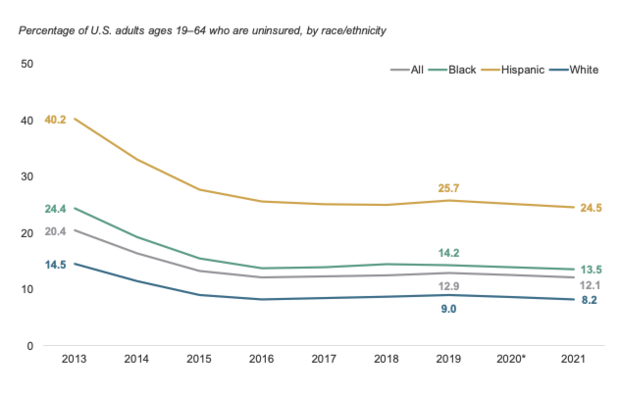
Coverage inequities between Black, Hispanic, and White adults have narrowed substantially since 2013. All groups reported improvements between 2019 and 2021.
The Commonwealth Fund
“Since its passage in 2010, the Affordable Care Act (ACA) has helped cut the U.S. uninsured rate nearly in half while significantly reducing racial and ethnic disparities in both insurance coverage and access to care — particularly in states that expanded their Medicaid programs,” reads the report.
Data shows that prior to the 2013 implementation of the Medicaid expansion — a provision of the ACA that made more families eligible for Medicaid coverage — 40.2{bf0515afdcaddba073662ceb89fbb62b6b1bf123143c0e06b788e1946e8c353f} of the Hispanic population, 24.4{bf0515afdcaddba073662ceb89fbb62b6b1bf123143c0e06b788e1946e8c353f} of the Black population, and 14.5{bf0515afdcaddba073662ceb89fbb62b6b1bf123143c0e06b788e1946e8c353f} of the White population were uninsured in America. However, by 2021, those numbers dropped significantly to 24.5{bf0515afdcaddba073662ceb89fbb62b6b1bf123143c0e06b788e1946e8c353f}, 13.5{bf0515afdcaddba073662ceb89fbb62b6b1bf123143c0e06b788e1946e8c353f}, and 8.2{bf0515afdcaddba073662ceb89fbb62b6b1bf123143c0e06b788e1946e8c353f}, respectively.
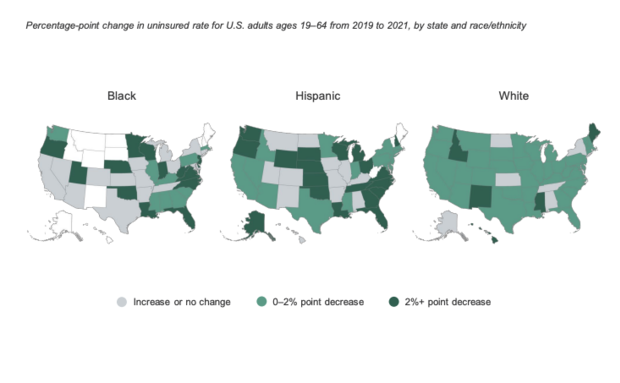
Uninsured rates for Black and Hispanic adults improved considerably in several states between 2019 and 2021, while White adults experienced modest gains in most regions.
The Commonwealth Fund
With more than 5 million people gaining coverage between 2020 and 2022 over the course of the pandemic, the overall uninsured rate in the U.S. dropped to just 8{bf0515afdcaddba073662ceb89fbb62b6b1bf123143c0e06b788e1946e8c353f}, a historic low, according to the report.
The report highlights specific ACA successes, including improved coverage rates for Black, Hispanic and White adults.
“The coverage gap between Black and White adults dropped from 9.9 to 5.3 percentage points, while the gap between Hispanic and White adults dropped from 25.7 to 16.3 points,” according to the the study.
Additionally, the report found that adult uninsured rates for Black, Hispanic, and White people all improved during the first two years of the pandemic across all states — whether they had expanded their Medicare coverage or not — and that Black and Hispanic adults experienced larger gains in insurance coverage than their White counterparts between from 2019 to 2021.
C Mandler
C Mandler is a social media producer and trending topics writer for CBS News, focusing on American politics and LGBTQ+ issues.
Thanks for reading CBS NEWS.
Create your free account or log in for more features.
Medicaid enlargement has not only diminished the in general variety of folks in the U.S. without having wellbeing insurance policies — it has also narrowed racial gaps in wellness insurance protection.
According to a new report from The Commonwealth Fund, well being coverage coverage for Black, Hispanic/Latino, and white older people enhanced amongst 2013 to 2021. Furthermore, the protection gap among Black and white grown ups and involving Hispanic/Latino and white older people shrank.
In 2013, in advance of Medicaid growth went into influence, 40.2{bf0515afdcaddba073662ceb89fbb62b6b1bf123143c0e06b788e1946e8c353f} of the Hispanic/Latino inhabitants, 24.4{bf0515afdcaddba073662ceb89fbb62b6b1bf123143c0e06b788e1946e8c353f} of the Black inhabitants, and 14.5{bf0515afdcaddba073662ceb89fbb62b6b1bf123143c0e06b788e1946e8c353f} of the white populace ended up uninsured. By 2021, these quantities fell to 24.5{bf0515afdcaddba073662ceb89fbb62b6b1bf123143c0e06b788e1946e8c353f}, 13.5{bf0515afdcaddba073662ceb89fbb62b6b1bf123143c0e06b788e1946e8c353f}, and 8.2{bf0515afdcaddba073662ceb89fbb62b6b1bf123143c0e06b788e1946e8c353f}, respectively.
“A whole lot of the progress in uninsured premiums going down and these disparities narrowing [is] certainly stemming from the Inexpensive Treatment Act protection expansions,” Jesse Baumgartner, co-author of the report and senior investigation associate at The Commonwealth Fund, instructed Yahoo Finance. “Those took impact in 2014. So you see major drops concerning 2013 and 2016 as the market subsidies arrived on line, [and] a large amount of states expanded their Medicaid systems at that time. So that is of course a enormous driver for that progress then.”
Growth vs. non-growth
Medicaid was expanded in 2013 via the Inexpensive Treatment Act (ACA) — commonly known as Obamacare. The provision will allow homes whose profits falls below 138{bf0515afdcaddba073662ceb89fbb62b6b1bf123143c0e06b788e1946e8c353f} of the federal poverty degree to grow to be suitable for Medicaid.
Following a Supreme Court ruling, nevertheless, it was left up to each and every condition to make your mind up no matter whether or not to adopt the expansion. As of March 2023, 39 states and the District of Columbia have expanded Medicaid.
According to the Commonwealth Fund report, amongst 2013 to 2021, states that adopted the Medicaid enlargement noticed greater fees of coverage coverage and wellbeing care accessibility than non-enlargement states. They also saw smaller disparities between racial and ethnic groups.
When just about every racial and ethnic team has designed significant strides in well being care protection given that 2013, the get in health treatment coverage for the Hispanic/Latino inhabitants has been specifically noteworthy: Its uninsured rate shrunk by 15.7 share factors concerning 2013 to 2021, the most of any demographic.
“There have been huge gains,” Baumgartner said, despite difficulties stemming from fewer entry to employer-sponsored insurance policy and regulations connected to immigration position that impression Medicaid eligibility.
Still, the Hispanic/Latino population has the maximum uninsured charge in the U.S., which Baumgartner claimed is “a substantial remaining inequity” and a person that “needs the most do the job shifting ahead.”
‘A apparent, huge threat to the development that’s been made’
As of October 2022, additional than 91 million Individuals had been enrolled in Medicaid and the Kid’s Overall health Insurance policy System (CHIP).
There ended up significant enhancements between 2019 to 2021, which Baumgartner attributed to federal policy steps taken in response to the coronavirus pandemic, particularly the Families Initial Coronavirus Reaction Act and American Rescue Strategy.
“What the info in this report indicates is that the federal coverage steps through the pandemic… designed a large influence in not only halting protection losses but in fact ensuing in some gains of protection for all of individuals teams through that time,” he claimed.
The Families First Coronavirus Response Act, which was signed into legislation in March 2020, allotted $3.5 trillion in funding for factors like coronavirus tests, diet expert services, and the General public Wellbeing and Social Providers Crisis Fund.
The American Rescue Strategy, passed a year afterwards, expanded the eligibility for ACA subsidies and amplified the sum of money support for those people presently eligible for the ACA. These subsidies have been prolonged right up until 2025.
“The details in this article truly speaks to the impression of those expanded subsidies and how they’ve built protection far more cost-effective,” Baumgartner explained. “Moving ahead, the issues we believe policymakers ought to continue to keep in brain is the extension of that earlier 2025 as unquestionably a different choice that this data highlights.”
Beginning on March 31, on the other hand, a provision of the federal coverage reaction to the pandemic — constant Medicaid enrollment — might occur to an conclude, removing health care coverage for millions of People.
In accordance to the Kaiser Household Foundation, “states that acknowledge the improved federal funding can resume disenrollments commencing in April but must meet up with sure reporting and other requirements for the duration of the unwinding course of action.”
That could affect some of the modern development on insurance coverage coverage, particularly for Black and Latino family members.
Among 2019 and 2021, uninsured costs for Black adults dropped by at the very least two share factors in 14 states, although fees for Hispanic/Latino adults fell by the identical total in 19 states, according to the Commonwealth Fund report.
“The even larger question is: What can states and the federal authorities do to lessen coverage decline and swap individuals who will inevitably be moved off Medicaid?” Baumgartner stated. “It’s a clear, massive chance to the progress that is been created simply because clearly these insurance policies, and the continual enrollment policies, in certain, feel to have had a really big affect.”
Previous President Obama waves as he comes to provide remarks on the Very affordable Care Act and Medicaid at the White Dwelling on April 5, 2022. (Photo by MANDEL NGAN/AFP)
Until finally that distinct problem can be tackled, Baumgartner stated federal policymakers really should aim on developing a federal fallback choice for non-enlargement states.
“The problem gets to be: How are states heading to be equipped to get persons onto other coverage, to go them above to market coverage that they may possibly be qualified for, to seriously decrease the disruption and preserve the progress going and not have a backsliding?” he stated. “That’s the authentic vital.”
—
Adriana Belmonte is a reporter and editor covering politics and health treatment plan for Yahoo Finance. You can follow her on Twitter @adrianambells and arrive at her at adriana@yahoofinance.com.
Simply click here for politics news connected to business and dollars
Read the most up-to-date money and business enterprise information from Yahoo Finance
Healthcare organizations have leaned on several strategies to address access gaps.
Tools meant to connect to patients virtually, like telehealth, took off as the government relaxed regulations in response to the COVID-19 pandemic, and are now commonplace. Yet many in rural and low-income communities lack broadband internet service.
Major healthcare providers and other companies have expanded into alternative care sites such as retail stores and mobile clinics. Dollar General and CVS Health, for example, have the reach to thrive in underserved markets. However, only 10{bf0515afdcaddba073662ceb89fbb62b6b1bf123143c0e06b788e1946e8c353f} of patients used retail clinics last year, according to a Deloitte survey. And some consumers have trouble navigating the healthcare system without guidance.
In Mamou, Louisiana, a town of approximately 3,000 people in Evangeline Parish, an independent drugstore open since 1975 is struggling to provide for its longtime customers. In the past year, Reed’s Pharmacy has terminated long-standing contracts with insurers and pharmacy benefit managers and has transferred patients’ prescriptions to a Walmart in the next parish.
The drugstore couldn’t get by on what pharmacy benefit managers—often part of the same corporate families as insurers and chain drugstores—charge for the medications and pay for dispensing them, said Rebecca Cormier, pharmacist and co-owner.
“Grocery stores aren’t expected to buy bread for $1 and sell it for 50 cents, but that’s what they’re expecting us to do,” Cormier said.
Reed’s is one of two drugstores in Mamou. The other is on the campus of the 60-bed Savoy Medical Center on the edge of town.
Many of Reed’s customers have patronized the store their entire lives and lack the health literacy to navigate the healthcare system without help, Cormier said. Only 12{bf0515afdcaddba073662ceb89fbb62b6b1bf123143c0e06b788e1946e8c353f} of the town’s population has a college degree and one-quarter has disabilities, according to census data.
“Some of these people can’t maneuver a phone tree,” which are used by large companies, including chain drugstores, Cormier said. “We’ve been serving third and fourth generations of families over here. If you pick up the phone, you’re talking to a pharmacist and a person—you’re not pressing ‘one’ to talk to so-and-so.”
For some drugs, Reed’s managed to keep the cash price within $20 of what patients were paying with insurance, Cormier said. But for other medicines, including those treating the many locals with asthma and diabetes, the drugstore couldn’t solve the affordability problem.
The recent contract disputes leave those customers with fewer options, especially those without access to transportation, Cormier said.
“They don’t have a way to get out of town to get their medicine,” she said. “They’re going without their medicine because we can’t fill it. No one else in town is going to do it at a loss either, so they will just go without.”
Incentivizing transformation
Emerging market forces are shaping a framework of accountability and financial incentives that aim to close gaps in care. Government agencies and third-party accreditors are imposing standards for data collection, governance and quality research.
The Centers for Medicare and Medicaid Services now evaluates how providers incorporate health equity into strategic plans, data collection and analysis, and leadership. The agency also created a “birthing-friendly” designation to encourage hospitals to close maternal morbidity gaps. The Joint Commission, which accredits about 3,800 hospitals, has devised guidelines that include designating officers to lead efforts focused on eliminating disparities and screening patients for social determinants of health.
Value-based arrangements pay providers a fixed amount of money per person, per month, and allow them to decide how to spend the money. The upfront investment enables providers to build teams based on patient needs and fund community health programs. That includes hiring community health workers, dietitians and social workers or offering screenings and mobile vaccination clinics.
To make it work, providers and payers have to coordinate data and care plans, negotiate risk levels and overhaul revenue models. This would mark a major shift from the fee-for-service model, and it presents significant financial and logistical challenges to providers that benefit from the status quo. Healthcare organizations also have to reach beyond medical care and invest in other interventions to be successful.
“Old habits die hard,” said Dr. Chris Dodd, chief medical officer at Franklin, Tennessee-based home health provider Emcara Health. “Health systems have been traditionally focused on building more hospitals and hiring more specialists and using [primary care providers] to just funnel patients to higher-cost services.”
CMS’ Center for Medicare and Medicaid Innovation reported in 2021 that pilot programs testing new payment models aren’t being implemented in low-income areas. The agency is working to mitigate this by experimenting with novel payment arrangements under Medicaid and prioritizing interventions in locales identified as underserved by the Center for Health Disparities Research at the University of Wisconsin-Madison.
More flexibility for spending money on social interventions is needed and the federal government should be specific about what kinds of risk-sharing arrangements are proper and what populations should be targeted, said Hugh Lytle, founder and CEO of Equality Health, a population risk management company that enables value-based care arrangements among Medicaid and Medicare beneficiaries.
“There’s more than enough money in the system to get better results, but the incentives, even under the current value-based care systems, really encourage cherry-picking of the healthy patients and dumping of the less healthy patients,” said Dr. David Ansell, senior vice president for community health equity at Rush University Medical Center in Chicago and co-founder of the Healthcare Anchor Network.
06 Dec Multiple Demographic Disparities in Cardiovascular Risk After Pediatric and Youth Cancer
MedicalResearch.com Interview with:
Dr. Berkman
Amy Berkman, MD Department of Pediatrics Duke University School of Medicine
MedicalResearch.com: What is the background for this study?
Response: Cancer incidence in adolescents and young adults (AYAs, aged 15-39 years at diagnosis) is increasing, with approximately 90,000 new diagnoses annually in the US. Improvements in 5-year survival have led to a growing population of survivors of AYA cancer, currently estimated at >600,000 survivors. Survivors are at increased risk of treatment related chronic conditions including cardiovascular disease (CVD).
We wanted to determine whether certain sociodemographic and medical history factors further increase the risk of CVD in AYA cancer survivors and also compare risk of CVD between AYA cancer survivors and the general population.
MedicalResearch.com: What are the main findings?
Response: We found that male sex, Black race, household income <$50K/year, and current or former smoking were all associated with increased risk of CVD in AYA cancer survivors. Additionally, performing any moderate to vigorous intensity physical activity was associated with lower CVD risk.
Compared to the general population, the risk of CVD was significantly higher in survivors by sex, race/ethnicity, income, education, smoking status, and physical activity.
MedicalResearch.com: What should readers take away from your report?
Response: These results highlight the importance of long-term surveillance of adolescents and young adults after cancer treatment to ensure that appropriate screenings are initiated to reduce the risk of CVD and to promote healthy behavioral changes, such as physical activity, which impact long-term CVD outcomes.
MedicalResearch.com: What recommendations do you have for future research as a results of this study?
Response: Further studies are needed to better understand the trajectory of health behavior change, to determine barriers to healthcare access, and to identify opportunities for intervention in AYA cancer survivors.
Citation:
Berkman, AM, Andersen, CR, Roth, ME, Gilchrist, SC. Cardiovascular disease in adolescent and young adult cancer survivors: impact of sociodemographic and modifiable risk factors. Cancer. 2022; 1– 11. https://doi.org/10.1002/cncr.34505
The information on MedicalResearch.com is provided for educational purposes only, and is in no way intended to diagnose, cure, or treat any medical or other condition. Always seek the advice of your physician or other qualified health and ask your doctor any questions you may have regarding a medical condition. In addition to all other limitations and disclaimers in this agreement, service provider and its third party providers disclaim any liability or loss in connection with the content provided on this website.
Women were underrepresented in COVID-19 treatment clinical trials, and some racial and ethnic groups were underrepresented in COVID-19 prevention trials, according to a new meta-analysis conducted by Fred Hutchinson Cancer Center in collaboration with researchers from Beijing and London.
The study, published Dec. 5 in JAMA Internal Medicine, identified system-wide differences in representation among several key demographic groups in COVID-19 prevention and treatment trials in the U.S.
“To our knowledge, this is the first study to comprehensively examine demographic representation across the landscape of both COVID-19 prevention and treatment trials over the first two years of this pandemic,” said Hong Xiao, Ph.D., researcher in the Public Health Sciences Division at Fred Hutch and the lead author for the study.
By the numbers
Overall, the meta-analysis examined 122 U.S.-based clinical trials for COVID-19 vaccines or treatments, involving more than 175,000 participants. The selected trials were those registered on ClinicalTrials.gov or published in PubMed from October 2019 to February 2022.
Only studies that provided data about enrolled participants by sex, race or ethnicity were analyzed in this study. Representation rates from trials were compared to expected rates in the U.S. COVID-19 population.
Takeaways
Key findings from their review included:
Sex, race, and ethnicity were reported in 89.3{bf0515afdcaddba073662ceb89fbb62b6b1bf123143c0e06b788e1946e8c353f}, 77.9{bf0515afdcaddba073662ceb89fbb62b6b1bf123143c0e06b788e1946e8c353f}, and 71.3{bf0515afdcaddba073662ceb89fbb62b6b1bf123143c0e06b788e1946e8c353f} of U.S.-based COVID-19 clinical trials, respectively, suggesting there was a meaningful gap for many studies in this important aspect of trial reporting.
Female participants were underrepresented in treatment trials (85{bf0515afdcaddba073662ceb89fbb62b6b1bf123143c0e06b788e1946e8c353f} of expected participants) but were well represented in COVID-19 prevention trials.
Black and Asian individuals were underrepresented in COVID-19 prevention trials (53.7{bf0515afdcaddba073662ceb89fbb62b6b1bf123143c0e06b788e1946e8c353f} and 64.4{bf0515afdcaddba073662ceb89fbb62b6b1bf123143c0e06b788e1946e8c353f} of expected participants, respectively), but were well represented in COVID-19 treatment trials.
Hispanic individuals were overrepresented in treatment trials (more than 200{bf0515afdcaddba073662ceb89fbb62b6b1bf123143c0e06b788e1946e8c353f} of expected participants).
Author commentary
The study authors noted that female participants historically have been underrepresented in clinical trials in general for various reasons. Pregnant women have routinely been excluded from clinical trials; as such, women of reproductive age may have had greater concerns about how developmental COVID-19 treatments would affect their health and current or future fertility.
The authors also speculated that Hispanic overrepresentation might have occurred for several reasons, including the fact that one-third of the U.S.-based COVID-19 trial sites were in California, Texas and Florida—areas with large Hispanic populations. Additionally, COVID-19 treatment trials were typically conducted among inpatient populations, which may have disproportionately affected Hispanic populations due to a lack of primary care and increased risk for COVID-associated hospitalizations.
“In many instances, our findings highlight achievements in the successful enrollment of historically underrepresented patients. However, our findings also underscore that despite efforts to eliminate sex, racial and ethnic disparities, gaps in reporting and differences in representation in U.S.-based COVID-19 trials have persisted,” said Joseph M. Unger, Ph.D., MS, Fred Hutch biostatistician and health services researcher and the study’s senior author. “Clearly, more progress needs to occur to fully close these gaps and achieve greater diversity among participants.”
Equitable access
“This vital work by Fred Hutch researchers and their collaborators highlights the ongoing disparities in who accesses and enrolls in clinical research,” added Rachel Bender Ignacio, MD, medical director of the COVID-19 Clinical Research Center at Fred Hutch. “We must remain laser-focused on ensuring that clinical-trial participation is representative of the general population, which both requires trust in and access to research, and also ensures that the products of that research are acceptable to and appropriate for everyone.”
Xiao, Unger and the rest of the study authors concluded that additional strategies are needed to ensure that all trial sponsors, whether federally supported or industry-funded, are held accountable for appropriate representation of females and racial and ethnic groups in clinical trials.
Citation:
Large-scale review of COVID-19 clinical trials highlights multiple disparities (2022, December 5)
retrieved 5 December 2022
from https://medicalxpress.com/news/2022-12-large-scale-covid-clinical-trials-highlights.html
This document is subject to copyright. Apart from any fair dealing for the purpose of private study or research, no
part may be reproduced without the written permission. The content is provided for information purposes only.