Prime IV Hydration & Wellness, Refuge Coffee, Planet Fitness and Nutrition Lounge open; Irish pubs close

Primary IV Hydration & Wellness hopes to inject a stylish new wellness strategy into the Area, recently opening its very first Indiana site in Valparaiso.

A single of a handful of IV clinics to pop up a short while ago in Northwest Indiana, a regionally owned franchise of the nationwide chain opened in a recently built strip shopping mall at 1703 Calumet Ave. The 1,400-square-foot company employs a half-dozen folks, which includes registered nurses who administer the intravenous fluids.

“We do IV hydration with natural vitamins, minerals and amino acids,” operator Kristin Knight stated. “It’s 100{bf0515afdcaddba073662ceb89fbb62b6b1bf123143c0e06b788e1946e8c353f} absorption from an injection.”

Key IV also provides a wide variety of injections of amino acids, minerals and vitamins like B nutritional vitamins and vitamin C.

It has 14 different IV drips meant to provide various wellness wants. Different IVs intention to hydrate, struggle exhaustion, make improvements to athletic performance and enable people recover from hangovers. They can be customized to swap out nearly anything anyone may be allergic to.

Best sellers are Glow, Immunity Armor and The Myers Cocktail, an intravenous cocktail of magnesium chloride, calcium gluconate, B-advanced, B-5, B-6, vitamin C and B-12 that’s intended to relieve disorders like migraines, melancholy, bronchial asthma, fatigue, aches, pains, fibromyalgia, muscle spasm, respiratory bacterial infections, allergies and gastrointestinal issues, Knight said.

An additional preferred alternative is the Skinny Drip that is supposed to speed up metabolic rate and minimize appetite.

“We serve a range of distinctive persons, from all those fascinated in wellness or athletic general performance or these who are traveling and need to have an immunity enhance,” she mentioned. “We serve avid outdoor people and provide handover relief.”Knight chose to open up the initial spot in Valparaiso due to the fact it is where by she life. She’s seeking to open as a lot of as 16 spots throughout Indiana, which include possibly far more in Northwest Indiana.

The Valparaiso area accepts walk-ins but appointments are preferred. Men and women get VIP treatment method the place they are pampered with a massage chair, a head-to-toe therapeutic massage, a blanket and a complimentary vitamin h2o with their initially appointment.

“We’ve gotten comments that men and women glimpse greater and carry out improved,” she mentioned. “I assume people today are exhausted of staying sick and sick of becoming tired.”

Key IV Hydration & Wellness is open up from 10 a.m. to 6 p.m. Monday Wednesday, Thursday and Friday, from 11 a.m. to 7 p.m. Tuesday and from 10 a.m. to 3 p.m. on Saturday.

For more information and facts, pay a visit to primeivhydration.com or call 219-265-4000.

Medtronic and NVIDIA Collaborate to Build AI Platform for Medical Devices

Integrating NVIDIA Technologies Into Medtronic’s Authentic-Time AI Endoscopy Machine to Assist Enhance Affected person Treatment and Results

GTC—NVIDIA nowadays announced that it is collaborating with Medtronic, the world’s major health care technological innovation provider, to speed up the improvement of AI in the healthcare procedure and bring new AI-dependent alternatives into affected individual care.

The companies will combine NVIDIA healthcare and edge AI systems into Medtronic’s GI Genius™ clever endoscopy module, created and manufactured by Cosmo Prescribed drugs. GI Genius is the very first Food and drug administration-cleared, AI-assisted colonoscopy resource to aid physicians detect polyps that can direct to colorectal cancer.

GI Genius has been built to host a suite of AI algorithms and integrating the NVIDIA Clara™ health care platform could let Medtronic to scale progress of algorithms for authentic-time processes, perhaps accelerating AI innovation for far better affected individual care.

“Artificial intelligence is a impressive software that can improve the velocity, performance and effectiveness of international overall health devices,” explained Kimberly Powell, vice president of health care at NVIDIA. “We’re collaborating with Medtronic to speed up AI innovation by enabling a software program-outlined business product, with the objective of increasing scientific decision earning, reducing professional medical variability and driving improved affected individual results.”

“We think that collaborating with AI providers and developers like NVIDIA and Cosmo is necessary to driving innovation within the health care product business,” stated Giovanni Di Napoli, president of Gastrointestinal Small business at Medtronic. “We are committed to functioning with the ideal and brightest minds in the subject of AI to acquire new systems that can increase client results and remodel the way we technique healthcare.”

Medtronic intends to combine NVIDIA Holoscan — a actual-time AI computing application system for making clinical devices — and NVIDIA IGX, an industrial-grade edge AI hardware platform, to run with its GI Genius AI-assisted colonoscopy method to help medical professionals with AI-enhanced diagnostic photos. Holoscan will help deliver the most current AI purposes into clinical options by delivering the entire-stack infrastructure necessary for scalable, application-defined processing of streaming info at the edge.

The NVIDIA Holoscan and IGX system helps make program-outlined healthcare devices feasible by enabling builders to successfully teach and validate AI styles in just the Cosmo Innovation Centre, and then host the AI-driven applications on Medtronic’s GI Genius AI Access™ Platform, a market for application-as-a-healthcare-machine (SaMD) purposes.

The to start with GI Genius units developed with the NVIDIA know-how will be offered later this yr.

Enjoy NVIDIA founder and CEO Jensen Huang explore the Medtronic collaboration in his GTC keynote.

5 lifestyle changes to reduce your cancer risk

In a world comprehensive of undesirable information, here’s a bit of great: A third to a 50 {bf0515afdcaddba073662ceb89fbb62b6b1bf123143c0e06b788e1946e8c353f} of all cancers are preventable.

Cancer deaths have been on the decline for a lot more than 3 decades—and stayed on the decline, even with the pandemic raging, in accordance to a modern report from the American Cancer Culture. And they are reliably dropping by a percentage point or two just about every year, Karen Knudsen, CEO of the American Cancer Modern society, tells Fortune.

The optimistic craze is due in element to developments in treatment, which include vaccines that can combat cancer in those who have it and quit it from returning in all those who’ve gone into remission. (There are also vaccines that can stop it from taking place completely.)

But the steady drop in fatalities is also thanks to the fact that so significantly of cancer is preventable—and term is receiving out. 

Almost 610,000 cancer fatalities are envisioned in the U.S. this 12 months, Knudsen says—a little more than 1,670 per day. The silver lining: “Eighteen {bf0515afdcaddba073662ceb89fbb62b6b1bf123143c0e06b788e1946e8c353f} of new cancer cases—and 16{bf0515afdcaddba073662ceb89fbb62b6b1bf123143c0e06b788e1946e8c353f} of cancer deaths—are attributable to points men and women can modify.”

Below are 5 rather very simple way of life changes you can make to appreciably lower your danger of producing cancer—and boost your all round wellbeing.

1. Limit your consuming or reduce it out altogether.

You read through that ideal: Go dry. Period. Entire halt.

Alcoholic beverages “has now been affiliated with five to six kinds of most cancers,” Dr. Ernest Hawk, head of the Most cancers Avoidance and Population Sciences division at the University of Texas’s MD Anderson Most cancers Middle, tells Fortune. “We utilized to feel there was a cardiologic advantage, but that’s mostly been refuted.”

Although the most the latest suggestions get in touch with for whole avoidance of alcoholic beverages to quash affiliated cancer threat, if you’re not ready to reduce it out absolutely, gals should not take in additional than one particular consume a working day at most—two a day for gentlemen, according to Hawk.

2. Avoid recognized carcinogens like tobacco (and secondhand smoke, way too).

Smoking is poor for your health—especially for your lungs. That is not information. But inspite of widespread awareness of the simple fact, 14{bf0515afdcaddba073662ceb89fbb62b6b1bf123143c0e06b788e1946e8c353f} to 15{bf0515afdcaddba073662ceb89fbb62b6b1bf123143c0e06b788e1946e8c353f} of the populace however smokes, Hawk tells Fortune.

Besides staying linked to lung cancer, using tobacco can also direct to other varieties of cancer like pancreatic and bladder, Knudsen adds.

Individuals who are addicted to nicotine “really are worthy of a whole lot of focus and help and remedy, which is now commonly readily available,” Hawk suggests. “It’s critical to know they’re not in it on your own.”

Most smokers—more than 95{bf0515afdcaddba073662ceb89fbb62b6b1bf123143c0e06b788e1946e8c353f}—can’t quit on their possess, he states. The most effective method: “a mix of medicine with counseling.” If you smoke and are open to quitting, get hold of your most important-treatment service provider for help—or contact the U.S. Centers for Disease Handle and Prevention’s national hotline at 1-800-Stop-NOW to communicate with a quitting coach.

It’s value mentioning that secondhand smoke can also be extremely fatal. It’s  dependable for nearly 7,500 lung most cancers fatalities each year among U.S. adults who never smoke, according to the CDC. Nonsmokers who are exposed to secondhand smoke improve their lung most cancers chance by 20{bf0515afdcaddba073662ceb89fbb62b6b1bf123143c0e06b788e1946e8c353f} to 30{bf0515afdcaddba073662ceb89fbb62b6b1bf123143c0e06b788e1946e8c353f}. So stay clear of it like the plague.

3. Control your fat with diet plan and physical exercise.

Not only will carrying out so improve your coronary heart well being and help retain your blood pressure less than control, but it will also lower your hazard of building cancer in the upcoming, authorities say.

The best information: Physical exercise and consume balanced throughout your daily life span. Some of the recommendations available to Fortune viewers:

  • Fill about two-thirds of your plate with fruits and veggies, and the remainder with wholesome proteins like fish and poultry, Hawk advises.
  • Make guaranteed your diet regime is varied. “Color matters,” Knudsen suggests, incorporating that dark eco-friendly, purple, and orange greens are fascinating, as are fiber-loaded veggies like beans and peas. And be sure to toss in a generous helping of entire grains, as very well as a rainbow of fruit alternatives. Stay clear of extremely processed foodstuff.
  • Make guaranteed you get in between 150 and 300 minutes of reasonable exercising, or 75 to 100 minutes of vigorous physical exercise, every single 7 days, Knudsen endorses.

The closer a single gets to the larger conclusion of that selection, the better, Knudsen claims, introducing that authorities really don’t but completely fully grasp just why there’s a correlation concerning work out and cancer reduction.

Nonetheless, “you need to really feel great on your treadmill or out using a vigorous wander, knowing that you are not just doing excellent factors for your body, but that you are engaging in cancer prevention as effectively,” she adds.

Whilst workout is important, it’s not a overcome-all. Be positive you are not living a sedentary lifestyle usually, she cautions: “Get up and shift all around often.”

4. Put on sunscreen and really do not use tanning beds.

The moment again, the goal right here is to decrease your publicity to sunburns throughout your everyday living span, Hawk claims.

“Getting burned early in lifetime is related with very long-expression possibility of pores and skin cancer,” he advises.

When it comes to sunshine protection, he recommends the following:

  • Put on protecting clothing.
  • Keep away from likely out in the warmth of the day.
  • Put on sunscreen each and every day.

“All the popular-sense things your mom taught you turns out to be right,” he claims.

5. Learn your family risk—even if the discussion is not comfortable.

It is great to know if you have a background of cancer in your spouse and children. But it’s especially vital to be conscious of most cancers background amongst to start with-degree relatives—parents, siblings, and youngsters, Hawk advises.

“Whether they had precancerous lesions or cancers, it feeds into your chance,” he states.

If family have a record of most cancers, enable your major-care service provider know. You are going to most likely be screened earlier than encouraged for that kind of most cancers.

“At minimum historically, family members have been unwilling to share information of a cancer prognosis, even with relatives,” he suggests. “That’s the completely wrong information. Share exposures, at least amongst blood kin, so everybody is informed that they might be at elevated chance.”

Some of these life style adjustments seem pretty simple—but we all know this sort of factors are less difficult stated than done. People looking to boost their over-all wellbeing and reduce their cancer risk should know that “you never have to do this overnight,” Knudsen suggests. 

Much more good news: The adjustments get less complicated with time.

“Once you get started down this route, people today often locate they really feel better—which is beneficial reinforcement,” she provides.

Social frailty comes with health risks for older adults


CNN
 — 

Consider three hypothetical women in their mid-70s, all living alone in identical economic circumstances with the same array of ailments: diabetes, arthritis and high blood pressure.

Ms. Green stays home most of the time and sometimes goes a week without seeing people. But she’s in frequent touch by phone with friends and relatives, and she takes a virtual class with a discussion group from a nearby college.

Ms. Smith also stays home but rarely talks to anyone. She has lost contact with friends, stopped going to church and spends most of her time watching TV.

Ms. Johnson has a wide circle of friends and a busy schedule. She walks with neighbors regularly, volunteers at a local school twice a week, goes to church and is in close touch with her children, who don’t live nearby.

Three sets of social circumstances, three levels of risk should the women experience a fall, bout of pneumonia or serious deterioration in health.

Of the women, Ms. Johnson would be most likely to get a ride to the doctor or a visit in the hospital, experts suggest. Several people may check on Ms. Green and arrange assistance while she recovers.

But Ms. Smith would be unlikely to get much help and more likely than the others to fare poorly if her health became challenged. She’s what some experts would call “socially vulnerable” or “socially frail.”

Social frailty is a corollary to physical frailty, a set of vulnerabilities (including weakness, exhaustion, unintentional weight loss, slowness and low physical activity) shown to increase the risk of falls, disability, hospitalization, poor surgical outcomes, admission to a nursing home and earlier death in older adults.

Essentially, people who are physically frail have less physiological strength and a reduced biological ability to bounce back from illness or injury.

Those who are socially frail similarly have fewer resources to draw upon but for different reasons — they don’t have close relationships, can’t rely on others for help, aren’t active in community groups or religious organizations, or live in neighborhoods that feel unsafe, among other circumstances. Also, social frailty can entail feeling a lack of control over one’s life or being devalued by others.

Many of these factors have been linked to poor health outcomes in later life, along with so-called social determinants of health — low socioeconomic status, poor nutrition, insecure housing and inaccessible transportation.

Social frailty assumes that each factor contributes to an older person’s vulnerability and that they interact with and build upon each other.

“It’s a more complete picture of older adults’ circumstances than any one factor alone,” said Dr. Melissa Andrew, a professor of geriatric medicine at Dalhousie University in Halifax, Nova Scotia, who published one of the first social vulnerability indices for older adults in 2008.

This way of thinking about older adults’ social lives, and how they influence health outcomes, is getting new attention from experts in the United States and elsewhere. In February, researchers at Massachusetts General Hospital and the University of California, San Francisco published a 10-item “social frailty index” in the Proceedings of the National Academy of Sciences journal.

Using data from 8,250 adults 65 and older who participated in the national Health and Retirement Study from 2010 to 2016, the researchers found that the index helped predict an increased risk of death during the period studied in a significant number of older adults, complementing medical tools used for this purpose.

“Our goal is to help clinicians identify older patients who are socially frail and to prompt problem-solving designed to help them cope with various challenges,” said Dr. Sachin Shah, a coauthor of the paper and a researcher at Massachusetts General Hospital.

“It adds dimensions of what a clinician should know about their patients beyond current screening instruments, which are focused on physical health,” said Dr. Linda Fried, a frailty researcher and dean of the Mailman School of Public Health at Columbia University.

Beyond the corridors of medicine, Fried said, “we need society to build solutions” to issues raised in the index — the ability of older adults to work, volunteer and engage with other people; the safety and accessibility of neighborhoods in which they live; ageism and discrimination against older adults; and more.

Meanwhile, a team of Chinese researchers recently published a comprehensive review of social frailty in adults age 60 and older, based on results from dozens of studies with about 83,900 participants in Japan, China, Korea and Europe. They determined that 24{bf0515afdcaddba073662ceb89fbb62b6b1bf123143c0e06b788e1946e8c353f} of these older adults, assessed both in hospitals and in the community, were socially frail — a higher portion than those deemed physically frail (12{bf0515afdcaddba073662ceb89fbb62b6b1bf123143c0e06b788e1946e8c353f}) or cognitively frail (9{bf0515afdcaddba073662ceb89fbb62b6b1bf123143c0e06b788e1946e8c353f}) in separate studies. Most vulnerable were people 75 and older.

What are the implications for health care? “If someone is socially vulnerable, perhaps they’ll need more help at home while they’re recovering from surgery. Or maybe they’ll need someone outside their family circle to be an advocate for them in the hospital,” said Dr. Kenneth Covinsky, a geriatrician at UC San Francisco and coauthor of the recent Proceedings of the National Academy of Sciences article.

“I can see a social frailty index being useful in identifying older adults who need extra assistance and directing them to community resources,” said Jennifer Ailshire, an associate professor of gerontology and sociology at the University of Southern California Leonard Davis School of Gerontology.

Older people who are socially vulnerable may need more assistance with health care.

Unlike other physicians, geriatricians regularly screen older adults for extra needs, albeit without using a well-vetted or consistent set of measures. “I’ll ask, ‘Who do you depend on most and how do you depend on them? Do they bring you food? Drive you places? Come by and check on you? Give you their time and attention?’ ” said Dr. William Dale, the Arthur M. Coppola family chair in supportive care medicine at City of Hope, a comprehensive cancer center in Duarte, California.

Depending on the patients’ answers, Dale will refer them to a social worker or help modify their plan of care. But he cautioned that primary care physicians and specialists don’t routinely take the time to do this.

Oak Street Health, a Chicago-based chain of 169 primary care centers for older adults in 21 states and recently purchased by CVS Health, is trying to change that in its clinics, said Dr. Ali Khan, the company’s chief medical officer of value-based care strategy.

At least three times a year, medical assistants, social workers or clinicians ask patients about loneliness and social isolation, barriers to transportation, food insecurity, financial strain, housing quality and safety, access to broadband services and utility services.

The organization combines these findings with patient-specific medical information in a “global risk assessment” that separates older people into four tiers of risk, from very high to very low. In turn, this informs the kinds of services provided to patients, the frequency of service delivery and individual wellness plans, which include social as well as medical priorities.

The central issue, Khan said, is “what is this patient’s ability to continue down a path of resilience in the face of a very complicated health care system?” and what Oak Street Health can do to enhance that.

What’s left out of an approach such as this, however, is something crucial to older adults: whether their relationships with other people are positive or negative. That isn’t typically measured, but it’s essential in considering whether their social needs are being met, said Linda Waite, the George Herbert Mead distinguished service professor of sociology at the University of Chicago and director of the National Social Life, Health, and Aging Project.

For older adults who want to think about their own social vulnerability, consider this five-item index, developed by researchers in Japan.

1. Do you go out less frequently compared with last year?

2. Do you sometimes visit your friends?

3. Do you feel you are helpful to friends or family?

4. Do you live alone?

5. Do you talk to someone every day?

Think about your answers. If you find your responses unsatisfactory, it might be time to reconsider your social circumstances and make a change.

Bay Pines VA Research Program | VA Bay Pines Health Care

Study Area Psoriasis Title/BP Study Number A Multicenter, Open Registry of Patients with Psoriasis who are Candidates for Systemic Therapy Including Biologics “PSOLAR” Study #1573980 Synopsis Observational Study collecting information related to the treatment of psoriasis and evaluates patient and disease characteristics, patient-reported assessments and clinical and quality of life outcomes. Clinical Trials: NCT00508547 Study Team Local PI: Daniel Hogan, MD Lori Sisler lorine.sisler@va.gov 727-385-0223 Sarah Crim sarah.crim@va.gov 727-398-6661, ext. 17975 Status Enrolling Study Area Genetics Title/BP Study Number Million Veteran Program “MVP” Study #1612959 Synopsis A national research program to learn how genes, lifestyle, and military exposures affect health and illness. All Veterans can participate in this one-time blood collection project. Study Team Local PI: Allison Williams, RN, Ph.D., ND Gary Smith gary.smith@va.gov 727-398-6661, ext.17284 Lori Sisler lorine.sisler@va.gov 727-385-0223 Status Enrolling Study Area Opioid Abuse Title/BP Study Number Comparative Effectiveness of Two Formulations of Buprenorphine for Treating Opioid Use Disorder in Veterans “VA BRAVE” CSP 2014 Study #1612560 Synopsis Treat Veterans with Opioid Use Disorder (OUD) to understand whether Buprenorphine a medication to treat OUD, given in a monthly injection form works similarly to or better than buprenorphine oral form. Participation in the study will last 1 year. Clinical Trials: NCT04375033 Study Team Local PI: Maha Lahoud-Bladykas, MD Chris Vallanat christopher.vallanat@va.gov 727-398-6661, ext. 15992 Mariah Alexis mariah.alexis@va.gov 727-398-6661, ext. 10152 Status Enrolling Study Area Opioid Abuse Title/BP Study Number A Randomized, Double-Blind Study Comparing 2 Maintenance Dosing Regimens of Buprenorphine Extended-Release Subcutaneous Injection (RBP-6000) in Treatment-Seeking Adult Participants with Opioid Use Disorder and High-risk Opioid Use ”INDIVIOR” Study #1651131 Synopsis The primary objective of the maintenance phase is to compare the efficacy of 100 mg and 300 mg maintenance doses of extended-release buprenorphine administered every 4 weeks. Clinical Trials: NCT04995029 Study Team Local PI: Maha Lahoud-Bladykas, MD Mariah Alexis mariah.alexis@va.gov 727-398-6661, ext. 10152 Chayla Lee Chayla.lee@va.gov 727-398-6661, ext. 10111 Status To be launched Study Area Lung Cancer Title/BP Study Number Veterans Affairs Lung Cancer Surgery Or Stereotactic Radiotherapy Trial “VALOR” CSP 2005 Study #1573963 Synopsis Veterans diagnosed with stage I non-small cell lung cancer who are healthy enough to have surgery, agree to be randomized to either surgery (standard of care treatment) or an alternative non-surgical treatment – Stereotactic Radiotherapy (SBRT). Clinical Trials: NCT02984761 Study Team Local PIs: Edward Hong, MD Ryan Burri, MD Marlena Kern, RN marlene.kern@va.gov (VA cell) 727-219-7174 Status Enrolling Study Area PTSD/Mental Health Title/BP Study Number Veteran Health Behavior Study (Wave 2) Study #1573969 Synopsis Observational trial recruiting Veterans who were deployed to Iraq or Afghanistan to learn more about the bidirectional relationships between sleep quality, PTSD symptoms and Alcohol Use Disorder symptoms. Clinical Trials: NCT04552782 Study Team Local PI: Jessica Keith, PhD Anna Rosenblatt Anna.Rosenblatt2@va.gov 727-398-6661, ext.14728 or 727-317-7361 Camille Compton Lori.Compton@va.gov 727-398-6661, ext. 14728 or 10151 Status Enrolling Study Area Infectious Disease Title/BP Study Number Randomized, Double-blind, Placebo-controlled, Multicenter Phase 3 Study to Assess the Efficacy, Safety And Immunogenicity of Vaccination With ExPEC9V Study #1624732 Synopsis Phase III clinical trial to evaluate the safety and efficacy of Vaccination With ExPEC9V in the Prevention of Invasive Extraintestinal Pathogenic Escherichia coli Disease in Adults Aged 60 Years And Older with a History of Urinary Tract Infection in the Past 2 Years. Clinical Trials: NCT04899336 Study Team Local PI: Kaley Tash, MD Anna Rosenblatt Anna.Rosenblatt2@va.gov 727-398-6661, ext.17051 or 727-317-7361 Cortny Withee Cortny.Withee@va.gov 727-398-6661, ext.15900 Status Enrolling Study Area PTSD/Insomnia Title/BP Study Number CSP #2016 National Adaptive Trial for PTSD related Insomnia (NAP) Study #1612520 Synopsis A clinical trial to compare the efficacy of trazodone hydrochloride, eszopiclone, and gabapentin to placebo, as adjunctive therapies in the treatment of insomnia symptoms among Veterans with military related PTSD. Study Team Local PI: Ateiat Philips, MD Stella Inting-Toothman 727-398-6661, ext. 17184 727-776-8687 Stella.inting-toothman@va.gov Status Enrolling Study Area Psoriatic Arthritis Title/BP Study Number Solstice- Guselkumab therapy in patients with active Psoraitic Arthritis (PsA) Study #1634796 Synopsis For Veterans with active psoriatic arthritis who have failed a prior anti-TNF (Humira, Enbrel, etc.) The primary objective is to evaluate the efficacy of guselkumab. Study Team Local PI: Priyanka Murali, MD Sarah Crim sarah.crim@va.gov 727-398-6661, ext. 17975 Camille Compton Camille.compton@va.gov 727-398-6661, ext. 14728 or 10151 Status Enrolling Study Area Psoriatic Arthritis Title/BP Study Number Star- Guselkumab therapy in patients with Psoraitic Arthritis (PsA) who have never been treated with a biologic before Study #1634798 Synopsis For bionaive Veterans who have never been treated with a biologic participants with psoriatic arthritis axial disease. The goal is to evaluate the efficacy of guselkumab by assessing reduction in axial symptoms. Study Team Local PI: Priyanka Murali, MD Sarah Crim sarah.crim@va.gov 727-398-6661, ext. 17975 Camille Compton Camille.compton@va.gov 727-398-6661, ext. 14728 or 10151 Status Enrolling Study Area Psoriatic Arthritis Title/BP Study Number Affinity- Combination therapy with guselkumab and golimumab in patients with Psoriatic Arthritis (PsA) Study #1634801 Synopsis For Veterans with active psoriatic arthritis, who have failed prior treatment of anti-TNF (Humira, Enbrel, etc.) and are interested in a dual therapy of guselkumab AND golimumab. Study Team Local PI: Priyanka Murali, MD Sarah Crim sarah.crim@va.gov 727-398-6661, ext. 17975 Camille Compton Camille.compton@va.gov 727-398-6661, ext. 14728 or 10151 Status Enrolling Study Area Cardiology Title/BP Study Number Pragmatic Evaluation of Events and Benefits of Lipid-Lowering in Older Adults (PREVENTABLE) Trial Study #1612747 Synopsis PREVENTABLE is a multi-center, randomized, parallel group, placebo-controlled superiority study that will evaluate if taking a statin could help older adults live independently for longer by preventing dementia, disability, or heart disease. PREVENTABLE will randomly assign Atorvastatin 40 mg daily or matching placebo once daily to 20,000 community-dwelling adults ≥75 years of age without clinically evident cardiovascular disease, significant disability, or dementia, and follow them for up to 5 years. Clinical Trials: NCT04262206 Study Team Local PI: Dennis Hall Chayla Lee Chayla.lee@va.gov 727-398-6661, ext. 10111 Cortny Withee Cortny.Withee@va.gov 727-398-6661, ext. 15900 Status Enrolling Study Area Infectious Disease Title/BP Study Number CSP #2001 Investigation of Rifampin to Reduce Pedal Amputations for Osteomyelitis in Diabetics (VA INTREPID) Study #1613455 Synopsis VA Cooperative Study #2001 is a prospective, randomized, double-blind investigation of the addition of 6 weeks of rifampin, 600 mg daily, vs. matched placebo (riboflavin) to standard-of-care, backbone antimicrobial therapy for Diabetic Foot Osteomyelitis. The primary endpoint is amputation-free survival. Clinical Trials: NCT03012529 Study Team Local PI: Melissa Abercrombie, MD Cortny Withee Cortny.Withee@va.gov 727-398-6661, ext. 15900 Sarah Crim sarah.crim@va.gov 727-398-6661, ext. 17975 Status Enrolling Study Area Infectious Disease Title/BP Study Number CSP #596 Optimal Treatment for Recurrent Clostridium difficile Infection (OpTION) Study #1613094 Synopsis The primary objective of this study is to determine whether 1) standard fidaxomicin treatment and 2) standard vancomycin treatment followed by taper and pulse vancomycin treatment are superior to standard vancomycin treatment alone for sustained clinical response at day 59 for all treatments, for participants with either their first or second recurrence of C. difficile infection. Clinical Trials: NCT02667418 Study Team Local PI: Kaley Tash, MD Cortny Withee Cortny.Withee@va.gov 727-398-6661, ext. 15900 Sarah Crim sarah.crim@va.gov 727-398-6661, ext. 17975 Status Enrolling Study Area Cardiology Title/BP Study Number CSP2002 VA-IMPACT Investigation of Metformin in Pre-Diabetes on Atherosclerotic Cardiovascular OuTcomes Study #TBD Synopsis VA Cooperative Studies Program #2002 will determine whether treatment with metformin, compared with placebo, reduces the risk of major adverse cardiovascular events (MACE) in patients with pre-diabetes and established atherosclerotic cardiovascular disease (ASCVD). Study Team Local PI: Manjunath Harlapur, MD Stella Inting-Toothman (727) 398-6661, ext. 17184 (727) 776-8687 Stella.inting-toothman@va.gov Sarah Crim sarah.crim@va.gov 727-398-6661, ext. 17975 Status To be launched Study Area Lung Cancer Title/BP Study Number LungLife AI Inc. Study #1651410 Synopsis The objective of this study is to use blood draws to validate a device developed by LungLife AI Inc in detecting circulating tumor cells for patients presenting with pulmonary nodules. The test aims to aid in the detection of early-stage lung cancer. Clinical Trials: NCT05171491 Study Team Local PI: Stephen Clum, MD Camille Compton Lori.compton@va.gov 727-398-6661, ext. 10151 Mariah Alexis Mariah.alexis@va.gov 727-398-6661, ext. 10152 Kameron Wheelock Kameron.wheelock@va.gov 727-398-6661, ext. 17842 Status Enrolling Study Area Prostate Cancer Title/BP Study Number Identification of Targetable Prostate Cancer Alterations Through Tumor DNA Screening Study #1573965 Synopsis This is an observational, non-interventional study of screening veterans receiving care within Bay Pines VA Healthcare System who carry the diagnosis of advanced prostate cancer, metastatic or recurrent, for the presence of DNA mutations in tumor or germline DNA which could provide access to therapies with potential to significantly prolong survival. Study Team Local PI: Ryan Burri, MD Hayley Maither Hayley.maither@va.gov 727-398-6661, ext. 15925 Kameron Wheelock Kameron.Wheelock@va.gov 727-398-6661, ext. 17842 Mariah Alexis Mariah.Alexis@va.gov 727-398-6661, ext. 10152 Status Enrolling Study Area Prostate Cancer Title/BP Study Number VA STARPORT: Veterans Affairs Seamless Phase II/III Randomized Trial of Standard Systemic Therapy with or without PET-directed Local Therapy for Oligorecurrent Prostate Cancer Study #1616760 Synopsis This is an interventional study for patients with oligorecurrent prostate cancer to determine whether adding metastasis-directed therapy to standard systemic therapy improves disease outcomes further. This study also determines if certain mutations present in tumor DNA can predict if Veterans will benefit from PET-directed local therapy. Study Team Local PI: Ryan Burri, MD Hayley Maither Hayley.maither@va.gov 727-398-6661, ext. 15925 Kameron Wheelock Kameron.Wheelock@va.gov 727-398-6661, ext. 17842 Status Enrolling Study Area Lung Cancer Title/BP Study Number A Phase III, Randomized, Placebo-controlled, Double-blind, Multi-center, International Study of Durvalumab with Stereotactic Body Radiation Therapy (SBRT) for the Treatment of Patients with unresected Stage I/II, lymph-node negative Non-small Cell Lung Cancer (PACIFIC-4/RTOG-3515) Study #1600510 Synopsis This is a study assessing the efficacy and safety of durvalumab versus placebo with standard of care Stereotactic Body Radiation Therapy (SBRT) in patients with unresected clinical Stage I/II lymph node-negative (T1 to T3N0M0) Non-Small Cell Lung Cancer. Study Team Local PI: Ryan Burri, MD Kameron Wheelock Kameron.Wheelock@va.gov 727-398-6661, ext. 17842 Hayley Maither Hayley.maither@va.gov 727-398-6661, ext. 15925 Status Enrolling Study Area Bladder Cancer Title/BP Study Number A Phase 3, Randomized, Double-blind, Placebo-controlled Clinical Trial to Study the Efficacy and Safety of Pembrolizumab (MK-3475) in Combination With Chemoradiotherapy (CRT) versus CRT Alone in Participants with Muscle-invasive Bladder Cancer (MIBC). Study #1573968 Synopsis This is a trial for muscle-invasive bladder cancer to compare intact event-free survival in participants from Arm A (pembrolizumab + chemoradiotherapy) and Arm B (placebo + chemoradiotherapy). Study Team Local PI: Andrew Leone, MD Hayley Maither Hayley.maither@va.gov 727-398-6661, ext. 15925 Kameron Wheelock Kameron.Wheelock@va.gov 727-398-6661, ext. 17842 Status Enrolling Study Area Lung Cancer Title/BP Study Number A Phase 2 Trial of MRTX849 Monotherapy and in Combination with Pembrolizumab in Patients with Advanced Non-Small Cell Lung Cancer with KRAS G12C Mutation Study #1679339 Synopsis This is a study assessing the efficacy and safety of MRTX849 alone and in combination with Pembrolizumab as a first-line treatment in patients with Advanced Non-Small Cell Lung Cancer with a KRAS G12C mutation. Patients will be randomized to different arms depending on their Tumor Progression Score (TPS). Study Team Local PI: Ryan Burri, MD Kameron Wheelock Kameron.Wheelock@va.gov 727-398-6661, ext. 17842 Hayley Maither Hayley.maither@va.gov 727-398-6661, ext. 15925 Mariah Alexis Mariah.Alexis@va.gov 727-398-6661, ext. 10152 Status Enrolling Study Area Bladder Cancer Title/BP Study Number An observational study of efficacy and utility of Cxbladder tests in the identification of low vs high risk patients and the detection of urothelial carcinoma in patients presenting with hematuria Study #1683093 Synopsis This is an observational study recruiting patients presenting with blood in the urine, who are undergoing investigation for the presence of Urothelial Carcinoma. This study is designed to compare the Cxbladder tests versus standard of care procedures. Study Team Local PI: Andrew Leone, MD Mariah Alexis Mariah.Alexis@va.gov 727-398-6661, ext. 10152 Hayley Maither Hayley.maither@va.gov 727-398-6661, ext. 15925 Kameron Wheelock Kameron.Wheelock@va.gov 727-398-6661, ext. 17842 Status To be launched Study Area Head and Neck Cancer Title/BP Study Number Randomized Phase II/III Trial of Radiation with High-Dose Cisplatin (100 mg/m2) Every Three Weeks versus Radiation with Low-Dose Weekly Cisplatin (40 mg/m2) for Patients with Locoregionally Advanced Squamous Cell Carcinoma of the Head and Neck (SCCHN) Clinical Trials: NCT05050162. Study #1682403 Synopsis This study for patients with locoregionally advanced squamous cell carcinoma of the head and neck is to determine whether radiation with low-dose cisplatin weekly is superior in terms of acute toxicity to radiation with high-dose cisplatin every 3 weeks. Study Team Local PI: Ryan Burri, MD Hayley Maither Hayley.maither@va.gov 727-398-6661, ext. 15925 Kameron Wheelock Kameron.Wheelock@va.gov 727-398-6661, ext. 17842 Mariah Alexis Mariah.Alexis@va.gov 727-398-6661, ext. 10152 Status Enrolling Study Area Prostate Cancer Title/BP Study Number A Single-arm, Open-label, Phase II Study of Checkpoint Inhibitors in Men with Progressive Metastatic Castrate Prostate Cancer (mCRPC) Characterized by a Mismatch Repair Deficiency or Biallelic CDK12 Inactivation (CHOMP). Study #1612473 Synopsis The purpose of this study is to determine the response rate to the anti-PD1 antibody, pembrolizumab in Veterans with mCRPC characterized by either mismatch repair deficiency (dMMR) or biallelic inactivation of CDK12. Study Team Local PI: Ryan Burri, MD Hayley Maither Hayley.maither@va.gov 727-398-6661, ext. 15925 Kameron Wheelock Kameron.Wheelock@va.gov 727-398-6661, ext. 17842 Status Enrolling Study Area Prostate Cancer Title/BP Study Number An open-label, multicenter phase II study to compare the efficacy of carboplatin as first-line followed by second-line olaparib versus olaparib as first-line followed by second-line carboplatin in the treatment of patients with castration resistant prostate cancer containing homologous recombination deficiency (COBRA). Study #1612483 Synopsis To determine progression free survival (PFS) to initial therapy (PFS-1L) with carboplatin vs. olaparib in the treatment of patients with metastatic castration resistant prostate cancer (mCRPC) containing inactivation of the homologous DNA repair pathway, including BRCA1, BRCA2, PALB2, BARD1, BRIP1, CHEK1, FANCL, RAD51B, RAD51C, and RAD54L. Study Team Local PI: Ryan Burri, MD Kameron Wheelock Kameron.Wheelock@va.gov 727-398-6661, ext. 17842 Hayley Maither Hayley.maither@va.gov 727-398-6661, ext. 15925 Status Enrolling Study Area Prostate Cancer Title/BP Study Number VA Multi-Omics Analysis Platform for Prostate Cancer and Sequencing (VA MAPP-SEQ) Biorepository Study #1713735 Synopsis Biorepository for men with the potential to be diagnosed with prostate cancer or having a diagnosis of prostate cancer scheduled to undergo surgical/non-surgical procedure on the prostate gland or metastatic tissue. The purpose of this study is to create a centralized biorepository for future research for Veterans with prostate cancer. Study Team Local PI: Andrew Leone, MD Hayley Maither Hayley.maither@va.gov 727-398-6661, ext. 15925 Kameron Wheelock Kameron.Wheelock@va.gov 727-398-6661, ext. 17842 Mariah Alexis Mariah.Alexis@va.gov 727-398-6661, ext. 10152 Status Enrolling Study Area Pulmonary/COPD Title/BP Study Number A Phase III, Multicenter, Randomized, Double-blind, Chronic-dosing, Parallel-group, Placebo-controlled Study to Evaluate the Efficacy and Safety to Two Dose Regimens of MEDI3506 in Participants with Symptomatic Chronic Obstructive Pulmonary Disease (COPD) with a History of COPD Exacerbations (TITANIA). Study #1672631 Synopsis For Veterans 40 years and older with a diagnosis of COPD who have a history of exacerbations within the past year. The goal is to evaluate the efficacy and safety of MEDI3506 300 mg every 8 weeks and 300 mg every 4 weeks dose regimens. The study is to be conducted. Study Team Local PI: Ravi Patel, MD Sarah Crim Sarah.Crim@va.gov 727-398-6661, ext. 17975 Lori Camille Compton Lori.Compton@va.gov 727-398-6661, ext. 10151 Chayla Lee Chayla.Lee@va.gov 727-398-6661, ext. 10111 Status Enrolling Study Area Cardiology Title/BP Study Number A Multi-Center Study Evaluating Participants who Received CanGaroo® Envelope, TYRX™ Envelope, or No Envelope During CIED Implantation. Study #1605396 Synopsis The purpose of this study is to look at the differences of healing and complications in patients who have had previous heart device procedures done. The study will compare the results of the previous procedure (a type of envelope used or no envelope used). Clinical Trials: NCT04645173 Study Team Local PI: Afolabi Sangosanya, MD Cortny Withee Cortny.Withee@va.gov 727-398-6661, ext. 15900 Lori Camille Compton Lori.Compton@va.gov 727-398-6661, ext. 10151 Chayla Lee Chayla.Lee@va.gov 727-398-6661, ext. 10111 Status Enrolling

The Affordable Care Act has significantly reduced racial disparities in health care access, report says

The Affordable Care Act, passed in 2010 under former President Barack Obama, has expanded health insurance coverage across the U.S. and significantly reduced racial and ethnic disparities in access to health care, according to a new report by the Commonwealth Fund.

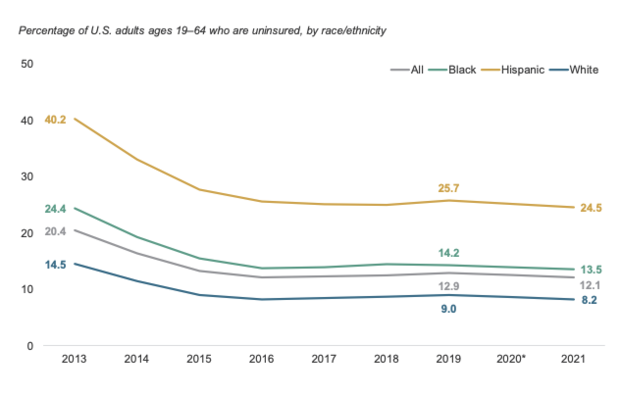
Percentage of U.S. adults ages 19–64 who are uninsured, by race/ethnicity
Coverage inequities between Black, Hispanic, and White adults have narrowed substantially since 2013. All groups reported improvements between 2019 and 2021.

The Commonwealth Fund


“Since its passage in 2010, the Affordable Care Act (ACA) has helped cut the U.S. uninsured rate nearly in half while significantly reducing racial and ethnic disparities in both insurance coverage and access to care — particularly in states that expanded their Medicaid programs,” reads the report.

Data shows that prior to the 2013 implementation of the Medicaid expansion — a provision of the ACA that made more families eligible for Medicaid coverage — 40.2{bf0515afdcaddba073662ceb89fbb62b6b1bf123143c0e06b788e1946e8c353f} of the Hispanic population, 24.4{bf0515afdcaddba073662ceb89fbb62b6b1bf123143c0e06b788e1946e8c353f} of the Black population, and 14.5{bf0515afdcaddba073662ceb89fbb62b6b1bf123143c0e06b788e1946e8c353f} of the White population were uninsured in America. However, by 2021, those numbers dropped significantly to 24.5{bf0515afdcaddba073662ceb89fbb62b6b1bf123143c0e06b788e1946e8c353f}, 13.5{bf0515afdcaddba073662ceb89fbb62b6b1bf123143c0e06b788e1946e8c353f}, and 8.2{bf0515afdcaddba073662ceb89fbb62b6b1bf123143c0e06b788e1946e8c353f}, respectively.

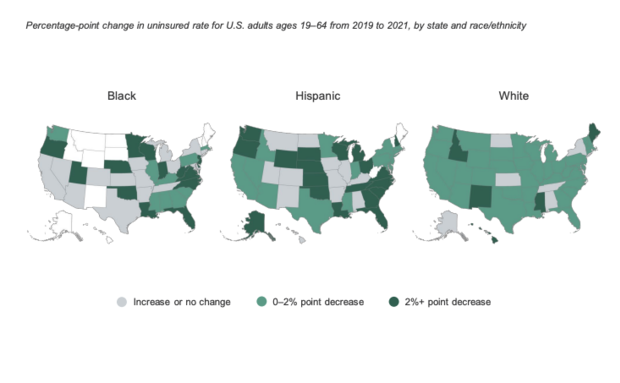
Percentage-point change in uninsured rate for U.S. adults ages 19–64 from 2019 to 2021, by state and race/ethnicity
Uninsured rates for Black and Hispanic adults improved considerably in several states between 2019 and 2021, while White adults experienced modest gains in most regions. 

The Commonwealth Fund


With more than 5 million people gaining coverage between 2020 and 2022 over the course of the pandemic, the overall uninsured rate in the U.S. dropped to just 8{bf0515afdcaddba073662ceb89fbb62b6b1bf123143c0e06b788e1946e8c353f}, a historic low, according to the report.

The report highlights specific ACA successes, including improved coverage rates for Black, Hispanic and White adults.

“The coverage gap between Black and White adults dropped from 9.9 to 5.3 percentage points, while the gap between Hispanic and White adults dropped from 25.7 to 16.3 points,” according to the the study. 

Additionally, the report found that adult uninsured rates for Black, Hispanic, and White people all improved during the first two years of the pandemic across all states — whether they had expanded their Medicare coverage or not —  and that Black and Hispanic adults experienced larger gains in insurance coverage than their White counterparts between from 2019 to 2021.