A Progress Check on Hospital Price Transparency

For decades, U.S. hospitals have generally stonewalled patients who wanted to know ahead of time how much their care would cost. Now that’s changing — but there’s a vigorous debate over what hospitals are disclosing.

Under a federal rule in effect since 2021, hospitals nationwide have been laboring to post a mountain of data online that spells out their prices for every service, drug, and item they provide, including the actual prices they’ve negotiated with insurers and the amounts that cash-paying patients would be charged. They’ve done so begrudgingly and only after losing a lawsuit that challenged the federal rule.

How well they’re doing depends on whom you ask.

The rule aims to pull back the curtain on opaque hospital prices that may vary widely by hospital for the same service or even within the same hospital. The expectation is that price transparency will boost competition, giving consumers and employers a way to compare prices and make informed choices, ultimately driving down the cost of care. Whether that will happen is not yet clear.

Insurers and large employers are also required to post their negotiated prices with all their providers, under separate rules that took effect last summer.

Hospitals have made “substantial progress,” according to an analysis by the federal Centers for Medicare & Medicaid Services of 600 randomly selected hospitals that was published in the journal Health Affairs last month. The agency looked at whether hospitals had met their obligation to post price information online in two key formats: a “shoppable” list of at least 300 services for consumers, and a comprehensive machine-readable file that incorporates all the services for which the hospital has standard charges. This file should be in a format that allows researchers, regulators, and others to analyze the data.

CMS found that 70{bf0515afdcaddba073662ceb89fbb62b6b1bf123143c0e06b788e1946e8c353f} of hospitals published both lists in 2022. An additional 12{bf0515afdcaddba073662ceb89fbb62b6b1bf123143c0e06b788e1946e8c353f} published one or the other. By contrast, the agency’s previous progress assessment in 2021 found that just 27{bf0515afdcaddba073662ceb89fbb62b6b1bf123143c0e06b788e1946e8c353f} of 235 hospitals had both types of lists.

The 2022 analysis “represents a marked improvement,” said Dr. Meena Seshamani, deputy administrator and director of the Center for Medicare at CMS, in a statement. But she also said the advances are still “not sufficient” and CMS will continue to use “technical assistance and enforcement activity” so that all hospitals “fully comply with the law.”

The American Hospital Association said the CMS assessment demonstrated the progress hospitals had made under very challenging circumstances as they grappled with the covid-19 pandemic.

“These are complicated policies that went into effect in the most complicated time in hospitals’ history,” said Molly Smith, group vice president for policy at the trade association. “And we have seen increases in compliance over the past 18 months.”

Some groups that have looked at the hospitals’ posted price data, though, were less upbeat. In an analysis published last month, Patient Rights Advocate examined 2,000 hospitals’ listings and found that only 489 of them, 24.5{bf0515afdcaddba073662ceb89fbb62b6b1bf123143c0e06b788e1946e8c353f} of the total, were compliant with all the requirements of the rule. An earlier analysis in August 2022 found that 16{bf0515afdcaddba073662ceb89fbb62b6b1bf123143c0e06b788e1946e8c353f} met all the requirements.

The advocacy group’s analysis covered not only the two types of lists that CMS looked for but also checked whether the hospitals included required data on specific types of standard charges for every service offered, such as the gross or “chargemaster” charge before any discounts are applied, the discounted cash price, and the negotiated charge by insurer.

Although most hospitals have published files online, too often the data is incomplete, illegible, or not clearly associated with specific health plans or insurers, said Cynthia Fisher, founder and chair of Patient Rights Advocate, which promotes health care price transparency.

“As hospitals continue to post incomplete files with swaths of missing prices, patients are unable to accurately compare prices across hospitals and across plans to make the best health care decisions and protect themselves from overcharges,” Fisher said. Such hospitals were considered noncompliant in the PRA analysis.

The hospital association faulted PRA’s analysis. The contracts that hospitals have with health plans vary substantially from one to the next, and prices are not always based on a simple dollar amount, said Terry Cunningham, AHA’s director of policy. They might be based on a bundle of services or on volume, for example, he said.

“It’s both frustrating and problematic for these other organizations to be weighing in, saying, ‘This cell shouldn’t be blank,’” Cunningham said.

In their 2020 lawsuit, hospitals argued that they should not be required to disclose privately negotiated prices, and maintained that doing so would confuse patients and lead to anti-competitive behavior by insurers.

Last summer, price transparency requirements took effect in the health insurance industry as well, complementing and providing a cross-reference tool for what hospitals have posted. The insurer transparency requirements are even broader than those for hospitals: Insurers and self-funded employers must list every negotiated rate they have with every doctor, hospital, and other health care providers.

Some critics charge that data isn’t user-friendly either. Sens. Maggie Hassan (D-N.H.) and Mike Braun (R-Ind.) sent a letter March 6 to CMS Administrator Chiquita Brooks-LaSure encouraging the agency to take steps to close “technical loopholes” such as large files and a lack of standardization that make it difficult to use the data they’re reporting.

That’s where pricing platforms like Turquoise Health come in. The data becoming available from hospitals and insurers is a vast treasure trove the company is mining to devise user-friendly tools that consumers and businesses can use to discover and compare prices.

In its own analysis of how effective hospital price transparency efforts were in 2022’s third quarter, Turquoise Health found that 55{bf0515afdcaddba073662ceb89fbb62b6b1bf123143c0e06b788e1946e8c353f} of the more than 4,900 acute care hospitals that posted machine-readable files were “complete,” meaning they posted the cash, list, and negotiated rates for a “significant quantity” of items and services. Twenty-four percent of hospitals were judged to be “mostly complete.” (The analysis didn’t evaluate the second type of posting, the list of shoppable services.)

According to Chris Severn, Turquoise Health co-founder and CEO, the company uses a scoring algorithm of 60 variables to assess how complete a hospital’s file is.

“What you end up with is a more nuanced look at these files that hopefully takes into consideration shades of gray,” Severn said, rather than a simple pass-fail rating.

Regardless of the differences in how the hospital disclosures are evaluated, experts generally agree that CMS should require data be reported in a standardized format for ease of comparison and enforcement. CMS has developed a template, but hospitals aren’t required to use it.

For price transparency to work, enforcement also needs consistent attention, experts say. The Biden administration increased the maximum potential penalty to more than $2 million annually per hospital for 2022. Still, last year CMS penalized just two hospitals for noncompliance even though 30{bf0515afdcaddba073662ceb89fbb62b6b1bf123143c0e06b788e1946e8c353f} of hospitals didn’t meet the requirement to post both a machine-readable file of prices as well as a shoppable list.

CMS provided technical assistance to many hospitals to help them come into compliance, said Seshamani, and it also plans stronger enforcement actions.

She said the agency will “continue to expedite” the time frame hospitals have to reach full compliance after submitting a corrective action plan, which indicates they have fallen short on some posting requirements. “CMS also plans to take aggressive additional steps to identify and prioritize action against hospitals that have failed entirely to post files,” she said.

KHN (Kaiser Health News) is a national newsroom that produces in-depth journalism about health issues. Together with Policy Analysis and Polling, KHN is one of the three major operating programs at KFF (Kaiser Family Foundation). KFF is an endowed nonprofit organization providing information on health issues to the nation.

USE OUR CONTENT

This story can be republished for free (details).

Apps are helping make medical diagnoses, but they’re still works in progress

Comment

The identical gadgets employed to just take selfies are becoming repurposed and commercialized for quick access to facts essential for monitoring client health. A fingertip pressed versus a phone’s camera lens can evaluate a coronary heart price. The microphone, saved by the bedside, can screen for rest apnea.

In the greatest of this new environment, the knowledge is conveyed remotely to a clinical experienced for the usefulness and ease and comfort of the individual — all without the need to have for highly-priced hardware.

But making use of smartphones as diagnostic tools remains a work in progress. Whilst health professionals and their sufferers have located some true-entire world achievements, gurus mentioned their all round likely remains unfulfilled and unsure.

Smartphones arrive packed with sensors capable of monitoring a patient’s critical indications. They can support evaluate people for concussions, watch for atrial fibrillation and perform psychological well being wellness checks, to title the utilizes of a couple of nascent apps.

Eager firms and scientists are tapping into phones’ designed-in cameras and mild sensors microphones accelerometers, which detect overall body movements gyroscopes and even speakers. The applications then use synthetic intelligence software program to assess the gathered sights and seems to generate an straightforward relationship concerning sufferers and doctors. In 2021, a lot more than 350,000 electronic wellbeing items have been out there in application outlets, in accordance to a Grand Check out Research report.

“It’s quite really hard to place gadgets into the patient property or in the hospital, but everybody is just walking close to with a cellphone that has a community connection,” claimed Andrew Gostine, a medical professional and CEO of the sensor network corporation Artisight. Most People in america individual a smartphone, together with additional than 60 p.c of men and women 65 and over, according to the Pew Investigate Centre. The pandemic has also manufactured folks far more at ease with virtual treatment.

The makers of some of these solutions have sought clearance from the Food items and Drug Administration to industry them as health-related devices. Other people have been specified as exempt from the regulatory process, put in the identical medical classification as a Band-Support. But how the agency handles AI and equipment understanding-primarily based health care equipment is even now being adjusted to reflect software’s adaptive mother nature.

Ensuring precision and medical validation is essential to securing acquire-in from well being-care providers. And a lot of tools however have to have fantastic-tuning, mentioned Eugene Yang, a medical professor of drugs at the University of Washington.

Judging these new systems is complicated because they count on algorithms constructed by equipment studying and synthetic intelligence to gather data, alternatively than the bodily tools usually utilised in hospitals. So researchers simply cannot “compare apples to apples” with healthcare business requirements, Yang said. Failure to make in these types of assurances can undermine the technology’s targets of easing expenses and access since a health care provider nonetheless will have to confirm effects, he additional.

Massive tech firms this kind of as Google have greatly invested in the spot, catering to clinicians and in-home caregivers, as properly as consumers. At the moment, Google Healthy application customers can verify their coronary heart rate by inserting their finger on the rear-dealing with digital camera lens or observe their respiratory rate utilizing the entrance-struggling with digital camera.

Google’s exploration employs device studying and laptop or computer eyesight, a discipline inside of AI primarily based on info from visual inputs these types of as videos or images. So as a substitute of making use of a blood tension cuff, for instance, the algorithm can interpret slight visible alterations to the physique that provide as proxies and biosignals for blood stress, claimed Shwetak Patel, director of health systems at Google and a professor of electrical and laptop or computer engineering at the College of Washington.

Google is also investigating the usefulness of its smartphone’s crafted-in microphone for detecting heartbeats and murmurs and using the digital camera to maintain eyesight by screening for diabetic eye disorder, according to info the organization posted in 2022.

The tech giant not long ago purchased Sound Life Sciences, a Seattle start-up organization with an Fda-cleared sonar technological innovation app. It works by using a clever device’s speaker to bounce inaudible pulses off a patient’s human body to determine movement and keep track of respiratory.

Binah.ai, based mostly in Israel, is also utilizing the smartphone digicam to estimate important indicators. Its software package studies the location all over the eyes and analyzes the light-weight reflecting off blood vessels again to the lens, business spokesperson Mona Popilian-Yona stated.

Purposes even attain into disciplines these kinds of as optometry and mental overall health:

  • With the microphone, Canary Speech utilizes the exact same fundamental technological know-how as Amazon’s Alexa to analyze patients’ voices for psychological wellbeing situations. The computer software can combine with telemedicine appointments and allow clinicians to display for stress and anxiety and depression employing a library of vocal biomarkers and predictive analytics, explained Henry O’Connell, the company’s CEO.
  • Australia-based mostly ResApp Wellbeing obtained Fda clearance in 2022 for an Apple iphone app that screens for average to critical obstructive slumber apnea by listening to respiratory and loud night breathing. SleepCheckRx, which will involve a prescription, is minimally invasive in contrast with snooze scientific studies now made use of to diagnose snooze apnea.
  • Brightlamp’s Reflex app is a scientific determination assist resource for assisting control concussions and eyesight rehabilitation, between other things. Applying an iPad’s or iPhone’s digicam, the mobile app actions how a person’s pupils respond to alterations in gentle. As a result of equipment understanding evaluation, the imagery gives practitioners data points for analyzing patients. Brightlamp sells immediately to overall health-treatment suppliers and is currently being employed in additional than 230 clinics. Clinicians pay a $400 typical yearly cost per account, which is not included by insurance policy. The Protection Section has an ongoing clinical demo working with Reflex.

In some circumstances, this sort of as with the Reflex app, information is processed immediately on the phone — fairly than in the cloud, Brightlamp CEO Kurtis Sluss mentioned. By processing almost everything on the gadget, the app avoids running into privacy problems, as streaming data somewhere else calls for patient consent.

But algorithms need to have to be qualified and examined by accumulating reams of info, and that is an ongoing system.

Researchers, for instance, have located that some personal computer vision purposes, together with some for coronary heart amount and blood stress checking, can be a lot less precise for darker skin. Scientific studies are underway to find better alternatives.

“We’re not there however,” Yang mentioned. “That’s the base line.”

This short article was manufactured by Kaiser Health and fitness Information, a program of the Kaiser Spouse and children Foundation, an endowed nonprofit group that provides details on health and fitness problems to the country.

New progress in bioimaging based on multi-feature deep learning

New progress in bioimaging based on multi-feature deep learning
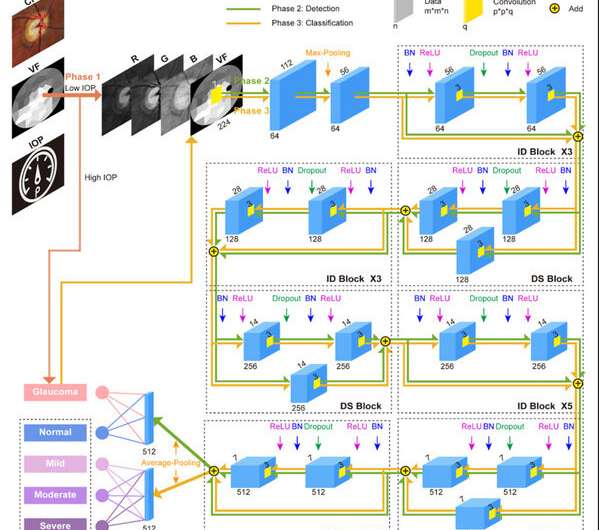
Architecture of MFDL. Credit: Zhejiang University

Deep learning plays an increasingly crucial role in biomedical research, due to its exceptional data processing capacity. However, single-feature data is far from enough to present the full picture of an issue.

Recently, a multi-feature deep learning system was proposed by Prof. Si Ke’s group from Zhejiang University and successfully applied in accurate glaucoma severity diagnosis.

Glaucoma is the leading cause of irreversible blindness. However, manual assessment of the glaucoma is labor intensive and highly dependent on image interpretation by trained specialists, which restricts the wide glaucoma screening in the general population. Recently, single-feature deep learning has shown considerable promise in glaucoma diagnosis.

However, several studies have demonstrated that there may be disagreement between structural and functional measurements in glaucoma patients, which may cause false negative results. Current multi-feature deep learning methods in glaucoma diagnosis mainly focus on distinguishing health and glaucoma without further identification of the severity of glaucoma, leading to very limited significance for clinical treatment guidance.

Prof. Si Ke’s group published their article titled “A multi-feature deep learning system to enhance glaucoma severity diagnosis with high accuracy and fast speed” in the journal Biomedical Informatics on November 3. They proposed a multi-feature deep learning (MFDL) system based on intraocular pressure (IOP), color fundus photograph (CFP) and visual field (VF) to classify the glaucoma into four severity levels.

A three-phase framework of glaucoma screening, detection and classification is used to classify glaucoma into normal, mild, moderate and severe. The proposed model can potentially assist ophthalmologists in efficient and accurate glaucoma diagnosis that could aid the clinical management of glaucoma.

New progress in bioimaging based on multi-feature deep learning
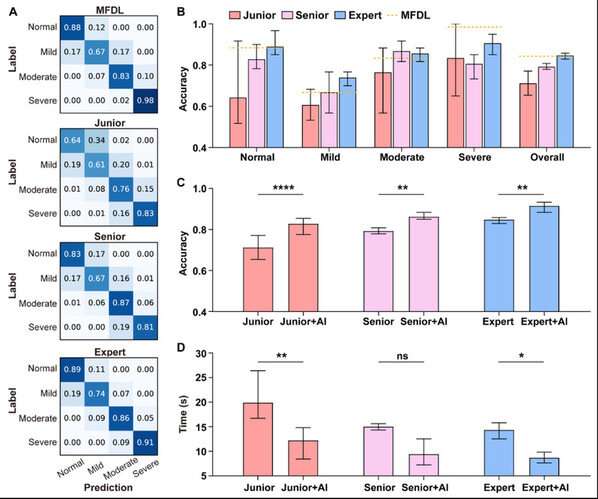
Comparison between MFDL and 14 ophthalmologists. Credit: Zhejiang University

In the study, the researchers designed a three-phase framework for glaucoma severity diagnosis from coarse to fine, which contains screening, detection and classification. They trained it on 6,131 samples from 3,324 patients and tested it on independent 240 samples from 185 patients.

The results show that MFDL achieved a higher accuracy of 0.842 (95{bf0515afdcaddba073662ceb89fbb62b6b1bf123143c0e06b788e1946e8c353f} CI, 0.795–0.888) than the direct four classification deep learning (DFC-DL, accuracy of 0.513 [0.449–0.576]), CFP-based single-feature deep learning (CFP-DL, accuracy of 0.483 [0.420–0.547]) and VF-based single-feature deep learning (VF-DL, accuracy of 0.725 [0.668–0.782]).

Its performance was statistically significantly superior to that of 8 juniors. It also outperformed 3 seniors and 1 expert, and was comparable with 2 glaucoma experts (0.842 vs. 0.854, p = 0.663; 0.842 vs. 0.858, p = 0.580). With the assistance of MFDL, junior ophthalmologists achieved statistically significantly higher accuracy performance, with the increased accuracy ranged from 7.50{bf0515afdcaddba073662ceb89fbb62b6b1bf123143c0e06b788e1946e8c353f} to 17.9{bf0515afdcaddba073662ceb89fbb62b6b1bf123143c0e06b788e1946e8c353f}, and that of seniors and experts were 6.30{bf0515afdcaddba073662ceb89fbb62b6b1bf123143c0e06b788e1946e8c353f} to 7.50{bf0515afdcaddba073662ceb89fbb62b6b1bf123143c0e06b788e1946e8c353f} and 5.40{bf0515afdcaddba073662ceb89fbb62b6b1bf123143c0e06b788e1946e8c353f} to 7.50{bf0515afdcaddba073662ceb89fbb62b6b1bf123143c0e06b788e1946e8c353f}. The mean diagnosis time per patient of MFDL was 5.96 s.

As an efficient auxiliary diagnostic tool, MFDL could assist ophthalmologists who are not specialized in glaucoma severity diagnosis, especially in remote and poor communities. It allows for rapid glaucoma screenings during primary care visits and provides individualized health care advices for glaucoma patients, which is a promising approach to benefit a wide patient population.

More information:
Ying Xue et al, A multi-feature deep learning system to enhance glaucoma severity diagnosis with high accuracy and fast speed, Journal of Biomedical Informatics (2022). DOI: 10.1016/j.jbi.2022.104233

Provided by
Zhejiang University

Citation:
New progress in bioimaging based on multi-feature deep learning (2022, December 15)
retrieved 15 December 2022
from https://medicalxpress.com/news/2022-12-bioimaging-based-multi-feature-deep.html

This document is subject to copyright. Apart from any fair dealing for the purpose of private study or research, no
part may be reproduced without the written permission. The content is provided for information purposes only.