Leading American medical journal continues to omit Black research, reinforcing a legacy of racism in medical knowledge

The leading U.S. medical journal, read regularly by doctors of all specialties, systematically ignores an equally reputable and rigorous body of medical research that focuses on Black Americans’ health.

The American Medical Association created a segregated “whites only” environment more than 100 years ago to prohibit Black physicians from joining their ranks. This exclusionary and racist policy prompted the creation in 1895 of the National Medical Association, a professional membership group that supported African American physicians and the patients they served. Today, the NMA represents more than 30,000 medical professionals.

In 2008, the AMA publicly apologized and pledged to right the wrongs that were done through decades of racism within its organization. Yet our research shows that despite that public reckoning 15 years ago, the opinion column of the AMA’s leading medical journal does not reflect the research and editorial contributions by NMA members.

Invisibility in the opinion column of one of the most prominent medical journals in the U.S. is another form of subtle racism that continues to lessen the importance of equitable medical care and health issues for Black and underserved communities.

As rhetoricians and researchers who study scientific communication, we look at the ways scientific writing perpetuates or addresses racial inequity. Our recent study traced how research is referenced by medical professionals and colleagues, known as citations, of flagship journals of the NMA and AMA: the Journal of the National American Association and the Journal of the American Medical Association.

Invisible research

Our research began with a question: Has the AMA’s 2008 apology had any effect on the frequency with which JAMA opinion writers draw on insights and research of JNMA scholars and authors?

We studied opinion columns, also referred to as editorials, precisely because they are useful indicators of current and future research as well as priorities and agendas. The purpose of editorials is to critically analyze and sift through various opinions and evidence. Effective editorials in scientific journals are especially rich forums for debate within the medical community.

Medical publications like JNMA and JAMA do not simply convey knowledge. They also establish professional community values through the topics that are studied and who is credited for ideas related to research. When writers choose to reference or cite another scholar, they are acknowledging and highlighting that expertise.
Leading American medical journal continues to omit Black research, reinforcing a legacy of racism in medical knowledge
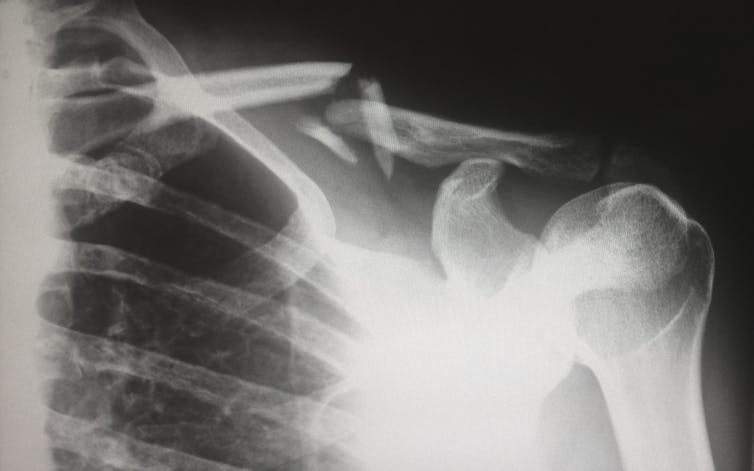
Influential medical journals serve to inform and shape health care.
Harlie Raethel for Unsplash

As such, citations play an important role in the visibility of research. Articles and authors with more citations are more likely to have a greater effect on the scientific community and patient care. Opinion pieces can shape the broader conversation among medical professionals, and citations can widen that circle of communication.

Invisible racism

We traced how frequently JAMA and JNMA opinion writers referenced one another from 2008 to 2021 by reviewing the 117 opinion pieces published in JNMA and 1,425 published in JAMA during this 13-year period. We found that JAMA opinion columns have continued to, in effect, uphold racial bias and segregation by ignoring JNMA findings.
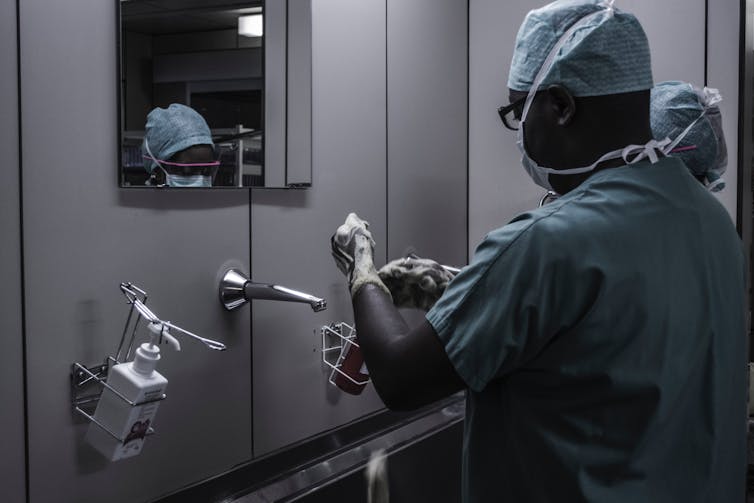
A Black medical professional adjusts gloves in front of a mirror.
The work of Black medical proessionals is being overlooked in national medical journals.
Piron Guillaume for Unsplash, CC BY-ND

Even when focusing on race, racism and health disparities, topics that JNMA has explored in great detail, JAMA opinion columns did not reference JNMA colleagues or research. Only two JNMA articles were credited and referenced in the 1,425 JAMA opinion pieces that we reviewed.

Editors at JAMA did not respond to our requests for their comments on our analysis.

Racial equity in medicine

The story of the AMA and NMA is not only a reminder of the racist history of medicine. It demonstrates how the expertise of Black professionals and researchers continues to be ignored today. The lack of JNMA citations in JAMA research undercuts the AMA’s own work on racial equity and potentially compromises the quality of medical knowledge published in its journals.

For example, a recent study in the Proceedings of the National Academy of Sciences found that scientists from underrepresented groups innovate, or contribute novel scientific findings, at a higher rate than those from majority groups.

An article published in the weekly medical journal of the Public Library of Science noted that diverse research teams are often more successful in developing new knowledge to help treat women and underrepresented patients with greater precision.

Dissolving systemic bias

One way to intentionally tackle racial bias and segregation in medical knowledge is by deliberately referencing Black researchers and their work. To change this dynamic of racial bias, medical journals must pay attention to how much and how often the Black medical establishment is referenced. Health issues in underserved communities would likely become more visible and achieve greater quality of care in keeping with the AMA’s commitment to social justice.

Journal editors could tell writers and editorial staff to prioritize citation practices. Individual authors might conduct research and evaluate their reading habits to intentionally include research from the Black medical community.

However, this work must go beyond individuals. Undoing decades of collective habits and embedded racism requires collaborations that work across systems, institutions and disciplines.

One hand holds a bottle of pills and the other hand holds three white pills.
Racial disparities in health care often result in lower-quality medical treatment and worse health care outcomes for Black Americans.
Towfiqu Barbhuiya for Unsplash, CC BY-ND

For example, libraries, databases, and search engines that help researchers find and evaluate medical publications might review today’s research tools. It is hard to contribute to a research conversation if your work is invisible or can’t be found.

Many tools, like impact factors, rank research according to how influential it is. If research begins in a category of less importance, it can be harder for the technology to rank it equitably. JNMA’s work was already marginalized when the tools that rank research were developed.

Thus, search results can hinder efforts of individual authors to work toward equitable citation practices. Black researchers and their research of Black health were excluded from the beginning, and existing systems of sharing knowledge and drawing attention to important studies incorporate that structural racism.

The AMA apology in 2008 and its recent progress on addressing racism in its publication process are promising steps. Influential medical journals serve to inform and shape health care. Who is referenced in these journals matters to the medical establishment, research funders and, ultimately, to the patients that are served by innovations in medicine.

Attention to citation can help reduce systemic bias in medical knowledge to achieve greater fairness in health care and, in the long run, help increase attention and resources that will help solve health issues in underserved communities.

Who are the leading innovators in ultrasonic stimulation devices for the medical devices industry?

The medical devices industry continues to be a hotbed of innovation, with activity driven by increased need for homecare, preventative treatments, early diagnosis, reducing patient recovery times and improving outcomes, as well as a growing importance in technologies, such as machine learning, augmented reality, 5G and digitalization. In the last three years alone, there have been over 450,000 patents filed and granted in the medical devices industry. , according to GlobalData’s report on Innovation in Medical Devices: Ultrasonic stimulation devices.

However, not all innovations are equal and nor do they follow a constant upward trend. Instead, their evolution takes the form of an S-shaped curve that reflects their typical lifecycle from early emergence to accelerating adoption, before finally stabilising and reaching maturity. 

Identifying where a particular innovation is on this journey, especially those that are in the emerging and accelerating stages, is essential for understanding their current level of adoption and the likely future trajectory and impact they will have. 

150+ innovations will shape the medical devices industry 

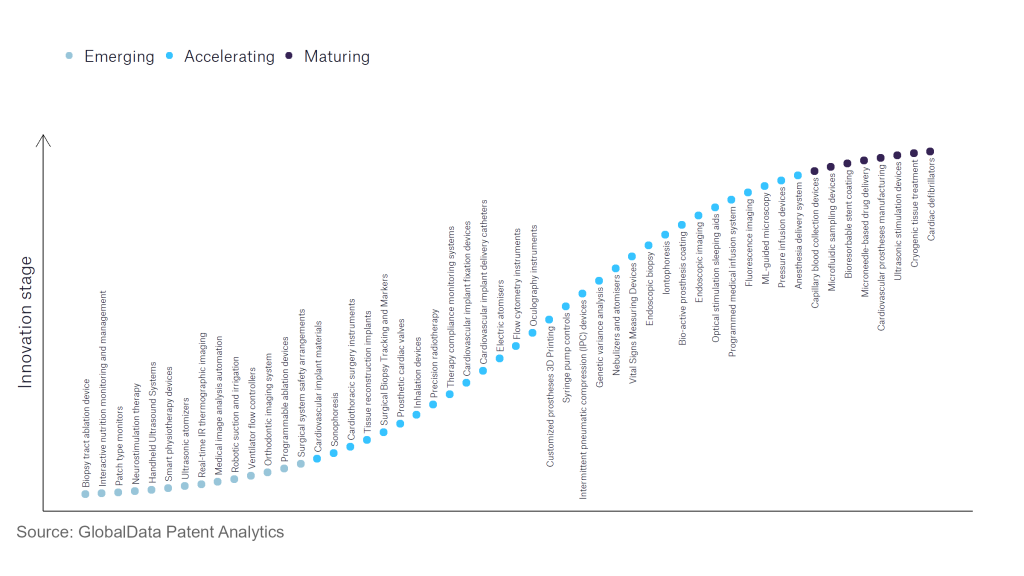
According to GlobalData’s Technology Foresights, which plots the S-curve for the medical devices industry using innovation intensity models built on over 550,000 patents, there are 150+ innovation areas that will shape the future of the industry. 

Within the emerging innovation stage, neurostimulation therapy, smart physiotherapy devices, and real-time IR thermographic imaging are disruptive technologies that are in the early stages of application and should be tracked closely. Precision radiotherapy, electric atomisers, and bio-active prosthesis coating are some of the accelerating innovation areas, where adoption has been steadily increasing. Among maturing innovation areas are bioresorbable stent coating and cryogenic tissue treatment, which are now well established in the industry. 

Innovation S-curve for the medical devices industry 

Who are the leading innovators in ultrasonic stimulation devices for the medical devices industry?

Ultrasonic stimulation device is a key innovation area in the medical devices industry 

Ultrasonic stimulation devices deliver non-invasive pulsed ultrasonic waves to specific areas in the brain to either inhibit or excite neural activity. The devices provide high spatial resolution and can potentially target different sites of the peripheral and central nervous system. It is an emerging therapeutic technique for an array of psychiatric, developmental and neurological disorders, gradually replacing the traditional electric and magnetic stimulation methods.  

GlobalData’s analysis also uncovers the companies at the forefront of each innovation area and assesses the potential reach and impact of their patenting activity across different applications and geographies.  According to GlobalData, there are 40+ companies, spanning technology vendors, established medical devices companies, and up-and-coming start-ups engaged in the development and application of ultrasonic stimulation devices. 

Key players in ultrasonic stimulation devices – a disruptive innovation in the medical devices industry  

‘Application diversity’ measures the number of different applications identified for each relevant patent and broadly splits companies into either ‘niche’ or ‘diversified’ innovators. 

‘Geographic reach’ refers to the number of different countries each relevant patent is registered in and reflects the breadth of geographic application intended, ranging from ‘global’ to ‘local’. 

Medtronic is one of the leading patent filers in the field of ultrasonic stimulation devices. Some other key patent filers in the field include Merz Pharma and Highland Instruments. 

In terms of application diversity, Thermalin leads the pack, followed by Merz Pharma and Autonomix Medical. By means of geographic reach, Autonomix Medical holds the top position, followed by Medical Energetics and Cerevast Medical in the second and third spots, respectively. 

Ultrasonic stimulation devices have become crucial neuromodulation therapeutic tools for patients with brain disorders. The technology has drawn considerable attention for its advantages, such as deeper penetration and no tissue heating. The rapidly ageing population with brain disorders and limited availability of effective surgical and medication alternatives is likely to drive the overall growth of this market. 

To further understand the key themes and technologies disrupting the medical devices industry, access GlobalData’s latest thematic research report on Medical Devices. 


Who are the leading innovators in robotic dental surgery tools for the medical devices industry?

The healthcare equipment field carries on to be a hotbed of innovation, with action pushed by greater need to have for homecare, preventative treatments, early diagnosis, lessening affected person recovery occasions and enhancing results, as very well as a developing worth of technologies these kinds of as device mastering, augmented reality, 5G and digitalisation. In the final three several years alone, there have been more than 450,000 patents submitted and granted in the clinical devices marketplace, in accordance to GlobalData’s report on Robotics in Clinical Devices: Robotic dental surgical procedure resources.

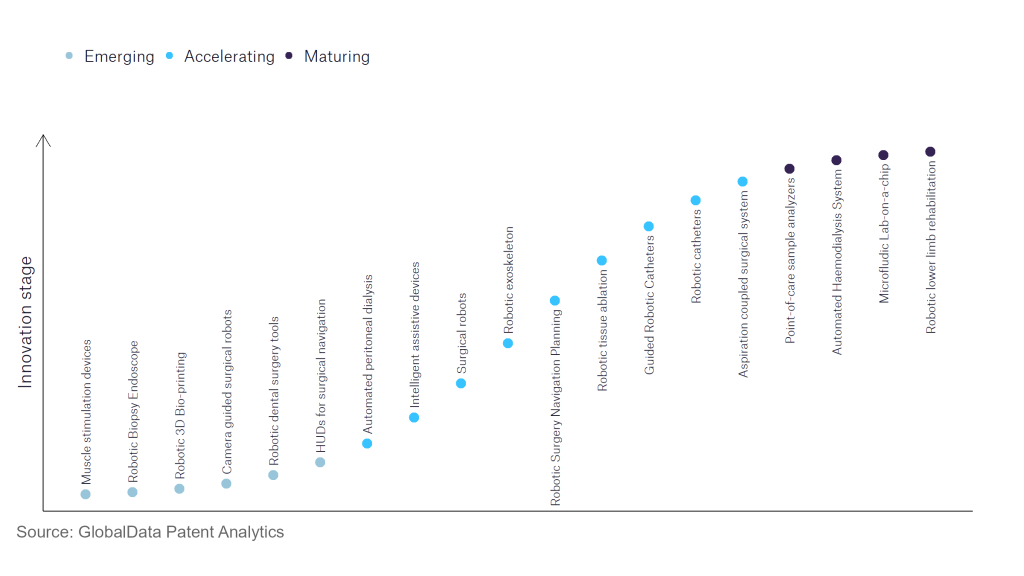
Having said that, not all improvements are equivalent and nor do they abide by a regular upward craze. In its place, their evolution requires the type of an S-shaped curve that displays their normal lifecycle from early emergence to accelerating adoption, just before ultimately stabilising and achieving maturity.

Figuring out in which a unique innovation is on this journey, specially those people that are in the emerging and accelerating stages, is essential for comprehending their current amount of adoption and the very likely foreseeable future trajectory and effect they will have.

150+ improvements will condition the healthcare products sector

In accordance to GlobalData’s Technologies Foresights, which plots the S-curve for the healthcare units market employing innovation depth products created on above 550,000 patents, there are 150+ innovation areas that will shape the upcoming of the business.

In the emerging innovation stage, HUDs for surgical navigation, robotic biopsy endoscope, and camera-guided surgical robots are disruptive technologies that are in the early phases of software and should be tracked closely. Robotic exoskeleton, surgical robots, and robotic catheters are some of the accelerating innovation parts, where by adoption has been steadily escalating. Among the maturing innovation areas are robotic reduced limb rehabilitation and microfluidic lab-on-a-chip, which are now properly founded in the field. 

Innovation S-curve for robotics in the clinical devices sector

Who are the leading innovators in robotic dental surgery tools for the medical devices industry?

Robotic dental operation instruments is a important innovation space in robotics

Robotic dental surgical procedures applications deliver a better quality of care as they supply elevated accuracy and precision, protection, streamlined work processes, and much better workflows when when compared with regular methods. As the dental markets mature and treatment prerequisites adjust, these robotic instruments are anticipated to become commonplace in the treatment method of compact and significant dental interventions.

GlobalData’s examination also uncovers the providers at the forefront of just about every innovation region and assesses the opportunity achieve and impact of their patenting action across various purposes and geographies.  According to GlobalData, there are 10+ firms, spanning technological innovation suppliers, set up health-related equipment organizations, and up-and-coming start-ups engaged in the enhancement and software of robotic dental surgery tools.

Essential gamers in robotic dental operation equipment – a disruptive innovation in the clinical devices field

‘Application diversity’ actions the quantity of distinct applications discovered for each individual pertinent patent and broadly splits providers into either ‘niche’ or ‘diversified’ innovators.

‘Geographic reach’ refers to the selection of unique nations around the world just about every suitable patent is registered in and reflects the breadth of geographic application intended, ranging from ‘global’ to ‘local’.

Neocis and Zimmer Biomet are top patent filers in the subject of robotics dental surgical treatment. Some other essential patent filers in the subject contain Navigate Surgical Systems and X-Nav Systems.

In phrases of software variety, Brain Navi Biotechnology prospects the pack, followed by Dental Monitoring and TROPHY. By signifies of geographic access, Mind Navi Biotechnology retains the major posture, adopted by Dentsply Sirona and Neocis in the next and third spots, respectively.

Though robotics in dentistry gives quite a few benefits, the future relies upon on the acceptance of the two dentists and people to use this know-how in each day apply. Also, additional innovations are required to make treatment method additional precise, available, and precise.

To additional fully grasp how robotics is disrupting the clinical equipment market, accessibility GlobalData’s newest thematic study report on Robotics in Professional medical (2021).


Superbugs are a leading global health risk: UN report

Superbugs are now a top international wellbeing possibility, according to a big U.N. report printed Tuesday.

Important industries like the pharmaceutical and agricultural industries are mostly dependable for this developing threat, inadvertently driving harmful pathogens to evolve to outsmart at this time offered medications, the report claimed.

Antimicrobials, which contain antibiotics, antivirals, antifungals, and antiparasitics are typically applied to stop and take care of infections in people, animals and crops. However, their overuse and misuse have led to the advancement of antimicrobial resistance (AMR) in the earth, in which microorganisms grow to be resistant to therapies that have been as soon as successful. AMR has been discovered by the Planet Wellbeing Business as a person of the best 10 threats to global health, with the opportunity to trigger major hurt to human health and fitness, food items stability and the setting.

Superbugs are a leading global health risk: UN report

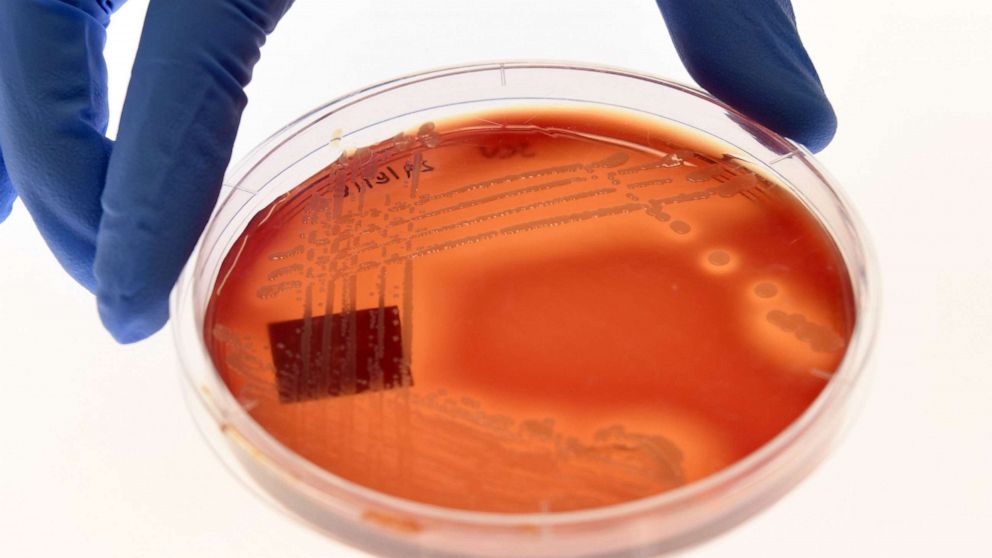
Jean Lee, a PhD scholar at Melbourne’s Doherty Institute, shows the superbug Staphylcocus epidermidis on an agar plate in Melbourne, Sept. 4, 2018. A superbug resistant to all regarded antibiotics that can induce “significant” infections or even death is spreading undetected via clinic wards throughout the globe.

William West/AFP by using Getty Illustrations or photos

In 2019, an approximated 1.3 million fatalities had been right joined to drug-resistant bacterial infections virtually 5 million deaths were being linked with AMR. At this speed, researchers estimate that by 2050 there could be up to 10 million further deaths for every year. The economic toll could outcome in a GDP fall of at minimum USD 3.4 trillion every year by 2030 as properly, according to the report.

“That financial toll will occur in phrases of really lives and livelihoods as a result of disruption of trade losses, livestock efficiency, and higher wellness care expenses, not counting of class the human toll on lives,” said Dr. Anthony D, So, director of the Innovation and Structure Enabling Obtain Initiative at Johns Hopkins Bloomberg School of General public Health. “The influence will be felt across sectors and disproportionately will tumble on poorer nations minimum very well-positioned to mitigate the effect of AMR,” So extra.

AMR is not only a general public health and fitness challenge, but also has ties to the environment.

“Environment plays seriously a crucial part in the progress, transmission and unfold of antimicrobial resistance,” explained Jacqueline Alvarez, Main of the Substances and Wellbeing Branch, United Nations Setting Programme. The report mentions that, “AMR is closely linked to the triple planetary disaster of local weather transform, biodiversity reduction, and air pollution and waste,” which are “pushed by human exercise and unsustainable consumption and output designs.”

“We have authentic tangible and actual physical recommendations…This goes outside of government. It talks about methods, it talks about culture, it talks about various sectors that want to really change the dynamics of the points that they are accomplishing,” Alvarez added.

The U.N. report’s authors argued these problems ought to be fastened with top-down, federal government-stage initiatives, which must be implemented as before long as achievable. Particularly, governments should think about freeing up sufficient funding for countrywide growth planning, weather improve initiatives and monitoring for the evolution of new superbugs.

Governments should also consider positioning regulatory restrictions on the use of antimicrobials on farms, discharge of wastewater from pharmaceutical organizations, improving upon wastewater management and beefing up safer sanitation practices, the report even further urged.

David Oczos, DO, is a Loved ones Medicine resident medical professional at Stony Brook Southampton Medical center and a member of the ABC Information Clinical Device.