Secrecy shrouds troubled state psychiatric hospital in Montana : Shots

Secrecy shrouds troubled state psychiatric hospital in Montana : Shots

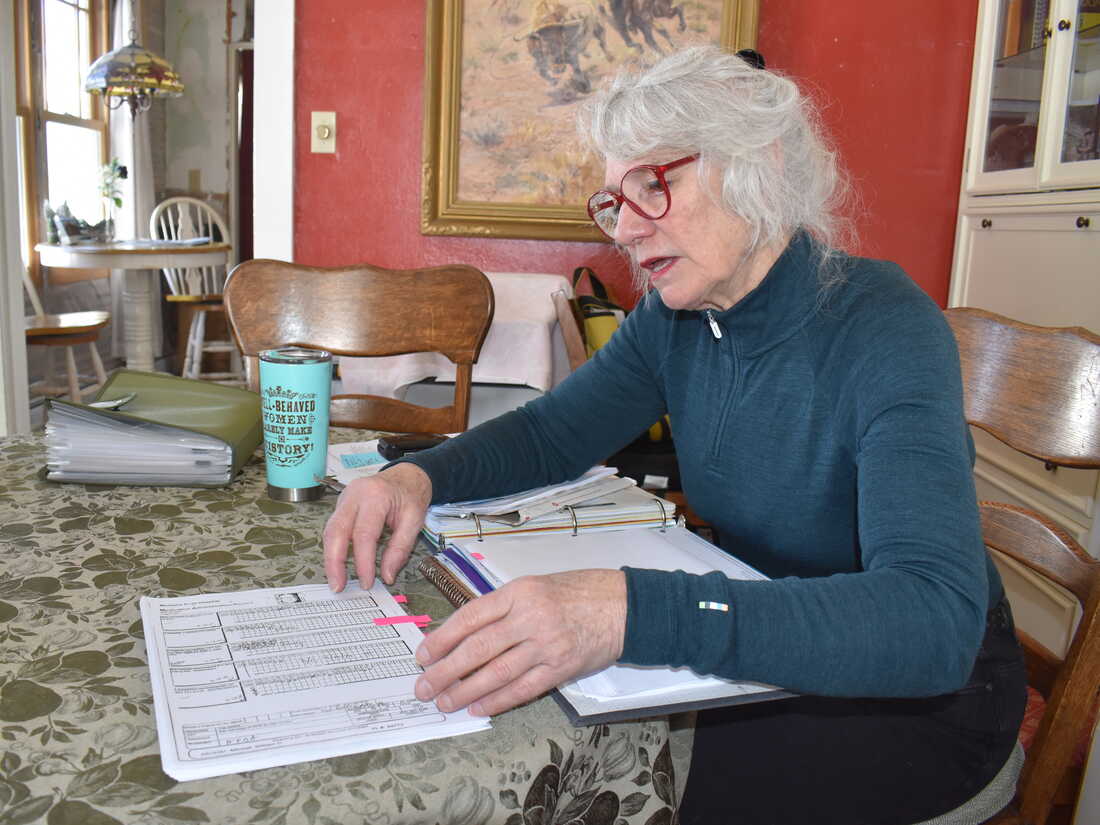
Jennifer Mitchell thumbs through her husband’s medical records from his time at the Montana State Hospital. Records show doctors took Mitchell’s husband off some of his congestive heart failure medications. Mitchell says she was never consulted.

Aaron Bolton/Montana Public Radio


hide caption

toggle caption

Aaron Bolton/Montana Public Radio
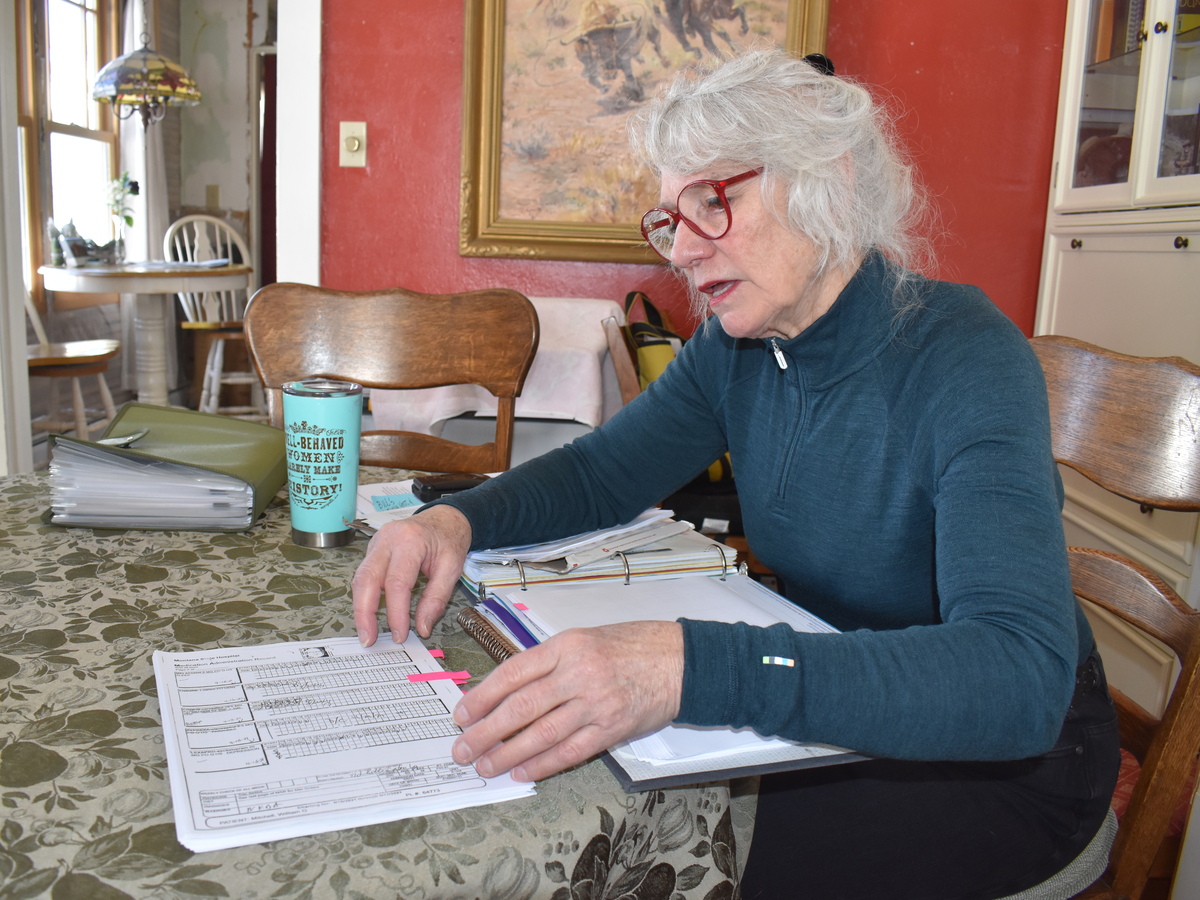

Jennifer Mitchell thumbs through her husband’s medical records from his time at the Montana State Hospital. Records show doctors took Mitchell’s husband off some of his congestive heart failure medications. Mitchell says she was never consulted.

Aaron Bolton/Montana Public Radio

BUTTE, Mont. — Jennifer Mitchell remembered getting a call nearly two years ago that her 69-year-old husband, Bill, had crashed his car and had been committed to the Montana State Hospital, the state-run psychiatric hospital for adults about 20 miles from their home in Butte.

Physicians thought Bill Mitchell had dementia and could be a danger to himself or others, according to medical records. But once he was admitted, his wife really began to worry. She couldn’t visit him because of covid-19 restrictions, and she couldn’t get details about the care or the medicine he was receiving.

“I tried to get an idea of what he was taking, not taking. I could not get answers,” Jennifer said.

When Bill was discharged after 60 days, Jennifer discovered he had been taken off some of his congestive heart failure medications. A month later, he went into cardiac arrest and was moved to hospice care. He died on July 30, 2021, a day after his 70th birthday.

The psychiatric hospital in southwestern Montana has been under scrutiny since the federal Centers for Medicare & Medicaid Services decertified it in April 2022 following investigations into patient deaths and assaults. Federal officials found in the investigations that the hospital had failed to meet Medicare’s “basic health and safety requirements.”

Mitchell said that she was infuriated by the lack of transparency around her husband’s care and that she hoped decertification would force a change for the better. But it’s had the opposite effect. When federal oversight and funding of the Montana State Hospital was removed, so too was the ability of the public to learn details surrounding patient deaths and injuries.

Between April’s decertification and the end of December, five Montana State Hospital patients have experienced severe injuries requiring immediate medical care or hospitalization, and there have been eight substantiated abuse and neglect reports, Montana Department of Public Health and Human Services spokesperson Jon Ebelt said.

Six patients died in that period in the 174-bed hospital, though Ebelt declined to say how many deaths were investigated or if any deaths were deemed preventable.

The Montana State Hospital in Warm Springs, Montana, lost federal funding in April 2022 after an investigation into four patient deaths and a violent patient-on-patient assault.

Aaron Bolton/Montana Public Radio


hide caption

toggle caption

Aaron Bolton/Montana Public Radio
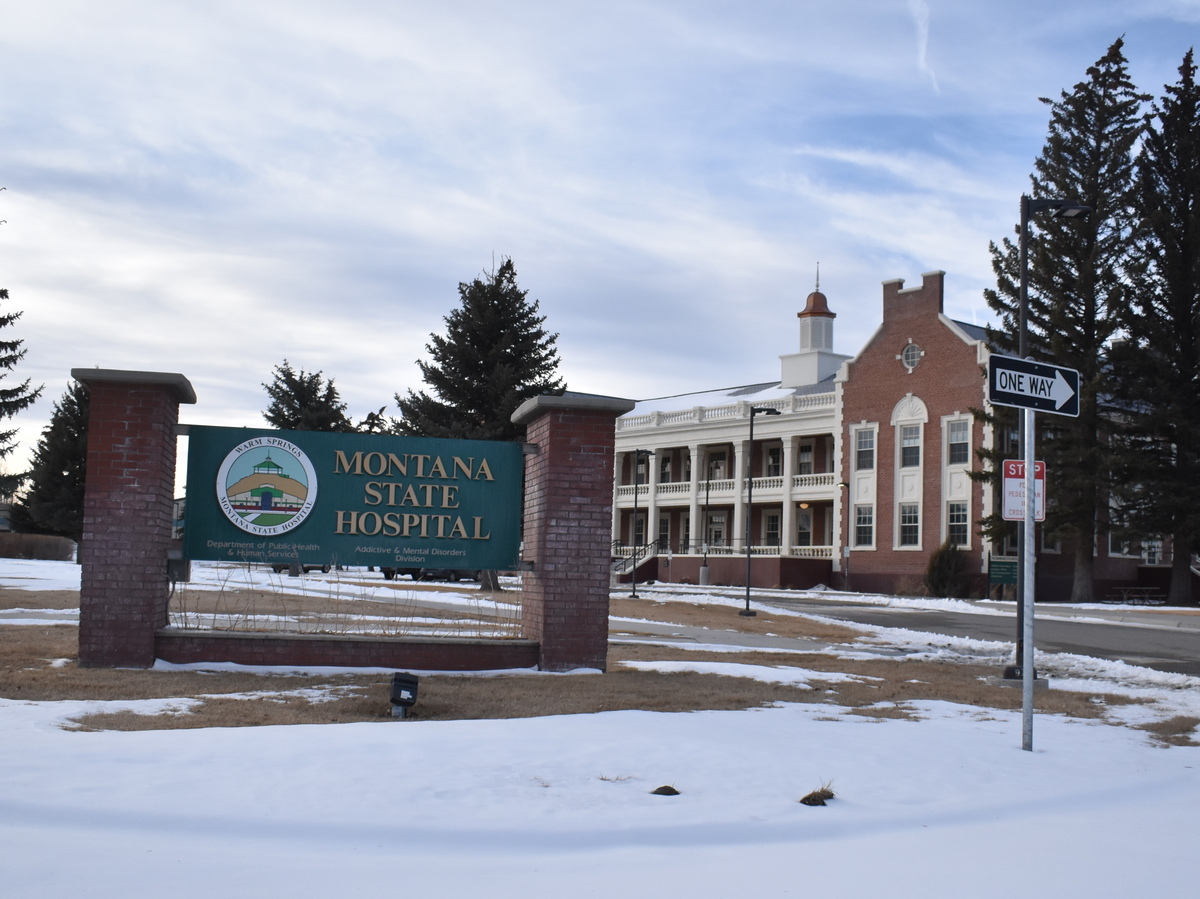

The Montana State Hospital in Warm Springs, Montana, lost federal funding in April 2022 after an investigation into four patient deaths and a violent patient-on-patient assault.

Aaron Bolton/Montana Public Radio

The circumstances surrounding all those incidents are not publicly known. That’s because, unlike federal investigations, state-level investigations are not public record.

The state health department denied a public records request for all investigations into Montana State Hospital patient deaths, injuries, and assaults since losing federal certification. Ebelt cited a Montana law that says any records about providing treatment to the seriously mentally ill are confidential and privileged.

States vary widely in what information about abuse and neglect at state-run medical facilities is made public, said David Hutt, deputy executive director for legal services for the National Disability Rights Network.

Hutt noted that the lack of transparency at the Montana State Hospital is unique because it lost federal certification and oversight, which is extremely rare.

State-hired contractors have produced public reports highlighting improvements at the Montana State Hospital, such as a reduction in falls among geriatric patients. But those reports don’t disclose information related to patient deaths, severe injuries, or substantiated abuse and neglect cases, which had led to decertification in the first place.

The lack of information frustrates some lawmakers as they consider state health officials’ and Republican Gov. Greg Gianforte’s request for a $300 million appropriation to overhaul the state’s mental health system and a nearly $20 million request for capital improvements and CMS recertification efforts at the state hospital.

“We’ve stabilized MSH since that decertification with a change in leadership and with no significant increase in deaths, serious injuries, or substantiated abuse or neglect allegations,” state health department Director Charlie Brereton told state senators during his recent confirmation hearing.

State Democratic Rep. Mary Caferro, who serves on committees considering funding requests and other legislation to reform the state hospital, likened the current level of oversight at the state hospital to the fox watching the henhouse.

“The legislature, when we have good information, thorough information, we make better policy that’s in the best interest of the people we represent,” Caferro said.

Mental health experts agree with Caferro.

“We should know the answers to whether people in the hospital are safe,” said Ben Miller, a clinical psychologist and former president of Well Being Trust, a national foundation focused on mental health care.

A bill that passed through the Montana Senate and is before the House would automatically send all abuse and neglect reports at the state hospital to Disability Rights Montana within five days of an incident. The nonprofit is the federally designated advocacy and watchdog organization for people with disabilities in the state. It recently released a report detailing how some patients were discharged to homeless shelters.

Bernie Franks-Ongoy, the organization’s executive director, said that Disability Rights Montana hopes to be able to share general information from the reports with lawmakers and the public, but noted that state law significantly limits what can be made public. Caferro said she’ll seek to amend the bill to make redacted versions of the reports available to lawmakers and the public.

The Montana Mental Disabilities Board of Visitors also has regular access to the facility and patient records, but its last inspection of the state hospital was in 2019 and the next inspection isn’t expected until next year.

Some lawmakers call the oversight adequate.

“I don’t worry so much about the administration at the hospital hiding anything because they really do have the light shown on them constantly with [Disability Rights Montana] and the Board of Visitors,” said Republican Rep. Bob Keenan, who chairs the committee considering funding requests for the state hospital and the state’s mental health system.

Jennifer Mitchell looks through pictures of travels with her husband, Bill. After Bill was discharged from the Montana State Hospital, Jennifer discovered he was taken off some of his congestive heart failure medications. He later suffered a cardiac arrest and died in hospice care.

Aaron Bolton/Montana Public Radio


hide caption

toggle caption

Aaron Bolton/Montana Public Radio


Jennifer Mitchell looks through pictures of travels with her husband, Bill. After Bill was discharged from the Montana State Hospital, Jennifer discovered he was taken off some of his congestive heart failure medications. He later suffered a cardiac arrest and died in hospice care.

Aaron Bolton/Montana Public Radio

Keenan and Gianforte blame the current conditions at the facility and loss of CMS certification at the state hospital on prior Democratic administrations. Federal officials noted serious deficiencies at the Montana State Hospital in 2017, but federal officials later deemed those issues resolved.

If lawmakers approve the mental health funding requests, the administration plans to open two lower-level mental health facilities in the coming years to reduce demand at the state hospital. However, the hospital would remain a key fixture of Montana’s mental health system, according to state health officials. Mental health advocates and many lawmakers agree the state hospital should be saved.

Jennifer Mitchell, the woman whose husband died shortly after his discharge from the state hospital, thinks the hospital is beyond repair and worries more patients will die at the facility. She reflected on how hospital officials frequently changed her husband’s medication in response to his depression and refusal to eat, and said she believes her husband would still be alive today if he hadn’t been committed there.

“There were just so many little mistakes or little things that could have been different, and it would have been a totally different outcome,” she said.

This story is from of NPR’s partnership with Montana Public Radio and KHN. KHN (Kaiser Health News) is a national newsroom that produces in-depth journalism about health issues.

Inside America’s youth mental health crisis

Kids in the U.S. and around the world are in crisis. 

More than 60{bf0515afdcaddba073662ceb89fbb62b6b1bf123143c0e06b788e1946e8c353f} of children with depression don’t get any mental health treatment, according to Mental Health America. Pair that statistic with the fact that about 80{bf0515afdcaddba073662ceb89fbb62b6b1bf123143c0e06b788e1946e8c353f} of the United States has a severe shortage of child psychiatrists, and the picture becomes clear: there is a growing mental health crisis in the United States and beyond. 

thumbnail-kid-in-crisis-full-screen-website.png

That’s why CBS News and local CBS-owned television stations spent more than six months exploring the sources of the problem, as well as solutions across the country that could address it. This is a collection of the reporting by CBS journalists, committed to the well-being of our kids.  

Documenting kids’ personal struggles

“Bring darkness into the light,” said filmmaker Noemi Weis. 

That’s the goal of her documentary, “Connecting the Dots,” which features young people from around the world candidly talking about their struggles with mental health and the need to be supported. 

“We need to listen in a way that is with open eyes and with providing a safe space, providing no judgment,” Weis told CBS News.  “As much as we believe that we are in a world where we are all connected, the disconnect is huge. The isolation, the loneliness needed to be addressed.” 

CBS News licensed the documentary for an exclusive release nationwide on its streaming platforms Wednesday night. The film will be available to view on demand following the streaming event.

The filmmaker created facilitator guides, in partnership with UNICEF, for youth, parents, educators, mental health professionals, and others to watch the documentary and discuss it.

Seeking mental health help 

If you or someone you know is in crisis, get help from the Suicide and Crisis Lifeline by calling or texting 988. 

In addition, help is available from the National Alliance on Mental Illness, or NAMI. Call the NAMI Helpline at 800-950-6264 or text “HelpLine” to 62640. There are more than 600 local NAMI organizations and affiliates across the country, many of which offer free support and education programs. 

Read more from CBS News and local stations

CBS News will continue to update this page as we publish more stories about youth mental health in the coming days.

Fearing Daniel might harm himself, his parents took him to the only place they could: the emergency room. After seven days in the ER, Daniel was discharged; hospital staff felt he was no longer in danger. His parents disagreed. Read more

Young people are increasingly turning to social media platforms like TikTok to diagnose their mental health struggles and often getting misinformation. A California psychology professor has gained a million followers on TikTok by debunking wellness advice that could do more harm than good. Read more

Jamie Howard, senior clinical psychologist at the Child Mind Institute, joins “CBS Mornings” to discuss the youth mental health crisis and shares tips on how parents can have an open conversation with their teens about mental health and social media. Read more  

In a city with near daily gun violence, the sound of police sirens and the roar of emergency vehicles often become a part of life in some high-crime areas, leaving the ear-piercing noise nearly ignored. For those young people who are becoming more of the victims of gun violence, their trauma seeps through and is ever-present. Read more

A tragedy in the San Francisco Bay Area was the spark a group of California teens needed to do something about breaking the stigma associated with youth mental illness and how to react in an emotional crisis. Read more

Taking a break from social media – even a short one – can have a powerful impact on the self-esteem of young women. Researchers at Colorado College conducted a study with teenage girls, and found that just three days off social media led to significant improvements in body image. Read more

On a piece of land on Chicago’s West Side, the community group BUILD Inc. has done just that. “We’ve got a whole new building,” said David Rodriguez, a BUILD member. “We’ve got a second floor finally.” Read more

Behind the hustle and bustle of Manhattan, and tucked away beneath another busy school day, there’s a break — 45 tranquil minutes in the basement of New Design High School on the Lower East Side.

It’s where kids forget about calculus and chemistry and clear their minds through yoga. Read more

Children languish in emergency rooms awaiting mental health care

This story includes discussions of suicide. If you or someone you know is in crisis, you can get help from the Suicide and Crisis lifeline by calling or texting 988.


While most kids his age were wrapping up their junior year of high school, Daniel was in a box. 

“It was like I was sitting in a gigantic FedEx box being shipped somewhere,” he said. “But like, add one bed and the door had to be closed at all times.” 

Daniel’s years of mental health struggles, stretching back into his early childhood, came to a head in early 2022. His often-uncontrollable emotional outbursts became unmanageable; he was “unraveling,” his parents said. 

CBS News is only using the first names of former patients interviewed for this story to protect their privacy. 

Fearing Daniel might harm himself, his parents took him to the only place they could: the emergency room. After seven days in the ER, Daniel was discharged; hospital staff felt he was no longer in danger. His parents disagreed.  

“We were like no, no, no, he is so not ready,” his mom Kathe said. “We’ve been waiting and waiting, but he is not ready.” 

Daniel’s therapist even wrote a letter to the hospital saying he wasn’t ready to be released. But the hospital said he needed to go home.  

Ten days later, he was back in the ER — this time at another nearby hospital, where he would stay for 19 days.  

“There’s barely any room in the [hospital] room to walk around,” Daniel, now 18, said. “So I was just sitting on my bed all of the time. I had some rough times there, like it was really difficult to, like, stay put, you know, and that’s what they expected [me] to do.”

Read more: Inside America’s youth mental health crisis 

Instead of the intensive mental health care he needed, Daniel said he got very little help while in the room.  

“Dan, rightfully so, he was like, what am I doing here?” Kathe said. “This is not help. You promised help. Where’s the help?” 

“Severe shortage”

Stories similar to Daniel’s are growing more common in the U.S., fueled by a critical shortage of doctors, therapists and resources to address the needs of kids in crisis. 

In Massachusetts, the number of kids landing in ERs for mental health treatment soared 200{bf0515afdcaddba073662ceb89fbb62b6b1bf123143c0e06b788e1946e8c353f}-400{bf0515afdcaddba073662ceb89fbb62b6b1bf123143c0e06b788e1946e8c353f} during the pandemic. That same trend is reflected across the country: a 2021 study found the number of kids stuck in ERs awaiting treatment tripled between 2019 and 2021. 

“I do think it is very bad,” said Dr. Muniya Khanna, research scientist at Children’s Hospital Philadelphia and a former faculty member at the University of Pennsylvania’s Department of Psychiatry. “Suicide is now the number two leading cause of death in children 10 to 24. And this trajectory is only getting worse after the COVID pandemic. And so, we are absolutely in a crisis.” 

Experts say it’s a demand and supply issue: demand for mental health services has increased after the pandemic and the supply of trained staff hasn’t increased enough to fulfill the needs. 

Forty U.S. states and Puerto Rico all have “severe” shortages of child psychiatrists, according to data from the American Academy of Child and Adolescent Psychiatry (AACAP) analyzed by CBS News. Only the District of Columbia reported having enough child and adolescent psychiatrists to meet AACAP standards.

RELATED: Half of all Texas school districts have no mental health services 

Amid this lack of formal mental health treatment options, ERs have become the last and only option for many families, according to numerous mental health experts interviewed by CBS News.  

“Kids languish for days, weeks, sometimes even over a year in children’s hospitals around the country,” said Zach Zaslow, vice president of advocacy and community health at Children’s Hospital Colorado. “This is not just a Colorado problem, and it happens because there’s nowhere else that’s safe for them to go.” 

In Colorado, Michaela, who grew up in foster homes, told CBS News she tried get a special therapist to address her anger, anxiety and depression nearly a dozen times. 

“I would be crying out for help,” Michaela said. “I would say I need support. And it wouldn’t happen until I came to a point where it was too late to really come back and not make a bad decision that in the end would hurt me.” 

Michaela said she tried to hurt herself, including several suicide attempts, over those years. She said the system in its current form does not do enough for young people until they reach a crisis point. 

“I think it’s really hard to get into a good therapist or just a therapist in general,” Michaela said. “It doesn’t matter if they’re good or bad.”  

Michaela said she had a total of eight ER visits for mental health crises, and often left the ER without seeing a therapist. The few times she did meet with a mental health expert, she said her therapy was cut short. 

“It did cause me to have to go back [to the ER] again like less than a year later just because I didn’t get the help that I needed,” said Michaela. “And I think it was partly because I left too early.”  

Michaela, who is now 20, said she is proud that she’s “beat the odds” and survived. She now sits on a youth advisory board as part of a partnership between the University of Colorado and Children’s Hospital Colorado. 

“It definitely made me feel like all of that pain and suffering that I had to go through wasn’t a waste,” said Michaela. “Because now I can be the voice of power for so many other young people who are stuck in the same situation that I was and give them hope that I didn’t have then.” 

A revolving door at ERs

Experts told CBS News the use of ERs as stopgap mental health treatment measures simply doesn’t work.  

“For anybody who’s been in an emergency department for more than a few hours, it is not an ideal place to be,” said Dr. Kevin Carney, an emergency room physician at Children’s Hospital Colorado.   

Massachusetts General Hospital in Boston, where Daniel stayed for 19 days, acknowledged the problem, saying in a statement to CBS News that “shortages [of proper mental health treatment options] have forced youth in crisis — and their families — to turn to their local emergency departments where ongoing capacity challenges may mean waiting for days or weeks for appropriate inpatient care to become available.” 

For kids in crisis, ER visits can make matters even worse.  

A December 2022 American Academy of Pediatrics study found more than a quarter of children who went to ERs for mental health issues were hospitalized — either in ERs or in mental health facilities — within six months. And about 26.5{bf0515afdcaddba073662ceb89fbb62b6b1bf123143c0e06b788e1946e8c353f} were back in the ER within a week.  

Dr. Sandra DeJong, a psychiatrist and the secretary with the American Psychiatric Association, said if kids don’t get proper care early, their condition can rapidly get worse. 

“My fear is that we really have significant risk for the future,” DeJong said. “Because if we don’t address the needs of particularly young people now, then they are going to grow up to be people who are diminished and don’t have the capacity to function in the way that they could have if they had gotten the treatment.  

“And frankly, they’re going to be expensive to care for because if they go untreated, there are situations that are likely to get worse and then they will need higher intensity care. It’s just not an effective way to approach the problem.” 

Meanwhile, more and more kids find themselves in crisis. Suicide attempts by teen girls jumped more than 51{bf0515afdcaddba073662ceb89fbb62b6b1bf123143c0e06b788e1946e8c353f} between 2019 and 2021, according to a study by the CDC. And a recent study published in the journal JAMA Pediatrics found the number of suicide attempts by overdose reported to poison control centers more than doubled between 2000 and 2020.

The number of kids with mental health issues coming to the ER “has been unrelenting,” said Zaslow.  

“And it’s not acceptable,” he added. “It means ultimately, at the end of the day, that there are kids waiting for those beds every single minute as soon as one frees up.”   

Dr. Taylor Louden, medical director at Cook Children’s Medical Center in Fort Worth, Texas, said that in recent years he’s seen more and more young patients come into his ER for mental health problems. 

“We are seeing even younger and younger kids, 8-, 9-year-olds — ages of my kids,” said Louden. “Some are expressing that they want to hurt themselves that they want to die and it’s really tough to hear.” 

Not only are there more kids showing up in ERs, Louden said, but they’re staying longer, too.  

“No one should ever be in an ER longer than a few hours,” he said. “That means that the system is broken, in my mind.” 


Inside an ER’s psych room

04:04

“It’s not acceptable” 

Numerous experts CBS News interviewed said serious investments are needed to increase the mental health resources available to kids in crisis.  

CBS News went to the person in charge of the system in the U.S.: Health and Human Services Secretary Xavier Becerra, who said “we have to do a lot” to fix the problem. 

“It wasn’t until recently that you could get an insurer who actually gave you access to mental health services,” Becerra said. “And we still have a system where mental health is what you get at a primary care physician when you go to a family doctor.  

“That’s got to change. Mental health, it’s got to be part of primary health, not something where you get a referral to a specialist.”  

When asked about children getting stuck in ERs rather than proper mental health treatment facilities, Becerra said it was “not acceptable.” 

“It’s not care,” Becerra said. “It’s housing them until we can get somebody who could give them professional help. They’re crying out and shame on us that we haven’t prepared.”  

Becerra pointed out that several states and the federal government are investing billions of dollars into mental health care. And last summer, the Biden White House announced $300 million to expand mental health services in schools. 

“That’s where the president last year in the State of the Union and again, double down this year has said, Congress, we’ve got to step up, we’ve got to finish the job of making sure that mental health is treated like any other aspect of health,” Becerra said.  

But doctors Khanna and DeJong both said much of this federal spending comes in the form of one-time grants that will eventually expire.  

“Now it’s really time to start investing time and resources on all levels for making that happen more on a regular basis,” said Khanna. 

Attracting more people to work in youth mental health must be part of the equation, DeJong said.  

“You can build all the beds and clinics in the world,” DeJong said. “But if you don’t have enough people to staff them, which is a real problem right now, we’re not going to meet the needs that we’re facing.”   

Secretary Becerra agreed.  

“You just got to put your money where your mouth is. And President Joe Biden is trying to put his money there,” Becerra said. “We need now the partnership with Congress to make it happen.”  


HHS Secretary Xavier Becerra speaks about youth mental health crisis

06:53

Some aren’t waiting on the federal government to help, instead trying new approaches in attempts to address this crisis and meet young people where they are.   

One of those approaches comes in the form of a youth advisory group at Children’s Hospital Colorado. The advisory group consists of teenagers who regularly meet to give advice to therapists and hospital officials about how to meet the needs of young people. 

Another new approach: construction of a new, first-of-its-kind facility at the Cherry Creek School District outside Denver that will combine a mental health medical facility and a school when it’s completed in the fall of 2023.  

When kids in crisis leave ERs 

Finding help after a hospital stay can be even more challenging. 

The Academy of Pediatrics study found just 31.2{bf0515afdcaddba073662ceb89fbb62b6b1bf123143c0e06b788e1946e8c353f} of children had a mental health follow-up visit within seven days of leaving the hospital and only about half had a mental health follow-up with a specialist within 30 days of leaving the hospital. 

“I think what is very distressing about this mental health crisis that we’re facing is that while we very much take as part of our responsibility to make sure that we are keeping kids safe and stabilizing them when they’re in crisis or have harmed themselves,” Dr. Carney said. “The very hard thing is knowing that at that point I can’t do anything else for that child.” 

Dr. Glenda Wrenn Gordon knows those statistics firsthand: she and her 18-year-old son lived them.  

Wrenn Gordon said even though she’s an Atlanta-area psychiatrist herself, she was surprised by the effort she had to put in to find help for her son in crisis after she got him to the ER. She said she thought she knew what to do, but still found the system of finding and getting care post-hospital visit to be daunting. 

“We moved very quickly through the ER because I knew exactly what to say and how to say it to get us where we needed to go,” she said. “I was extremely frustrated for how hard it was. I was thinking about these other families. What hope do they have and what it must be like?”  

When asked what she fears most if the system is not changed, Wrenn Gordon was blunt. 

“We will continue to bury our children,” she said. 


Atlanta psychiatrist struggles to find help for her son

02:56

If you or someone you know is in crisis, get help from the Suicide and Crisis Lifeline by calling or texting 988. 

In addition, help is available from the National Alliance on Mental Illness, or NAMI. Call the NAMI Helpline at 800-950-6264 or text “HelpLine” to 62640. There are more than 600 local NAMI organizations and affiliates across the country, many of which offer free support and education programs. 

Idaho dropped Medicaid recipients instead of trying hard to track them down : Shots

Idaho dropped Medicaid recipients instead of trying hard to track them down : Shots

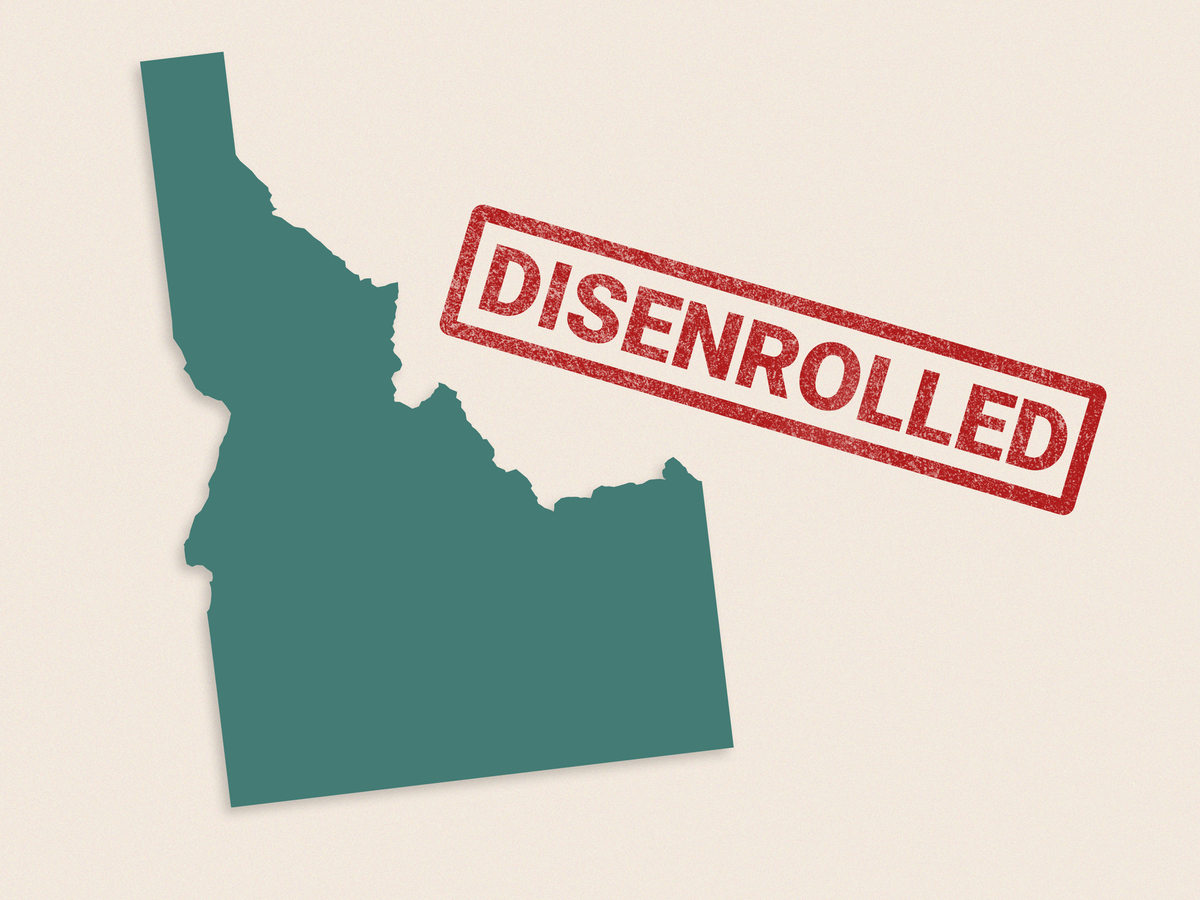
Idaho removed nearly 10,000 people from Medicaid in the pandemic’s first years when enrollees couldn’t be reached. The episode previews what could occur in other states after April 1, when a COVID-era coverage mandate ends.

Eric Harkleroad/KHN


hide caption

toggle caption

Eric Harkleroad/KHN


Idaho removed nearly 10,000 people from Medicaid in the pandemic’s first years when enrollees couldn’t be reached. The episode previews what could occur in other states after April 1, when a COVID-era coverage mandate ends.

Eric Harkleroad/KHN

During the first two years of the COVID-19 pandemic, while the federal government was trying to prevent people on Medicaid from losing health coverage, Idaho dropped nearly 10,000 people from the safety-net program.

Federal law generally banned states from dropping people, and federal officials said Idaho acted improperly. Idaho officials, however, said they didn’t think they did anything wrong.

The episode, revealed in documents KHN obtained through a public records request and in interviews with state officials, offers a preview of what could soon unfold across the United States for millions of people covered through Medicaid, the federal-state health insurance program for people with low incomes.

It shows how easily state bureaucracies can disenroll people they shouldn’t be disenrolling, leaving those people in financial and medical jeopardy. It also illustrates the potential for confusion and disagreement over what procedures states should follow before cutting off anyone’s benefits, particularly when enrollees can’t be reached.

Why it could happen in other states starting April 1

A COVID-19 relief law Congress enacted in 2020 prohibited states from removing people from Medicaid except in a few narrow circumstances, such as if an enrollee died or moved out of state.

On April 1 of this year, after the prohibition expires, states will resume removing people who no longer qualify or do not furnish needed information. That process has come to be known as “the unwinding.” Some states see the end of the mandate as a chance to quickly winnow Medicaid rolls that have grown to record levels.

Idaho Gov. Brad Little was among 25 Republican governors who told President Joe Biden in a December letter, that, by keeping ineligible people on the Medicaid rolls, the mandate was “negatively affecting states.”

Idaho’s Medicaid program had nearly 450,000 enrollees at the start of this month. The state said about 150,000 of them no longer qualified or had not been in contact with the program during the public health emergency.

By the time recipients notice, ‘the damage will be done’

Nationally, as disenrollments ramp up, many officials are predicting a mess. The Department of Health and Human Services has predicted that nearly 7 million people still entitled to Medicaid benefits will lose coverage because they fail to complete renewals or state governments won’t be able to contact them.

People may not realize they’ve been dropped until they seek care.

“The damage will be done,” said Tricia Brooks, a research professor with Georgetown University’s Center for Children and Families.

Idaho terminated Medicaid benefits for more than 9,800 beneficiaries during the pandemic after mail the state sent them was returned as undeliverable and other attempts to confirm that they still resided in Idaho failed, according to emails obtained by KHN between the Idaho Department of Health and Welfare and the U.S. Centers for Medicare & Medicaid Services.

The emails, sent last spring and summer, detail Idaho’s rationale for the terminations, CMS’ concerns, and the state’s efforts to restore benefits.

CMS officials maintained that, when Idaho’s mailings were returned with no forwarding address or an out-of-state forwarding address, the state didn’t do enough to make contact with the beneficiaries and ensure they no longer lived in Idaho.

“CMS appreciates the state’s efforts to come into compliance,” Sarah O’Connor, a CMS official, wrote on Aug. 18 of last year.

In meetings with CMS, Idaho officials were told the state could not kick people off if it didn’t make “physical contact,” Shane Leach, administrator of the Division of Welfare at Idaho’s Department of Health and Welfare, recounted in correspondence with CMS.

“What they were saying early on,” Leach told KHN, “is, basically, we didn’t do enough outreach to really prove that this person was no longer in Idaho and not eligible for Medicaid.”

He added: “My perspective is, we did our due diligence.”

Many calls and letters went unanswered, Idaho says

For the first two years of the pandemic, when Idaho received returned mail with an out-of-state forwarding address or no forwarding address — possibly indicating the enrollee no longer lived in Idaho — Leach said state officials would call them.

A lot of the calls went unanswered, he said.

“They’re really concerned about physically talking to the person or having them say, ‘Yes, I’m in another state,'” Leach said of CMS. “And so that’s where they said, ‘OK, well, you need to reinstate those individuals.'”

“We felt like we were following the guidance,” said Jennifer Palagi, a deputy director at the Idaho health department.

CMS guidance in August 2021 stated that returned mail alone was not reason enough to disenroll Medicaid beneficiaries during the public health emergency. But if CMS had issued a written version of the standard to which it was holding Idaho — in which disenrollments would be justified only if the state made contact with the enrollee — Medicaid consumer advocates and other specialists said they were unaware of it.

CMS declined to answer several questions about the Idaho situation.

“CMS is committed to working with states to ensure continuity of coverage for eligible individuals, including those for whom the Medicaid agency receives returned mail,” Bruce Alexander, director of CMS’ office of communications, said in a written statement to KHN.

According to the batch of emails obtained by KHN, Idaho in March 2022 did change the state’s procedures after discussions with CMS. By July, the state Medicaid agency had reinstated benefits for 6,400 people the state couldn’t get hold of.

In one of the emails the Idaho Medicaid agency sent to CMS last July, the state said it was reviewing the extent to which it needed to pay medical bills the program had originally rejected.

It’s a long-standing problem — and about to get bigger

The inability to reach Medicaid enrollees has been a long-standing problem. The paperwork that agencies send people to fill out often goes unreturned. Some ends up at the wrong address. Up-to-date phone numbers or email addresses may not be available to state and county workers.

“In a perfect situation, a member responds to give you their current address, a phone number, an email address, etc.,” said Jack Rollins, director of federal policy for the National Association of Medicaid Directors. “But that is not the case for a lot of situations.”

And that’s bound to become a larger problem, consumer advocates say, after the pandemic-era enrollment mandate ends this spring. On Jan. 27 of this year, CMS detailed to health agencies in all states the minimum they’ll need to do to reach a Medicaid recipient who hasn’t responded to a mailed form: Before ending benefits, a state must try to obtain up-to-date contact information and attempt to reach the person through at least two means, such as by mail, phone, email or text message, if those means are available.

Still, “there’s just a lot of variation in terms of what that could look like,” said Farah Erzouki, a senior health policy analyst for the Center on Budget and Policy Priorities, a think tank in Washington, D.C.

If any state isn’t following the rules, Georgetown University’s Brooks said, it can take months to fix the problems — all while people’s benefits hang in the balance.

“This is what we want to avoid,” Brooks said. “We don’t need to spend the next three years after ‘the unwinding’ trying to get people back on who should not have been disenrolled.”

KHN (Kaiser Health News) is an editorially independent, national program of KFF (Kaiser Family Foundation).

Teens turning to TikTok for mental health advice are self-diagnosing

It’s a relatable feeling. You’re feeling unwell, have multiple symptoms, and you decide to Google what might ail you. Sometimes doom takes hold and you self-diagnose with the worst-case scenario. But it’s not just physical ailments. CBS News found that as the mental health crisis among American teens deepens, they seek out alternative forms of support and information. Increasingly young people turn to social media platforms like TikTok and diagnose themselves with serious mental health problems.

With qualified therapists expensive and increasingly hard to find many young people search for answers on social media platforms where the answers are abundant and free but not necessarily accurate.

According to a recent Pew Research survey, 1 in 6 Gen Zers use TikTok as a search engine — a place not only to watch dance videos and lip synching, but to find bite-sized chunks of informational content.

“If I’m trying to figure out how to do something, I feel like it’s easier to go on TikTok,” said Alexis Diomino, a third-year psychology student.

It’s not just a search engine. It’s a place to give advice, share feelings and experiences and talk about serious mental health disorders.

“Social media therapy”

At an early age, 19-year-old Samantha Fridley was diagnosed with anxiety and depression. By the time she was in fifth grade she began having suicidal thoughts. Even with therapy her struggles with anxiety and thoughts about self-harm made her feel alone.

“I felt like there was no one that could help me. And I felt because I had been through so much that there is just no treatment for me,” said Fridley. “I started looking for other people through social media. Then I looked through Instagram — any social media I could. And then Tik Tok.”

It was on TikTok that Fridley said she began searching for mental health advocacy and motivation. It’s not uncommon. On TikTok the hashtag “mental health” has been searched more than 67 billion times.

The phenomenon now gaining traction is referred to as social media therapy.

“What they are doing is they are going into the interactive media space to soothe themselves, to make themselves feel better, to make themselves the master of that environment when they don’t feel that they’ve mastered the environment of the outside world,” said Dr. Michael Rich, director of the Digital Wellness Lab at Boston Children’s Hospital.

“There is a demand that’s being filled by people now. The question really is, is how well and how safely is it being filled?”

Experts like Rich say that open conversation about mental health can provide support and reduce stigma. But there are concerns that turning to social media influencers as de facto therapists is risky.


How the social media “echo chamber” can harm teens’ mental health

12:18

“I think that we need to understand why people are coming to these influencers for help. But we also have to have some kind of quality control,” said Rich. “Unfortunately, when these young people, usually young people, are untrained and with the best of intentions, are trying to be there for their peers, they are, first of all, not able to necessarily detect how much distress someone is in or how much how close someone is to actually harming themselves. And so, I think there’s a real issue here of the demand far outstripping the need.”

The algorithm feeding frenzy

Fridley says her search for mental health related content led her down a dangerous rabbit hole. She was already seeing a therapist for her diagnosed anxiety and depression but started watching countless videos of influencers sharing thoughts on serious mental health conditions — and says TikTok flooded her feed with hundreds more.

“As you look through TikTok and as the algorithm strengthens, it turned into diagnosis and turned into other things like ADHD and borderline personality disorder and more depression and anxiety,” said Fridley.

The content appearing in her “For You” feed was the result of TikTok’s unique algorithm which sends suggested videos based on what you’ve searched, shared or liked. Fridley says being bombarded with vague symptoms of various mental disorders led to her diagnosing herself.

“It just got to a point where I was losing sleep because of it. I would be up until like 3 a.m. on TikTok, just like researching,” she said. But Fridley was never professionally diagnosed with any of those disorders.

In an email to CBS News TikTok said the “For You” feed “…reflects preferences unique to each user. The system recommends content by ranking videos based on a combination of factors, including videos you like or share, accounts you follow, comments you post, and content you create.”

TikTok told CBS News it began testing ways to avoid recommending a series of similar content on topics to users and is checking to see if their system inadvertently feeds a narrower range of content to its viewers.

But there are concerns about what the unintended consequences of providing a steady stream of mental health content can lead to — especially, when it’s inaccurate or misinformed.

In one recent study by the Center for Countering Digital Hate, researchers posed as 13-year-old users and searched and “liked” mental health videos. They found that TikTok pushed potentially harmful content to these users on average every 39 seconds. Some users received recommendations for content about suicide within 2.6 minutes of joining the app.

“What’s online is a free-for-all. There really is no accountability for this and there is no responsibility taken,” said Rich.

According to one analysis published in The Canadian Journal of Psychiatry of popular TikTok videos about ADHD, 52{bf0515afdcaddba073662ceb89fbb62b6b1bf123143c0e06b788e1946e8c353f} were deemed misleading.

TikTok wouldn’t agree to an interview but in a statement to CBS News a spokesperson wrote: “We will remove misinformation that causes significant harm to individuals, our community, or the larger public regardless of intent.”

The company also wrote: “We care deeply about the well-being of our community, which is why we continue to invest in digital literacy education aimed at helping people evaluate and understand content they engage with online. We strongly encourage individuals to seek professional medical advice if they are in need of support.” (Read the full TikTok statement here.)

Debunking misinformation

“I’ve talked even to people at TikTok, and I kept saying, ‘you know, at some point, I know you only care about misinformation if it’s COVID, or politics. You don’t care about misinformation, about psychology, but you have to understand this is mental health,'” said Dr. Inna Kanevsky, a professor of psychology at San Diego Mesa College.

For the last few years, Kanevsky has been battling psychological misinformation on TikTok, debunking faulty mental health information one video at a time.

“You can give people advice based on your experience as long as you’re clear that that’s where you’re coming from,” said Kanevsky.

With a million followers and more than 36 million views, Kanevsy has become a TikTok star and reverse influencer herself. But her candid takes on mental health misinformation is not always well received — especially from those users who find themselves on the receiving end of a debunking video.

“If I correct people… people get very mad at me because they [say] they are just talking about their personal experience. They’re not doing anybody any harm.”

But Kanevsky says there can be actual harm which is why she steps in.

“People believe all kinds of things that are not actually true because somebody they find relatable said it, and they find this person more relatable than some medical doctor or some Ph.D. with science articles. And they want to value the personal experience.”

Social media experts say that is at the heart of the problem.

“There are content creators who are trained physicians, trained clinicians people working in disinformation in this space trying to counter it. But it’s almost like being a salmon and swimming upstream,” said Robin Stevens, an associate professor of communications at the University of Southern California in Los Angeles.

“To see real change, it really does have to come at the platform level and requires quite a bit of content moderation,” she said.

Stevens runs the Health Equity and Media Lab at USC. She typically works with Black and Latinx youth and studies how they are using social media to find solutions to the public health issues they face — including mental illness.

For most of her career, Stevens studied and critiqued social media platforms. But this past year she began working with Instagram’s Well-being Creator Collective — a pilot program aimed at influencers and content creators to educate and train them on how to create responsible mental health content.

Meta, the parent company of Facebook and Instagram, recently held a two-day summit with these content creators in Los Angeles. Stevens is one of their expert advisers.

“As they created Reels, we content-analyzed them to see what the level of disinformation was. What was the level of how much the teens respond to it? What was the content that teens were viewing over and over?” she said. “And then we would feed that back to them to help them create better Reels.”

“I was a little skeptical to see what they would really be doing. Was this just PR? And I will say that working in the Wellness Collective, they actually had a brilliant approach of how to bring more supportive content that showed they understood how youth use media,” said Stevens.

But until more content moderation happens at the platform-level how youth use media means users must be aware of the ways in which their feeds are populated.

Samantha Fridley says it took a full detox for her to finally free herself from the grips of mental health influencers and self-diagnosis. She spent 56 days in residential rehab away from her phone and TikTok. And while she still uses the app, the way she uses it has changed dramatically. She stopped watching mental health videos and searched for content that would reset her feed, like K-pop and comedy.

“It’s a great resource for funny videos,” said Fridley. “But it’s not a good resource for diagnosing yourself. And if you start diagnosing yourself, you’re going to fall into a spiral that you will really have a hard time getting out of.”

Advice for teens and parents

Both Dr. Kanevsky and Dr. Rich say parents need to play an active part in how their children are engaging with mental health-related social media posts. Dr. Rich says it’s like a power tool — using it safely must be taught.

A couple of strategies teens can use if their feeds are flooded with negative posts is to try and reset the algorithm by changing the types of videos they watch, like and comment on. Watching positive posts can help displace the negative content. They can even delete their accounts and start from scratch.

TikTok, Snapchat, YouTube and Meta are named in a federal lawsuit joined by families around the country claiming the platforms’ algorithms have caused depression, eating disorders and suicide in young people.  Statements from Snapchat, YouTube owner Google and Meta to CBS News can be found here.

Biden admin to limit telehealth prescriptions for some controlled drugs

The Biden administration is shifting to involve clients to be evaluated by a medical doctor in particular person just before receiving prescriptions for some controlled prescription drugs, which includes Adderall and OxyContin.

The proposal would reverse a policy enacted through the coronavirus pandemic that authorized physicians to prescribe these medicines via telehealth appointments. The move will make it much more challenging for Individuals to entry some prescription drugs employed for dealing with ache and psychological wellness disorders.

The Drug Enforcement Administration declared the proposed guidelines on Friday, which point out that telehealth flexibilities will be prolonged for frequent, non-controlled medicines but plan II medicines and narcotics will be prohibited with out an in-individual appointment.

Patients have to check out a health practitioner in human being at minimum once to acquire an first prescription for medicine the federal governing administration thinks have the maximum prospective for abuse, such as Vicodin, OxyContin, Adderall and Ritalin. Refills for these medicines could nevertheless be approved in excess of telehealth appointments.

NEW YORK NURSE ACCUSED OF SLAMMING Newborn On to BASSINET FIRED, Less than INVESTIGATION

Biden admin to limit telehealth prescriptions for some controlled drugs

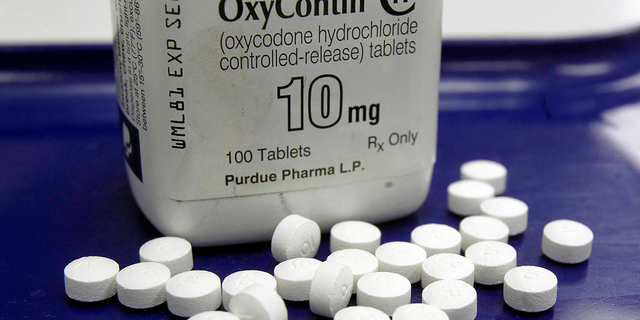
OxyContin supplements are organized for a picture at a pharmacy in Montpelier, Vermont. (AP Photo/Toby Talbot)

Health professionals will only be capable to prescribe managed remedies like Ambien and Xanaxas, as properly as medications applied to handle opioid habit, for 30 days. Any refills for these medications will need an in-particular person analysis.

The regulations intention to sustain expanded obtain to telehealth, which has been critical for hundreds of thousands of patients, notably all those dwelling in rural regions, when also balancing safety.

“DEA is dedicated to making sure that all Individuals can accessibility desired medicines,” DEA Administrator Anne Milgram claimed in a statement. “The permanent expansion of telemedicine flexibilities would continue larger access to treatment for clients across the nation even though making sure the protection of clients. DEA is dedicated to the growth of telemedicine with guardrails that stop the on the internet overprescribing of managed medicines that can cause harm.”

The shift arrives amid an ongoing opioid disaster and a developing selection of overdose deaths from managed drugs this kind of as fentanyl.

Adderall XR capsules are displayed in front of a medicine bottle.

Adderall XR capsules are displayed in front of a drugs bottle. (AP Photo/Jenny Kane)

The DEA mentioned the proposed telemedicine procedures will advance its aim of increasing obtain to medication for opioid use ailment to anybody in the country who needs it. 

“Medication for opioid use condition helps these who are battling to overcome material use condition by aiding persons obtain and maintain restoration and also avoid drug poisonings,” Milgram explained. “The telemedicine polices would continue on to develop access to buprenorphine for patients with opioid use problem.”

U.S. overdose deaths reached a document in 2021, and about a few-quarters of those had been from opioids. But the loss of life toll from synthetic opioids like fentanyl far exceeded people similar to prescription medicine that very same 12 months, according to Facilities for Condition Command data. Fentanyl is progressively existing in the black marketplace, as the capsules are normally pressed into phony prescription drugs or combined into other prescription drugs.

Facial area MASKS Produced ‘LITTLE TO NO DIFFERENCE’ IN Avoiding Spread OF COVID, SCIENTIFIC Review FINDS

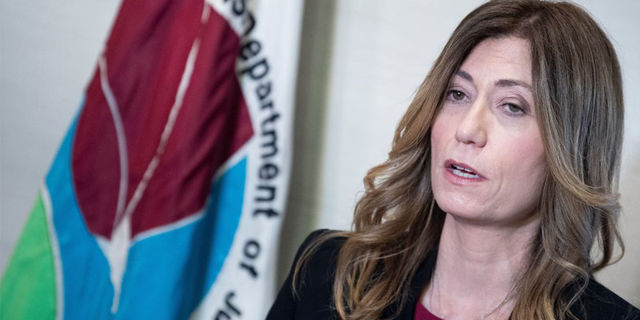
DEA Administrator Anne Milgram speaks at a press conference.

DEA Administrator Anne Milgram speaks at a push convention. (Getty)

Simply click In this article TO GET THE FOX News App

Quite a few states have presently moved to restore restrictions for telehealth treatment. As of October, just about 40 states and Washington, D.C., had ended emergency pandemic declarations making it easier for doctors to see patients in other states.

The proposed rules come just after startups in the telehealth sector launched in new many years to treat and prescribe drugs for mental wellness or focus deficit disorders. The marketplace and persons with difficulty accessing in-particular person treatment have mostly benefitted from the pandemic-period policy.

The new guidelines are anticipated to be in put before the COVID-19 public overall health emergency expires on May well 11.