China orders rural hospitals to prepare for migrants’ return

BEIJING — China’s Cupboard requested rural parts Friday to put together for the return of migrant staff this holiday getaway year in hopes of stopping a key surge in COVID-19 conditions in communities with constrained health-related sources.

Returnees will have to put on masks and steer clear of make contact with with aged folks and village committees should watch their movements, the suggestions claimed, but didn’t point out the chance of isolation or quarantines.

China final 7 days dramatically eased some of the world’s strictest COVID-19 containment actions and now says it has shifted focus from prevention and handle to cure.

The moves have sparked fears of a major surge in circumstances in the world’s most populous country, specially all-around the holiday getaway travel rush when tens of thousands and thousands take to trains, buses and planes for what may be their only vacation household all calendar year.

The approaching Lunar New Yr falls on Jan. 22, but migrants generally start out heading residence two months or additional in advance. Some Chinese universities say they will let college students to complete the semester from household to support unfold the journey hurry out and lessen the possible for a bigger COVID-19 outbreak.

Medical means in lesser metropolitan areas and rural communities, which are dwelling to close to 500 million of the nation’s 1.4 billion folks, lag much powering those people of substantial metropolitan areas these types of as Beijing and Shanghai. Rural clinical infrastructure features 17,000 county-stage hospitals — numerous of which absence even a solitary ICU mattress — 35,000 township overall health centers and 599,000 village clinics.

China has been pushing to enhance the selection of fever clinics in rural areas to treat individuals with COVID-19 signs and symptoms. At this time, about 19,400 these types of clinics or consulting rooms operate in communities and townships close to the nation, state media documented Friday.

By March 2023, about 90{bf0515afdcaddba073662ceb89fbb62b6b1bf123143c0e06b788e1946e8c353f} of health and fitness centers at the township degree will have fever clinics, Nie Chunlei, head of major health at the Countrywide Well being Commission, mentioned at a news conference Thursday.

“This will proficiently greatly enhance the functionality of primary-level wellness care institutions to acquire clients with fever,” mentioned Nie, who also urged stocking of medicines and antigen check kits, lots of of which have develop into scarce even in big towns.

The lifting of some journey polices has spurred each reduction and nervousness around the level of preparedness for the abrupt about-deal with.

Health industry experts have claimed publicly that China will facial area a peak of infections in the up coming month or two and is making an attempt to persuade hesitant seniors and other folks most at possibility to get vaccinated.

The alterations comply with escalating frustration with the “zero-COVID” plan blamed for hindering the overall economy and making large societal tension. The easing commenced following Beijing and numerous other metropolitan areas noticed protests more than the limitations that grew into calls for President Xi Jinping and the Communist Social gathering to move down — a amount of public dissent not viewed in a long time. The unrest and economic discomfort may have at last forced the party’s hand.

China wasn’t entirely well prepared for opening up from a community overall health standpoint, and the selection was pushed largely by financial and social variables, Zeng Guang, a health specialist formerly affiliated with China’s Centre for Sickness Regulate, claimed Friday at a convention organized by the social gathering newspaper International Moments.

Underneath the peaceful rules, obligatory testing is no for a longer time needed and people with gentle indicators are permitted to get well at property somewhat than being taken to a quarantine centre. The federal government also stopped announcing asymptomatic scenario totals previously this 7 days, indicating an precise depend was not possible. The results of residence assessments also will not be captured.

Meanwhile, the semi-autonomous gambling enclave of Macao will scrap its required lodge quarantine for arrivals from Hong Kong, Taiwan and abroad commencing Saturday, the federal government stated.

Having said that, vacationers will be necessary to commit five times in property isolation and go through tests and are barred from coming into mainland China until eventually the 10th day upon arrival. Both equally Macao and Hong Kong have scrapped most of their anti-COVID-19 steps.

Mainland China’s formal demise toll remains lower, with just 5,235 deaths — compared with 1.1 million in the United States. Even so, community health experts warning that this sort of data just can’t be directly compared. Chinese well being authorities count only individuals who died right from COVID-19, excluding these whose fundamental ailments have been worsened by the virus. In a lot of other nations, tips stipulate that any death where by COVID-19 is a component or contributor is counted as a COVID-connected death.

Authorities say this has been the longstanding follow in China, but concerns have been lifted at times about whether officials have sought to lower the figures.

———

Affiliated Press reporter Kanis Leung contributed from Hong Kong.

New progress in bioimaging based on multi-feature deep learning

New progress in bioimaging based on multi-feature deep learning
Architecture of MFDL. Credit: Zhejiang University

Deep learning plays an increasingly crucial role in biomedical research, due to its exceptional data processing capacity. However, single-feature data is far from enough to present the full picture of an issue.

Recently, a multi-feature deep learning system was proposed by Prof. Si Ke’s group from Zhejiang University and successfully applied in accurate glaucoma severity diagnosis.

Glaucoma is the leading cause of irreversible blindness. However, manual assessment of the glaucoma is labor intensive and highly dependent on image interpretation by trained specialists, which restricts the wide glaucoma screening in the general population. Recently, single-feature deep learning has shown considerable promise in glaucoma diagnosis.

However, several studies have demonstrated that there may be disagreement between structural and functional measurements in glaucoma patients, which may cause false negative results. Current multi-feature deep learning methods in glaucoma diagnosis mainly focus on distinguishing health and glaucoma without further identification of the severity of glaucoma, leading to very limited significance for clinical treatment guidance.

Prof. Si Ke’s group published their article titled “A multi-feature deep learning system to enhance glaucoma severity diagnosis with high accuracy and fast speed” in the journal Biomedical Informatics on November 3. They proposed a multi-feature deep learning (MFDL) system based on intraocular pressure (IOP), color fundus photograph (CFP) and visual field (VF) to classify the glaucoma into four severity levels.

A three-phase framework of glaucoma screening, detection and classification is used to classify glaucoma into normal, mild, moderate and severe. The proposed model can potentially assist ophthalmologists in efficient and accurate glaucoma diagnosis that could aid the clinical management of glaucoma.

New progress in bioimaging based on multi-feature deep learning
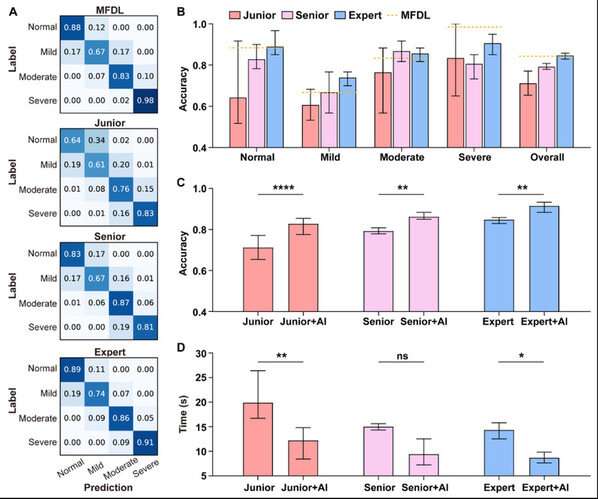
Comparison between MFDL and 14 ophthalmologists. Credit: Zhejiang University

In the study, the researchers designed a three-phase framework for glaucoma severity diagnosis from coarse to fine, which contains screening, detection and classification. They trained it on 6,131 samples from 3,324 patients and tested it on independent 240 samples from 185 patients.

The results show that MFDL achieved a higher accuracy of 0.842 (95{bf0515afdcaddba073662ceb89fbb62b6b1bf123143c0e06b788e1946e8c353f} CI, 0.795–0.888) than the direct four classification deep learning (DFC-DL, accuracy of 0.513 [0.449–0.576]), CFP-based single-feature deep learning (CFP-DL, accuracy of 0.483 [0.420–0.547]) and VF-based single-feature deep learning (VF-DL, accuracy of 0.725 [0.668–0.782]).

Its performance was statistically significantly superior to that of 8 juniors. It also outperformed 3 seniors and 1 expert, and was comparable with 2 glaucoma experts (0.842 vs. 0.854, p = 0.663; 0.842 vs. 0.858, p = 0.580). With the assistance of MFDL, junior ophthalmologists achieved statistically significantly higher accuracy performance, with the increased accuracy ranged from 7.50{bf0515afdcaddba073662ceb89fbb62b6b1bf123143c0e06b788e1946e8c353f} to 17.9{bf0515afdcaddba073662ceb89fbb62b6b1bf123143c0e06b788e1946e8c353f}, and that of seniors and experts were 6.30{bf0515afdcaddba073662ceb89fbb62b6b1bf123143c0e06b788e1946e8c353f} to 7.50{bf0515afdcaddba073662ceb89fbb62b6b1bf123143c0e06b788e1946e8c353f} and 5.40{bf0515afdcaddba073662ceb89fbb62b6b1bf123143c0e06b788e1946e8c353f} to 7.50{bf0515afdcaddba073662ceb89fbb62b6b1bf123143c0e06b788e1946e8c353f}. The mean diagnosis time per patient of MFDL was 5.96 s.

As an efficient auxiliary diagnostic tool, MFDL could assist ophthalmologists who are not specialized in glaucoma severity diagnosis, especially in remote and poor communities. It allows for rapid glaucoma screenings during primary care visits and provides individualized health care advices for glaucoma patients, which is a promising approach to benefit a wide patient population.

More information:
Ying Xue et al, A multi-feature deep learning system to enhance glaucoma severity diagnosis with high accuracy and fast speed, Journal of Biomedical Informatics (2022). DOI: 10.1016/j.jbi.2022.104233

Provided by
Zhejiang University

Citation:
New progress in bioimaging based on multi-feature deep learning (2022, December 15)
retrieved 15 December 2022
from https://medicalxpress.com/news/2022-12-bioimaging-based-multi-feature-deep.html

This document is subject to copyright. Apart from any fair dealing for the purpose of private study or research, no
part may be reproduced without the written permission. The content is provided for information purposes only.

US workers sue Georgia for transgender healthcare discrimination | Gender Equity News

Two state employees and a public school media clerk are suing the state of Georgia in southeast United States, saying state health insurance illegally discriminates by refusing to pay for gender-transition healthcare.

The lawsuit was filed in federal court in Atlanta on Wednesday by Micha Rich, Benjamin Johnson and an anonymous state employee suing on behalf of her adult child.

They argue Georgia’s State Health Benefit Plan (SHBP), which insures more than 660,000 state government and public school employees and retirees, is breaking federal law.

“The exclusion not only harms the health and finances of transgender people seeking gender dysphoria treatment, it also reinforces the stigma attached to being transgender, suffering from gender dysphoria and seeking a gender transition,” the lawsuit argues.

“The exclusion communicates to transgender persons and to the public that their state government deems them unworthy of equal treatment.”

The plaintiffs said the exclusion against gender-transition healthcare in the SHBP should be overturned and they should be repaid for the money they spent on procedures not covered by insurance. They have also requested money damages and lawyers’ fees.

The Department of Community Health, which administers the plan, declined comment, according to spokesperson Fiona Roberts.

The lawsuit cites a 2020 Supreme Court ruling that treating someone differently because they are transgender or gay violates a section of the Civil Rights Act of 1964, which prohibits discrimination on the basis of sex. The plaintiffs in that case included an employee of Georgia’s Clayton County.

The suit also argues that Georgia’s actions violate the 14th Amendment’s right to equal protection and that, in the case of Johnson, violate federal prohibitions against sex discrimination in education.

The plaintiffs include three transgender men. Rich is a staff accountant at the Georgia Department of Audits and Accounts. Johnson is a media clerk with the Bibb County School District in Macon. The mother of the third man, identified only as John Doe, is an administrative support worker at the Division of Family and Children Services in suburban Paulding County. She covers Doe, a college student, on her insurance.

All three were assigned as women at birth but transitioned after therapy. All three were seeking top surgery to reduce or remove breasts. All three appealed their denials and won findings from the US Equal Employment Opportunity Commission that Georgia was discriminating against them. The US Department of Justice also started an investigation.

In the meantime, Rich paid $11,200 for his surgery in 2021 and later declared bankruptcy. The Paulding County family paid $8,769 for John Doe’s surgery and is still repaying loans. Both Rich and Doe also say the state owes them for testosterone prescriptions. Johnson dropped his state insurance and bought coverage elsewhere, having surgery in September.

“My employer should not be able to deny me health care because of who I am,” Rich said in a statement. “For years, I had to put off living my life fully while I waited to have the medical treatments that my doctors and I knew I needed.”

The lawsuit is the fourth in a line of lawsuits against Georgian agencies to force them to pay for gender-confirmation surgery and other procedures. State and local governments have lost or settled the previous suits, changing rules to pay for transgender care.

The University System of Georgia paid $100,000 in damages in addition to changing its rules in 2019 when it settled a case brought by a University of Georgia catering manager. A jury in September ordered Georgia’s Houston County to pay $60,000 in damages to a sheriff’s deputy after a federal judge ruled her bosses illegally denied the deputy health coverage for gender-confirmation surgery.

The Department of Community Health agreed to change the rules of Georgia’s Medicaid program in April to settle a lawsuit by two Medicaid beneficiaries.

The Atlanta skyline, featuring Georgia's Capitol dome
State and local governments in Georgia have either lost or settled previous lawsuits pushing for transgender healthcare [File: Jonathan Ernst/Reuters]

The current lawsuit comes as some states seek to ban all gender-confirming care for children. Georgia could consider such a ban next year.

“They did not accept our invitation to negotiate an end to their discrimination without litigation – and, plainly, they didn’t remove the exclusion,” wrote David Brown, legal director at the Transgender Legal Defense & Education Fund, which is representing the plaintiffs.

In question are two health plans paid for by the state but administered by Anthem Blue Cross and Blue Shield and UnitedHealthcare.

The lawsuit states insurers told the department in 2016 that transgender exclusions were discriminatory. It also says a state lawyer told health plan leadership in July 2020 that a court would likely find the rule illegal.

“Yet the defendants have knowingly and intentionally maintained the exclusion year after year, long after it became plain – and the SBHP itself concluded – that doing so is unlawful discrimination,” the lawsuit states.

A recent court ruling found a similar ban in North Carolina to be illegal. The state is appealing. A Wisconsin ban was overturned in 2018. West Virginia and Iowa have also lost lawsuits over employee coverage, Brown said, while Florida and Arizona are being sued.

Does Medicare Help Pay for Gym Memberships?


The answer isn’t a simple yes or no. Whether you can count on Medicare to cover these costs depends on what type of coverage you have, but you do have options.

Staying fit is beneficial at any age. Regular physical activity helps all older adults, according to the federal Centers for Disease Control and Prevention (CDC), reinforcing the long-known belief that exercise positively affects our physical health and our emotional well-being.

While the way to do that is through a mix of aerobic activity, strength training and maintaining flexibility, these workouts often require specific equipment that’s available only at gyms or fitness centers. And those memberships are pricey.

Original Medicare (Parts A and B) doesn’t cover gym memberships, but it does cover some fitness-related benefits in special situations. For example, Medicare covers:

  • Group sessions for prevention of diabetes and programs to help you manage your condition, change your diet, exercise more and control your weight.
  • Weight-loss counseling for people with a body mass index (BMI) of 30 or higher, which includes obesity screening, a dietary assessment and behavioral therapy designed to help you lose weight by focusing on diet and exercise.

Does Medicare Advantage pay for gym memberships?

If you opt for a Medicare Advantage plan through a private insurer instead of original Medicare, coverage for gym memberships and fitness centers is available.

Almost all Medicare Advantage members (98 percent) were in plans that covered some fitness benefits in 2022, according to a Kaiser Family Foundation study. These benefits take several forms, including membership in the popular SilverSneakers program for people 65 and older or its competitors Renew Active and Silver&Fit.

SilverSneakers provides access to more than 15,000 fitness locations across the country; online dance, exercise, meditation, stretch and yoga classes; and an on-demand video library of prerecorded workouts. A free SilverSneakers GO fitness app for Apple and Android phones is also available. Other Medicare Advantage plans also offer free gym memberships with access to a nationwide network of health clubs and exercise locations, personalized fitness plans and on-demand workout videos.

In addition to gym access, many plans provide incentives to stay active, such as a free fitness tracker every two years, discounts on a smartwatch or exercise equipment if you meet activity goals, or gift cards if you take certain healthy actions, such as exercising or getting a flu shot.

How do I find Advantage plans with fitness benefits?

To find Medicare Advantage plans with fitness benefits in your area, go to the Medicare Plan Finder, type in your zip code and choose Medicare Advantage Plan for the search. It will prompt you to put in your medications, but you can bypass that.

Next, you’ll see a list of Medicare Advantage plans available in your area. The Plan Benefits summary for each option will have a green check mark if the plan has vision, dental, hearing, transportation to and from a medical appointment, or fitness benefits. Click on the Plan Details button and scroll down to Extra Benefits for a summary of fitness benefits available. To learn more details beyond “Not covered” or “Some coverage,” you can contact the plan at the phone number at the top of the Plan Details web page or read plan documents on the insurer’s website, linked at the top of the page.

Do Medigap plans offer fitness benefits?

Even though Medicare supplemental plans, also known as Medigap, don’t include fitness benefits as part of their standard coverage, you may find they include gym membership as well as discounts for dental, hearing, and vision services at no additional cost. Some plans offer low-cost packages to add these benefits.

Here, too, you can use Medicare’s Plan Finder tool to learn more about Medigap plans in your area.

Keep in mind

You can get free gym memberships and fitness benefits in other ways.

  • Employer and retiree health insurance may include wellness benefits, such as exercise programs, gym memberships, health coaching, health education classes, stress-management counseling and weight-loss programs.
  • Local gyms and fitness centers often offer senior discounts. Some YMCAs, for example, offer discounts for people 65 and older and financial assistance for people with low incomes.
  • Senior centers may have free or low-cost exercise programs and gyms, group biking or walking programs, health and wellness education and even personal trainers. Senior centers are usually affiliated with local Area Agencies on Aging, which you can find through the Eldercare Locator.

Published December 14, 2022

Global Refurbished Medical Equipment Market Driven by Increasing Demand in Developing Countries – Business

Global Refurbished Medical Equipment Market Driven by Increasing Demand in Developing Countries – Business

Image: The global refurbished medical equipment market revenue is expected to surpass USD 29 billion by 2027 (Photo courtesy of Pexels)

Purchasing a new piece of medical equipment comes with many upfront costs. And in a constantly changing industry, medical equipment can rapidly become outdated. Refurbishment is the systematic process of making used equipment equal to or better than new. Refurbishment is rebuilding or updating used equipment with new materials, components or parts to restore their original (or better) working condition and appearance. Refurbishment typically costs about half as much as buying a new one and can bring a machine back to a new-like condition. Refurbished equipment can help to avoid high upfront costs and being forced to use something that will quickly become obsolete. Refurbished medical equipment provides flexibility and also saves money by extending their lifespan to realize maximum return on investment. As a result, the global refurbished medical equipment market is projected to grow at a CAGR of 11.76{bf0515afdcaddba073662ceb89fbb62b6b1bf123143c0e06b788e1946e8c353f} from USD 15.23 billion in 2021 to USD 29.68 billion by 2027, driven by increasing demand for medical equipment in the developing countries, high capital and procurement costs of new medical equipment, and growing preference for eco-friendly products. These are the latest findings of Arizton Advisory & Intelligence (Chicago, IL, USA), a market research firm.

Nearly one-third of the medical equipment industry in the developing countries is part of the refurbished medical equipment market. The dearth of access to medical equipment in the developing countries has attracted global interest in the refurbished medical equipment market for disease diagnosis. Healthcare systems in the low-and middle-income countries often have limited access to medical equipment for routine use. Implementing medical equipment refurbishment in a developing country provides employment, increases the knowledge of medical technology among the people, and thus, provides a sustainable supply of skilled personnel for the healthcare industry.

Medical equipment typically consists of complex machines that are expensive to purchase and operate and require significant maintenance. Small & medium-sized hospitals often cannot afford to buy new high-end equipment. Smaller clinics and local medical centers may not be inclined to spend their resources on purchasing limited new equipment that can easily deplete their entire annual budget. These facilities prefer refurbished equipment of reputed brands that will cost less but perform well for a few years without complaints. Purchasing refurbished medical equipment allows healthcare providers to maximize their budget while providing quality treatment options to each patient. By investing in refurbished equipment, hospitals and clinics can free up much-needed funds for other uses, such as staff, disposables, and medicines, further contributing to the growth of the refurbished medical equipment market. Additionally, refurbished medical equipment eliminates the annoying problems faced in using a worn-down machine and avoids the learning curve associated with new equipment.

Medical equipment inventory is an accepted cost of doing business for manufacturers and is often the most significant cost category. Since medical equipment is typically a high-value product, any efficiencies or cost reductions can quickly contribute to the bottom line. Older equipment does not last forever, and this equipment eventually will need to be replaced and refurbished. Many facilities are now eager to replace their older systems with the resolution of global supply chain problems. This will contribute to the rising sales of refurbished medical devices, aided by a large inventory of used medical equipment.

Refurbished medical equipment also offers environmental benefits. By extending the useful life of medical equipment from 5-7 to 10-14 years or even more, refurbishment is a form of reuse and waste prevention, contributing to an environmental economy. Refurbishment saves energy, and the materials are used to produce new equipment. Refurbishing medical equipment and extending its service life maximizes the return on the initial investment of energy and materials. Approximately 90{bf0515afdcaddba073662ceb89fbb62b6b1bf123143c0e06b788e1946e8c353f} of the material for a system undergoing refurbishment can be reused; only 10{bf0515afdcaddba073662ceb89fbb62b6b1bf123143c0e06b788e1946e8c353f} of the material must be recycled, which is done using environmentally friendly processes. In addition to important environmental benefits, refurbishing provides sustainable economic benefits by creating business and employment in the refurbished medical equipment market. Even existing equipment owners may consider refurbishing their machines rather than disposing off old ones and buying new ones if their users are comfortable using the specific model. A refurbished asset can be re-capitalized on a depreciation schedule at half the value of new equipment.

Based on product type, the medical imaging segment dominated the refurbished medical equipment market in 2021 with the highest share of 25.58{bf0515afdcaddba073662ceb89fbb62b6b1bf123143c0e06b788e1946e8c353f}. The use of medical diagnostic imaging equipment can resolve between 70-80{bf0515afdcaddba073662ceb89fbb62b6b1bf123143c0e06b788e1946e8c353f} of diagnostic problems, but nearly 2/3 of the world’s population has no access to diagnostic radiology. Refurbished X-ray machines, ultrasound systems, MRI machines, CT scanners, and nuclear medicine systems (PET, SPECT, and PET/CT) allow healthcare facilities to provide patients with life-saving medical diagnostic imaging services. The medical imaging equipment segment is expected to record the highest incremental growth of USD 3.10 billion, while the IVD & laboratories equipment segment is expected to register the highest CAGR of 13.14{bf0515afdcaddba073662ceb89fbb62b6b1bf123143c0e06b788e1946e8c353f} over the forecast period.

Based on application, the diagnosis & monitoring segment dominated the refurbished medical equipment market in 2021 with a share of 69.46{bf0515afdcaddba073662ceb89fbb62b6b1bf123143c0e06b788e1946e8c353f}, followed by the treatment & surgical interventions segment. Medical equipment is extensively utilized for patients’ diagnosis and treatment. Diagnostic and monitoring applications comprise Cardiology, Urology, Neurology, Orthopedics, Physiology, Emergency Medicine, Oncology, Obstetrics/Gynecology (OB/GYN), and others. The diagnosis & monitoring segment is expected to register the highest incremental growth of USD 9.73 billion, while the treatment & surgical interventions segment is expected to register the highest CAGR of 12.40{bf0515afdcaddba073662ceb89fbb62b6b1bf123143c0e06b788e1946e8c353f} over the forecast period.

Based on end-user, the hospital segment dominated the refurbished medical equipment market in 2021 with the largest share of 37.97{bf0515afdcaddba073662ceb89fbb62b6b1bf123143c0e06b788e1946e8c353f}. Hospitals utilize more medical equipment than any other healthcare setting. Diagnostics are the primary screening method in hospitals, which are the first point of contact for any infection and disease. The rising number of people with various infectious diseases compels physicians in hospitals to use diagnostic imaging equipment, thereby increasing their demand. The hospital segment is expected to register the highest incremental growth of USD 5.24 billion, while the clinical & research laboratories segment is expected to record the highest CAGR of 12.18{bf0515afdcaddba073662ceb89fbb62b6b1bf123143c0e06b788e1946e8c353f} over the forecast period.

Geographically, North America and Europe are the matured markets for refurbished medical equipment. In 2021, North America dominated the global refurbished medical equipment market with a share of 28.24{bf0515afdcaddba073662ceb89fbb62b6b1bf123143c0e06b788e1946e8c353f} and revenues of USD 4.30 billion, due to its aging population, prevalence of chronic diseases, growing healthcare expenditure, need for advanced imaging techniques, presence of well-established players, and a significant shift towards digital medical equipment in the region. Further, the US accounted for a share of 91.21{bf0515afdcaddba073662ceb89fbb62b6b1bf123143c0e06b788e1946e8c353f} of the North American refurbished medical equipment market, led by an increasing diseased population, growing access to insurance, and faster adoption of advanced healthcare instruments for treatments in the country. Following North America, the refurbished medical equipment market was dominated by Europe, APAC, Latin America, and the Middle East & Africa. The APAC market for refurbished medical equipment is expected to register the highest CAGR of 14.45{bf0515afdcaddba073662ceb89fbb62b6b1bf123143c0e06b788e1946e8c353f} and the highest incremental growth of USD 4.84 billion over the forecast period, driven by constant public and private funding, advancements in diagnostic imaging models, and growing medical awareness.

Related Links:

Arizton Advisory & Intelligence 

Why Food Labels Don’t Improve Health

I can vaguely recall how it felt to be my 21-calendar year-previous, energetic, large-eyed self the 12 months I started graduate faculty. I was commencing a doctoral program targeted on overall health and developmental psychology and I was heading to modify the globe. I was guaranteed that I could do investigation that would ultimately enable teens to adopt healthier behaviors if they just understood far better.

Why Food Labels Don’t Improve Health

(Anastasia Pelikh/iStockphoto)

Due to the fact most of you looking through this are almost certainly more mature than 21, you have gathered sufficient lifestyle knowledge to discover my previous naïveté laughable. In my protection, I did increase up in the midst of the “Just Say No” and “Just Do It” strategies. I knowledgeable a childhood complete of oversimplified adult voices. Why would not I assume that it is merely as quick as telling individuals what they require to do to be healthy? Once you know, you know.  Ideal?

Creating Healthy Food items Choices

A handful of decades later I recognize that this understanding-deficit strategy to science interaction – just deliver information so persons can make the “right choice” – is deeply flawed. Of course, sharing information is critical to maximize comprehending about challenges that persons really don’t at present have an understanding of. On the other hand, the know-how-deficit viewpoint assumes that folks really do not have whichever knowledge they (supposedly) don’t have in the initially position.

What does this have to do with food items labels? The Foods and Drug Administration has just lately explained new requirements for identifying no matter if or not a food can be labeled wholesome. These criteria have not been revised because 1994, so they’re overdue for thing to consider. The labeling scheme would enable all fruits and veggies to be labeled healthier. No. They are not all at present labeled wholesome.

So that’s … development? It also assumes that most folks really don’t by now know that fruits and vegetables are balanced. Hmmm.

The new Food and drug administration labeling plan also necessitates limits on sugar, sodium and saturated fats ahead of a box or offer of anything at all can be labeled healthful. Foods must incorporate enough of a food items group (if not fruits and veggies than grains, protein or dairy) to wear the new label. The Food and drug administration claims the conclusion-target is “to show that a food’s degree of nutrients may aid people retain healthful dietary procedures by helping them realize a whole diet program that conforms to dietary suggestions.”

In other terms, labeling foodstuff – pretty much, often with stickers and brightly colored imagery – is intended to guideline shoppers towards creating “the suitable decision.” But it turns out that foodstuff and drugs are not similar whilst just expressing no to medications is generally a good idea, foodstuff is a each day requirement. And food is not only required but complicated. Realizing that some food items are nutrient dense or “nutritious” does not automatically guide us to decide on these food items.

A current analyze that reviewed earlier investigation on entrance-of-package labels on food items will make this very clear. The analyze authors located that labels have a quite modest impact on shoppers’ purchases. They could direct persons to grab much more nutrient-dense food items occasionally, but reasonably hardly ever.

A further study suggests that this could be for the reason that food stuff labels in basic are not often effortlessly recognized by people. What specifically is a portion? What does “low-fat” mean? How is a consumer’s cultural context related to these determinations? Occasionally labels elevate a lot more thoughts than solutions.

What Helps make Foodstuff Healthful?

Alli Spotts-De Lazzer, a therapist who treats clients with consuming and overall body image worries, talked with me about the new labeling plan and prompt that “for those people who experience a absence of fresh new, available, affordable foodstuff, the ‘healthy’ labels could assistance notify their possibilities. For example, if two merchandise are on the shelf and equally priced, a ‘healthy’ label could quite possibly support a parent decide on the seemingly healthier, more nutrient-dense choice for their family members. Regretably, on the other hand, ‘healthy’ labels may also lead to disordered eating, orthorexia and eating conditions among the some.”’

I would not go as far as to say that the provision of nutritional information and facts should be abandoned all collectively. I come across it valuable at periods to use nutritional information and facts as a tough information in earning conclusions about food buys. Even so, maybe labeling food items as “healthy” or, by default, “not healthy” is oversimplifying issues a little bit way too substantially? Under no circumstances head, that most individuals can make these wide assessments on their have, without having a label. It is not a deficiency of expertise that’s foremost folks to decide the fries about the aspect salad, it is for the reason that the fries taste far better!

A Healthier Connection With Foodstuff

Oona Hanson, an educator and mum or dad mentor specializing in ingesting disorder recognition, avoidance and recovery implies “there is so substantially about food that could in no way be entirely captured on a diet label – specifically something as oversimplified as ‘healthy’ and ‘unhealthy.’ Creating a healthier romantic relationship with food stuff is what we ought to be advertising in our public overall health messages rigid principles and labels actually interfere with that course of action.”