How eye tests could help detect diabetes, MS, and dementia

The eyes have long been called the “windows to the soul,” and increasingly, evidence is suggesting that they might be also windows to both the brain and body. Several health conditions can be detected by examination of the eyes, among them diabetes, multiple sclerosis, and even Alzheimer’s disease. Medical News Today spoke to experts in the field to discover how the eye can reveal the body’s secrets.

How eye tests could help detect diabetes, MS, and dementiaShare on Pinterest
How much could our eyes reveal about our health? Image credit: A.J. Schokora/Stocksy.

Most of us have our eyes tested regularly, but few may be aware that an eye test is not just for checking vision and correcting sight problems.

Because it has a “window” at the front, the eye is the only part of the body where doctors can, non-invasively, examine the inside of an organ. At the back of the eye is the retina, where blood vessels and the optic nerve can be clearly seen.

Thanks to this, optometrists and ophthalmologists could diagnose not only disorders of the eye, but also systemic diseases — those that affect other organs in the body or the whole body.

If a routine eye test raises concerns, the optometrist can refer a person to a medical ophthalmologist who will investigate by carrying out further eye examinations. If their investigations reveal a systemic disease, they can then refer the person to the relevant specialist.

Dr. Hagar Ibrahim, senior specialist trainee (ST6) in medical ophthalmology at St. Paul’s Eye Unit, Liverpool University Hospitals NHS Trust, in the United Kingdom, told Medical News Today that “a routine eye examination in which the pupils are dilated using eye drops can provide a full and clear view of the optic nerve, which connects to the brain, the retina, […] and all the blood vessels supplying the retina.”

“Therefore, pathology in the eye can be clearly seen during [an] eye examination, both in localized eye conditions and in systemic disease, truly making the eye a window into the rest of the body,” she added.

“People are often surprised when an eye doctor diagnoses them with a systemic illness but they shouldn’t be. Many people with systemic illnesses are first diagnosed by their eye doctor, which is just one reason why all adults should have regular eye examinations at least every 2 years.”

– Dr. Philip Storey, a board-certified ophthalmologist and fellowship-trained retina specialist at Austin Retina Health

As well as identifying problems with vision, such as nearsightedness, farsightedness, and astigmatism, a routine eye test will detect other eye disorders, such as glaucoma, and age-related macular degeneration.

By examining the blood vessels in the retina and the optic nerve, the optometrist can also discover a lot about a person’s general health.

This non-invasive process can detect many other health conditions that may seem unconnected to the eyes, among them hypertension, diabetes, thyroid disorders, and neurodegenerative diseases such as Alzheimer’s disease, and multiple sclerosis (MS).

“Ocular inflammation can affect many parts of the eye, and can often be the first sign of a systemic disease. The key to diagnosing the cause is in focused history taking followed by [a] guided investigation of the relevant body systems, including blood tests,” explained Dr. Ibrahim.

Changes in the blood vessels in the retina can be early indicators of both diabetes and hypertension.

Dr. Storey told MNT that “[d]iabetes is the most commonly diagnosed disease given the frequency of the illness as well as the classic findings on retina exam, which can include bleeding, leakage of fluid, and areas of poor blood flow.”

Although a firm diagnosis of diabetes can only be made with a blood glucose test, changes in the blood vessels of the retina can give a strong indication that a person may have diabetes. They can then be referred for further testing.

According to the American Academy of Ophthalmology, the signs of diabetic retinopathy can sometimes be detected by eye examination even before a person suspects they may have diabetes.

Once diagnosed, provided the diabetes is well controlled, the person can then minimize the risk of further eye damage, as Dr. Ibrahim explained: “In addition to localized eye therapies such as laser treatment or intravitreal eye injections, improving blood sugar levels by sticking to the proper pharmacological treatment, restricting sugar intake and making necessary lifestyle changes, can result in regression of diabetic retinopathy.”

However, for those with diabetes, the most important eye tests take place after diagnosis, to monitor changes in the eyes and take steps to prevent further damage, as Dr. Howard R. Krauss, surgical neuro-ophthalmologist and director of Pacific Neuroscience Institute’s Eye, Ear & Skull Base Center at Providence Saint John’s Health Center in Santa Monica, CA, noted:

“In most cases, diabetes is diagnosed before changes become evident in the retina, but the retinal examination is a vital part of routine diabetic evaluations, so as to aid in the management of the disease, and to intervene when indicated, with any of a variety of treatments to reduce the risk of blindness from diabetic retinopathy.”

Studies have shown that signs of hypertension, or high blood pressure, are found in the eyes of around 10{bf0515afdcaddba073662ceb89fbb62b6b1bf123143c0e06b788e1946e8c353f} of the adult, diabetes-free population.

On examination, an eye doctor might see traces of narrowing of arterioles in the retina, arteriovenous nicking, retinal hemorrhages, and, as in diabetic retinopathy, microaneurysms. All these are indicators of hypertensive retinopathy.

“Hypertension also presents with classic signs within the eye. The earliest signs of hypertension are narrowing of the vessels, often referred to as ‘silver wiring’ because of their appearance.”

– Dr. Philip Storey

The good news is that if the hypertension is controlled, the damage can be halted, as Dr. Ibrahim explained.

“Early detection means that appropriate precautions are taken and necessary lifestyle changes are made, such as eating a healthy diet and exercising regularly, in addition to starting the proper medical treatment thereby reducing the risk of heart disease,” she told us.

During a routine eye test, the eye doctor will also examine the optic nerve to look for any abnormalities or changes.

Dr. Ibrahim explained why: “The optic nerve connects the eye to the brain and is therefore an extension of the central nervous system. It is the only part of the brain that can be clearly visualized by examining the back of the eye.”

“Optic nerve swelling or inflammation can be detrimental to vision and color vision, and can diagnose MS, [which is] an autoimmune demyelinating disease of the brain and spinal cord, [as well as] neuroinflammatory disorders such as neuromyelitis optica or brain tumor,” she added.

Vision problems in MS, which tend to flare up then resolve within a few weeks, are usually a result of optic neuritis, an acute inflammatory demyelinating disorder of the optic nerve.

Optic neuritis is the first symptom in up to 20{bf0515afdcaddba073662ceb89fbb62b6b1bf123143c0e06b788e1946e8c353f} of people who are subsequently diagnosed with MS, although it can indicate other disorders, or even be the result of a viral infection or vitamin deficiency.

If an optometrist suspects optic neuritis in a routine eye examination, they will refer a person for further testing to confirm the diagnosis and identify the cause.

“Retinal screening of Alzheimer’s disease is an exciting prospect at the forefront of current medical research. The retina […] is made up of multiple layers of specialized neural cells and there is strong evidence that the same changes in the brain can occur in the retina, potentially allowing screening patients for early signs of Alzheimer’s disease.”

– Dr. Hagar Ibrahim

Current methods of diagnosing Alzheimer’s are often lengthy, invasive and expensive, so being able to diagnose the condition from the retina would be a huge advance.

Although this is not yet a disease that can be diagnosed from a routine eye examination, recent research has suggested that doctors could, in the future, diagnose Alzheimer’s through retinal scans.

The new technique, so far tested only in mice, combines the results of two scans to assess the condition of the retina. Those with Alzheimer’s disease have a much rougher retinal surface than those without.

Other research has identified beta-amyloid plaques on the retina as an indication of Alzheimer’s disease, and also in the lens of the eye, both of which can be detected by non-invasive methods.

Dr. Ibrahim explained some of the new developments:

“There are several areas under research. Firstly, looking for the presence of beta-amyloid fragments in the retina, which may be detected by specialist retinal imaging modalities, before symptom onset. […] Secondly, looking at biomarkers detectable on retinal OCT-A images in the form of differences of retinal microvasculature in patients with Alzheimer’s disease and mild cognitive impairment compared to healthy controls.”

Perhaps these findings may lead to easier, earlier diagnosis of Alzheimer’s disease enabling treatment to begin before symptoms become severe.

As well as allowing an optometrist to detect diseases elsewhere in the body, changes in the eyes can tell a physician how a systemic disease is progressing.

So regular eye tests are important, particularly as we get older, as Dr. Benjamin Bert, an ophthalmologist at MemorialCare Orange Coast Medical Center in Fountain Valley, CA, told MNT:

“While eye exams are mostly to check the health of the eyes, they do help to screen for systemic diseases. For adults, if you don’t have any need for glasses or contact lenses, it is still recommended to get an annual exam at least once in your 20s, twice in your 30s, and more regularly after 40. After 40 is when eye-specific ailments can start to become more common — including presbyopia, glaucoma, cataract, and changes to the retina from diabetes or high blood pressure.”

Dr. Krauss reiterated the same advice.

But it is also important to remember that eye examinations are only one tool in monitoring health conditions.

“An examination of the retina often reflects the severity of a disease throughout the body. […] However, patients should not rely on an eye examination to assess how well their systemic disease is controlled,” Dr. Storey cautioned.

“The damage that we see in the eye can take years to occur. Even when a patient’s eye examination is normal, their systemic disease — hypertension or diabetes for example — could be poorly controlled,” he explained.

So, make sure a regular eye test is part of your overall health care, particularly as you get older — it may just detect a condition that you were unaware of, helping you to take control of your health.
Two decades of stagnant funding have rendered Canada uncompetitive in biomedical research. Here’s why it matters, and how to fix it.

You may imagine that the hard part of being a Canadian scientist is having a bright idea. However, while curiosity, persistence and inventiveness are prerequisites for scientific success, the major obstacle to being a biomedical scientist in Canada is obtaining research funding.

Canadian biomedical scientists receive funding to hire scientific staff and buy experimental materials by applying for federally funded grants from the Canadian Institutes of Health Research (CIHR).

To purchase their high-tech tools (infrastructure), researchers apply for grants from the Canada Foundation for Innovation (CFI). These grant agencies are underfunded, and some of their programs are poorly designed, with funding success rates so low scientists must apply repeatedly to obtain funding that is financially inadequate.

As a result, Canadian scientists may feel like they spend more time writing grant applications than doing research. The reality is that stagnant funding is holding back Canadian science.

Securing CIHR grants has become impractically competitive. Most applications require multiple revisions and resubmissions, often imposing an interval of one to two years between first submission and funding. Since funding from a CIHR project grant only lasts five years, the life of the lab — and the jobs of Canadian scientists — are recurrently in jeopardy.

Core funding issues

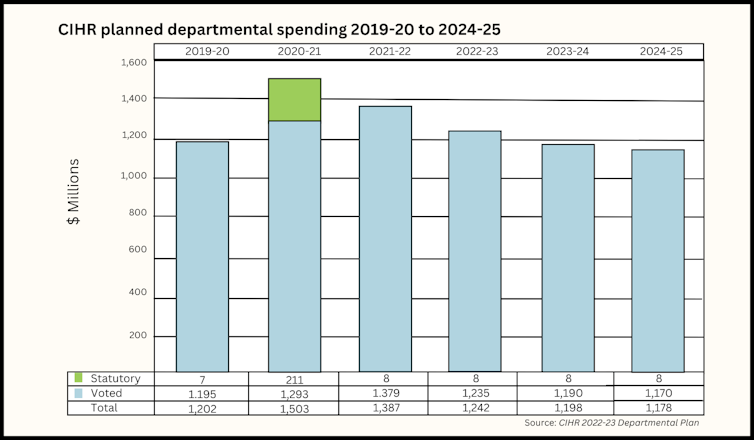
Let’s review the core problems with the funding of Canadian science. Stagnation in Canada’s biomedical grant funding reflects the fact CIHR’s funding from the Government of Canada has not increased since 2006 (in constant dollars, year 2000) and is not predicted to increase by 2025.

Two decades of stagnant funding have rendered Canada uncompetitive in biomedical research. Here’s why it matters, and how to fix it.
Graph of planned spending over time illustrates that CIHR funding is flat.
(CIHR data)

The United States is a relevant comparator because it is home to many of the world’s leading scientists. Canadian scientists, if not funded, often relocate to the U.S. Compare America’s National Institutes of Health (NIH) 2020-21 budget of US$45 billion (roughly C$60 billion) to CIHR’s C$1.2 billion. America’s NIH budget is 50-fold that of Canada’s CIHR budget, but the U.S. population is only nine-fold greater than ours.

Canada’s spending on research and development, as a percentage of gross domestic spending, is also smaller than the U.S.’s.

Grant competition success rates

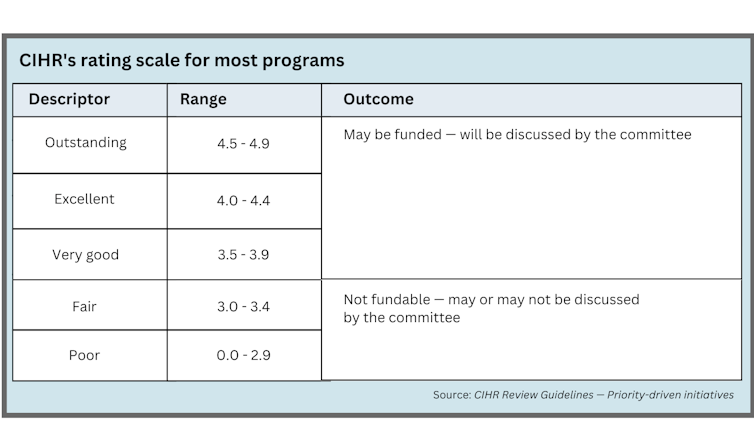
The success rate in CIHR grant competitions has declined from 31 per cent in 2005 to around 15 per cent in 2020.

CIHR evaluates applications on a scale of zero to 4.9, corresponding to categories of poor, fair, very good, excellent and outstanding. Currently, CIHR grants are rarely funded unless the voted score is outstanding (rated 4.4 to 4.9). Usually only the top 18 per cent of all grants — fewer than one in five — are funded, and virtually all grants rated excellent are rejected.

This low-success endeavor is a demoralizing waste of time for the 82 per cent of scientists who are rejected and for the peer-review volunteers — unpaid colleagues who spent weeks reviewing the applications.

chart showing CIHR grant rating categories
Almost all grants scored by CIHR as excellent go unfunded.
(CIHR data)

Once funded, challenges remain. All CIHR awarded project grants are now subject to a 23.5 per cent across-the-board funding cut. This cut allowed CIHR to fund 87 additional grants per competition from 2018 to 2020, however the value of a five-year project grant shrank from $950,000 to $725,000.

These cuts mean scientific staff must take pay cuts or be terminated, and the approved research can only be partially completed.

Fixing funding

Canada needs to revitalize its scientific mojo and to do so must improve research funding. There are several steps that would improve science funding in Canada.

1. Implement the Fundamental Science Review recommendations

The fix for Canadian science was well enunciated by the Fundamental Science Review, also known as the Naylor Report, in 2017. This report recognized that underfunded Canadian science was falling behind.

It noted that federal underfunding is exacerbated by CIHR’s practice of earmarking substantial portions of its limited funds to targeted proposals that address governmental priorities, rather than funding research and discovery science.

The report made simple recommendations to improve Canadian research: “Rapidly increase its investment in independent, investigator-led, research to redress the imbalance caused by differential investments favouring priority-driven, targeted research.”

A group of people sitting on blue storage drawer units in a V formation.
Members of the author’s research team at the Archer laboratory at Queen’s University.
(Author provided), Author provided

It also recommended “formation of an independent advisory committee on basic research and industrial innovation, comprised of leaders in research and industry” (not government employees). Our government currently makes many top-down science funding decisions without a strategic scientific plan or an external scientific committee to advise them. An independent advisory committee would reduce political interference in science.

The Naylor report’s recommendations have not been fully implemented, but would transform Canadian research. This would require commitment of an additional 0.4 per cent of the Government of Canada’s annual budget to our science sector.

2. Fund salaries for scientists who run infrastructure

In the meantime, CFI and CIHR could each implement “researcher-centric” changes.

CFI could accompany its infrastructure grants with funding for the scientists who are needed to operate these complex research platforms.

CFI grants are used to purchase the multi-million-dollar tools needed to conduct research at the cutting-edge, such as NextGen gene sequencers and super resolution confocal microscopes. CFI has a 30 per cent funding success rate, allowing purchase of infrastructure; but it does not pay for the scientists who run these scientific infrastructure platforms.

This makes it difficult to sustain a CFI scientific platform.

3. Bring back the foundation grant program

CIHR could resurrect its very successful foundation grant program.

A woman in a white coat in a lab
Foundation grants allowed scientists to bundle all their research into a single, comprehensive application.
(Shutterstock)

CIHR understood that its most successful scientists usually required two to three project grants, and recognized the time drag that acquiring multiple project grants required.

They responded in 2014 with the foundation grant program. Foundation grants allowed scientists to bundle all their research into a single, comprehensive application which offered more funding (equivalent to two to three project grants) for a longer duration (seven years instead of five years for project grants).

This allowed researchers to spend more time on doing science and less on writing and reviewing grants. My foundation grant gave me the stability and flexibility to simultaneously study oxygen sensing, mitochondrial dynamics and to develop drugs to treat pulmonary hypertension, cancer and COVID-19.

However, the foundation grant program was unceremoniously terminated, forcing grant holders to once again, apply for two to three simultaneous project grants.


Read more:
How COVID-19 damages lungs: The virus attacks mitochondria, continuing an ancient battle that began in the primordial soup


Funding research pays off

Researchers are key to Canada’s capacity to create a high-tech economy, build the biomedical sector and seed entrepreneurial activity. Researchers also support our academic health sciences centres and universities, making them internationally competitive.

Research has a great return on investment, with an estimated 30 to 100 per cent of the expenditure on publicly funded research being returned to society. Each research laboratory is a small business creating well-paying jobs, knowledge and intellectual property, which many commercialize.

In addition to launching medical innovations, patents and spin-off companies, Canada’s researchers teach university students, and many CIHR-funded clinician-scientists provide patient care in our hospitals. In all of these ways, investment in research is critical to making Canada healthy, wealthy and wise.

The health care system rethinks obesity

Illustration of a measuring tape around a pill bottle.

Illustration: Shoshana Gordon/Axios

Medical practitioners and healthcare authorities are top a rapid cultural shift all over weight problems, viewing it as a sickness instead than a life style preference.

Why it issues: That change is opening new treatment plans and better treatment — but also new controversies above who can access people solutions and how most effective to use them.

What they’re indicating: “Obesity is a very prevalent continual disease characterised by excessive body fat accumulation or distribution that presents a threat to well being and calls for daily life-long care. Nearly every process in the human body is influenced by weight problems,” 6 obesity advocacy businesses lately wrote in a joint statement.

  • “Each individual human being with weight problems need to have accessibility to evidence-primarily based treatment method.”

Driving the news: An present course of diabetes drugs has demonstrated massive promise for bodyweight decline, supplying a ray of hope to the tens of millions of Americans with obesity.

Indeed, but: Numerous insurers, which include Medicare, will not include those medications for fat decline. And they can be unaffordable with out insurance plan coverage.

  • Wegovy, which is permitted for excess weight reduction underneath specified ailments, has a list selling price of $1,349 for a month’s offer.
  • “A the vast majority of my clients can’t afford to fork out $1,300 a month, specifically for a medicine that they require to be on extensive phrase,” Veronica Johnson, an being overweight specialist at Northwestern Drugs in Chicago, explained to NBC News.

The other facet: Kristine Develop, a spokesperson for America’s Wellness Insurance Designs, not long ago told Axios that the therapies have constraints and “have not but been tested to function perfectly for very long-expression weight management and can have troubles and adverse impacts on people.”

  • The exact class of medicine also can be misused. Some electronic wellbeing startups are advertising and prescribing the medicine to persons who are not over weight, the Wall Street Journal claimed this week.

Concerning the strains: The remedy landscape is switching fast for little ones as nicely as grownups.

  • New advice launched final month by the American Academy of Pediatrics endorses versus delaying obesity treatment method for little ones, and argues that doctors ought to be proactive about strategies like intense health and fitness actions and way of living treatment and, in some instances, prescription medicine or surgery.
  • But the guidance is currently drawing pushback. Ingesting disorder professionals, for illustration, are warning that it could backfire, NPR described this week.
  • “We operate the danger of executing major damage to young ones who are 6 or 8 by telling them that they have a disease … only dependent on their body weight standing,” Kim Dennis, an taking in ailment professional, informed NPR.

What we’re viewing: An uncommon array of interest teams is now pushing for Medicare to protect the drugs for obesity, STAT studies.

  • And more broadly, the existence of an successful cure raises massive queries about how to protect against yet another prescription drug from getting usually misused — and how to harmony obtain to weight problems cure towards the threats of perpetuating a stigma.

Texas fitness influencer will stand trial next month for sending anorexics $300 weight loss plans

A Texas influencer who despatched prospects with anorexia $300 excess weight loss designs as portion of a fitness plan that also allegedly misled gals about ‘personalized’ eating plan programs is set to stand demo next thirty day period. 

Brittany Dawn Davis experienced promised to enable thousands of ladies with health and fitness deals priced from $92 to $300 featuring personalized well being options, coaching providers, exercise and nourishment strategies. 

But a lawsuit filed in early 2022 promises the personalised options and tips in no way took place and that the program violated shopper defense laws, misled folks with ingesting conditions, and made use of misleading tactics to get customers. 

Davis, who has amassed additional than 474,000 followers on Instagram, deserted her physical fitness gig yrs ago following clients commenced complaining about her questionable business enterprise procedures. She is set to stand demo on March 6 in Dallas County, Texas. 

Texas fitness influencer will stand trial next month for sending anorexics 0 weight loss plans

Brittany Dawn Davis is established to stand trial on March 6 soon after allegedly misleading clients about ‘personalized’ diet regime plans and exacerbating the ailments of purchasers with consuming disorders 

Davis, who has amassed more than 474,000 followers on Instagram, abandoned her fitness gig years ago after customers began complaining about her questionable business practices.

Davis, who has amassed extra than 474,000 followers on Instagram, deserted her fitness gig yrs in the past immediately after clients commenced complaining about her questionable enterprise tactics.

At minimum 14 ladies with eating disorders turned to Davis for assistance in their restoration, but claimed she rather built their conditions worse with low-calorie diet regime regimens that would only be acceptable for individuals searching to lose lbs, according to the Texas Lawyer General’s lawsuit. 

In a person instance, a previous customer who weighed 80 kilos at the time signed up for Davis’ system simply because she advertised herself as an ‘eating dysfunction soldier.’ 

That purchaser practically passed out due to bad diet, The Dallas Early morning News documented. 

The lawsuit also promises that Davis charged shoppers a shipping cost for emailed diet program and diet designs that had been meant to be individualized to satisfy customers’ certain wants but were being as a substitute generic.

Prosecutors mentioned the influencer, who ran a organization known as Brittany Dawn Physical fitness LLC, started selling on line fitness offers to 1000’s of customers in 2014, promising every single 1 they’d obtain ‘personalized’ nutritional steering and coaching. 

Plans ranged in rate from $92 for a a single-time consultation to $300 for a few months of nutritional information, training and coaching.

‘However, the online nutrition and exercise ideas shipped to individuals ended up not individualized,’ the lawsuit explained. ‘Defendants also unsuccessful to supply the promised coaching and look at-ins.’

Davis had promised to help thousands of women with fitness packages priced from $92 to $300 offering personalized health plans, coaching services, exercise and nutrition tips

Davis had promised to enable hundreds of gals with exercise offers priced from $92 to $300 providing customized health designs, coaching providers, training and nourishment tips

Davis posted before and after photos of herself on Instagram in promoting her program

Davis posted before and immediately after shots of herself on Instagram in promoting her program 

Davis began facing heat in 2019 after a growing number of women came forward saying that she sold them 'generic' workout plans and then deleted their complaints on social media

Davis began struggling with warmth in 2019 following a increasing variety of women arrived ahead declaring that she marketed them ‘generic’ workout ideas and then deleted their grievances on social media

Davis began experiencing heat from prospects in 2019 just after a growing number of girls arrived forward stating that she offered them ‘generic’ exercise session options and then deleted their complaints on social media.

She overlooked consumer complaints right until 2019, when a public outcry above her solutions led her to handle the grievances on YouTube.

‘I made a miscalculation,’ she said. ‘I’ve taken whole duty for it, I produced things ideal, and I did whichever it took to make points ideal. As a business owner, as an influencer, I’ve acquired from it and I am a prime example of what can occur when you have a system and you mess up.’

Soon after the complaints commenced rising, Davis took down the website the place she marketed diet program and health ideas.

But several of her unhappy clients said they did not receive refunds for the phony programs. In a non-public Facebook group dedicated to grievances about Davis, additional than 5,000 ladies gathered to share their horror tales.

A single client who bought a 90-working day system been given just one particular e-mail from Davis. One more purchaser who purchased a comparable prepare mentioned Davis reduce off contact within two months.

Others reported that when they would achieve out to Davis with a query or precise problem, they’d gained impersonal responses these types of as ‘THAT’S MY Woman! You are killing it!’ or ‘you’ve obtained this babe!’

Davis referred her prospects to a ‘Team Brittany Dawn’ Fb team for help, but the discussion board backfired when customers realized they ended up presented identical plans, the court document stated.

‘One client commented that “I assumed at initially you experienced designed this exercise routine program primarily based on my demands and wants…. till I referred 2 mates to you and their programs were being the similar,’ the authorized submitting claimed.

Davis referred her customers to a 'Team Brittany Dawn' Facebook group for support, but the forum backfired when customers realized they were given identical plans

Davis referred her clients to a ‘Team Brittany Dawn’ Facebook group for help, but the forum backfired when clients recognized they were supplied equivalent programs

At least 14 customers mentioned eating disorders in their complaints, despite Davis claiming she never treated customers with eating disorders, the lawsuit claims

At least 14 shoppers outlined eating conditions in their issues, inspite of Davis proclaiming she never ever dealt with prospects with taking in problems, the lawsuit statements

Customers said failed to tailor nutrition plans appropriately for those recovering from eating disorders, and tacked on an extra 'shipping fee' to email documents

Buyers stated unsuccessful to tailor diet ideas correctly for these recovering from having ailments, and tacked on an further ‘shipping fee’ to electronic mail paperwork

The lawsuit also claimed she misled consumers with consuming issues, luring them in with a YouTube online video in which she claimed to have conquer her possess feeding on problem as a result of work out and a healthful diet program.

She promoted her conditioning ideas in the social media posts, the courtroom submitting reported, primary opportunity clients to believe that that she experienced exclusive coaching to tackle ingesting issues.

‘One buyer famous that “the primary motive I chose her [Ms. Davis] out of all the coaches out there was exclusively that she advertised herself as an “taking in condition soldier.”

‘It was very important to me that the person I selected to coach me experienced an concept of what it was like to offer with an taking in ailment.’

Additional than a dozen taking in disorder sufferers who subscribed to Davis’s options reported they had been provided ‘low-calorie macronutrient strategies that would only be suited for anyone who wanted to drop fat, not place it on.’

We need to include energy for home medical equipment in covered medical costs

As a pulmonary and significant care health practitioner at Yale, I have a front row seat at the health care financial debt crisis. Though many persons associate healthcare charges with visits to a healthcare facility, medical doctor, or the acquire of medication, there is one particular often neglected charge that can have a profound affect: resilient professional medical devices.

In my apply, I normally prescribe strong clinical gear (DME), this sort of as oxygen concentrators, walkers, ventilators, or other equipment to assistance my clients are living a much healthier everyday living. While patients’ insurers will normally pay out for the products alone, the resulting improve in their electrical expenditures can be substantial. My research, published in the Journal of the American Health-related Association, has revealed that these bills can simply be hundreds of dollars a yr, and in some circumstances, extra than $1,000.

This cost can be particularly burdensome for my sufferers who are on Medicaid, as their severe overall health difficulties generally make it tricky to keep work and live on a fastened income. They just cannot manage these substantial costs. I, together with my colleagues, have seen firsthand how this economic load can have a devastating impression on their top quality of lifetime and health care care. 

As a society, we should acknowledge that the charge of professional medical treatment is not constrained to visits to the health care provider or the charge of treatment. The monetary burden of DME can have a long lasting impact on the life of our most vulnerable citizens. We will have to consider actions to address this situation and make certain that everyone has access to the professional medical tools they have to have to direct healthier and fulfilling life.

There are various likely solutions to this difficulty. One alternative is to grow funding for the Low-revenue Residence Vitality Support Method (“LIHEAP”), which assists much more than 5 million small-earnings households every year with payments on the electric, gas, oil and propane charges, assisting them to continue to be warm in the winter season and awesome in the summer months. But existing funding is insufficient to attain the 30 million households that are suitable. A lot more funding would be desired to focus on supplemental payments to these with terribly significant electric expenses due to reliance on DME.

One more alternative would entail payers of clinical payments (Medicare, Medicaid, non-public insurers) to pay back not only the cost of the equipment alone but also to defray the price of the enhanced electrical payments.

A 3rd solution is to present tax incentives to folks who need to have DME, so they can offset the prices affiliated with it.

Ultimately, the option will most likely entail a combination of these ways and potentially some others. However, what is most critical is that we consider action. The expense of healthcare treatment is a complex and demanding issue, but we can’t afford to disregard the effects it has on the life of sufferers.

Dr. Peter Kahn is a fellow in the Part of Pulmonary, Vital Treatment and Sleep Medication at Yale Faculty of Medication. He graduated from the Albert Einstein University of Drugs with honors and his M.P.H. from the Johns Hopkins Bloomberg Faculty of General public Health in the section of Wellness Plan and Administration. Dr. Kahn’s investigate has concentrated on health policy with a unique desire in the impact of weather change and utilities on wellness plan. Comply with him on Twitter @PeterKahnMD

Charlie Harak is senior legal professional for electricity and utilities challenges at the Countrywide Consumer Law Centre. He represents customers right before regulatory agencies, testifies at legislative hearings, and offers legal and coverage counsel to lower-revenue advocates, legal companies legal professionals, and federal government officials. He is the co-writer of “Guarding Seriously Sick Consumers from Utility Disconnections: What States Can Do to Help save Life Now” (Feb. 2021).

Promote nutritious diet, healthy lifestyle to combat childhood obesity

The new American Academy of Pediatrics rules for childhood being overweight have shifted from a “watchful waiting” method to “early and aggressive therapy.” The latest protection of the suggestions in The Seattle Occasions and other trustworthy news retailers has identified this new comprehension of childhood weight problems as a condition in have to have of speedy, aggressive intervention, but has presented tiny consideration to what has been proven to aid retain youngsters healthy — a healthy diet regime and healthful way of living habits.

Physique measurement is elaborate and influenced by a multitude of factors. In accordance to the Facilities for Sickness Management and Prevention, weight problems in children ages 2 to 18 is described as a entire body mass index previously mentioned the 95th percentile. Common physique dimensions and pounds in human beings in the United States has amplified noticeably about the earlier 60 several years, which usually means much more older people and kids slide into types outlined to be chubby and obese. There has been much stress on health-related companies to “fix” the dilemma of escalating physique body weight, but I imagine our point of view and technique has been all improper.

Emphasizing entire body dimensions, particularly in kids, is unlikely to enable us obtain our supreme objective for our patients — advertising and marketing health, nicely-being and longevity. Drugs and surgical procedure in young small children address just 1 symptom. Nonetheless, it tends to undermine root brings about, which is what is certainly driving our skyrocketing incidence of persistent ailments, circumstances this kind of as cardiovascular disorder, diabetic issues, dementia and early mortality.

The respond to lies in the observe and promotion of lifestyle drugs, systemic alterations to our foods source and availability, intuitive ingesting procedures and a de-emphasis on human body dimension as the analyzing aspect of overall health and properly-staying.

According to a analyze in the American Journal of Clinical Nourishment, a diet plan wealthy in greens, fruits, legumes and complete grains is related with decrease body body weight in little ones, which is linked with a lowered threat of chronic ailment. Decades of study show that this variety of healthful, plant-based ingesting can assistance stop, boost and even reverse variety 2 diabetic issues. The American Diabetes Association even endorses a plant-primarily based diet plan.

A very low-fats, plant-based diet plan also lowers the possibility of coronary heart disease in little ones by increasing their blood pressure and cholesterol concentrations, according to a Cleveland Clinic study. That’s crucial as some children now clearly show evidence of sizeable heart ailment beginning as younger as age 8! And half of U.S. children and adolescents do not have great cholesterol concentrations, with 25{bf0515afdcaddba073662ceb89fbb62b6b1bf123143c0e06b788e1946e8c353f} in the clinically superior vary.

I have viewed firsthand in my pediatric observe the variance diet and life style modifications can make for the overall health and effectively-remaining of youngsters and their entire household. My target is not to mildew little ones into a selected entire body measurement but deliver all the education and applications to live a extended and healthy daily life by way of well being-advertising behavior and behaviors.

Some recommendations I share with moms and dads to encourage the adoption of wellness-selling taking in habits include:

• Train little ones the benefit of excellent diet and that meals is a gas for well being and effectively-being. There are no great and terrible meals but some foods are larger in nutrient density and fiber.

• Have healthful foodstuff readily out there for foods and snacks, for instance hummus and crackers, or a clean or frozen fruit smoothie.

• Observe a adaptable plan for food and snack times and aid little ones as they understand to hear to normal starvation and fullness cues, alternatively than focusing on “cleaning plates.” 

• Have interaction children in the meals planning method.

When diet plan is not a panacea, the mention of prevention and dietary interventions that operate to lessen the threat of persistent disorder ought to be a element of any reporting on childhood being overweight.