Roy and Diana Vagelos Institute for Biomedical Research Education Launched at Columbia University with $175 Million Gift

With the COVID-19 pandemic highlighting the critical importance of biomedical research and new questions being raised about society’s capacity to generate world-changing scientific breakthroughs1, Roy and Diana Vagelos have made a $175 million gift to Columbia University to address this need. The Vagelos Institute for Biomedical Research Education created with this gift will be home to PhD students pursuing the most creative, potentially disruptive ideas in biomedical science, and will spur the training of more physician-scientists able to translate the latest paradigm-shifting discoveries into revolutionary new methods in patient care.  

logo

The gift will enable Columbia to create a new academic model that encourages and accelerates the intellectual risk-taking needed to make historic advances in health science research. Supportive career pathways, promising stability and academic freedom, are being developed to attract more students and junior faculty to this essential endeavor. Currently in the United States, PhD students, MDs in training, residents, fellows, and early-career physician-scientists who pursue a career in basic, translational or clinical research must contend with both financial challenges and professional uncertainty2.

By directly addressing and mitigating these obstacles, the Vagelos gift seeks to create an academic research environment conducive to bold experimentation and a sustained commitment to solving longstanding medical problems. Reducing the disproportionate financial burdens that deter historically marginalized groups from pursuing a career in science is a central pillar of this program.

“The financial support provided by Roy and Diana Vagelos to Columbia has been extraordinary, and so too is the leadership they provide through the values embodied in their philanthropy,” said Katrina Armstrong, Dean of the Columbia University Vagelos College of Physicians and Surgeons, and EVP for Health and Biomedical Sciences. “The Vagelos Institute for Biomedical Research Education will have an enormous impact in harnessing the power of science to transform clinical care, and I believe we will see similar initiatives started at other university medical schools. The reward for this effort will be unprecedented strides forward in curing disease and treating illness. It’s an opportunity—and a responsibility—we must embrace.”

The largest portion of the gift—$125 million—will establish an endowment to transform the prevailing approach for funding PhD students. This will provide Columbia trainees with greater freedom to explore different interests at the start of their careers. The remaining $50 million of the gift will support aspiring physician-scientists seeking to develop expertise in both fundamental biology and clinical medicine.

An external scientific advisory board of seasoned scientists and experts in graduate biomedical education will guide the development of these programs and of the new graduate biomedical curriculum tracks. The board is tasked with ensuring that Columbia University creates the optimal environment to nurture the growth of scientists who will shape the future of medicine. The initial group of board members includes Enrique M. De La Cruz, PhD, of the Yale School of Medicine; Tracy Johnson, PhD, of UCLA; William Kaelin Jr., MD, of the Dana-Farber Cancer Institute; and Shirley M. Tilghman, PhD, of Princeton University.

“This extraordinary generosity from Roy and Diana Vagelos continues their visionary support of education at the Vagelos College of Physicians and Surgeons, which so appropriately bears their name,” said Columbia University President Lee C. Bollinger. “It also continues their trailblazing efforts to rethink and strengthen the future of science and medical education at Columbia and around the world. For all of this, and so much more, we are extremely grateful.”

Roy and Diana Vagelos have been trailblazers in rethinking and strengthening the future of science and medical education at Columbia and around the world. Together with scholarship support from countless VP&S alumni, friends, and faculty, their transformative $250 million gift in 2017 made it possible for Columbia’s medical school to become the first in the nation to offer debt-free education to students. Their leadership precipitated a national movement among medical schools to eliminate student debt. The medical school was renamed the Vagelos College of Physicians and Surgeons as a tribute to their impact. This second transformational gift reflects the couple’s remarkable generosity and their deeply held values. It builds on a shared lifetime of charitable and compassionate action, particularly in their efforts to advance science, medical education, and better health care for all. For more information about Roy and Diana Vagelos, their respective professional accomplishments, and their prior giving to Columbia, please visit this page.

“We all know that continued scientific progress is the foundation for solving our most pressing medical problems,” said Dr. Vagelos. “Diana and I each vividly recall the difference that financial support made in creating a sense of freedom and instilling the confidence to pursue our passions early in our lives. We want to give others this same freedom by removing the obstacles facing researchers and scientists in training. The larger the number of talented researchers who are able to explore areas of discovery that capture their imaginations, the greater the impact they will have in changing medicine and improving health. It is our honor to give back.”

Johns Hopkins University to shut down its COVID tracker : Shots

Johns Hopkins University to shut down its COVID tracker : Shots

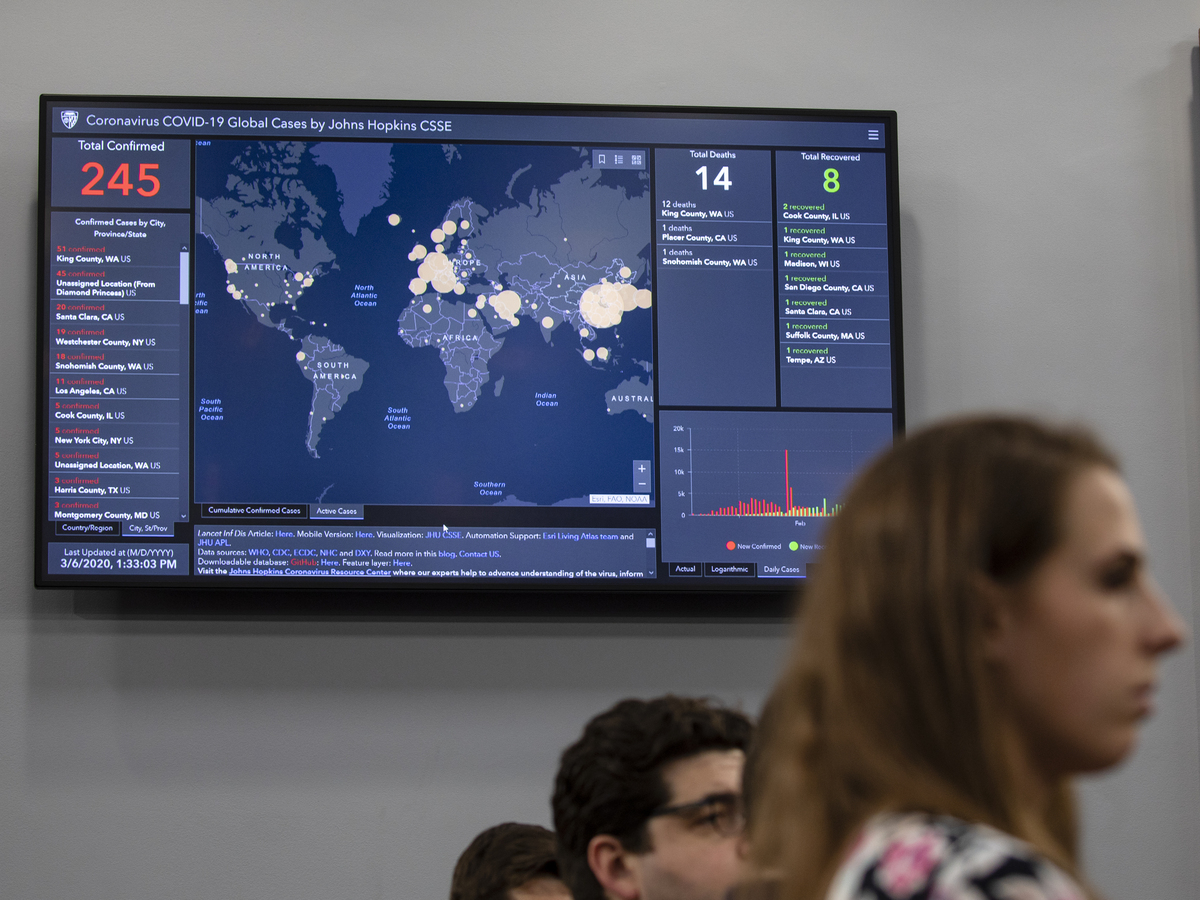
The COVID-19 dashboard produced by the Johns Hopkins Centre for Devices Science and Engineering is shown all through a briefing on Capitol Hill in early March 2020, when only 245 confirmed scenarios experienced been claimed in the U.S.

Samuel Corum/Getty Illustrations or photos


conceal caption

toggle caption

Samuel Corum/Getty Photos


The COVID-19 dashboard produced by the Johns Hopkins Centre for Devices Science and Engineering is exhibited during a briefing on Capitol Hill in early March 2020, when only 245 confirmed scenarios experienced been documented in the U.S.

Samuel Corum/Getty Pictures

In one more indicator of the altering state of the pandemic, an priceless resource of information and facts about the virus more than the last a few many years is shutting down, NPR has acquired.

The Johns Hopkins Coronavirus Source Middle options to cease operations March 10, officers advised NPR.

“It can be bittersweet,” suggests Lauren Gardner, an engineering professor who released the project with 1 of her students on March 3, 2020. “But it is really an suitable time to shift on.”

When the pandemic erupted, no just one knew considerably of anything at all about the virus and how to react. Was it safe to go grocery browsing? How quickly could a person get contaminated on a bus or teach? Could runners get sick just by passing a further jogger in the park?

“As anyone can bear in mind, there was extremely small info, particularly at the beginning of the pandemic,” suggests Beth Blauer, an affiliate vice provost at Johns Hopkins who has served operate the heart.

“And when we started out to see the scenarios go out of China and in by way of Europe and headed towards our shores, we knew that there were heading to be a collection of general public coverage conclusions that would have to be made,” Blauer suggests.

People selections included the place to impose remarkable but very important public wellness steps. Ought to mayors close faculties? Really should governors mandate masks? Should really CEOs shut down factories? Ought to heads of point out seal borders?

But there was no great details out there to make individuals choices. Neither the Centers for Disorder Manage and Avoidance nor the Globe Well being Business had been giving enough helpful numbers in serious time. So journalists and tutorial researchers at locations like Johns Hopkins jumped in to fill the void.

NPR launched its personal tracker on March 16, 2020, drawing facts from Johns Hopkins. It was seen about 52 million situations more than the final three decades as visitors sought to stay current on COVID metrics. On Feb. 1, NPR ceased updating the website page, recognizing that Individuals can obtain the data they need on the CDC’s COVID internet site. This was not the scenario early in the pandemic.

“I know CDC has the potential to do this and has done it quite a few instances in the earlier,” suggests Dr. Ali Khan, a former CDC official who is now dean of the Higher education of Community Wellness at the University of Nebraska Healthcare Middle. “So it was unconventional that at the commencing of this COVID pandemic that they did not gather this details and place it out in a well timed quite a few. Very unconventional and really stunning.”

Johns Hopkins “in essence filled the vacuum,” Khan claims, “That was invaluable to recognize what was heading on.”

Soon after Johns Hopkins launched the challenge, the web-site rapidly turned crucial for determining almost everything from in which drug providers should test vaccines to in which Hollywood need to film flicks. Even the White Home and the British key minister ended up relying on Hopkins data.

Gardner recollects a lot of conversations “with people today that were just out about executing their task — touring in Japan, listed here and there — who would tell me the dashboard was the driving power in determination-generating for them … about quitting their task and then coming household so that they wouldn’t get caught.”

The site’s maps of the globe and particular person nations became an iconic way of tracking the virus’s inexorable distribute.

“I would refresh my computer screen over and about again over the training course of the get the job done working day seeking to see what the latest numbers ended up,” suggests Dr. Celine Gounder from the Kaiser Household Basis, who was performing as an infectious illness professional at the Bellevue Hospital in New York when the pandemic commenced.

“It was definitely startling to see even above the training course of the day how the quantities had been evolving. I consider my colleagues imagined I was a very little obsessive,” Gounder suggests. “But it was also viewing history unfold in real time on your display screen.”

The web page, which Blauer and Gardner notice was developed and run largely by females, value $13 million and at some point drew extra than 2.5 billion views, Blauer claims.

“It is a staggering total of visitors,” she states. “These are figures I do not think I’ll at any time see yet again in my specialist occupation.”

But now that the threat of the pandemic is receding, states are reporting info less usually and the CDC has ramped up the agency’s data reporting, the college determined it was time to shut it down.

“There is certainly surely a bitter sweetness about the conclusion,” Blauer says. “But we are at an inflection place.”

Equally Blauer and Gardner say they hope the CDC and the general public health and fitness method will carry on to commit in facts collection so the country will be greater organized in the long term. But they are well prepared to step back in if vital.

“There will be yet another pandemic,” Gardner states. “And, so we are going to have to see.”

Six Life Lessons from Minority College Student to Tenured Faculty Member | University of Utah Health

I graduated from Cornell University Health-related Higher education in 1998. To my awareness, it was the very past yr that our health-related college was recognized by that identify, as the very up coming 12 months, the naming rights for the Professional medical Faculty had been obtained by Sanford I. Weill, for a 100 million greenback donation, and it is now known as Weill Cornell Medication.

With the name alter, and subsequent donations, the campus of the professional medical university I attended modified radically. So, you can consider my pleasure when I was invited to talk at Weill Cornell Drugs, on the subject of Getting ready for a Job in Educational Medicine. This convention was sponsored by Making the Upcoming Era of Academic Doctors, and the audience was underrepresented in medicine clinical students, citizens, and college across all healthcare specialties. I was deeply honored to be invited, and I invested several hours getting ready for the meeting and the address. Despite the fact that I am comfortable speaking to substantial groups, this speak built me anxious.

The talk centered all-around 6 life classes that I have uncovered on this journey from minority university pupil to tenured college member at the Spencer Fox Eccles University of Drugs at the University of Utah. I began by sharing my journey—from not so humble beginnings, and the huge privilege that I have getting a person, and staying the little one of two college or university graduates. The journey has taught me that achievement is a staff activity. Anybody who tells you that they pulled themselves up by their bootstraps is probably not recognizing the head start they ended up specified.

I then shared a story about a study elective I had in clinical university. I imagined I was heading to get the job done with people who realized what they have been carrying out, but alternatively, I was doing the job with persons who had been in the very same mastering phase as me when it came to publication of medical study. This created me know the 2nd lesson: At any phase of a career, we do not know what we do not know. In other terms, our awareness is normally limited when making an attempt new points.

The third lesson I shared was with my 1st true investigate encounter. When I was a 2nd calendar year resident, I was invited by a faculty member, soon after expressing curiosity in functioning with him on his investigation in Guatemala, to go with him to execute study at the Medical center Typical San Juan de Dios. It was early in the AIDS epidemic, and the school member was an outstanding mentor, Dr. Matthew Anderson. Once he read I was intrigued, he organized funding for me to expend four weeks in Guatemala conducting this analysis. Soon after the task was accomplished, he ensured that I proceed with the undertaking and it resulted in my very first publication—The Emergence of AIDS in Guatemala, released in the Intercontinental Journal of STD/AIDS. From Dr. Anderson, I uncovered that faculty favor learners. He went out of his way to commence me on my profession.

There had been quite a few occasions for the duration of my career that I desired to go away educational medication. I was mad, a lot of periods offended, belittled and ignored. But when the anger struck, I recognized I had a choice. I could operate away, or I could be strategic. I figured out that when I am mad, that is not the greatest time to make a decision. The fourth lesson is that I should really “make decisions when I am calm” or “a mad choice is a terrible decision.”

Lesson selection five was the toughest 1 to learn. As I done extra investigate in academic medicine and the practical experience of minoritized college in that space, it turned incredibly distinct to me that I was not by yourself in my struggles with my career. It was also apparent that the difficulties I was encountering ended up not private failings, but had been troubles that were created into an educational clinical process that was not supposed for individuals who identified like I did. Our analysis groups summarized the encounters of minority college in educational medication as the “minority tax.” To this working day, “Addressing disparities in Tutorial Drugs: What of the Minority Tax” is our most cited paper, and the most cited paper in BMC Professional medical Education and learning for the yr it was posted.