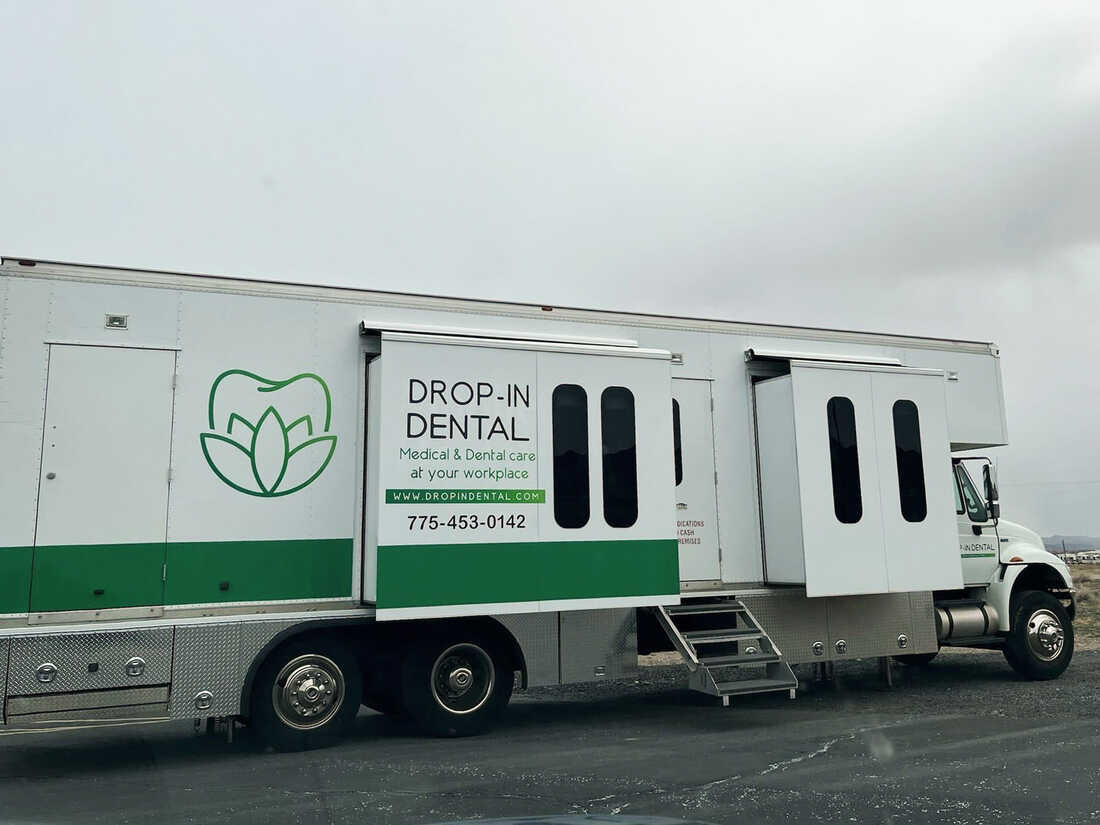

Clinics in rural areas with fewer doctors, dentists and nurses are turning to mobile health care clinics to take care to where it’s most needed. The Healthy Communities Coalition organizes a few mobile dental events each year in Lyon County, Nev.
Wendy Madson/KHN
hide caption
toggle caption
Wendy Madson/KHN
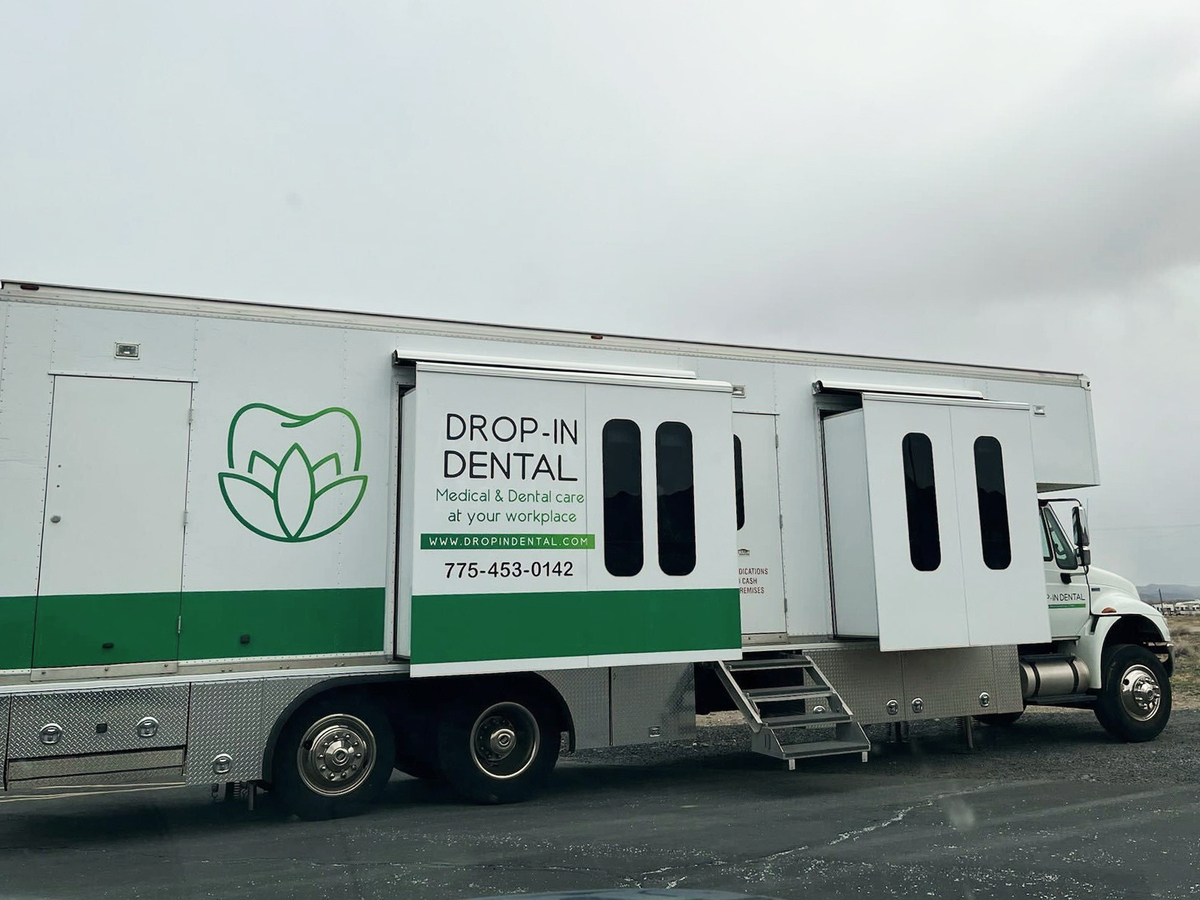
Clinics in rural areas with fewer doctors, dentists and nurses are turning to mobile health care clinics to take care to where it’s most needed. The Healthy Communities Coalition organizes a few mobile dental events each year in Lyon County, Nev.
Wendy Madson/KHN
Nearly 12 years ago, a nonprofit centered on substance abuse prevention in Lyon County, Nev., broadened its services to dental care.
Leaders with the Healthy Communities Coalition were shocked into action after two of their food pantry volunteers used pliers to pull each other’s abscessed teeth. The volunteers saw no other option to relieve their overwhelming pain in the small town where they lived, 40 miles southeast of Reno, because of a dearth of dental care providers.
That drastic act, said Wendy Madson, executive director for the coalition, prompted her organization to use mobile clinics to offer health and dental services in rural communities where there aren’t enough patients to support brick-and-mortar offices.
The coalition now sends a van outfitted with dental equipment to county schools to treat hundreds of students per stop a few times each year. They also host events providing free care for adults in the region. The response has been overwhelming.
“Dental is the hot ticket,” Madson said. “Everybody wants dental. Availability of those services is what runs out first in those large mobile events.”

The coalition’s mobile programs mirror efforts nationwide to dispatch services to patients experiencing gaps in the health care system, especially in rural areas.
Rural residents face more significant health care provider shortages, including dentists, compared with their counterparts in larger cities. Since the beginning of the pandemic, mobile clinics have increased access to a range of services in hard-to-reach places with sparse populations.
A recently passed law, which makes it easier for rural communities to pay for new mobile clinics, could expand this trend. In the past, clinics that serve low-income rural residents couldn’t spend federal grant money — called new access point grants — on mobile services in communities where they didn’t already have facilities.
Then last fall, Congress passed the MOBILE Health Care Act, sponsored by Sens. Jacky Rosen, D-Nev., and Susan Collins, R-Maine, which gives federally qualified health centers – health clinics serving medically underserved areas — greater flexibility to use federal funding to create and operate mobile units.

Healthy Communities Coalition executive director Wendy Madson says mobile dental clinics in Lyon County, Nevada, help reach young students whose parents might otherwise lack the means or insurance to schedule regular visits.
Wendy Madson/KHN
hide caption
toggle caption
Wendy Madson/KHN
Since 2019, the number of mobile clinics on the road has expanded, according to the National Association of Community Health Centers. Many were used for COVID-19 testing and vaccinations. And health and community organizations started using mobile units to bring primary care, behavioral health, and reproductive services to out-of-the-way patients. The new funding pathway could soon put even more mobile health vans on the road.
For now, the law is dependent on congressional funding, and experts predict it could be at least a year before health centers can access the grant money.
Freed from brick-and-mortar requirements, health centers can roll out the vans
Once funded, the regulatory shift will allow health centers to collaborate with independent organizations like Madson’s Health Communities Coalition in Nevada to expand services in underserved regions. Because the coalition is not a federally qualified health center, it has relied on a mix of other federal and state grants.
Nearly 1,400 federally qualified health centers nationwide receive federal funding for providing comprehensive health services in underserved areas. The previous requirement that health centers establish brick-and-mortar clinics before expanding mobile clinics prevented many from applying, said Steve Messinger, policy director for the Nevada Primary Care Association. It was burdensome and costly for health centers.
But in rural areas with small populations, served well by mobile clinics, it wouldn’t make sense to first establish a building with a full-time provider, he said. That could eat up the budget of a federally qualified health center.
While health center advocates lobby Congress for base funding, the Healthy Communities Coalition is forging ahead with three dental events this year funded by a grant from the Health Resources and Services Administration, part of the Department of Health and Human Services.
At the first medical outreach event the coalition organized in 2012 in Lyon County, where 61,400 residents are spread across more than 2,000 square miles, more than 200 people showed up to receive free care and 150 teeth were pulled, Madson said. Since then, the organization has hosted several events a year — except in 2020, when the pandemic paused work.

Mobile dental clinics organized by the Healthy Communi(Wendy Madson) ties Coalition help ensure Lyon County, Nev., students receive cleanings, screenings, X-rays, and more.
Wendy Madson/KHN
hide caption
toggle caption
Wendy Madson/KHN
Many of the dental events are school-focused and provide children with such services as screenings, X-rays, sealings, varnish, and cleanings. But an overwhelming need for care also exists among area adults, said Madson, because Medicare and Nevada’s Medicaid do not include comprehensive dental coverage for adults. It’s harder to fund those events, she said.
Of the five communities in Lyon County, at least one, Silver Springs, does not have a single dentist. There are 10 dentists total in Fernley and Dayton, communities with a combined population of 38,600 people, but only two of those practices accept Medicaid, which covers low-income people younger than 21 and limited dental services for adults.
Filling a desperate need for dental and health services
Traci Rothman, who manages the coalition’s food pantries, said the dental outreach events made a difference for her 29-year-old son, who moved to Silver Springs last year. He went to two mobile clinics to receive free care, which Rothman said was a big relief because he’s uninsured and needed dental care badly.
“Otherwise, you’re going to somebody that you’re paying cash,” she said. “Oftentimes I cannot pay, honestly; it’s just out of reach for some people, or most people … in rural areas.”
Madson said the coalition stepped in to help a young student in desperate need of a root canal. The coalition is helping the girl’s family apply for Medicaid or Nevada Check Up, the state Children’s Health Insurance Program, and is paying $1,600 to cover the service with federal grant money. Another student had to be referred to several specialists before she had her decayed baby teeth surgically removed and received restorative treatment for adult teeth that had begun to decay.
“Her mom was so thankful, she was in tears,” Madson said. “She told me that her daughter woke up without instant pain for the first time in years.”
Madson said her organization has enough grant funding for three events through May, but she hopes the MOBILE Health Care Act will help expand services. Besides dental care, the group provides primary care mobile clinics for immigrant workers in Yerington, a small town in an agricultural region about 70 miles southeast of Reno.
Sara Rich, CEO of Choptank Community Health in Maryland, said she shares Madson’s hope.
Choptank serves five counties in Maryland, including small towns between the Chesapeake Bay and the Delmarva Peninsula. Amid the pandemic, the health organization struck an unlikely partnership with a car dealership and used federal COVID relief money to buy a Ford Transit cargo van for mobile clinics.
Choptank used its new van to provide vaccines but has since started using it to provide primary care to immigrant workers and dental services to children at 36 schools. The mobile clinics have been so successful that the health center is working on purchasing more vans to expand its services.
Rich said the mobile clinics are “breaking down barriers that a lot of us have been working on for a long time.”
Among the new services Choptank seeks to provide are behavioral health, preventing and treating substance use disorders, and skin screenings for people working on the shores of Maryland.
“Flexibility has been a theme over the last few years,” Rich said. “I think this MOBILE Health Care Act will help us do that even more into the future.”
KHN (Kaiser Health News) is a national newsroom that produces in-depth journalism about health issues. Together with Policy Analysis and Polling, KHN is one of the three major operating programs at KFF (Kaiser Family Foundation). KFF is an endowed nonprofit organization providing information on health issues to the nation.

