‘The People’s Hospital’ doctor treats Houston’s uninsured and undocumented : Shots

‘The People’s Hospital’ doctor treats Houston’s uninsured and undocumented : Shots

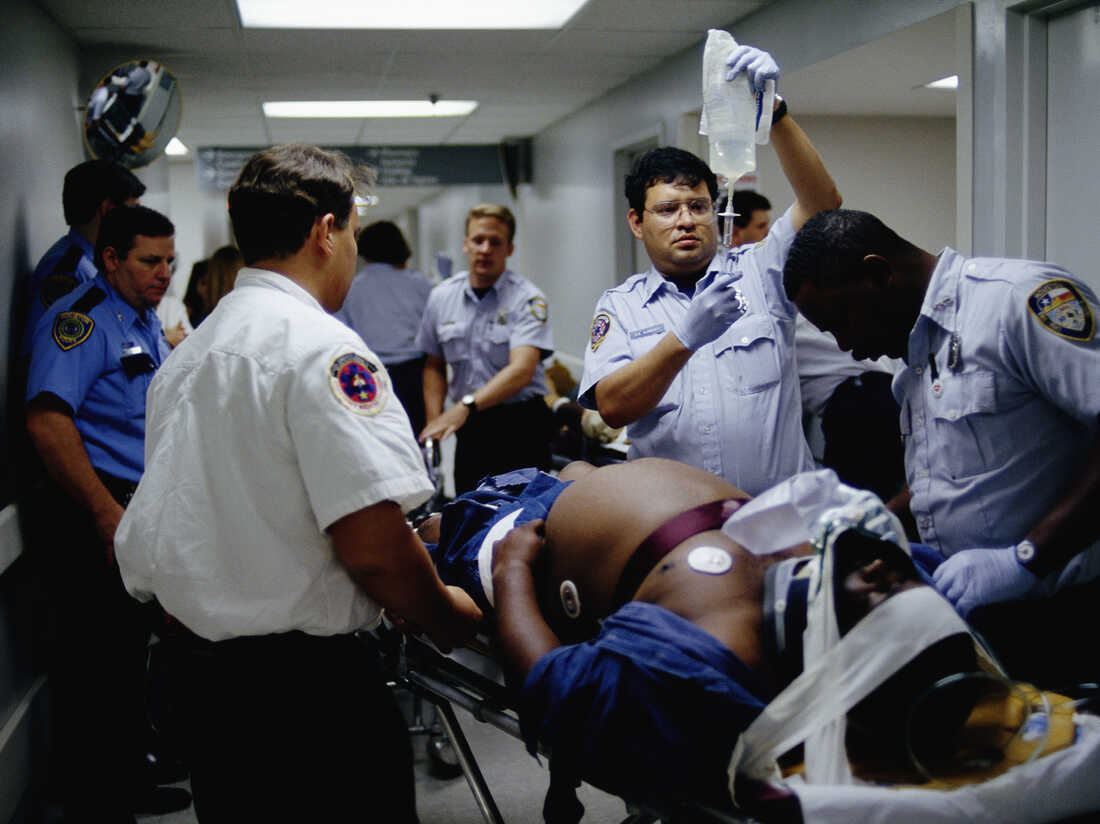
Paramedics at Ben Taub General Hospital speed a patient with a gunshot wound to the trauma team for further care. Ben Taub is the largest safety-net hospital in Houston.

Gregory Smith/Corbis via Getty Images


hide caption

toggle caption

Gregory Smith/Corbis via Getty Images


Paramedics at Ben Taub General Hospital speed a patient with a gunshot wound to the trauma team for further care. Ben Taub is the largest safety-net hospital in Houston.

Gregory Smith/Corbis via Getty Images

As a doctor in a so-called “safety-net” hospital, Ricardo Nuila’s daily practice looks quite different from that of his colleagues who work in private or not-for-profit hospitals. That’s because safety-net hospitals treat everyone who walks in the doors — regardless of insurance status.

Many of Nuila’s patients at Houston’s Ben Taub Hospital are dealing with serious illnesses as a result of not being able to get access to basic preventive care. “What we see is that patients’ lack of health care has meant that the disease has been able to grow within their bodies,” he says. “Their cancer is widespread, or we find that they have an infection that has not been treated or discovered.”

In his new book, The People’s Hospital, Nuila writes about his experiences at Ben Taub, which is the largest safety-net hospital in Houston. He says despite the hospital’s budget constraints, the doctors and nurses there still manage to provide quality health care. By limiting the number of patients a practitioner can see in a day, Ben Taub allows physicians to spend more time with their patients than is typical.

“My cap is 15 patients in one day,” Nuila says. “That’s compared to some of my colleagues in the private world, who I’ve heard admit up to 24 patients in one night, or don’t carry a cap.”

Because resources are tight at Ben Taub, there is an emphasis on using them mindfully, Nuila says. Instead of ordering an MRI with the push of a button, for instance, he might talk to the radiologist directly, to find out if extra imaging is really called for. “There are benefits to further discussion between medical professionals about emergencies and how to deal with these emergencies,” he says.

Overall, Nuila says, working at a safety-net hospital allows him to keep his focus on medicine: “I like that I have the time to be able to hear my patients’ stories, that I don’t have to think about billing all the time, that I can sit with them and hear about why they came to the hospital and learn about their lives — and that, no matter what, we are going to be thinking about how best to help them, regardless of whether they have insurance or not.”

Interview highlights

The People's Hospital, by Ricardo Nuila

On treating undocumented people at the hospital

It’s not considered illegal. … The law EMTALA — the Emergency Medical Treatment & Labor Act — that was passed in the 1980s, that states that anybody in the United States, whether you’re a resident or not, whether you have health insurance or not, can go to a hospital and receive an exam and stabilizing treatment. So that’s a right that everybody in the United States has, regardless of citizenship. What’s different about the safety-net hospital is that we have clinics and we have chronic care also — and that was under question by certain politicians, who ultimately found that it didn’t make any sense to question that. Because when you get in the way of preventive care, when you get in the way of primary care, those patients end up coming to the emergency room and they become much more expensive. … So, [the politicians] decided that the financial gains were more important [than limiting care].

On explaining the American health care system to uninsured patients

The patients are all so different — some have had multiple family members in the United States before, so they understand the landscape a little bit better. But yeah, it can feel very, very contradictory when I tell patients that, well, “You need health insurance for that.” And they will say sometimes, “Well, in Mexico or in Guatemala (or whatever), I don’t necessarily.” And it’s hard to explain that in the richest country in the world, there’s little available for people without health care insurance.

Now, I’m happy that in Harris County [in Texas], where I work at Harris Health, we can provide a robust set of services. But somebody who lives outside of the county doesn’t have availability for those services. And that’s one of the things that I’ve argued, is that the line between Mexico and the United States is not as important as the line between Harris County and Fort Bend County, for instance, in some of the treatments that we give to patients.

On speaking Spanish with patients

That’s one of the reasons that I love my job and I love the hospital where I work — I can speak Spanish. … The people are so happy to hear somebody attempt to speak their language, and not just on a translation basis, but the flavor of the language and also thinking about the locations [they come from]. For instance, when I ask somebody where they’re from and they say Mexico or El Salvador, it’s never enough for me to hear just a country. I need to ask a region so I can situate it in my mind, the map, and draw a relationship that I have with that region. And so I think it helps a lot for building trust with patients.

On his reaction when very sick patients put their faith in God

I don’t dismiss it. Because I feel that science and medicine, we don’t know everything. There’s a lot of mystery in this world and I think faith is important. I’m not saying that faith in one particular religion is important, but faithfulness is important. I think that in my experience, when people demonstrate faith, whether it’s in their God or whether it’s in the treatment, they do better. It’s not my job to take away that person’s faith. What I tell people is that I’m just doing my job, which is [that] I’m a human being, and I need to tell you … the recommendation from doctor human beings for this illness and for the treatment, but that I’m just a person and I don’t know. And that’s the truth – we don’t know everything. We have very good ideas. When somebody is close to death, we can prognosticate quite accurately if that person’s going to die or not. But I can not tell exactly when that is going to happen. And I don’t want to rob somebody of their faithfulness.

On struggling with thoughts of suicide after the suicide of a friend and colleague

I think everything was a struggle. And I think that seeing somebody like Dave, who I admired so much, who was a friend, my best friend in the hospital, who I could speak with and who was so knowledgeable and intelligent — just to know that that is a risk for me as I grow older. Dave was also a very good father and it’s something that I’ve struggled with, parenting.

It felt so much like a pressure of trying to be a good father while trying to be a good doctor, while trying to be a good writer. They can work together, but there are moments where they feel like they can just implode on themselves. And I think that knowing that that had happened to my friend weighed on me and made me think, Is this going to be me? Is this the fate that so many of us who care a lot that we face? …

Therapy helped. I found a therapist who was very attuned to people who were creative types. … That listening really helped. My relationships improved. When I was at my lowest, I could look at my relationships with the people who were around me, who I valued the most, and I can see that at that moment they weren’t great relationships. And somehow over time, those relationships started to improve and that helped immensely. I think that writing also helped me too, at the end of the day.

On hospital staff losing their sense of meaning with their job because of burnout

For me that just demonstrates a real fundamental problem with how health care is administered in this country. If something like medicine, where you are helping people on a daily basis, if you can’t see the meaning behind that, that’s a bad omen. Whenever a patient tells me, “I’m thirsty” and I go get them ice water, I feel really good that day. Something as simple as that. With my Spanish-speaking patients, they can say one phrase to me and I will feel satisfied for that day — when they say, “Que amable,” which means you were very kind in the way you said that. And I feel that that gives me a lot of meaning for the day. But I feel that the pressures and the mechanism by which health care operates right now obfuscates that for so many people. And that’s sad to me. Now, I take a little bit of heart in that the medical field is really taking this seriously and is trying to do something about this. There is an added emphasis now on bringing in the arts and humanities into medicine.

Audio interview produced and edited by: Sam Briger and Thea Chaloner. Audio interview adapted for NPR.org by: Bridget Bentz, Molly Seavy-Nesper and Deborah Franklin.

European Union-funded medical sterilization equipment and training boosts health protection – Lao People’s Democratic Republic (the)

This week, more than US$160 000 of WHO-procured hospital sterilization equipment will be dispatched to healthcare facilities across the country, as part of ongoing efforts by the Ministry of Health, WHO and the European Union (EU) to tackle COVID-19 and other infectious diseases, and strengthen the health system’s capacity for future health threats including antimicrobial resistance.

The donation – a mixture of 12 units of 150L and 200L autoclaves used for industrial-scale sterilisation of medical equipment – have been provided to healthcare facilities across the country. The units will greatly expand the ability of provincial hospitals to conduct high-volume, high-temperature sterilisation of surgical and medical devices.

The donation accompanies an EU-funded, WHO-delivered infection prevention and control training for 243 nurses, doctors and midwifes in central, provincial and district hospitals in Luang Prabang, Oudomxay, Champasack, Xieng Khouang, Xekong and Vientiane provinces, and Vientiane Capital.

“Improving the quality and safety of healthcare services for our people is our Ministry’s key focus,” said Dr. Bounfeng Phoummalaysith, Minister of Health. “This generous EU assistance will enhance infection prevention and control, an essential part of improving the quality of healthcare, and strengthen our health system now and in the future.”

“This timely donation and support from the European Union is greatly appreciated, it will improve patient safety by reducing the incidence of healthcare associated infections,” said the Ministry of Health’s Dr. Somchan Thounsavath, Deputy Director General, Department of Healthcare and Rehabilitation.

“Providing the greatest level of quality care, and health for all, is our top priority, and this contribution allows us to better protect healthcare workers, patients, and communities.”

The autoclaves, providing 2,000L of sterilization capacity in total, have been supported by training for health care workers on strengthening infection prevention knowledge, skills, monitoring, evaluation, and developing tailored plans to address gaps in infection prevention and control in each facility. Under the leadership of the Nursing and Midwifery Division, Department and Healthcare and Rehabilitation-Ministry of Health, WHO provided the training, as well as supporting assessments.

“The European Union is proud to help reinforce the healthcare system in Lao PDR’ and assist health workers be better equipped with knowledge and equipment,” said Ina Marčiulionytė, the EU Ambassador to Lao PDR.

“Together with our partners at WHO and the Government of Lao PDR, we will continue working to make sure citizens all over Lao PDR receive improved access to healthcare and support during the COVID-19 pandemic. The EU, with the rest of Team Europe, remain committed to support the country in building back better and stronger.”

Amid the COVID-19 pandemic, infection prevention and control has been crucial in reducing the spread of the virus in medical facilities, as well as other diseases. Hundreds of millions of people are affected globally every year by avoidable infections in health care, often related to poor sterilization or hygiene practises or equipment.

“While no one should catch an infection while receiving health care. It does happen, but we can stop it with the right tools and skills,” said WHO Representative Dr. Ying-Ru Lo. “Infection prevention and control measures are one of the most effective ways to prevent infections including antimicrobial resistant germs in health facilities, improve the quality and safety of healthcare services.”

“The EU’s significant contribution has and will help curve the spread of COVID-19 and other diseases, particularly for vulnerable people in health facilities, and directly save lives. We greatly appreciate their generous contribution to improving health.”

This support is part of wider collaboration between the EU and WHO to support health in Lao PDR. The recent donation is part of several million dollars of COVID-19-addressing activities to improve health and wellbeing for people and communities, including support for laboratories and disease surveillance, health emergency response, improvements in clinical management, infection prevention and control, improving water, sanitation and hygiene, and logistics strengthening.

Miami Beach startup makes house calls, bringing medical services to people’s homes

Derrick L. Miles, shown in downtown Miami, is the CEO and founder of CourMed, a startup that provides concierge delivery of healthcare products and services to people’s homes.

Derrick L. Miles, demonstrated in downtown Miami, is the CEO and founder of CourMed, a startup that supplies concierge shipping of health care merchandise and solutions to people’s properties.

pportal@miamiherald.com

Read through Additional


Emphasis on black-owned companies

Below are three profiles of Black entrepreneurs in South Florida through this Black History Thirty day period.


Just as Uber revolutionized the way individuals hail vehicle rides, CourMed founder Derrick Miles thinks his company can modify the way men and women access health care expert services in the Miami area.

CourMed, dependent in Miami Beach front, provides concierge healthcare solutions to its clientele that include in-property medical and eyesight providers, EKG tests, blood attracts and lab assessment. Consumers can organize solutions by way of an app from licensed health care practitioners who get compensated quickly as contractors.

“I always had a heart to support others,” Miles, 50, explained.

He put in his summers in the course of his undergraduate scientific tests at Bethune Cookman College volunteering at Morton Plant Hospital in Clearwater and inevitably gained a degree in health care know-how and afterwards a diploma in overall health administration from University of Alabama at Birmingham.

Miles worked as a healthcare facility administrator for 15 several years and recognized that prescription delivery services could greater support patients who essential to receive their medicine in an effective way. In 2018, CourMed launched as a prescription-shipping provider. When the pandemic began in March 2020, his corporation pivoted to delivering COVID-19 screening providers and afterwards presented coronavirus antibody supply companies and vaccinations versus the virus.

Citing study that ranks Miami as the No. 2 international sector for superior internet truly worth residents behind Dubai, Miles stated this is the great current market for the healthcare concierge products and services that CourMed features. Many large-profits consumers just can’t go to typical healthcare visits at a physician’s business for the reason that of their get the job done schedules that’s where concierge companies can enable.

“Concierge companies are in bigger demand from customers in Miami than any other metropolis in the United States,” he said. “Operating in the Miami market place has permitted us to deliver concierge overall health and wellness activities for citizens in luxurious condos, fast paced company executives, athletes and non-athletes who want a competitive edge by way of regenerative therapies.”

For consumers like Dallas resident Chris Moreland, remaining ready to use CourMed, frees up worthwhile time that he can use for meetings with his crew of 6 folks or clientele. In the winter of 2020, with COVID-19 vaccines not readily offered, Moreland contracted the virus and was relegated to his residence. His views have been blurry, his head and system hurt and he could not lead his consulting agency.

Weary, he informed Miles about his sickness and acquired an unexpected alternative.

“His quick response was, ‘We acquired the monoclonal antibody drip and can provide it to your property,’” Moreland explained. “He mentioned, we can carry it in 24 several hours and sent me a url, which is all it was.”

Inside 12 hrs, a health-related technician was at Moreland’s property to stroll him through his medical approach and set him up with an intravenous drip in his kitchen area. Moreland was promised that he would wake up the subsequent day feeling like a new particular person and he was straight away back again to work the up coming working day.

Miles reported that CourMed’s concierge products and services give consumers a look at the long run of health care. He predicted concierge health and fitness and wellness will turn into a assistance line in hospitals and expects Mayo Clinic, Cleveland Clinic or Johns Hopkins to undertake CourMed companies.

“Because we have already secured investments from the likes of Microsoft and Google, we have no geographical boundaries,” he stated. “There are medical professionals in Dubai, nurse practitioners in Singapore, phlebotomists in Brazil and dental hygienists in London who can obtain our CourMed Concierge app and offer concierge wellness and wellness experiences in homes, workplaces, condos, luxury hotels or on the go.”

Now, CourMed solutions are only available for superior-profits clients. Miles’ next purpose is for clientele of all economic backgrounds to have accessibility to CourMed products and services, and he expects that can come about as early as 2024.

Miami Beach startup makes house calls, bringing medical services to people’s homes

Michael Butler writes about the household and commercial genuine estate sector and traits in the area housing current market. Just like Miami’s various populace, Butler, a Temple University graduate, has both nearby roots and a Panamanian heritage.

people’s health cannot be held hostage

This winter will be life-threatening for millions of people in Ukraine. 

The devastating energy crisis, the deepening mental health emergency, constraints on humanitarian access and the risk of viral infections will make this winter a formidable test for the Ukrainian health system and the Ukrainian people, but also for the world and its commitment to support Ukraine. 

The country is facing a therma-crisis on top of a perma-crisis brought on by the war and the pandemic. 

Half of Ukraine’s energy infrastructure is either damaged or destroyed. This is already having knock-on effects on the health system and on people’s health.

Put simply, this winter will be about survival.

WHO has so far verified 703 attacks on health since the war began 9 months ago. This is a breach of international humanitarian law and the rules of war. 

Continued attacks on health and energy infrastructure mean hundreds of hospitals and health-care facilities are no longer fully operational – lacking fuel, water and electricity to meet basic needs.   

Maternity wards need incubators; blood banks need refrigerators; intensive care beds need ventilators; and all require energy. 

To focus the world’s attention on this situation is why I am here on my 4th visit this year and just days after the largest wave of missile strikes across the country – to meet officials, health workers and patients and offer WHO’s unwavering support to the Ministry of Health, to the government and to the Ukrainian people. 

And to express my gratitude and respect for Ukraine’s doctors, nurses and other health workers, who continue to show their heroism.      

What we know is that hundreds of thousands of premises across the country – including private homes, schools and hospitals – have no gas supplies, essential not only for cooking but also for heating. 

Today, 10 million people – a quarter of the population – are without power.    

Temperatures are predicted to plummet as low as -20 ˚C in parts of the country.

As desperate families try to stay warm, many will be forced to turn to alternative heating methods, like burning charcoal or wood, or using generators fuelled by diesel, or electric heaters. These bring health risks, including exposure to toxic substances that are harmful for children, older people and those with respiratory and cardiovascular conditions, as well as accidental burns and injuries. 

We expect 2–3 million more people to leave their homes in search of warmth and safety. They will face unique health challenges, including respiratory infections such as COVID-19, pneumonia and influenza, and the serious risk of diphtheria and measles in under-vaccinated populations.  

All of this is taking its toll on the mental health of Ukrainians. This week, the war enters its 9th month, and already some 10 million people are at risk of mental disorders such as acute stress, anxiety, depression, substance use and post-traumatic stress disorder, or PTSD. 

By training health-care workers on how to provide mental health services, WHO has so far reached 1400 people with severe mental health conditions across Ukraine.

Tens of thousands of psychosocial support and mental health consultations have been held for health-care workers and the general public, including by mobile mental health teams who go out to the community to offer care. This wouldn’t be possible without the tireless support of the First Lady, Her Excellency Ms Olena Zelenska, whom I thank for our meeting earlier today. 

I have also met with the Prime Minister, His Excellency Mr Denys Shmyhal, and the Minister of Health, Mr Viktor Liashko, with whom I discussed energy supply, preparing for the winter, and perhaps most crucially, meeting critical health needs in both newly regained and occupied areas.   

And this brings me to my next point – humanitarian access. 

The war has impacted both access to health-care and supply lines for the flow of humanitarian aid. Ukraine needs sustained resources to see the health system through the winter and beyond, points that will be high on the agenda at next month’s Ukraine Conference in Paris, under the leadership of President Macron and President Zelenskyy. 

I am very concerned for 17 000 HIV patients in Donetsk, who may soon run out of critical antiretroviral drugs that help keep them alive. I am urgently calling for the creation of a humanitarian health corridor into all newly regained and occupied areas. WHO and our partners are ready to mobilize at a moment’s notice. 

I reiterate my call on both parties to allow urgent humanitarian access to meet people’s health needs.

Access to health care cannot be held hostage.  

Finally, let’s not forget that people are more likely to acquire viral respiratory infections in the winter than other seasons. Like in the rest of Europe, the many sub-variants of Omicron are also circulating in Ukraine. However, with low basic vaccination rates, let alone boosters, millions of Ukrainians have waning or no immunity to COVID-19. Couple that with an expected surge in seasonal influenza and difficulties in accessing health services, and this could spell disaster for vulnerable people.

We are helping Ukraine’s health system prepare for the winter. This includes emergency repairs to health facilities and heating infrastructure, and energy maintenance. 

We are also providing prefabricated structures in newly regained areas, portable heating devices with fuel, survival blankets, diesel generators and ambulances. 

Ukraine’s health system is facing its darkest days in the war so far. Having endured more than 700 attacks, it is now also a victim of the energy crisis. It is being squeezed from all sides and the ultimate casualty is the patient. 

In the short term, we must find practical solutions that allow health-care services to continue through the winter as best as they can. But this is not a sustainable scenario. This war must end, before the health system and the health of the Ukrainian nation are compromised any further.