The #1 Diet and Exercise Plan

If you’ve ever tried just dieting or exercising to burn off belly fat and have been unsuccessful, you’re not alone. Burning stubborn belly fat and keeping it off for the long haul is best accomplished by a combination of healthy eating habits and exercise to ensure you not only melt your midsection, but also have some solid muscle to show once it’s gone. We’ve put together the ultimate diet and exercise plan that’ll help you lose inches off your waist, so listen up.

The following program calls for personal adjustment, depending on your fitness level and nutrition requirements, and it’s not a replacement for a dietetic-supervised meal plan. However, in my experience, the guidelines discussed successfully lead healthy individuals to burn fat and get fit when followed consistently for at least three months.

Without delay, let’s dive in! And next up, don’t miss Lose 5 Inches off Your Waist With This Bodyweight Workout, Trainer Says.

The ultimate diet plan for a slim waist:

The #1 Diet and Exercise Plan
Shutterstock

If you want to see sustainable weight loss with corresponding health improvements, follow the guidelines below.

Aim for a caloric deficit of 300 to 500 calories per day.

Eating about 500 calories per day fewer than you burn is a sustainable way to burn about a pound of fat per week. While you can go higher for faster weight loss, this is more difficult to sustain and puts you at greater risk of losing muscle mass and having reduced energy levels.

Focus on nutrient-dense foods.

Aim to eat three to five servings of fresh fruits and vegetables every day to lose inches off your waist. Lean proteins such as chicken, fish, and plant proteins, as well as unsaturated fats from olive oil, are also helpful for getting your body the maximum amount of nutrients while keeping your calorie intake lower.

Limit your intake of sweetened beverages and alcohol.

Sodas, fruit juices, and alcoholic drinks are essentially “empty calories” that spike your blood sugar. They make losing weight harder by racking up the calorie count without providing vital micronutrients.

RELATED: 5 Easy Daily Habits To Cut Calories and Lose Weight, Expert Says

Drink plenty of water.

Adult men and women need an average of 3.7 and 2.7 liters of water per day, respectively, according to the Mayo Clinic. If you do not meet your daily need, sugar and food cravings become harder to resist and so does preventing yourself from overeating. If you find yourself craving sweets, ask yourself, “Have I consumed enough water today?”

The ultimate workout plan to blast stubborn belly fat and find your waist:
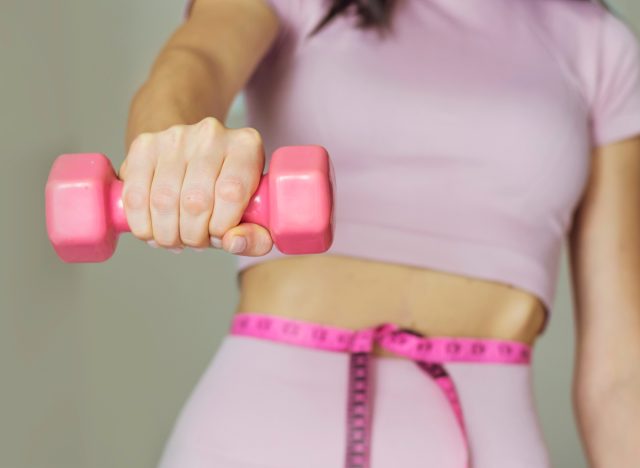
woman holding pink dumbbell weight loss concept
Shutterstock

When it comes to how to lose inches off your waist through working out, you need a two-to-three-day-per-week plan that hits upper and lower body exercises at a high intensity.

For lower body workouts, select three to five leg exercises, then perform 10 to 20 reps with 30 seconds of rest between sets, for a total of three to five rounds.

For upper body exercises, select a horizontal push and pull, along with a vertical push and pull exercise, for a total of four exercises. Perform three sets of 10 on each.

If you prefer jogging, I recommend using HIIT-style training to maximize your calorie burn and fat loss.

RELATED: 5 Best Habits to Lose Belly Fat and Actually Keep it Off, Says Science

Example of a lower-body workout:

Perform each exercise for 10 to 15 reps using moderate resistance, then rest for 30 seconds, and complete the next exercise. Repeat for three to five rounds.

  • Squats
  • Lunges
  • Deadlifts
  • Side lunges

Example of an upper-body workout:

Perform each exercise for 10 to 15 reps using moderate resistance, then rest for 30 seconds, and complete the next exercise. Repeat for three to five rounds.

  • Pull-ups
  • Dumbbell overhead press
  • Dumbbell rows
  • Dumbbell bench press

Example of an interval workout:

Run for 10 to 15 minutes, alternating 30 seconds of intense running followed by a 30-second jog. You can start by performing a few interval cycles, then finishing with a slower jog, until you are able to complete a full 15 minutes of interval training.

The bottom line

Any program is only as good as your ability to stick with it long enough to see results. These guidelines give you a framework to follow a diet and exercise program that will lead you to sustainable fat loss, slimming down your waist to reveal a fit, toned physique and all-around healthy body. Following this program for at least three months is the best way to ensure sustainable weight loss results.

Tyler Read

Tyler Read is a personal trainer and has been involved in health and fitness for the past 15 years. Read more about Tyler

Can diet, exercise cure Type 2 diabetes? How one woman beat it

As President Joe Biden noted on the steps of the White House when he proclaimed November National Diabetes Month, the disease — particularly Type 2 diabetes — is an American problem that isn’t going away.

According to statistics from the American Diabetes Association, nearly 5,000 people are diagnosed with Type 2 every day, adding up to 34 million Americans — about 1 in 10 — who are currently battling the disease.

“I call on all Americans to join in activities that raise diabetes awareness and help prevent, treat, and manage this disease,” urged the president.

Or, in Jody’s case, reverse it.

* * *

merlin_2949723.jpg

Jody Reid, a mother of three who reversed her Type 2 diabetes through exercise and diet, right, runs with daughter Kaylyn,13, during a fitness class at Roy CrossFit in Roy on Wednesday, Nov. 9, 2022.

Laura Seitz, Deseret News

Jody Reid is a 36-year-old mother of three with many diabetic relatives, a sweet tooth, a desk job at the IRS — and a membership to the Roy CrossFit workout gym.

All these factors contribute to her story. One that begins in despair and ends in her joining a rare club of people who once were diabetic, and now aren’t.

Unbeknown to her, Jody’s battle with diabetes began when she was born. A long line of aunts, uncles, grandparents, on both sides, had contracted Type 2 diabetes before her, suggesting a strong genetic disposition to the disease.

Then there’s her affection for sweets. As she puts it, given a choice between kale and a KitKat, “I’ll take the KitKat every time.”

Add in the job she’s held at the IRS since 2006 that requires sitting at a desk for eight hours a day.

If that sounds like a recipe looking for a diabetes diagnosis … well, it was in Jody’s case.

She was just 31 when the doctors warned her she was prediabetic — a danger zone where your sugar level numbers are trending in the wrong direction (it’s estimated 94 million Americans are prediabetic).

In response, Jody joined a gym. She chose a crossfit gym near her home — CrossFit workouts feature high intensity interval training, usually in groups — because her sister, Jenny, had joined a CrossFit gym and “lost a bunch of weight.”

“I thought I’d be able to exercise my way out of it,” Jody says. Plus she’d drop some pounds in the process.

Instead, just the opposite occurred.

Based on someone mistakenly advising her, “If you’re CrossFitting you can eat whatever you want,” before and after workouts she continued to inhale the candy and chocolates she kept stashed in her car’s console.

She gained weight.

Worse, at the beginning of 2019 her blood work revealed she had crossed the line from prediabetic to full-fledged Type 2 diabetes. The doctor sent her home with Metformin, the starter medication often given to new diabetics.

She came to the gym that day sobbing. She found plenty of sympathy, but she also found a stern warning from her coach, Van Aston, who is also a physician’s assistant.

“I get emotional talking about it,” says Jody, “but he just looked at me and he said, ‘You have to take this seriously. This disease kills people every day.’

“That scared me. Nobody had put it that harshly, and I needed it to rock my world. I’d been in denial, avoiding the truth, because it was hard to swallow the pill that I was doing it to myself.”

Shortly after that, the gym sponsored a nutrition challenge. Jody signed up. She was committed with a capital C. She cut out the junk food, she educated herself about proper nutrition and added healthy food to her diet. She drank 100 ounces of water a day. She put in her 10,000 steps. She attended CrossFit classes six days a week.

Her weight plummeted to 160 pounds (she’d been 220 when she joined the gym two years earlier). Her energy returned. She could tie her shoes without having to take a break. When she got in the car there was a big gap between her stomach and the steering wheel.

And those were just the hors d’oeuvres.

In July she went back to the doctor for her six-month checkup.

“They take your blood work and tell you they’ll call the next day if there’s anything to report,” she explains.

The next day her phone rang.

“This cute little nurse said, ‘Your numbers are awesome. You have reversed the Type 2 diabetes. They are so good you’re not even prediabetic any more.’”

After celebrating with her husband and kids, Jody was back at the gym, sobbing again. But this time, instead of sympathy, she received “high-fives, hugs, tears.” The same people who commiserated with her in January celebrated with her in July.

“We did the happy dance,” remembers gym owner Kevin Lundell. “It was a big freakin’ deal.”

* * *

merlin_2949729.jpg

Jody Reid, a mother of three who reversed her Type 2 diabetes through exercise and diet, participates in a fitness class at Roy CrossFit in Roy on Wednesday, Nov. 9, 2022.

Laura Seitz, Deseret News

Three years have come and gone since Jody reversed her diabetes. She continues to eat better. She admits she has her lapses. “I’m still addicted to sweets,” she says, confessing to what she calls “a bender” she went on during the holidays last year.

She was relieved when her blood work numbers were still OK after that. “I thought I was doing awful but I think overall my habits are significantly better than the behavior that led to the Type 2 diabetes. The changes and choices I made then influence the choices I make today.

“I’m not perfect, but now I know about nutrition and what I need to do to stay healthy. It’s hard work. It’s not always uphill, it’s not always downhill, but it’s never a straight line.”

Her CrossFit classes remain a daily staple.

“How awesome this CrossFit community is,” she says, “to be surrounded by people who want to be healthier, who want you to be healthier, who cheer you on to do hard things. I’m way healthier in my 30s than I was in my 20s, and happier. It’s easier to live life when you’re feeling better.”

merlin_2949725.jpg

Jody Reid, a mother of three who reversed her Type 2 diabetes through exercise and diet, is pictured at Roy CrossFit in Roy on Wednesday, Nov. 9, 2022.

Laura Seitz, Deseret News

Morning exercise linked to lowest risk

Morning exercise linked to lowest riskShare on Pinterest
People should exercise in the morning if they want to reap the best cardiovascular benefits, a study suggests. Image credit: wAleksandarNakic/Getty Images.
  • A new study investigates the potential effect of exercising at different times for preventing cardiovascular disease and stroke.
  • The study finds that people who exercise in the morning achieve the greatest reduction in risk. This is particularly true for women.
  • The best time of day to exercise may be around 11 a.m. according to the study.

Although exercise is always generally good for health, a large new prospective study finds that one particular time of day may offer the greatest benefit when it comes to lowering the risk of cardiovascular disease (CVD) and stroke.

The study found that physical activity in the morning, between 8 and 11 a.m., had the greatest positive effect on a person’s risk of CVD and stroke compared to activity at other times of day.

The association applied equally to individuals who described themselves as morning or evening people.

The study authors also found that people who exercised both early and late in the morning — versus mid-morning — derived the greatest benefit.

Dr. Paul Arciero, professor in the Human Physiological Sciences Department at Skidmore College in Sarasota Springs, NY, explained why the study is so persuasive:

“This is the largest prospective study to date in more than 86,000 participants, over a six-year follow-up period, examining the effects of exercise time of day, or ‘chronoactivity,’ on cardiovascular disease [heart attack and stroke] risk.”

“I think this study does a great job of trying to tackle a few of the biggest challenges in physical activity intervention research,” Dr. Asad R. Siddiqi commented to Medical News Today. “Namely, [the] scale of study, generalizability, and follow-up interval.”

Dr. Siddiqi is a sports medicine and rehabilitation expert at Weill Cornell Medicine and NewYork-Presbyterian in New York. Neither he nor Dr. Arciero were involved in the study.

The study appears in the European Journal of Preventive Cardiology.

The researchers analyzed data from 86,657 individuals in the UK Biobank. Their average age was 62, and they ranged in age from 42 to 78. The majority of individuals, 58{bf0515afdcaddba073662ceb89fbb62b6b1bf123143c0e06b788e1946e8c353f}, were women. Accelerometers recorded participants’ physical activity over a period of 7 days.

Dr. Siddiqi expressed some concern about the study’s fitness tracking, noting that “[t]he participants were followed for only 7 days, and in a manner that involved an ‘intervention’ — wearing an accelerometer, which they otherwise may not do — and we always need to be cognizant of how these interventions affect participant behavior, i.e., the Hawthorne Effect.”

“The real question is whether a 1-week tracking period is a fair representation of habits throughout the 6 to 8-year follow-up period,” he said.

Dr. Arciero, however, did not consider this a problem, saying that “[b]ased on a previous research study, a 7-day physical activity accelerometer measurement is considered a representative time period to assess a person’s overall physical activity level.”

The lead author of the study is Dr. Gali Albalak of Leiden University Medical Center in the Netherlands. Even though people’s activity could have changed over time, she told MNT, the accelerometer data “enables objective measurement of physical activity without any recall or other forms of bias that play a role in questionnaire-based physical activity information.”

In any event, added Dr. Siddiqi, “[i]n general, given that the study population was largely middle-age[d] to older adults with presumable ‘formed’ behavioral habits and patterns, there isn’t a strong suggestion that these habits would change significantly over the follow-up period.”

After 6 years, 2,911 study participants developed coronary artery disease (CAD), and 796 participants had had a stroke.

Overall, people who exercised at 11 a.m. were 16{bf0515afdcaddba073662ceb89fbb62b6b1bf123143c0e06b788e1946e8c353f} less likely to develop CAD, and 17{bf0515afdcaddba073662ceb89fbb62b6b1bf123143c0e06b788e1946e8c353f} less likely to have a first stroke of any kind. They were also 21{bf0515afdcaddba073662ceb89fbb62b6b1bf123143c0e06b788e1946e8c353f} less likely to have a first ischemic stroke, compared to the study’s reference group.

People who exercised early in the morning lowered their CAD risk by 11{bf0515afdcaddba073662ceb89fbb62b6b1bf123143c0e06b788e1946e8c353f}.

When the researchers tabulated women and men separately, it turned out that women benefited considerably more from morning exercise. By itself, the benefit of morning exercise for men was not statistically significant.

Women who exercised in the early or late morning reduced their risk of CAD by 22{bf0515afdcaddba073662ceb89fbb62b6b1bf123143c0e06b788e1946e8c353f} and 24{bf0515afdcaddba073662ceb89fbb62b6b1bf123143c0e06b788e1946e8c353f}, respectively.

“In support of this large prospective study,” added Dr. Arciero, “a recent 3-month exercise intervention study published from our laboratory with a group of middle-aged, healthy-weight women and men showed that women exercising in the morning reduced systolic and diastolic blood pressure to a significantly greater amount (-10{bf0515afdcaddba073662ceb89fbb62b6b1bf123143c0e06b788e1946e8c353f} vs. -3{bf0515afdcaddba073662ceb89fbb62b6b1bf123143c0e06b788e1946e8c353f}) compared to women exercising in the evening.”

“Thus, our data also supports morning exercise in women to improve cardiovascular health, and therefore lower incident risk for CVD,” he argued.

Dr. Albalak noted: “We were not able to explain this difference in our finding[s]. One of the possible explanations could be that the etiology of cardiovascular disease is different in men and women.”

“So, more research is needed,” said Dr. Albalak, “before we can make any recommendations for men or women. However, we see our research as a first step in the right direction.”

Dr. Albalak noted that “[a]s this was an observation[al] study, we cannot say anything about the causal effect of physical activity timing on our [cardiovascular] health.” Still, she pointed out that the study’s findings align with her group’s previous work.

“We already were able to identify that morning physical activity was associated with metabolic health — BMI, glucose levels, and insulin resistance — in a group of 207 healthy but sedentary older adults,” she said.

“Also, physical activity is, just like food intake and exposure to light, an important ‘Zeitgeber,’ or circadian clock trigger,” said Dr. Albalak.

“This means that with these behavioral aspects, we can calibrate our biological clock and the circadian rhythms with each other and our environment [day and night cycle of the earth],” she added.

“From other research, we know that eating after 8 p.m. or exposing ourselves to bright light at night can have detrimental effects on our biological clock. We hypothesize that being physically active in the morning is the most appropriate timing to correctly set your clock.”

Dr. Siddiqi noted:

“For the majority of people, we are simply trying to introduce the habit of physical activity, and so any time of day is better than nothing. As a general rule, though, I try to make exercise promotion simple and flexible to increase adoption, recognizing that timing of exercise is a fine adjustment that has practical aspects and limitations.”

Five questions: FSU exercise physiologist works to help individuals achieve optimal performance

Five questions: FSU exercise physiologist works to help individuals achieve optimal performance
Michael Ormsbee, a professor in the College of Health and Human Sciences

Professor of Nutrition and Integrative Physiology Michael Ormsbee first became interested in how the body performs as a high school athlete, an interest that blossomed into a full-time career.

As a professor and director of Florida State University’s Institute of Sports Sciences and Medicine, or ISSM, he has worked with both individuals who are competing at the highest levels of athletic competition and those who are trying to improve their overall health.

He answered five questions about how he came to work in this field and his latest projects.

What first drew you to the field of exercise physiology and nutrition?

I grew up in an active household and played sports my entire life. I began training as a young teen and was always competing at the President’s Physical Fitness Tests that were held annually in middle and high school. My older brother was the same way and began to read some of the old school muscle and fitness magazines for fun. I was fortunate to then go on to college and play ice hockey. Around that time, I took an introduction to exercise physiology class as a freshman and had a professor that made me love the material and want to learn more. I was hooked.

How have your perspectives changed since you started working in the field? Or are there areas you are more interested in now as opposed to when you started?

My view has changed from a “me focused” approach to a more altruistic approach to asking research questions. I was at first, of course, interested in learning more about exercise and nutrition to improve my own personal performance on the ice or in the weight room. Later that morphed into a focus on how to help others achieve a high level of performance, be it for athletes to be bigger, faster and stronger or for the general population to be healthier, fit and happy. I suppose some of my interests shifted also to older populations as I got older too. In recent years, we have also become more focused on wearable technologies for sport, female physiology and sleep science. However, the underlying focus has always been to use nutrition and exercise to improve health, body composition and performance of any of the populations that we study.

You recently took over as director of the Institute of Sports Sciences and Medicine. What do you see as the role or mission of that institute going forward?

The vision I have for the institute is to make it the top authority in sport science, performance nutrition and sports medicine globally. We have some great momentum nationally and some collaborations internationally, but there is a need to expand our reach. In this new role, I hope to more fully incorporate interested researchers and research programs from both athletics and from medicine. We have traction in both areas, but I will be looking to expand our collaborations and reach. Simultaneously, I hope to provide improved experiences for students to not only learn about the theory of exercise and nutrition science, but to put it into practice. We are now re-opening our successful community outreach program to allow pay-for-service testing so that the community can have an “athlete experience” and get data to improve their own health such as fitness level, lactate threshold, aerobic capacity, body fat and muscle mass, or simply run on our anti-gravity treadmill.

This growth mindset will help to, first, gain visibility on campus and in our community and also open up research collaboration opportunities that did not exist before.

In addition to your work looking at how elite athletes can achieve optimal performance, you also are working on a project about how some of these principles can be applied to individuals struggling with health issues such as obesity and potentially Type 2 diabetes. Can you talk a little bit about how these different types of projects intersect or how one might help inform the other?

Yes, I have been fortunate to work with athletes, the general population and clinical populations. While these may sound like completely different research areas, they all fit under our primary umbrella of human performance nutrition research. For me, I think improving performance is equally impressive whether it is to simply take a few more steps, to be able to climb a flight of stairs, to improve body composition or translate it into actual on-field performance changes. Performance should not be limited to athletes; we all need to perform in life and at work. So, while our populations vary, our end goal is usually quite similar.

Currently we are working on projects with FSU athletes, firefighters, obese and diabetic individuals, and active older adults. What fascinates me constantly is the cross-talk between traditional medicine and sports nutrition. For example, there are a number of instances where a sports nutrition product is now used in clinical populations and vice versa. To give one example, creatine supplementation began in athletes but is now used in a plethora of clinical conditions with success. Likewise, there are modified starches that were developed for a clinical condition called glycogen storage disease that are now used by athletes.

The beauty of our work is that it is highly engaging for the scientist and is translatable for the physician, athlete or coach.

Where do you see your research going forward? Do you have any specific plans for ISSM or your personal research agenda that you’d like to share?

I am beginning to meet with other top research facilities and directors of other institutes that are similar to ours to understand what works and what does not. That will ultimately translate into an updated mission, increased collaboration with highly funded institutes or centers and improved recognition worldwide. I’m excited to bring in new faculty to the institute (we are currently hiring an assistant professor of sports nutrition) and creating more internal and external affiliates to focus on areas such as female physiology, warfighter/first responder resilience, sleep medicine, elite athletics and sports medicine.

/Public Release. This material from the originating organization/author(s) may be of a point-in-time nature, edited for clarity, style and length. The views and opinions expressed are those of the author(s).View in full here.