Racist Doctors and Organ Thieves: Why So Many Black People Distrust the Health Care System

Discrimination, lack of access, mistrust and mistreatment aren’t unique to Black Americans; Latinos and other minority groups experience it, too. Poor people often wait longer for worse care in underfunded, understaffed — and often de facto racially segregated — public hospitals and clinics than richer, better-insured people. And they know it.

Growing up in Detroit, Michael Winans, now in his early 40s, was “too busy getting by” to pay attention to a syphilis experiment that ended before he was born. But distrust of the medical establishment flowed in his family. His grandmother survived a stroke but died during routine follow-ups; the family suspected sub-par care. Later, his mother hesitated when she needed fibroid surgery. When she finally went in, she ended up with an unexpected hysterectomy. Winans knows that sometimes happens, that the less invasive operation isn’t always enough. But was it necessary for his mother? He wonders.

“When you grow up in a predominantly Black town like Detroit, you can go much of your life without really interacting with someone of another race,” he says. “If the first time is when you have a health issue … you ask yourself, ‘Does this person care for me? Or see me as a number?’ It’s another level of potential trepidation or concern.”

The Black American experience is getting particular scrutiny right now, along with hopes for change. Some of the people interviewed for this story were more optimistic than others about progress. But none saw the health system as color-blind.

“People see that I’m Black before they notice — if they ever get to the point that they notice — that I have a PhD.,” says Cara James, who ran the Office of Minority Health at the Centers for Medicare and Medicaid Services during the Obama administration. James, who also previously led work on racial disparities at the Kaiser Family Foundation, is now the president and CEO of Grantmakers in Health, which works with foundations and philanthropies to improve health care.

Things may have gotten better since the days when James would carefully select which suit to wear as she accompanied her grandmother, an agricultural worker in the South with little formal education, to medical appointments. But they haven’t improved enough.

“We are human,” she says, “We have perceptions and biases about others.”

Those biases can be subtle — or not.

When Matthew Thompson, a financial officer at a reproductive health organization in Texas, fell ill soon after relocating to Austin a few years back, he didn’t yet have a regular doctor but managed to get an appointment with someone. That doctor, who was white, took one look at Thompson, a 40-something Black male, and on the basis of a brief examination and blood pressure reading, diagnosed him with hypertension and handed him a prescription.

“He was a white doctor … he gave the whole speech about genetics and race,” Thompson recalls.

But most health differences between Black people and white people are not genetic; many are socioeconomic or the result of inequality or the lingering distrust that might deter a Black patient from seeking care earlier.

That doctor was right that hypertension is common in Black men. The problem is that Thompson didn’t have it. The doctor treated a stereotype, not a person.

Ironically, trust — tragically misplaced trust — was part of what allowed the Tuskegee study to go on for 40 long years. That’s according to Lillie Tyson Head, who leads the Voices for Our Fathers Legacy Foundation, an organization created by the descendants of those who suffered. The men, like her father, Freddie Lee Tyson, who was born with syphilis, were told they had “bad blood,” not syphilis. And they trusted those men in white coats who kept studying them, untreated, endangering them, their wives and their children.

“Those men were trusting,” says Tyson Head, 78, a retired schoolteacher. “They went forth thinking they would be treated. And they were still trusting for over 40 years.”
Northwest doctors say: Keep blood pressure in check with healthy lifestyle, testing at home

Because it draws zero attention to itself, high blood pressure — the technical term is hypertension — seems to be the easiest to shrug off of all ongoing health conditions in American adults.

It’s symptomless. It’s sneaky. A trivial paper cut will cause you more pain and suffering than this important aspect of your health.

Nearly half of all American adults have high blood pressure, according to the American Heart Association, and many don’t even know it.

But hypertension doesn’t stay symptomless forever, according to Dr. Noreen Nazir, a preventive cardiologist at Oregon Health & Science University.

“In the early stages, you can have elevated numbers but no sustained symptoms,” Nazir said. “The body is trying to compensate. It can do this for a time but you may be on your way to developing symptoms and developing negative outcomes later on.”

Avoid ‘Holiday Heart’

The holiday season is when we tend to eat and drink with abandon. Doctors have a name for seasonally troubled cardiovascular systems: “holiday heart.” If you’re trying to keep your blood pressure in check despite holiday treats and peer pressure, try these tips:

  • Before you hit that party, snack healthily and include protein. You’ll be less inclined to gorge.
  • At the party, start with a glass of water. Delay and reduce alcohol.
  • Keep exercising. In addition to keeping your blood pressure better regulated, it’ll reduce stress and keep your spirits bright.
  • Stick with your meds. If you tend to forget, get a weekly pill organizer.
  • Be careful with over-the-counter cold and flu meds, which can raise blood pressure. Read labels. 

According to the American Heart Association, chronic hypertension — that is, blood pressure that stays too high for too long — increases one’s risk of heart attack, stroke and a host of other health problems, from heart and kidney disease to vision loss and sexual dysfunction.

“Most people experience very little symptoms until it’s too late,” said Dr. Richard Segal, an internal medicine specialist at Kaiser Permanente in Salem, Ore.

Heart disease is the No. 1 cause of death for adults in the United States, according to the Centers for Disease Control and Prevention. Stroke is No. 5.

“Worldwide, raised blood pressure is estimated to cause 7.5 million deaths, about 12.8 percent of the total of all deaths,” according to the World Health Organization.

That’s why it’s important to get screened, understand what your numbers mean and come up with a plan if you need one.

“If you have risk factors you want to mitigate them,” Nazir said. “And if you have hypertension, you want to get it under control. You don’t want it to get worse.”

Physics vs. fast food

High blood pressure is really a simple physics problem, Nazir said. It happens when too much fluid is forced through constricted blood vessels.

Age and genetics are two reasons why healthy blood vessels may constrict over time, but our own behavior is usually the bigger factor. Smoking, an unhealthy diet, more than a little alcohol and lack of exercise are chief culprits. They all contribute to constricted, stiffened blood vessels as well as the buildup of plaque, which further blocks the way.

“Smoking is the No. 1 thing,” Segal said. “The nicotine in tobacco is a major factor in narrowing the blood vessels and letting plaque build up.”

Sugar, fat and alcohol are also culprits, Nazir said. Sodium is the most infamous blood-pressure raiser of all.

“Salt is everywhere,” she said. “It is easy to overdo and it has a lot of impact, as it causes the body to retain more fluid and the heart to pump more fluid.”

Industrial and commercial foods have everything to do with this, according to the CDC, which notes that sodium in restaurant and processed foods “contributes to high rates of blood pressure, heart attack and stroke.”

Still, Kaiser’s Segal cautioned against freaking out about hidden salt. If you take the trouble to read labels, make smart food choices and stay out of the drive-thru lane, he said, your sodium intake shouldn’t be much of a problem.

“And could you please make that with no salt or as little salt as possible?” is the way to make a polite nuisance of yourself in restaurants. Why not? You are paying for your food. Your hypertensive dining companions likely will admire your gumption, and even follow your lead.

Always exercise

Exercise is the best prescription for, well, just about everything, Segal said.

In terms of blood pressure, aerobic exercise strengthens the heart muscle as well as the elasticity of blood vessels. While it causes a temporary spike in blood pressure, exercise also promotes a healthier, more efficient, more resilient cardiovascular system overall.

Even obese people can benefit in myriad ways from getting moving, Segal said. In addition to a direct effect on blood pressure, moderate exercise promotes weight loss, stronger muscles and better moods.

And that’s important, Nazir said, because chronic stress is another blood pressure booster.

Walking, jogging, hiking, swimming and dancing are all great examples of aerobic exercise. The American Heart Association recommends that we all try for at least 30 minutes of moderate exercise, five days per week. If that’s new to you, start slowly and build toward it. If 30 minutes at once is too much, break it into 15- or 10-minute chunks.

(If you already have heart issues or have had a heart attack, check with your doctor first.)

Test yourself

Unhealthy habits aren’t the only reason why nearly half of all Americans have high blood pressure. The definition of “high” has also changed.

“We recognize, medically, that it’s healthier to have lower blood pressure,” Segal said. “We are watching our guidelines continuously drop.”

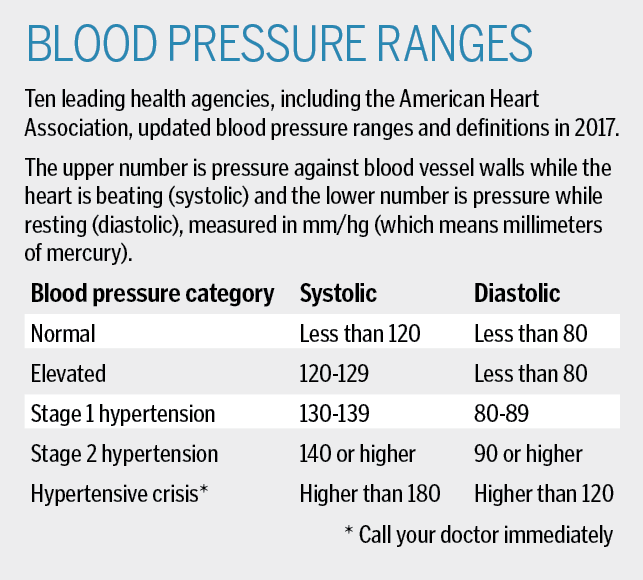
In 2017, the marker for detecting, managing and treating hypertension was lowered from 140/90 to 130/80. That swept many millions more people into a newly expanded group that ought to be testing and managing their blood pressure.

The new guideline stemmed from numerous clinical studies that showed that achieving lowered blood pressure goals significantly reduced the rate of “heart events” and death, according to the American Heart Association.

But because doctor’s offices tend to give people the willies and cause what’s known as White Coat Syndrome (anxiety that produces high blood-pressure readings), testing yourself in the comfort of your home will give you more meaningful results, Segal said.

Today’s over-the-counter arm cuffs are reliable and affordable, Segal said. He doesn’t recommend finger or watch-style wrist blood pressure readers, which are not accurate enough, he said.

When to test? Other than waiting half an hour or more after coffee — that’s a guaranteed spike — there’s no wrong answer.

“I always say the best time is whenever you can,” Nazir said.

Many people check right after waking in the morning but before eating or drinking anything. Then they become dismayed to discover that, despite still feeling groggy, their blood pressure is surprisingly high.

That’s thanks to your body’s natural release of the stress hormone cortisol, which helps you rev up in the morning and typically drives a blood-pressure spike, Nazir said.

Be aware of that dynamic, Segal and Nazir both said, but don’t let it alarm you. Test at various times during the day and you’ll likely be surprised at how much blood pressure varies. At night, when your day is winding down, you might just be surprised and comforted to see how low it goes.

More information is always better, Nazir said. Whenever you test, do it three times. Your digital reader can probably calculate the average for you.

“The important thing is the average,” Segal said.

Medical terms used by doctors often baffling to patients

The words some doctors use are often misunderstood by patients and their families, leaving them feeling confused and vulnerable, according to researchers.

In a study published Wednesday in the journal JAMA Network Open, University of Minnesota researchers found that the language doctors often use tends not to translate easily into everyday English.

A positive test result, for example, generally suggests something negative: A disease like Covid, for example, has been detected.

The disconnect in terms has long bothered Dr. Michael Pitt, associate residency program director in the department of pediatrics at the University of Minnesota. He teaches medical students how to communicate effectively with their patients and their families.

“You could be the smartest doctor in the world, yet you’re useless if your patients don’t understand what you are saying,” Pitt said. “It’s always driven me nuts.”

Pitt and his research team tested how well people understood medical jargon by going to one of the largest gatherings in Middle America: the 2021 Minnesota State Fair.

They surveyed 215 fairgoers on their knowledge of potentially confusing health terms. None of the participants had medical training, but all spoke and read English.

While nearly all, 96{bf0515afdcaddba073662ceb89fbb62b6b1bf123143c0e06b788e1946e8c353f}, of the respondents understood that a negative result on a cancer screening was actually a good thing, the medical meaning of other common words and phrases was often misinterpreted.

An ‘impressive’ chest X-ray

Take the word “impressive.” To most of us, getting straight-A’s in school, making a half-court shot in basketball or running a marathon are all “impressive” accomplishments.

But when doctors say a patient’s chest X-ray is “impressive,” they really mean, “This worries me.”

That translation was lost on 79{bf0515afdcaddba073662ceb89fbb62b6b1bf123143c0e06b788e1946e8c353f} of survey respondents.

The word “impressive” is a particular pet peeve for Dr. Giridhar Mallya, a former family physician and current senior policy director for the Robert Wood Johnson Foundation.

“It borders on disrespectful because we’re describing something as impressive that is causing real harm for patients,” Mallya said.

What’s more, 21{bf0515afdcaddba073662ceb89fbb62b6b1bf123143c0e06b788e1946e8c353f} of survey respondents did not understand that the phrase, “Your tumor is progressing,” meant that cancer was getting worse.

“If our patients don’t understand what we think is going on, what our treatment plan is, what we’re asking them to do to get cured, better, healthy,” Pitt said, “we actually could be causing physical harm.”

“They might be less inclined to actually follow up on the actual steps necessary, which could delay care,” he said.

“It is so clearly obvious why people can misunderstand” such language when “our typical terminology is the direct opposite meaning of the medical terminology,” said Dr. Holly Andersen, director of education and outreach at the Ronald O. Perelman Heart Institute at New York-Presbyterian Hospital/Weill Cornell Medical Center in New York City. Neither Andersen nor Mallya were involved in the new research.

“We as a profession have jargon oblivion,” Pitt said. “We forget that there was a time when we learned these words, and didn’t know them.”

Is it a hidden infection or witchcraft?

Dr. William Schaffner, an infectious disease expert at Vanderbilt University Medical Center in Nashville, Tennessee, is frequently called upon in the media for his ability to help translate complicated science in terms that anyone can understand. He said the new research is “very important.”

“It’s a message to medical professionals that they need to speak very clearly with their patients, rather than to them,” Schaffner said.

By far, the most misunderstood medical term in the study was the word “occult,” a word that conjures up an idea of witchcraft in most people.

“People thought it meant demonic or that we thought you were possessed,” Pitt said. In medicine, “occult” simply means that a problem was hidden, or not immediately apparent to health care providers.

‘We’re gonna put you to sleep’

Pitt, a pediatrician, takes the lessons in effective communication to heart when treating children.

“A phrase that could be heard very differently by a kid would be ‘we’re gonna put you to sleep’ before a procedure,” Pitt said. “Think about ways that they may have heard that before. It probably means their dog was killed.”

Patients should feel empowered to ask doctors, nurses and any other health care personnel to explain themselves clearly, even if it feels uncomfortable, Schaffner said.

“Don’t hesitate,” he said. “If somebody is using medical jargon, a phrase that you don’t understand, feel free to say, ‘Excuse me, I don’t understand what you’re trying to say. Could you be a little more clear about that?'”

Follow NBC HEALTH on Twitter & Facebook.