Opinion | How health systems can fight climate change by not using desflurane

Physicians, nurses and other front-line providers know firsthand the health impacts of climate change. Air pollution exacerbates asthma and emphysema; extreme heat worsens heart and kidney conditions; and rising temperatures increase the occurrence of a wide range of illnesses, including mosquito-borne infections and depression.

That’s why it’s so shocking to learn that health care itself is a major contributor to climate change.

In the United States, the health sector is responsible for nearly 9 percent of the nation’s greenhouse gases. Researchers estimate that the environmental harm caused by medical care ultimately costs as many lives as preventable medical errors, which are responsible for as many as 98,000 deaths annually. This is in direct conflict with the mission of the healing professions.

Brian Chesebro, an Oregon-based anesthesiologist who serves as medical director of environmental stewardship at Providence, had this “aha” moment in 2016. At the time, he told me, he was going through a period of “eco-grief” about the state of the Earth.

Sign up for The Checkup With Dr. Wen, a newsletter on how to navigate the pandemic and other public health challenges

“Instead of spiraling down, I realized that my greatest opportunity to advance environmental stewardship was through my job as a physician,” he said. “I could address it in my own practice, then, as a physician-leader in my hospital, inspire change in my colleagues.”

His work as an anesthesiologist turned out to be the right launchpad. That is because some anesthetic gases commonly used in operating rooms are extremely potent greenhouse gases.

As Emily Mediate from the nonprofit organization Health Care Without Harm told me, the elimination of one specific gas, desflurane, could make a profound impact. “Desflurane has the global warming potential of over 3,700 equivalents of carbon dioxide,” she told me. “It lasts for 14 years in the atmosphere.” Her organization is among those that have been urging health-care systems to move away from desflurane and switch to sevoflurane and isoflurane, anesthetics that are clinically equivalent but have a small fraction of the environmental consequence of desflurane.

Chesebro took on this challenge. He began by educating fellow clinicians. “We weren’t taught to think in terms of environmental impact in residency,” he said, noting that the response from other physicians was primarily “surprise, interest and curiosity.”

He also measured and documented each anesthesiologist’s desflurane use. When Chesebro informed a colleague that his use of desflurane was equivalent to driving a fleet of 12 Hummers, the colleague sputtered in defense, “But I drive a Prius!”

“He was trying so hard to make wise stewardship choices, but he didn’t realize that his environmental impact as an anesthesiologist far outstripped any other facet of his life,” Chesebro said. “He changed his practice that day and has never used desflurane since.”

Over time, Chesebro redesigned systems so that desflurane was less easily accessible than other inhaled gases. “We still keep one or two desflurane vaporizers so someone could use it if they really need it, but it is no longer at arm’s reach in every operating room,” he said. He believes this was more effective than banning the gas. “Instead creating adversaries, we created an army of advocates who are eager to partner with us” on other efforts.

Before this intervention, the Providence system’s eight Oregon hospitals used desflurane 42 percent of the time, according to Chesebro. Now, he says, the rate is 0.07 percent. “We’ve cut emissions related to anesthetic use by 95 percent, and, because desflurane is a more expensive option, we’ve also cut the financial cost by 80 percent.”

Providence is not alone. Mediate shared success stories from around the country. Virginia Mason Medical Center eliminated desflurane use, thanks to the advocacy of an anesthesiologist and an anesthesia tech there. This resulted in an estimated 60 percent decrease annually in its operating room greenhouse emissions and saved the hospital more than $30,000 each year. Advocate Aurora Health, in a nurse-led effort, also cut its use of desflurane. Since 2017, the health system has reduced its anesthetic gas emissions by 75 percent and saved $1.6 million.

There is still a lot more work to be done. While the U.S. health system accounts for about a quarter of all global health sector-related emissions, it is far behind many peer countries in tackling this problem. In fact, many political leaders are actively trying to block sustainability initiatives.

I was heartened to learn that Health Care Without Harm’s Climate Council includes 21 health systems representing more than 600 hospitals across 43 states. In addition to health sector-specific reforms, they are encouraging others to join them in addressing building emissions, switching to renewable energy and limiting single-use plastics, among other efforts to reduce their carbon footprint.

“Health-system leaders understand that the climate crisis is a health crisis,” Mediate said. “Better care is low-carbon care.”

That’s a perspective on medical care that I wasn’t aware of before. Now, I’m convinced that clinicians’ obligation to “first do no harm” should extend to our responsibility to reduce the effects of climate change caused by the health-care sector itself.

How major retailers are trying to change how America consumes health care

Illustration of a price tag in the shape of a red cross

Illustration: Sarah Grillo/Axios

Amazon, Walmart, CVS, Dollar General and other big retailers are elbowing their way into health care delivery, pushing a customized consumer experience driven by digital health products.

What’s happening: At its core, these companies are pulling together different tech-enabled services — urgent, primary, home and specialty care, pharmacy, and, in some cases, full integration with an insurer.

  • “Convenience is really front and center to those plays. They are trying to capture the attention of the patient when they already own that consumer,” Caroline Hofmann, head of emerging businesses at virtual specialty care company Thirty Madison.

Why it matters: A more user-friendly portal to the health system could lead to more engaged patients and better access to care in underserved areas. It could even yield a sustainable model for profitably offering better care for less money.

  • But the retailers’ forays are prompting growing anti-trust and privacy concerns, as well as fears of further erosion of the doctor-patient relationship once considered central to coordinated care.

What they are saying: “If you fast forward 10 years from now, people are not going to believe how primary care was administered,” said Amazon CEO Andy Jassy in a recent announcement about the company’s $3.9 billion acquisition of concierge medicine provider One Medical.

  • With that deal, which closed last month, Amazon brought in an on-demand virtual care services platform, more than 125 locations and a piece of the Medicare Advantage business.

Driving the news: Yesterday, Best Buy Health launched a hospital-at-home program with North Carolina-based Atrium Health. The tech retailer bought the remote patient monitoring company Current Health in 2021. Best Buy said it will provide patient education, its at-home care platform and devices, and technical support via specially-trained Geek Squad agents.

  • It came on the heels of Walmart Health announcing last week that it plans to nearly double the footprint of its in-store clinics, which offer primary, behavioral health vision and dental care. In the fall, Walmart also inked a 10-year Medicare Advantage deal with UnitedHealth Group.
  • In January, CVS Health announced a plan to buy Oak Street Health, a primary care group focused on Medicare patients. The pharmacy giant already owns insurer Aetna, pharmacy benefit manager CVS-Caremark, home health company Signify Health and health care service brands MinuteClinic and HealthHUB.
  • Also in January, Walgreens-backed primary care company VillageMD, scooped up more primary, specialty and urgent care investments, augmenting plans to open more than 500 full-service doctors’ offices in Walgreens locations,
  • Other companies like Rite Aid, Albertson’s, and Dollar General have launched programs in health care delivery.

Between the lines: Amazon, CVS and Walmart have made some of the most consequential moves by combining their massive retail footprints with assets like primary or urgent care sites, pharmacies and some sort of relationship with insurers, experts say.

  • “They’re all acquiring every piece of medicine,” Robert Pearl, a Stanford University professor and former CEO of The Permanente Medical Group, told Axios.
  • “Medicine as we know it will be very very different assuming they’re successful. They’re big companies, they’re smart companies.”

Be smart: Depending on the retailer, patients might have access to virtual care services, book appointments and fill prescriptions via an app.

  • They could get same-day care, get preventative services like vaccines and pick up their drugs in-store. A health worker might walk them down store aisles and guide them to healthy food purchases and wellness products.

In the first wave of this trend, retailers were more focused on urgent care or one-off visits for vaccines, said Jacob Effron, a principal at Redpoint Ventures.

  • “The criticism that could’ve been levied at that is that patients could just go for that ad hoc care and not have an ongoing relationship with a primary care doctor,” he said.
  • In recent months, retailers are investing in end-to-end primary care. “That’s what gets me increasingly excited about their role because there’s only so much you can do as the urgent care provider and much much more you can do when you have that longitudinal relationship between the doctor and a patient over time,” Effron said.

Between the lines: Each of these businesses also are clearly eyeing a very lucrative segment of health care: Medicare Advantage. More than half of eligible seniors are now covered by privately-run Medicare.

  • Medicare Advantage is attractive because its payment models are geared toward rewarding providers for wellness and prevention care. Payments are capped so there’s an incentive to use integrated care to keep people healthy rather than providing services when they are sick.
  • For some retailers, it’s similar to the Kaiser Permanente model, where the payer and provider are completely aligned, Pearl said. But the retailers could create an HMO on steroids.
  • “Why has Kaiser Permanente never really expanded nationally? It’s very hard to get enough of a population in a local area to provide it. You can’t hire enough specialists, enough doctors,” he said. “The beauty of the retail giants is how big they are. If you get every Amazon Prime member to join, they immediately have enough volume they need to put in place a high-functioning system.”

What to watch: How these businesses evolve.

  • Amazon until now has been mostly virtual in its offerings, Effron said. “It begs the question, will they do a similar model to what some of these others have done and put clinics in Whole Foods?”

The bottom line: This still makes up a very small segment of health care delivery — and may not solve the medical system’s biggest problems.

  • “These players ultimately have to deliver the same or better outcomes at a lower cost in order to be in-network and get recommended by payers as well as picked by the employers,” Hofmann said.
  • And, she said, they can certainly increase access. “It remains to be seen if they can really bend the cost curve,” she said.

Editor’s note: This story has been updated to correct the spelling of Caroline Hofmann’s name.

Millions of New Yorkers will feel health care change as COVID emergency ends. Here’s how.

Some federal pandemic-era policies that were put in place to make it easier to get health care and to minimize the spread of COVID-19 will get rolled back in the coming months. That will affect how New Yorkers access COVID-19 tests, health insurance, telehealth services and much more.

Most notably, millions of New Yorkers who were allowed to remain on Medicaid without scrutiny during the pandemic will be re-evaluated for eligibility starting in April. This move will restore a cycle of disenrollment and reenrollment that’s known to generate interruptions in health care among low-income communities. In New York state, some of the nearly 8 million enrollees will be kicked off of the public health insurance program by July, although state officials said many will likely qualify for other types of subsidized health coverage.

Free COVID-19 tests could also soon be harder to come by as insurance coverage requirements expire. President Joe Biden announced last week that he will allow the public health emergency around COVID-19 to end on May 11. The state of emergency was first declared under former President Donald Trump in January 2020 and has been renewed continuously ever since by the U.S. Health and Human Services Secretary.

A range of COVID-era policies were put in place and set to last only as long as the public health emergency was in effect – including the rule that health plans must cover the full cost of a COVID-19 test in most cases.

Along the way, federal policymakers added some safeguards to prevent these health care provisions from abruptly ending all at once. Some policies – including rules around Medicaid enrollment – have been decoupled from the public health emergency and will sunset on their own timelines.

“There was a concern that if this all happened at once, that could be even more disruptive,” said Cynthia Cox, director of the program on the Affordable Care Act at the health policy nonprofit KFF. “It’s still going to be the case that in the next year or so there will be a lot of changes to coverage, to access to care, and to cost.”

In some cases, state or local officials are stepping in to ensure that key resources are not cut off. For instance, as some insurance plans prepare to start charging patients for COVID tests, NYC Health + Hospitals and the city’s Test & Treat Corps have been working to expand the locations where people can pick up take-home tests for free.

Here’s what to expect as some of the pandemic-era health care policies are unwound.

COVID-19 testing and treatment

Free COVID tests were a centerpiece of the effort to minimize coronavirus spread by detecting cases early. Federal legislation passed in spring 2020 required health plans to cover most in-person testing without any patient copays, although some health care providers sought to get around those rules. As of January 2022, most plans also had to pay for members to get up to eight home testing kits per month.

When the public health emergency ends in May, private health plans and Medicare will no longer be required to cover the full cost of in-person or at-home COVID tests. Some plans may opt to restrict testing to in-network doctors or pharmacies, Cox said. Practically speaking, this means people with private plans will likely still have coverage for COVID-19 tests but may have to pay a copay or only go to certain health care providers.

Cox added that less insurance coverage for at-home tests might affect how widely available they are or how frequently they’re used. “If you’re not able to afford enough tests, then you might not be testing before you visit an elderly or vulnerable loved one,” Cox said. “Or you might not be testing your way out of COVID isolation or masking.”

New York’s Medicaid program will continue providing free at-home COVID-19 tests through September 2024, in accordance with federal guidance, said Cadence Acquaviva, a spokesperson for the state health department. She added that Medicaid will also continue to cover free in-person testing and did not specify an expiration date.

New Yorkers lineup to receive a free COVID-19 test kit in Bronx, Dec. 23, 2021.

Tayfun Coskun/Anadolu Agency via Getty Images

Free tests will still be widely available in New York City, though. Home testing kits are currently being offered at more than 280 walk-up sites, including libraries and rec centers. Those locations, along with in-person testing sites, are listed on the city’s COVID-19 testing page.

Paxlovid and other COVID-19 treatments that are purchased by the federal government will remain free for all patients as long supplies last, according to KFF. PBS reported that the medication could be transferred to the commercial market later this year. At least for now, New Yorkers who test positive for COVID-19 can get free home delivery of Paxlovid and other treatments by calling a city hotline at 212-268-4319.

COVID-19 vaccines

Vaccines will still be free for everyone, regardless of insurance status, as long as federal supplies last, according to KFF. Once the federal supply runs out, COVID vaccines will likely still be free under most health plans because of rules put in place under the Affordable Care Act. Those who are uninsured could start having to pay.

Medicaid enrollment

During the pandemic, many New Yorkers who lost jobs or income signed up for Medicaid, a largely free health plan for low-income residents. And many of those new enrollees were able to stay on the plan without facing an annual review of their eligibility.

That’s because New York took advantage of an increase in federal funding for Medicaid that was available on the condition that states refrained from terminating enrollment for most members or implementing any new restrictions on who qualified – a rule that foiled some of Gov. Andrew Cuomo’s plans to shrink Medicaid early in the pandemic.

As a result, the state’s Medicaid enrollment grew from 6.1 million members in March 2020 to 7.8 million members in December 2022 – a 27{bf0515afdcaddba073662ceb89fbb62b6b1bf123143c0e06b788e1946e8c353f} increase. More than half of this rise came from New York City, where enrollment jumped from 3.3 million to 4.3 million, according to data from the state Department of Health.

Then in December, Congress passed the Consolidated Appropriations Act of 2023, laying out a pathway for states to “unwind” both their continuous Medicaid coverage and their reliance on enhanced federal funding. The 6.2{bf0515afdcaddba073662ceb89fbb62b6b1bf123143c0e06b788e1946e8c353f} increase in federal matching funds for the program that was put in place during the pandemic will be reduced to 1.5{bf0515afdcaddba073662ceb89fbb62b6b1bf123143c0e06b788e1946e8c353f} by the end of this year.

The legislation indicated that states could begin moving people off Medicaid in April, but the New York State Department of Health said that’s when plans would first start reviewing people’s eligibility and New Yorkers wouldn’t begin losing coverage until July.

Gov. Kathy Hochul acknowledged in the executive budget that Medicaid enrollment is unlikely to drop back to pre-pandemic levels.

Eligibility checks will also start up again for the children enrolled in Child Health Plus, and those enrolled in New York’s Essential Plan, which provides free or cheap coverage to those with low incomes who don’t qualify for Medicaid.

Gov. Kathy Hochul acknowledged in the executive budget she released last week that Medicaid enrollment is unlikely to drop back to pre-pandemic levels. Last year, Hochul expanded eligibility by raising the income limits for seniors and people with disabilities and allowing undocumented immigrants over 65 to enroll.

“New York state has set forth a goal of transparent messaging that will minimize the number of New Yorkers at risk of losing their Medicaid, Child Health Plus, or Essential Plan coverage,” said Acquaviva, the state health department spokesperson.

She said the state aims to transition people who lose Medicaid coverage onto other plans, and many will likely still qualify for income-based subsidies.

Telehealth

Telehealth exploded during the pandemic, and the federal government put some policies in place to make it easier to provide and access. Some of those policies will end with the public health emergency, while others will be extended.

During the pandemic, the federal government said it would hold off on enforcing federal rules around patient privacy if health care providers violated them “in the good faith provision of telehealth” during the COVID-19 public health emergency. Health care providers have been allowed to use popular applications such as FaceTime or Zoom to provide telehealth services during the emergency, rather than being limited to technology that strictly complies with the Health Insurance Portability and Accountability Act, better known as HIPAA.

Regular enforcement of HIPAA compliance with regard to telehealth will resume when the public health emergency ends in May, according to KFF. That means the types of technologies that can be used to visit with your doctor remotely will be more limited.

For Medicare patients, some of the telehealth coverage afforded during the pandemic will remain in place at least through the end of next year, thanks to the recent passage of the Consolidated Appropriations Act of 2023. That includes the provision expanding the types of clinicians who can provide telemedicine. Private plans will generally continue to have discretion over the types of telehealth services they cover.

During the pandemic, health care providers were allowed to prescribe controlled substances such as Ritalin and Klonopin via telemedicine. That was particularly beneficial for New Yorkers addicted to opioids, who were able to get started on the treatment medication buprenorphine with a simple telephone call. But after May 11, in-person visits will be required, according to KFF.

The New York state health department “is reviewing potential options to continue using telemedicine to treat and prescribe to New Yorkers battling opioid use disorder” beyond the public health emergency, said Ruddy Cort, a spokesperson for the agency.

5 Strength Exercises That Change Your Body Shape After 50

Rising into your older self can be a tricky transition. Not only will you discover much more wrinkles and gray hairs popping up, but your metabolism also slows down, and weight clings on so considerably less difficult. Maintaining up a stable health plan is a important action in the correct direction, which is why we chatted with an pro who shares 5 toughness exercises that transform your entire body shape after 50.

According to Tim Liu, CSCS, an on-line exercise and nutrition mentor and a member of the Eat This, Not That! Professional medical Expert Board, these workouts are compound movements, therefore really effective. If you’re unfamiliar with the term, compound workout routines activate a bigger variety of muscle teams and enable you recruit the muscle mass fibers you require to sculpt muscle and reshape your entire body. “As you get older, it’s easier to eliminate lean muscle mass mass so you want to train frequently to create and sustain it,” Liu says.

If you’re prepared to change your system form right after 50, let’s get into Liu’s prime-proposed strength routines. Carry out just about every of them a bare minimum of three times each individual 7 days, and enjoy the outcomes!

5 Strength Exercises That Change Your Body Shape After 50
Shutterstock

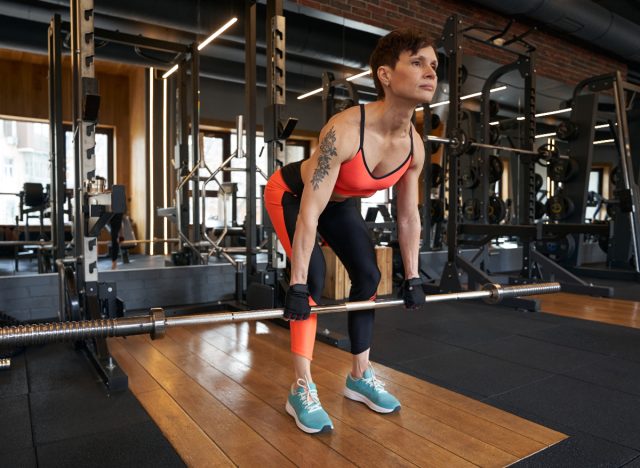
This training involves a set of dumbbells or a barbell. Hold the weights in front of your entire body. Soften your knees and retain your upper body lifted as you hinge your hips again even though “dragging” the dumbbells or the barbell down your thighs. You should really sense a stable stretch in your hamstrings. When you do, press your hips forward and squeeze your buttocks to conclude the movement.

Linked: 4 Workout routines That Can Considerably Change Your Body Condition Following 40

mature woman demonstrating dumbbell bench press exercises to change your body shape after 50
Shutterstock

Hold that set of dumbbells on hand for this upcoming exercising, which will have you lying down on an incline bench to start. Press the dumbbells over your body as you straighten your arms. Then, deliver the weights back down as you at the same time force your shoulders down into the training bench. Thrust the weights up once more, squeezing your triceps and upper pecs when you arrive at the top of the movement.

single-arm dumbbell row mature woman
Shutterstock

For this exercising, position your physique parallel to a stable area or work out bench one knee and hand—each on the exact same side—should be on the surface area to retain harmony. Holding a dumbbell in your reverse hand, row the fat up to your hip before decreasing it down toward the ground.

Linked: Key Exercising Tips To Reshaping Your Human body Right after 60, Coach Suggests

mature woman doing lat pulldown in gym
Shutterstock

Just take maintain of the lat pulldown bar, placing your fingers just outside the house of your shoulder span. Your palms need to confront away from you. Lean again a little, then, applying your elbows, pull the bar down. Create some resistance when bringing the bar back again up, building sure the stress continues to be in your lats.

mature woman doing dumbbell walking lunges, get a lean body after 50
Shutterstock

Previous but not least, let’s do some dumbbell going for walks lunges. Have a fat in just about every of your arms, and phase ahead with a single leg, planting that foot on the floor. Lessen into a lunge. Bring the other foot ahead to repeat the motion.

Alexa Mellardo

Alexa is the Brain + Human body Deputy Editor of Consume This, Not That!, overseeing the M+B channel and delivering powerful fitness, wellness, and self-care subjects to viewers.Read a lot more about Alexa

Breast cancer recovery options could be affected by a health insurance coding change

When Rita Davis located a small nodule on her appropriate breast, the middle college teacher and her husband, Britt, experienced no strategy that discovery would convert into a lot more than a yearlong battle versus intense most cancers that included medical professionals eliminating her suitable breast and offering her chemotherapy and radiation. Davis misplaced her hair, eyebrows, nails and her perception of self.

“Anything is so uncontrollable to you as the client,” she claimed.

So when medical practitioners requested if Davis needed breast reconstruction surgical procedure, she agreed.

“At the very least you get some type of a preference,” she claimed. “You get to have sort of a say of what is actually occurring to you and your overall body at that position.”

Most girls who bear breast reconstruction get implants, which are built of silicone and loaded with a silicone gel or saline alternative. But they have hazards of further surgical procedures, ache, rupture and even related immune procedure most cancers.

Davis understood from her own exploration that there was another selection: something known as diep flap medical procedures where pores and skin, tissue and blood vessels are eradicated from a woman’s abdomen — primarily a tummy tuck — to develop a new breast with the woman’s tissues. Breast reconstruction surgical procedure rose 62{bf0515afdcaddba073662ceb89fbb62b6b1bf123143c0e06b788e1946e8c353f} from 2009 to 2014, stats from the Company for Health care Study and Top quality clearly show.

But Davis’ circumstance highlights an issue some breast most cancers survivors who want reconstructive surgical treatment are coping with: variations in the way the governing administration codes the technique, which will make some kinds of surgical treatment more challenging to get, prompting some insurance policies companies to fall reimbursements appreciably, which usually means having to pay out of pocket is the only solution for some.

Though Davis preferred the idea of making use of her own pores and skin for the course of action, the few surgeons she could uncover in San Antonio who provided diep flap surgical procedure did not choose her insurance policies. 

Their income price? All-around $50,000.

“I never imagine which is reasonable, primarily right after combating this form of a journey, this sort of fight, to be explained to, ‘Because you never have the money, you never have the selection to do everything diverse,'” she stated.

Dr. Elisabeth Potter, who specializes in diep flap surgeries, suggests section of the issue is that the operation is longer and necessitates advanced microsurgical expertise, this means numerous plastic surgeons you should not offer you it. In addition, some medical doctors cost a lot increased charges — and is not going to acknowledge insurance plan.

Potter does settle for insurance plan, but now, she states, a alter in the way the governing administration codes the course of action is about to make the medical procedures even more challenging to get. That has prompted insurance policies providers to start off sending out letters declaring reimbursements will drop, some as much as 80{bf0515afdcaddba073662ceb89fbb62b6b1bf123143c0e06b788e1946e8c353f}. 

But all those who are unable to manage the medical procedures may perhaps be out of luck.

“Make no slip-up, women who want this surgical procedure and have money will constantly have entry to it,” Potter mentioned. “The only folks that this coding change has an effect on and hurts are women who need to have access through insurance plan.”

The Facilities for Medicare and Medicaid companies, the government agency that oversees the coding, suggests the coding improve arrived about after the American Healthcare Association and plastic surgeons asked for them. But medical practitioners groups explained to CBS Information the insurance policies organizations are to blame for determining to lessen their reimbursements.

Florida Rep. Debbie Wasserman Schultz, a breast cancer survivor, is element of a bipartisan effort and hard work to reverse the coding change.

“You know, to start with you face down irrespective of whether you might be heading to survive breast most cancers, but psychologically, so a lot of the aftermath as you go through the course of action of currently being a survivor turns on your psychological wellbeing and how you feel as a human and as a girl,” she claimed. “And this impediment was place in the way of breast most cancers survivors.”

In the meantime, Davis linked with Potter, who agreed to do her surgery for whatsoever total Davis’ insurance policies will pay — even though it won’t protect all her fees.