Sponsored Content by e-con SystemsNov 30 2022Reviewed by Louis Castel
Diagnostic and therapeutic accuracy has significantly increased as a result of the usage of cameras in the medical device industry. Camera-enabled medical devices, such as retina scanners, automated blood analyzers, digital microscopes, and skin scanners, have greatly decreased medical personnel’s workload and improved the overall patient experience.
Advances in embedded vision and camera technology have largely contributed to this transformation, with new cameras supporting many current medical applications. RGB-IR cameras have been a game changer due to their ability to record IR and visible light data with the same camera without color corruption.
This article discusses how RGB-IR cameras, which can capture images that adhere to the stringent requirements of current medical procedures, improve the performance of medical devices.
RGB-IR cameras and their growing popularity in the medical industry
Before examining how RGB-IR cameras benefit medical and life science applications, it is important to comprehend what they are and how they operate.
Sensors that collect visible and infrared light in the same frame are used in camera modules. This frequently resulted in a deterioration in image quality due to a process known as color corruption. This occurs when the IR data interpolates with the color (or RGB) data and affects the color fidelity of the resulting image.
Two approaches have commonly been employed to address this challenge:
Capture RGB and IR data with two cameras
Using an IR cut filter during the day to prevent IR light from falling on the sensor
In the first case, the system gets bulkier and more difficult to manage. However, the IR-cut filter solves this problem.
The IR cut filter is attached to the lens and is controlled by a mechanical switch. However, this causes wear and tear, dramatically reducing the camera system’s lifetime.
RGB-IR cameras help in this situation.
Technology
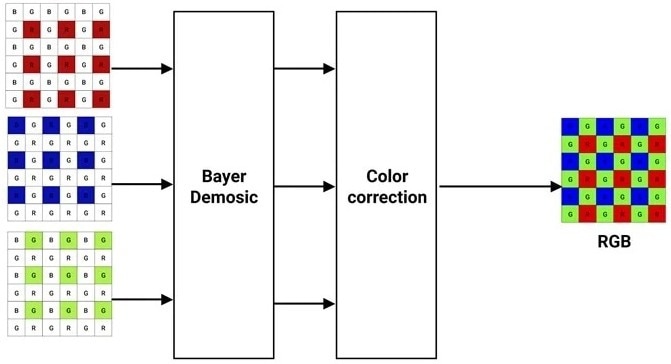
Sensors with distinct RGB and IR pixels are used in RGB-IR cameras. Unlike regular camera sensors with the Bayer BGGR pattern, RGB-IR cameras use a new form of CFA (Color Filter Array) with an extra set of pixels that permits only IR light to pass through.
The CFA configuration of an RGB-IR sensor is as follows:
Figure 1. Bayer pattern. Image Credit: e-con Systems
Figure 2. RGB-IR filter pattern. Image Credit: e-con Systems
This innovative technique allows for the separation of RGB and IR data from the camera output. Numerous medical applications benefit from this, including ophthalmology, fluorescence-guided surgery, and remote patient monitoring.
The following are some of the major advantages RGB-IR cameras provide:
Increased imaging capability in day and night conditions for continuous 24/7 image and video capture.
Smaller form factor due to eliminating the need for two separate cameras to gather RGB and IR data.
Improved camera lifetime due to non-mechanical switching between visible and IR imaging. This would also mean that the medical equipment linked with the camera would have a longer lifespan.
A distinct IR channel that helps measure the amount of IR light in the RGB component for intelligent color adjustment.
Designing an embedded camera for RGB-IR imaging
As RGB IR imaging necessitates a distinct CFA, the camera system must be precisely developed. This implies that different camera components, such as the sensor, optics, and ISP, must be capable of receiving and processing images suitable for RGB-IR imaging.
The essential parameters to consider when assessing a camera for RGB-IR imaging in terms of its component features are discussed in this section.
Sensor
The camera sensor must include a pixel array that includes both RGB and IR pixels. Various sensor manufacturers, including onsemi and OmniVision, provide RGB IR sensors with specialized RGB and IR pixels.
The pixel pattern of a sensor with RGB-IR capabilities is shown below:
Figure 3. Pixel array of an RGB-IR sensor. Image Credit: e-con Systems
Optics
Most off-the-shelf lenses on the market include an IR-cut filter to restrict IR light from entering during the day. This is because most cameras still employ mechanical switches to shift between day and night settings.
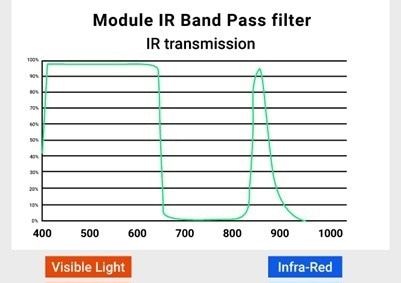
However, RGB-IR imaging requires a lens with a dual bandpass filter. This ensures that light from the visible and NIR spectrums falls on the sensor.
The transmission diagram for a dual bandpass filter is provided below:
Figure 4. Transmission diagram of a dual bandpass filter. Image Credit: e-con Systems
ISP
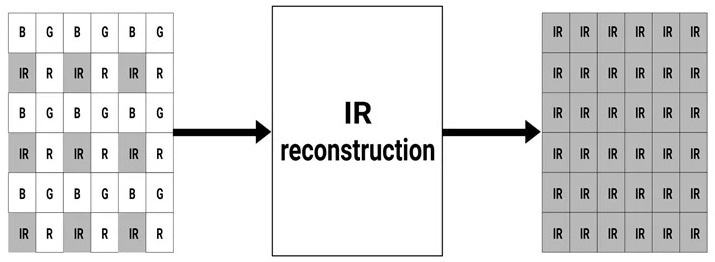
The Image Signal Processor (ISP) is one of the most significant components in an RGB-IR camera since extracting the RGB and IR frames from the data given by the sensor requires considerable ISP-side acumen.
e-con Systems, for example, does this through its proprietary algorithm. The company’s engineers also used their ISP expertise to devise an algorithm to remove IR interference from the RGB channels to achieve the correct colors.
One of its other distinguishing features is the ability to tune the ISP to produce processed RGB and IR frames based on the needs of the host platform.
Figure 5. RGB window imaging processing. Image Credit: e-con Systems
Figure 6. IR window imaging processing. Image Credit: e-con Systems
Key medical applications where RGB-IR cameras are making a wave of change
Some of the benefits of RGB-IR cameras have already been discussed. The following section details how they impact some of the most popular camera-enabled medical applications.
Remote patient monitoring
Remote Patient Monitoring (RPM) devices have benefited the medical industry by minimizing the need for in-person patient monitoring. Using artificial intelligence, RPM systems are now powerful enough to detect patient falls and movements autonomously. These life-changing devices require cameras to collect images and videos to make all of this feasible.
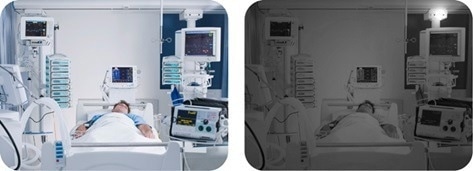
One of the major features of a remote patient monitoring system is that it must be operational around the clock to enable ongoing patient monitoring. This necessitates that the camera functions flawlessly during the day and night. This is where RGB-IR cameras come in.
They allow the RPM device to take images utilizing IR imaging even at night without requiring two separate cameras or a mechanical switch to activate an IR cut filter.
Figure 7. (Left) RGB image during daytime and (Right) IR image during night-time. Image Credit: e-con Systems
Image-guided surgery
In surgeries such as laparoscopic cholecystectomy, colorectal surgeries to evaluate bowel viability in hernia cases, mapping of sentinel lymph nodes, etc., fluorescence-guided surgical techniques such as Indocyanine Green (ICG) surgery are used (source: sciencedirect.com).
The dye can become fluorescent when subjected to a wavelength of 750 to 800 nm, which is how ICG surgery works. As a result, the camera utilized must be capable of capturing images in the Near-Infrared (NIR) spectrum.
But why not observe the organs with an RGB camera and an IR light source simultaneously?
The difficulty here is the low spectral resolution. To better grasp this, consider cancer diagnosis as an example application.
In this case, capturing the fluorescent image with a standard RGB camera may not provide enough detail. On the other hand, the IR capabilities of an RGB-IR camera can be utilized to efficiently enhance the cancer diagnosis procedure. At the same time, the RGB data can be used to evaluate any anomalies discovered using the IR output. All of this may be accomplished with a single-camera system.
Figure 8. (Left) RGB image during ICG Surgery and (Right) IR image during ICG Surgery. Image Credit: e-con Systems
Ophthalmology
The quality of images provided by camera modules inside ophthalmic devices such as fundus cameras and retina scanners substantially influences diagnosis accuracy.
IR imaging is required in these devices to observe sub-retinal characteristics because the deposits appear bright and thicker compared to the optic nerve heads, retinal vessels, and choroidal vessels found in darker regions. Visible light imaging, on the other hand, is essential to ensure that the camera gets the required details of the eye.
This necessitates the use of a single camera that is capable of both visible and IR imaging. As a result, RGB-IR cameras are ideal for such applications. Medical professionals can now efficiently detect and treat eye problems using these new-generation embedded cameras, which provide visible and IR images from the same camera.
Final words
As detailed above, RGB-IR cameras have numerous advantages and are well-suited for various medical applications requiring concurrent RGB and IR imaging. At the same time, specialized NIR cameras are favored for applications that require exceptionally high NIR sensitivity and performance. Before proceeding with camera integration into the device, it is advised that users consult with an imaging professional such as e-con Systems.
About e-con Systems
e-con Systems™ is a leading OEM camera manufacturer with 18+ years of experience and expertise in embedded vision. It focuses on delivering vision and camera solutions to industries such as medical, retail, and industrial. The company’s wide portfolio of products includes MIPI camera modules, USB 3.1 Gen 1 cameras, GMSL cameras, stereo cameras, etc. It has built over 250+ product-based solutions and shipped millions of cameras around the globe. What sets the company apart is its deep expertise in building customized product designs while ensuring rapid prototyping and custom modifications in hardware and software. e-con Systems™ has close partnerships with Sony, ON Semiconductor®, Omnivision, NVIDIA, Xilinx, Socionext™, Cypress, Connect Tech, Toradex, Variscite, Toshiba, Diamond Systems, Avermedia and Texas Instruments.
Giving sight to medical applications:
e-con Systems™ offers end-to-end camera solutions to meet the needs of the medical and healthcare industry. It has a strong foothold in the medical device industry – having empowered clients to integrate unique camera solutions for medical and life science applications in ophthalmology, dentistry, dermatology, laboratory equipment, microscopy, assistive technology, point-of-care technology etc. e-con Systems also has a solid track record of working with the medical device industry leaders such as Thermofisher, Idexx, Perkin Elmer, Amwell, Welch Allyn, Seegene and others.”
Sponsored Content Policy: News-Medical.net publishes articles and related content that may be derived from sources where we have existing commercial relationships, provided such content adds value to the core editorial ethos of News-Medical.Net which is to educate and inform site visitors interested in medical research, science, medical devices and treatments.
By Chrissy Krueger RN, RD, CDN, CDCES, Diabetes Education & Care Specialist, Oak Orchard Health
As a Diabetes Educator, at Oak Orchard Health, I hear a lot about the anxiety and stress of overeating during the holidays. Whether it’s Thanksgiving, Christmas, or another seasonal holiday, learning to eat healthy during this time can be a challenge – but you can do it. Keep in mind that each holiday represents just one day, and you can get back on your healthy meal plan the next day.
Here are a few tips to help you get through the holidays feeling good about yourself.
Start by preparing in advance.
If the party is not at your home, consider asking the hostess if you can help by bringing a dish to pass. That dish will be a healthy one for you and delicious for others. That’s your “go-to” dish when you’re feeling hungry or other options are not too appealing.
Skipping meals before the holiday dinner isn’t a good idea.
Skipping meals can result in moodiness or irritability. For some, it can also lead to low blood sugar. You should not get yourself so hungry that you will eat anything and everything!Try to eat regularly throughout the day, maybe smaller meals than usual, but do eat breakfast and lunch.
Re-think the holidays.
Why are you gathering? To be with family and friends? Sharing experiences with each other? The point is that holidays aren’t just about food. In fact, after eating your meal, avoid lingering near the holiday spread. Go into another room to mingle.Also, consider taking a walk with someone you haven’t seen in a while.
Avoid taking leftovers home.
Unless a loved one was unable to attend and you want to bring them some treats, avoid bringing leftovers home. If you’re the hostess, don’t make too much food and if you do, have a plan for giving it away to your guests or a local senior center or food shelter.
Don’t give up your healthy lifestyle.
Often people use Thanksgiving as a reason to start overeating throughout the holiday season. Try to think of each holiday as a one-day event and get back on track with your healthy habits the next day. You’ll feel better!
Heart-healthy portions.
Whether you have diabetes or not, these are great guidelines on how to fill your plate. A good rule of thumb is that half your plate should contain non-starchy vegetables such as green beans, broccoli, or cauliflower, a quarter of the plate with protein, and a quarter with carbohydrates. Riced cauliflower is very popular and can be substituted for mashed potatoes – or make half the mashed potatoes with real potatoes and the other half with riced cauliflower. Your guests won’t know the difference!
Desserts.
If you have room for dessert, try to limit your portion sizes. An eighth of a pie or 2” square of cake can be enough. If you’re going to bring a dessert, choose one that has fewer carbohydrates and sugar. People with diabetes can eat desserts but it’s all about the size of the portion. The smaller the better.
Always carry a glass of water.
Having a glass of water and sipping it throughout the day will help you avoid picking on food. This will also help to reduce your alcohol consumption.
No thank you.
Be comfortable saying no thank you when offered another portion.Those who truly love you will not change their mind based on how much or what you eat!
Holidays are not just for eating.
If you’re the hostess, you can plan to do something with your guests like playing games or taking a walk. Plan to have everyone step away from the table and go to another room to play a game like charades or a card game. The more active the better.
If you do overindulge, don’t beat yourself up about it. Just get back on track. Take a walk the next day and start eating healthy again.Remember, don’t skip meals either!
If you need help managing diabetes, are interested in nutrition and/or incorporating a healthy lifestyle, contact Oak Orchard Health and ask how to be referred to the nutrition diabetes care specialist. Happy holidays!
For decades, chemicals that make life easier — your eggs slide out of the frying pan, stains don’t stick to your sofa, rain bounces off your jackets and boots — have been touted as game changers for our busy modern lives. “Better things for better living … through chemistry,” was the optimistic slogan coined by DuPont, the company that invented the widely used chemical coating Teflon.
But this better living has come at a cost that is getting new attention. These chemicals — dubbed forever chemicals for their ability to last in the environment — are proving to have a lasting impact on human health. A growing body of research links the group of chemicals broadly known as PFAS, short for per- and polyfluoroalkyl substances, to conditions from unhealthy blood lipid levels to pregnancy complications to cancer.
Alarm about the health impacts of these chemicals has sparked a recent flurry of action from U.S. public health and regulatory officials. Warning that PFAS pose a greater health risk than previously thought, the U.S. Environmental Protection Agency in June dramatically lowered its recommended safe levels of the chemicals in drinking water.
“The updated advisory levels are based on new science, including more than 400 recent studies which indicate that negative health effects may occur at extremely low levels, much lower than previously understood,” Radhika Fox, assistant administrator of the EPA’s Office of Water, said in June at the Third National PFAS Conference, held in Wilmington, N.C.
Soon after, the National Academies of Sciences, Engineering and Medicine released the first clinical guidelines quantifying blood concentration levels of PFAS that could put someone’s health at risk. The 300-page report urges clinicians to recommend regular blood tests for anyone exposed to high levels of the chemicals and to provide information on how to limit exposure, such as installing special filters known to reduce PFAS in drinking water.
In the United States alone, by one measure, the tally in medical care costs and lost productivity from PFAS exposure linked to five medical conditions adds up to at least $5.5 billion annually, researchers at New York University reported July 26 in Exposure and Health. Those conditions include low birth weight, childhood obesity, hypothyroidism in women, and kidney and testicular cancers.
“We only looked at two of the more than 9,000 chemicals in the PFAS family, so we’re just seeing the tip of an iceberg,” says Leonardo Trasande, a pediatrician and environmental health expert at NYU Langone Health.
Ubiquitous chemicals
Among those most at risk of exposure are firefighters: PFAS make protective gear more water resistant, and the chemicals are found in a widely used fire suppressant foam. But most people have some measurable level of PFAS in their bodies, according to the U.S. Centers for Disease Control and Prevention. Exposure typically comes from ingesting PFAS-contaminated drinking water or food grown in soil treated with fertilizers made from sewage contaminated with the chemicals (SN: 11/24/18, p. 18). An estimated 2,854 locations across the United States have PFAS contamination.
“People and communities have had significant exposure to these chemicals. If they can ID that they are in an area of significant exposure, they should seek testing through their usual source of care,” says Ned Calonge, an epidemiologist at the Colorado School of Public Health in Aurora who chaired the committee that wrote the National Academies report. The committee linked PFAS exposure to a slightly different list of conditions than the NYU team, finding “sufficient evidence” linking PFAS to four conditions: poor antibody response to vaccination, abnormally high cholesterol levels, decreased infant and fetal growth, and kidney cancer. Evidence was “suggestive” for breast and testicular cancers, as well as thyroid problems and ulcerative colitis, an inflammatory bowel disease.
The report calls for more research into the health effects of PFAS, noting gaps in evidence on everything from neurological issues to bone density. These chemicals have a wide range of impacts on multiple systems in the body, Calonge says. And they’re “ubiquitous in the environment.”
Newer, not safer
PFAS have been produced in the United States since the 1940s. Because they are good at repelling oil and water, holding up at high temperatures and reducing friction, the chemicals became useful for a vast array of products, including carpeting, upholstery, food packaging and even dental floss. Yet, relatively few of the 9,000 or so versions of these synthetic chemicals have been studied for their toxicologic effects.
Many PFAS are now recognized as endocrine disruptors, chemical compounds that interfere with the normal functioning of the endocrine, or hormonal, system. But PFAS have other effects that can boost cancer risk, such as weakened immunity, excessive cell growth and altered gene activity. One study found a greater than twofold increase in kidney cancer risk between people with the highest versus lowest blood levels of one common PFAS called perfluorooctanoic acid, or PFOA, researchers reported in 2021 in the Journal of the National Cancer Institute.
A newer generation of PFAS was assumed to be safer because the chemicals are less likely to accumulate in the body. But these newer compounds are structurally similar to the older ones and can be just as harmful to health as their cousins, Trasande says. These newer molecules “are increasingly being associated with diseases like gestational diabetes. We’re just starting to see the bigger problem that might be at play.”
The EPA’s new drinking water advisory aims to tackle both old and new PFAS. It targets two of the earlier and most commonly found kinds of PFAS in the environment: PFOA and perfluorooctane sulfonic acid, or PFOS. The advisory reduces the level of drinking water contamination below which adverse health effects are not expected from 70 parts per trillion to 0.004 and 0.02 ppt, respectively. Those levels are based on routine exposure to them over a lifetime.
The EPA’s health advisory also provided the first-ever recommendations on two of the newer kinds of PFAS: hexafluoropropylene oxide dimer acid and HFPO ammonium salt, collectively known as GenX chemicals, and perfluorobutane sulfonic acid, or PFBS. The agency set the drinking water safety threshold at 10 ppt for GenX chemicals and 2,000 ppt for PFBS. These newer chemicals have similar persistence in the environment, the agency states.
Consumers can ask their municipal water provider for data on PFAS testing in their area. Testing is becoming more common, and providers should be able to list which PFAS they test for. Private wells can be contaminated with PFAS if they are near manufacturers that produce or use the chemicals, as well as airfields where PFAS are used for firefighting, firefighting training areas and some waste disposal sites. People with private wells near one of these facilities can get their water tested. The EPA is giving grants to help underserved small and disadvantaged communities provide household water quality testing and comply with drinking water regulations.
PFAS price tag
Because there are limited available data on the health effects of the newer generation of chemicals, the NYU and National Academies reports focused on the impacts of older PFAS.
First, the NYU team examined PFAS chemicals in blood samples obtained from roughly 5,000 adults and children who participated in the U.S. National Health and Nutrition Examination Survey. Then, based on earlier studies linking PFAS to certain diseases and models that estimate medical costs and lost worker productivity for these illnesses, the team came up with its PFAS price tag.
Childhood obesity, the largest contributor to the overall economic toll of PFAS exposure, costs about $2.7 billion a year, the team estimates, followed by hypothyroidism in women at $1.26 billion. When the researchers considered other PFAS-linked diseases beyond the top five, such as endometriosis, obesity in adults and pneumonia in children, the estimated economic burden rose to as much as $63 billion annually.
Assessing risk
The National Academies report focused in part on how to curb that toll by providing testing guidelines to clinicians to detect high levels of PFAS in the body and try to reduce exposure.
The report provides the first clinical guidelines on how to assess a person’s disease risk. A person with a PFAS blood concentration of less than 2 nanograms per milliliter doesn’t have to worry. But for patients with blood concentrations between 2 and 20 ng/mL, clinicians should screen for conditions like unhealthy levels of fat in the blood, which can lead to heart problems. Such screening is especially important for people more vulnerable to the effects of PFAS exposure, like children, pregnant people and those who are immunocompromised. For anyone who tests above 20 ng/mL, the report encourages routine screenings for some cancers, thyroid problems and ulcerative colitis.
“For almost 20 years, we’ve been able to measure PFAS in people’s blood, but there was no guidance to say what [those measurements] mean,” says National Academies report coauthor Jane Hoppin, who heads the Center for Human Health and the Environment at North Carolina State University in Raleigh. “For the first time, this actually sets some ranges, some guidance for what could be levels of concern, and what kinds of health follow-up might be appropriate.”
She hopes that the recommendations will increase testing availability and make both doctors and patients more aware of these chemicals and their health risks. The report also encourages doctors to work with their patients to figure out where they are being exposed to PFAS and how to mitigate those risks, by cutting down on PFAS-containing products and filtering water.
Activated carbon filters, found in some countertop or pitcher filters, don’t remove PFAS as completely as reverse osmosis filters, researchers at Duke University and North Carolina State reported in 2020. The National Academies report offers a link to NSF, a testing organization that offers technical details on which filters actually filter out PFAS.
Efforts like reducing PFAS in drinking water could help. While EPA’s health advisories are recommendations and not enforceable, Trasande is pleased that the agency acted quickly, particularly on newer chemicals like GenX. But he argues that in light of what we already know and are continuing to learn about the disease burden caused by these chemicals, PFAS should undergo more testing before they are approved. Better yet, they should be regulated by class instead of taking what he calls a whack-a-mole approach.
“Our environmental policy still takes a wait-and-see approach that we should wait 20 to 30 years, which is the time that people take to develop diseases due to chemical exposures,” he says.
BUFFALO, N.Y., Nov. 29, 2022 /PRNewswire/ — Circuit Clinical—one of the nation’s fastest growing integrated research organizations—has expanded their presence in the Hudson Valley region through a partnership with Middletown Medical, a top tier, multi-specialty physician group, increasing access to clinical research as a care option to an additional 100,000 patients that Middletown Medical serves. This partnership will bring trials to a more diverse patient population—comprised of approximately 50{bf0515afdcaddba073662ceb89fbb62b6b1bf123143c0e06b788e1946e8c353f} non-white individuals.
Middletown Medical Logo
The breadth of Middletown Medical’s primary and specialty care, combined with Circuit’s commitment to improving patient access and inclusion in clinical trials, will bring new care opportunities to Middletown’s patients through the provider relationships they already trust – further positioning the region as a destination for medical research and advancements. This partnership will initially include 11 Principal Investigators, participating in specialties such as, but not limited to, cardiology, rheumatology, neurology, gastroenterology, and family medicine.
“Patient care is a top priority for Middletown Medical and we are committed to providing any and all opportunities to our physicians and the communities they serve,” said Dr Rajan Gulati, President of Middletown Medical.
Middletown Medical and Circuit Clinical are committed to reducing the burden on patients who opt in for research participation. Along with localizing patient care within the Middletown Medical physicians’ offices, Circuit’s approach to transforming the patient journey includes hybrid care options through telemedicine, fully decentralized trial solutions, as well as trialjourney.com—an award-winning patient experience platform for finding trials and leaving site ratings and reviews to improve the experience of participating in clinical trials. This variety of care options can help eliminate traditional care obstacles that have created a burden for patients to participate in clinical research. Furthermore, patient participation in research will serve to benefit both individuals and communities, including offering extra care visits without co-pays, strengthening the patient-provider relationship, and often leading to improved health outcomes through a better and more personal care experience.
This collaboration was made possible through strategic partnerships with Labcorp—a leading global life sciences company that provides vital information to help doctors, hospitals, pharmaceutical companies, researchers, and patients make clear and confident decisions—as well as Medidata—a Dassault Systems company that is powering smarter treatments and healthier people with the world’s most trusted platform for clinical development, commercial, and real-world data.
“We are beyond excited to expand our national research network through amazing partnerships like this one with Middletown Medical,” said Irfan Khan, MD, CEO of Circuit Clinical. “Together we can empower patients to engage with clinical trials as a care option. The combined efforts of Circuit Clinical and our strategic partners, Labcorp and Medidata, allow us to make partnerships like this with Middletown Medical not only a reality, but as optimal and innovative as possible.”
About Middletown Medical
Middletown Medical is a multi-specialty physicians’ group dedicated to providing patients with top quality, comprehensive care in a warm and caring environment which delivers care to over 100,000 patients throughout Orange, Sullivan, and Ulster counties in New York state. Please access Middletownmedical.com to learn more about their doctors and the expansive scope of services provided.
About Circuit Clinical
Circuit Clinical®, one of the fastest-growing integrated research organizations in the USA, is dedicated to empowering patients to choose clinical research as a care option. Circuit is committed to transforming the experience for physicians and their patients of finding, choosing, and participating in clinical research. The company delivers clinical research services and an award-winning patient engagement platform, trialjourney.com. Learn more at circuitclinical.com and follow along for updates and announcements on LinkedIn.
For additional questions or inquiries, please contact the following:
Circuit Clinical
Candice Kent VP of Marketing and Communications [email protected]
Middletown Medical
Darcy Shepard CEO, Middletown Medical [email protected]
David Goldhill is the chief executive of SesameCare.com, a digital marketplace for discounted health services.
The United States spends twice as much per person as other wealthy countries on health care. This fact is well-known, and when it is mentioned, people often point out that the governments of other developed countries leverage purchasing power to drive cheaper, more universal care. So why doesn’t the United States do the same thing?
Because we can’t. In fact, the do-what-everyone-else-does option is uniquely unavailable to us.
The world’s other health-care systems survive only because they receive a massive and ongoing, but hidden, subsidy courtesy of the inefficient U.S. system. Two unique features of our arrangement — the absence of price controls and the profit drive of doctors and hospitals — allow other countries to transfer the risk and cost of medical innovation to Americans.
And unlike in any other industry, once Americans have borne the costs of lifesaving breakthroughs as well as incremental improvements in tools and techniques, these can be used elsewhere at little extra cost. American exorbitance allows other nations to offer price-controlled universal care with none of the decline in quality, technology or productivity that would otherwise result from central planning.
A similar complaint has been made about the country’s defense alliance: U.S. allies ride free on American defense spending. Health care, indeed, is a kind of second NATO.
The United States can’t lower its costs by doing what other countries do, because what others do depends on our unique system remaining as is. Our only hope is to put in place more sensible economic structures that could introduce the competition that’s necessary to bring prices down.
The size of the U.S. health-care system is almost impossible to overstate. With barely four percent of the world’s population, the United States accounts for almost half of the world’s $8 trillion health-care economy. England’s National Health Service is tiny by comparison — barely bigger than U.S. Veterans Affairs health system funding. Canada’s total spending is comparable to the revenue of a single American company, United Health. Free-market star Singapore spends only as much as New Jersey’s Medicaid program.
The world’s top 10 spenders in pharmaceutical products
In 2020, the United States spent more on pharmaceutical products than all other nine spenders in the ranking combined.
All other top 9
countries combined
Notes: Prices are reported at the ex-manufacturer level (price when sold from manufacturer to wholesaler or direct to pharmacies). * Hospital market only. **Pharmacy market only.
The world’s top 10 spenders in pharmaceutical products
In 2020, the United States spent more on pharmaceutical products than all other nine spenders in the ranking combined.
All other top 9 countries combined
Notes: Prices are reported at the ex-manufacturer level (price when sold from manufacturer to wholesaler or direct to pharmacies). * Hospital market only. **Pharmacy market only.
This is why all health-care innovators — makers of drugs, devices, diagnostics, medical software — share the same business plan: Make money in the United States and take whatever scraps you can get in the other markets.
The pharmaceutical industry earns almost 50 percent of its worldwide revenue here, as do medical information-technology firms. Device makers earn 40 percent of their money in the United States. And this understates things, because U.S. revenue is generated from higher prices, so margins are greater. If the United States accounts for half of a company’s revenue, it probably contributes at least 75 percent of its profits.
America’s domination might not seem obvious. After all, high-tech health care exists everywhere in the world. Even in emerging economies, brilliant researchers, great universities and advanced companies perform cutting-edge research. Many have close relationships with their countries’ health-care systems, and some innovations are introduced in other nations. But the profit opportunity — the reason to invest — is always generated in the United States.
Consider the well-known miracle drug Gleevec. Before it came along in 2001, less than 30 percent of patients diagnosed with chronic myelogenous leukemia survived at least five years; today, 90 percent do.
Gleevec is also a poster drug for American dysfunction. Novartis steadily raised its price in the United States — even after its patent expired — to eventually reaching more than $123,000 per year in 2020. Yet, in Canada, Gleevec was priced at $38,000. A generic version in India now costs just $400.
Drugmakers and their opponents argue over the “fair” returns on innovation that companies need to maintain their incentive to invest in new medicines. Critics point to the share of pharma’s profits that come from barely legal anticompetitive behavior or from drugs created with heavy public support — such as the U.S. government’s $12 billion investment in coronavirus vaccines.
But enormous returns on a few blockbuster drugs compensate for drugmakers’ many unsuccessful products. That’s the business model, and these big, “unfair” returns are available only in the United States.
If the world’s largest health economy limited drug companies to “fair” returns — as other countries try to — then few new drugs would be created. The United States doesn’t pay $123,000 a year for Gleevec despite Canada paying only $38,000; Canada can pay $38,000 only because the United States pays $140,000.
And while pharmaceuticals might be the most obvious area in which the U.S. economy drives innovation, the $3.5 trillion we spend on care other than drugs makes an even greater contribution to world health-care advances.
In 2000, Intuitive Surgical Systems introduced the first commercially successful robotic surgery system. The company’s da Vinci robots carry $2 million price tags plus costly service contracts. In the first 20 years, 6,000 of the robots were sold worldwide, and American hospitals purchased roughly two-thirds of them.
Why? In the United States, the prices charged by hospitals and doctors are unrestricted. American physicians earn roughly two to three times as much as their counterparts in western Europe. Hospitals charge two to five times as much for their services.
The obvious, if rarely asked, question is: Why doesn’t competition bring U.S. health-care prices down? The answer: America’s stagnant third-party payment system allows hospitals and doctors to avoid competing on price. Instead, they compete on innovation. This is why hospitals advertise advanced, high-tech cancer therapies; surgeons build reputations for cutting-edge procedures; and even your family physician must invest to keep up.
Right now, we’re stuck. We want what every other country has. American reformers believe we’re just one clever policy tweak away from getting it — perhaps by instituting accountable care or “value-based” care.
But the only way to lower U.S. health-care costs is to rethink the system’s top-down policy structures that rely on huge, centralized payers.
What’s needed is a way to separate the safety net function that insurance provides from consumer decision-making. If insurance covered only major and unanticipated health problems, a consumer economy could drive competition in the rest of the system. This would give doctors and hospitals an economic incentive to bundle services, enhance efficiency, reduce waste and offer genuinely “value-driven” care.
In this century, the world has seen the democratization of many services considered “too complicated” for consumers — computers, finance, international travel, furniture construction, you name it. All this happened because people had enough control over their own spending to drive competition among innovators. It’s how industry managed to put supercomputer power in everyone’s pocket, while reducing price by 99 percent.
Until the same kind of competition is introduced in health care, the U.S. system will continue to subsidize the world — and cost us a fortune.
The Arena Media Brands, LLC and its partners may receive compensation for links to products and services on this website. The Sports Illustrated editorial team is not involved in the creation of this content.
Cyber Monday deals are here and they’re some of the best offering from retailers during the shopping season. You won’t find these kind of deals again until next year. From Amazon and Walmart to Samsung and Spanx, it’s time to put a cap on your holiday shopping list.
From tech and fitness to outdoors and home goods, we’re sourcing the biggest and best Cyber Monday deals happening now. Be sure to check back for more updates throughout the day, deals are ending Monday, Nov. 28.
From Roombas and Apple devices to heated blankets and home goods, Amazon is showcasing some major deals now through Cyber Monday. You’ll find a slew of Cyber Monday Deals and lightning deals happening now. If you’re looking for shopping inspiration, be sure to check out the Amazon gift guides for some of the most popular sellers.
Save up to 50{bf0515afdcaddba073662ceb89fbb62b6b1bf123143c0e06b788e1946e8c353f} with the Cyber Savings event on BestBuy. There are limited quantities, and some exclusions apply, so be sure to shop quick.
Samsung’s The Frame TVs sport an enhanced QLED panel, an anti-reflective coating, and a Tizen smart interface. Right now you can save up to $1,000 on the 2022 models which range from 32 inches to 85 inches.
Get up to 50{bf0515afdcaddba073662ceb89fbb62b6b1bf123143c0e06b788e1946e8c353f} off the popular workout mirror featuring workout classes from world-class fitness instructors.
Save up to $500 off cardio and strength equipment from Nordictrack, including discounts on three of their most popular machines: the Commercial 14.9 Elliptical, Commercial X32i Treadmill and Vault.
REP Fitness is offering competitive deals on all their strength and fitness equipment, including 10{bf0515afdcaddba073662ceb89fbb62b6b1bf123143c0e06b788e1946e8c353f} off of your entire cart with the purchase of a rack.
Sole Fitness cardio equipment is designed with performance in mind, and this holiday season, they are offering major discounts (up to $1,000) across all categories plus free delivery.
Black Friday is a great time to invest in an all-in-one home gym, and Tonal is the top of the line. Save $250 on the Tonal trainer if you buy during its Cyber Monday sale.
Get fit anywhere with the all-in-one suspension trainer systems from TRX—the brand is offering 25{bf0515afdcaddba073662ceb89fbb62b6b1bf123143c0e06b788e1946e8c353f} off sitewide this Cyber Monday.
Score 20{bf0515afdcaddba073662ceb89fbb62b6b1bf123143c0e06b788e1946e8c353f} off new Whoop memberships this Cyber Monday and start tracking your activity, fitness stats and more.
The Acer Aspire slim laptop comes wit ha 15.6-inch full HD display, 8GB on-board memory, two build-in stereo speakers and ports for all of your accessories. Now down to $399.99, originally $649.99.
Amazon is everyone’s go-to when it comes to shopping, from easy and quick shipping options to the vast assortment of products and services you can explore. And during Cyber Monday, Amazon will be hosting a slew of major deals across every category. Here’s a few of our favorites.
Save on some of the most powerful chargers during Cyber Monday. One of our favorite picks: The Anker 535 Power Bank with 30W output, now 30{bf0515afdcaddba073662ceb89fbb62b6b1bf123143c0e06b788e1946e8c353f} off for Cyber Monday (down to $48.99).
Get the ASUS VivoBook Flip 14 for $349.99, down from $479.99. With the latest 11th generation Intel Core i3, Widows 10 Home, a 128GB SSD and 14-inch full HD touch display, this is the most portable two-in-one laptop perfect for on-the-go. It offers four viewing modes: tablet, tent, stand and laptop.
Save up to 50{bf0515afdcaddba073662ceb89fbb62b6b1bf123143c0e06b788e1946e8c353f} for the holiday, two-day shipping for orders $50 or more, free return shipping and a 90-day risk-free trial.
Save on Casetify’s durable phone cases in fun styles this Cyber Monday with a buy one get 15{bf0515afdcaddba073662ceb89fbb62b6b1bf123143c0e06b788e1946e8c353f} off or buy two get 25{bf0515afdcaddba073662ceb89fbb62b6b1bf123143c0e06b788e1946e8c353f} off deal. Our pick would be the Bounce Case, which can survive drops up to 15.5-feet.
For Cyber Monday, Courant is taking 25{bf0515afdcaddba073662ceb89fbb62b6b1bf123143c0e06b788e1946e8c353f} off sitewide on products like the chic Catch:2 for wirelessly charging two devices.
Save up to 60{bf0515afdcaddba073662ceb89fbb62b6b1bf123143c0e06b788e1946e8c353f} of gaming PCs and accessories for the Dell Cyber Monday kickoff. Get free two-day shipping on select PCs.
Get an extra 15{bf0515afdcaddba073662ceb89fbb62b6b1bf123143c0e06b788e1946e8c353f} off sitewide. Get the New Hero11 Black plus one-year GoPro subscription for $399.98, originally $549.98.
During JBL’s Cyber Monday event, you can save up to 70{bf0515afdcaddba073662ceb89fbb62b6b1bf123143c0e06b788e1946e8c353f} on portable speakers, headphones and earbuds.
Nixplay is taking 20{bf0515afdcaddba073662ceb89fbb62b6b1bf123143c0e06b788e1946e8c353f} off all smart digital photo frames that they currently have in-stock. Get an extra $20 off your order when buying two or more frames.
Get 30{bf0515afdcaddba073662ceb89fbb62b6b1bf123143c0e06b788e1946e8c353f} off sitewide, including cases for iPhone 14, power stations, MagSafe products and more. We love the leather loops for AirTags, now on sale for $9.95 (down from $14.95).
Get up to $1,000 enhanced trade-in credit on your first device, and a regular trade-in credit on a second device. Get $300 guaranteed trade-in credit on any condition Galaxy device.
Score 25{bf0515afdcaddba073662ceb89fbb62b6b1bf123143c0e06b788e1946e8c353f} off all orders under $150 with code BFCM25 and 30{bf0515afdcaddba073662ceb89fbb62b6b1bf123143c0e06b788e1946e8c353f} off orders more than that with code BFCM30 at Satechi. We’re fans of the USB-C Apple Watch Charger which is great for travel and eligible for 25{bf0515afdcaddba073662ceb89fbb62b6b1bf123143c0e06b788e1946e8c353f} off.
Up to 30{bf0515afdcaddba073662ceb89fbb62b6b1bf123143c0e06b788e1946e8c353f} off on tech deals, including headphones, home theater, video games, cameras and more.
Gainful is known for high quality supplements such as pre-workout, protein powder, superfood greens and more. This Cyber Monday, get 40{bf0515afdcaddba073662ceb89fbb62b6b1bf123143c0e06b788e1946e8c353f} off your first order.
Get 20{bf0515afdcaddba073662ceb89fbb62b6b1bf123143c0e06b788e1946e8c353f} off your first order from Jacked Factory this Cyber Monday, and try out any one of their well-reviewed (and good-tasting) pre-workouts, protein powders and other wellness supplements.
From immune support and hydration to weight loss and meal replacement, Kaged has got you covered with 30{bf0515afdcaddba073662ceb89fbb62b6b1bf123143c0e06b788e1946e8c353f} off sitewide this Cyber Monday with code SAVE30.
Take your performance to the next level with protein, sports nutrition and dietary supplements from Naked Nutrition: The brand is offering 15{bf0515afdcaddba073662ceb89fbb62b6b1bf123143c0e06b788e1946e8c353f} off sitewide.
Feel confident in your supplement routine with multivitamins, protein, gut health support and more from Ritual—the brand is offering 40{bf0515afdcaddba073662ceb89fbb62b6b1bf123143c0e06b788e1946e8c353f} off your first month when you bundle with Synbiotic+.
Save 30{bf0515afdcaddba073662ceb89fbb62b6b1bf123143c0e06b788e1946e8c353f} off everything for Cyber Monday, including some of the most popular small indoor planters such as the Sprout, starting at $69.95 (originally $99.95).
Get Cyber Monday deals across every major category, including bath and bedding, kitchen and dining, holiday décor and more. Take 25{bf0515afdcaddba073662ceb89fbb62b6b1bf123143c0e06b788e1946e8c353f} off one single item.
If you’ve been looking to spice up your home office with a new desk and chairs, it’s never been a better time. During the Branch Cyber Week sale, get up to 20{bf0515afdcaddba073662ceb89fbb62b6b1bf123143c0e06b788e1946e8c353f} off and free shipping.
Shop everything from bread machines and indoor grills, to air fryers and toaster ovens on Amazon, averaging 30{bf0515afdcaddba073662ceb89fbb62b6b1bf123143c0e06b788e1946e8c353f} off for Black Friday. The most popular COSORI Air Fryer Toaster Oven is now $135.99, originally $199.99 for Cyber Monday.
Take 40{bf0515afdcaddba073662ceb89fbb62b6b1bf123143c0e06b788e1946e8c353f} off all regular price purchases with code 40ENTIRE1128, online only and ends Tuesday, Nov. 29.
Ninja Woodfire™ Outdoor Grill (base package): $369.60 MSRP. Take $40 off with promo code SI40 at checkout.
Ninja Woodfire™ Pro Outdoor Grill with Built-in Thermometer and Premium Package: $459.60 MSRP. Take an additional $30 off with promo code SI30 at checkout.
Get 25{bf0515afdcaddba073662ceb89fbb62b6b1bf123143c0e06b788e1946e8c353f} off for Cyber Monday, including carry-ons down to $265 (originally $355), and Grand Carry-on suitcases up to 30{bf0515afdcaddba073662ceb89fbb62b6b1bf123143c0e06b788e1946e8c353f} off, down to $270 (originally $385).
Get up to 38{bf0515afdcaddba073662ceb89fbb62b6b1bf123143c0e06b788e1946e8c353f} off sparkling water makers and bundles on Amazon. The most popular SodaStream on Amazon is the SodaStream Fizzi One Touch Sparkling Water Maker, and is now $124.99, originally $189.99. This is perfect if you’re a huge Bubly fan.
Snag all of your Cyber Monday deals now. From tools and appliances to holiday, home and bath décor. Get up to 45{bf0515afdcaddba073662ceb89fbb62b6b1bf123143c0e06b788e1946e8c353f} off select tools and tool accessories, and free two-day delivery.
Get some fabulous finds up to 50{bf0515afdcaddba073662ceb89fbb62b6b1bf123143c0e06b788e1946e8c353f} off. You can find some pretty interesting and unique gifts, and even the PhoneSoap Smartphone Sanitizer now down to $39.95.
Get up to 20{bf0515afdcaddba073662ceb89fbb62b6b1bf123143c0e06b788e1946e8c353f} off on Amazon during Cyber Monday. Take up to 50{bf0515afdcaddba073662ceb89fbb62b6b1bf123143c0e06b788e1946e8c353f} when you shop directly at Vitamix.com, sale ends tonight.
Get up to 80{bf0515afdcaddba073662ceb89fbb62b6b1bf123143c0e06b788e1946e8c353f} off during Wayfair’s Cyber Monday sale. Check out the doorbuster deals for even larger discounts on must-have home products.
Sleep soundly this season on a Bear mattress, beloved by athletes and fitness-lovers alike. The brand is offering 35{bf0515afdcaddba073662ceb89fbb62b6b1bf123143c0e06b788e1946e8c353f} off plus free sleep accessories with your purchase.
Enjoy 30{bf0515afdcaddba073662ceb89fbb62b6b1bf123143c0e06b788e1946e8c353f} off sitewide from the popular online mattress retailer, including the Brooklyn Bedding Signature, Aurora and many others.
DreamCloud’s luxurious yet affordable mattresses are even more budget-friendly this Cyber Monday: Take 25{bf0515afdcaddba073662ceb89fbb62b6b1bf123143c0e06b788e1946e8c353f} off everything plus $599 of free accessories.
Helix’s customizable mattresses are designed to meet your unique sleep needs—and this Black Friday is the right time to shop. The brand is offering up to $450 off mattresses plus two free pillows.
If you’ve been dreaming about a new memory foam mattress, this is your chance to score one on the cheap: Nectar is offering 33{bf0515afdcaddba073662ceb89fbb62b6b1bf123143c0e06b788e1946e8c353f} off sitewide during its Cyber Monday sale.
Take up to $700 off and receive two free pillows from Nolah, the popular bed-in-a-box company known for their hybrid, memory foam and latex mattresses.
Get that hotel room sleeping experience at a fraction of the price with up to $500 off Saatva mattresses, including latex, hybrid and innerspring options.
WinkBeds is known for producing bed-in-a-box mattresses designed to fit every sleep need. This Cyber Monday, take an additional $300 off their already competitively-priced beds.
Take up to 45{bf0515afdcaddba073662ceb89fbb62b6b1bf123143c0e06b788e1946e8c353f} off Amazon Essential fashion items, from vests and t-shirts to robes and pajamas.
Use code THANKFUL for 20{bf0515afdcaddba073662ceb89fbb62b6b1bf123143c0e06b788e1946e8c353f} off all in stock items for Arctix’s Black Friday and Cyber Monday sale. You can get tons of ski gear, bibs, jackets, pants and more.
Get up to 70{bf0515afdcaddba073662ceb89fbb62b6b1bf123143c0e06b788e1946e8c353f} off select gear and apparel for Cyber Monday. Take 25{bf0515afdcaddba073662ceb89fbb62b6b1bf123143c0e06b788e1946e8c353f} off full-price North Face gear, and 10{bf0515afdcaddba073662ceb89fbb62b6b1bf123143c0e06b788e1946e8c353f} off skis, boards and outerwear kits.
Cyber Monday sale ends today at Coach. It’s your final chance to snag up to 50{bf0515afdcaddba073662ceb89fbb62b6b1bf123143c0e06b788e1946e8c353f} off hundreds of styles, and 25{bf0515afdcaddba073662ceb89fbb62b6b1bf123143c0e06b788e1946e8c353f} off select styles.
Get up to 60{bf0515afdcaddba073662ceb89fbb62b6b1bf123143c0e06b788e1946e8c353f} off almost everything at ColeHaan.com, and members get an extra 10{bf0515afdcaddba073662ceb89fbb62b6b1bf123143c0e06b788e1946e8c353f} off with code CYBER for Cyber Monday.
From outdoor apparel to exercise and wellness equipment, save up to 50{bf0515afdcaddba073662ceb89fbb62b6b1bf123143c0e06b788e1946e8c353f} on thousands of gifts for the family, and take $20 off $100 when you purchase through the app.
Take 50{bf0515afdcaddba073662ceb89fbb62b6b1bf123143c0e06b788e1946e8c353f} off everything, with hundreds of styles for women and men to pick from. From jeans and faux-leather pants to sweater sets and coats, you can find something for everyone on your list.
Shop women and men’s shoes, gifts and more during the FitFlop Cyber Monday sale. Take up to 50{bf0515afdcaddba073662ceb89fbb62b6b1bf123143c0e06b788e1946e8c353f} off and an extra 10{bf0515afdcaddba073662ceb89fbb62b6b1bf123143c0e06b788e1946e8c353f} off with code FLASH10.
Get up to 60{bf0515afdcaddba073662ceb89fbb62b6b1bf123143c0e06b788e1946e8c353f} off women, men and kid clothes, home, beauty, shoes and more–including clearance.
The J.Crew Cyber Monday Event is offering prices as low as $19.50, featuring over 65{bf0515afdcaddba073662ceb89fbb62b6b1bf123143c0e06b788e1946e8c353f} off for some of the best sellers.
Get 50-70{bf0515afdcaddba073662ceb89fbb62b6b1bf123143c0e06b788e1946e8c353f} off select styles of pajamas, coats and jackets. Take 60{bf0515afdcaddba073662ceb89fbb62b6b1bf123143c0e06b788e1946e8c353f} off heated blankets and throws. Women’s tops start at $11.99 (regularly $60), and beauty tools up to 40{bf0515afdcaddba073662ceb89fbb62b6b1bf123143c0e06b788e1946e8c353f} off.
Save up to 50{bf0515afdcaddba073662ceb89fbb62b6b1bf123143c0e06b788e1946e8c353f} off sitewide during Kenneth Cole’s final Cyber Monday event, using code CMGLITCH at checkout.
Cyber Monday exclusive–get a free six piece gift set with your purchase of $200 or more. Take 50{bf0515afdcaddba073662ceb89fbb62b6b1bf123143c0e06b788e1946e8c353f} off specials.
60{bf0515afdcaddba073662ceb89fbb62b6b1bf123143c0e06b788e1946e8c353f} off all fleece and 50{bf0515afdcaddba073662ceb89fbb62b6b1bf123143c0e06b788e1946e8c353f} of everything else.
Get 10{bf0515afdcaddba073662ceb89fbb62b6b1bf123143c0e06b788e1946e8c353f} off your entire order, plus free shipping wit ha $50 purchase. Use code WONDER10. Sale ends Tuesday, Nov. 29.
Take an extra 40{bf0515afdcaddba073662ceb89fbb62b6b1bf123143c0e06b788e1946e8c353f} off for Cyber Monday, including clothing, shoes, designer clothing, handbags and much more.
Shop the Cyber Monday Sale and get 40{bf0515afdcaddba073662ceb89fbb62b6b1bf123143c0e06b788e1946e8c353f} off sitewide plus additional Cyber Monday specials. This includes polos, golf gear, shoes and accessories, and more.
Get 30{bf0515afdcaddba073662ceb89fbb62b6b1bf123143c0e06b788e1946e8c353f} off sitewide and up to 70{bf0515afdcaddba073662ceb89fbb62b6b1bf123143c0e06b788e1946e8c353f} off OV Extra.
Get $50 off every $200 spent with code CYBER22SF. Plus take an extra 15{bf0515afdcaddba073662ceb89fbb62b6b1bf123143c0e06b788e1946e8c353f} off beauty online only today.
Take 30{bf0515afdcaddba073662ceb89fbb62b6b1bf123143c0e06b788e1946e8c353f} off your entire purchase for the last Cyber Monday savings event. Take 50{bf0515afdcaddba073662ceb89fbb62b6b1bf123143c0e06b788e1946e8c353f} off jackets, sweaters, beanies and more.
Get 30{bf0515afdcaddba073662ceb89fbb62b6b1bf123143c0e06b788e1946e8c353f} off select exclusives, including cozy slippers to some of the most fashionable styles of the season.
The Victoria’s Secret sale ends tonight. Shop 40{bf0515afdcaddba073662ceb89fbb62b6b1bf123143c0e06b788e1946e8c353f} off sitewide for the Cyber Monday sale, including bras, sleepwear, lingerie, beauty, sport and lounge and more.
Get 30{bf0515afdcaddba073662ceb89fbb62b6b1bf123143c0e06b788e1946e8c353f} off sitewide for Cyber Monday, and free shipping on all orders. Plus, get a select deluxe gift on order $100 or more.
This Camp Chef gas grill is 48{bf0515afdcaddba073662ceb89fbb62b6b1bf123143c0e06b788e1946e8c353f} off for Black Friday, now $249.10 (originally $474.99) on Amazon.
If you’re an avid cyclist, don’t miss these deals. From rearview radars to GPS mapping computers, you can find huge Cyber Monday deals across a slew of Garmin products on Amazon.
Find a huge selection of collapsible camp and outdoor chairs on Amazon, up to 35{bf0515afdcaddba073662ceb89fbb62b6b1bf123143c0e06b788e1946e8c353f} off. The most popular is the Outdoor Roadtrip Rocker, down to $70.28, originally $90.
Get up to 40{bf0515afdcaddba073662ceb89fbb62b6b1bf123143c0e06b788e1946e8c353f} off Cyber Monday top sellers, including a WWE Championship fanny pack, a retro picnic basket cooler (down to $39.99, originally $54.99) and so much more.
Get up to 55{bf0515afdcaddba073662ceb89fbb62b6b1bf123143c0e06b788e1946e8c353f} off select Lifestraw products on Amazon. The Lifestraw personal water filter is down to $12.74, originally $50.
Solo Stove is offering a number of deals including $50 off the Mesa Tabletop Fire Pit, and $225 of the Pi Pizza Oven. Get 45{bf0515afdcaddba073662ceb89fbb62b6b1bf123143c0e06b788e1946e8c353f} off fire pit bundles, 35{bf0515afdcaddba073662ceb89fbb62b6b1bf123143c0e06b788e1946e8c353f} off accessories and 30{bf0515afdcaddba073662ceb89fbb62b6b1bf123143c0e06b788e1946e8c353f} off camp stoves.







 Desserts.