Building Equity in Biomedical Research

“We have to create these opportunities,” Reede said. “The Visiting Research Internship Program provides the opportunities for these students to start to ask: Is there a place for me in this?”

Harvard Catalyst, the university’s clinical and translational science center, coordinates the VRIP in partnership with the HMS Office for Diversity Inclusion and Community Partnership and with funding from the National Center for Advancing Translational Sciences (NCATS), a program of the National Institutes of Health.

NCATS places a strong emphasis on integrating diversity and inclusion throughout its national programs. Along with an annual faculty fellowship, VRIP is a core program.

Opening doors, enlightening the path

For Gerald Lilly, now a physician, a VRIP summer in 2015 provided an opportunity to work on CRISPR gene editing and the experience sparked a love of science that Lilly is still chasing.

A Black man from the Midwest, Lilly was a second-year med student interested in exploring a research career when he was accepted into the program to collaborate with oncologist Daniel Bauer, HMS associate professor of pediatrics and the Donald S. Frederickson, MD Associate Professor of Pediatrics at Boston Children’s Hospital, who was doing work in cancer genetics.

Today, Lilly stands out in an elite group of Americans who’ve been named Presidential Management Fellows by a federal leadership-development program started by President Jimmy Carter in the 1970s.

The role places Lilly at the heart of pandemic preparedness, working on vaccine quality control at the National Institute of Allergy and Infectious Diseases (NIAID).

VRIP “enlightened my path,” Lilly said in an interview.

“It helped me to understand that I really wanted to do science with my MD and get more experience in the lab. I didn’t see direct patient care as my primary role, and that’s not what I’m doing in my career. I want to affect people by helping advance the science.”

Another former VRIP participant, Ross O’Hagan from the 2019 cohort, said the program convinced him to dig deeper into a career in translational science.

A student at the Icahn School of Medicine at Mount Sinai, he went on to earn a spot in the NIH Medical Research Scholars program and became immersed in pioneering translational work in the NIH lab of Lasker Clinical Research Scholar Nehal Mehta.

VRIP “made me like research so much that I wanted to train for a whole extra year,” O’Hagan said, laughing.

Living the academic life

VRIP targets first- and second-year medical students who are at critical junctures in their careers and links them with an HMS-affiliated clinician-scientist as research mentor.

Working on-site in Boston for two months, students are immersed in real-world academic research along with an intensive curriculum of seminars that cover research methods and practices.

Internationally recognized cancer researcher Marsha Moses, the HMS Julia Dyckman Andrus Professor of Surgery, whose lab is at Boston Children’s, was a first-time VRIP mentor in 2002, hosting Michael Dang, a medical student from the Texas Tech University Health Sciences Center.

As a result, Dang learned to work with cell cultures in a state-of-the-art wet-bench laboratory under the immediate tutelage of Roopali Roy, an HMS instructor in surgery in Moses’ lab at Boston Children’s.

In addition to working on his research project and immersing himself in the Harvard Catalyst curriculum, Dang attended weekly lab meetings and journal clubs. He was one of eight VRIP awardees in the 2022 session working in labs across the HMS campus this past summer.

“It’s important for young folks to understand what it means to do science for a living,” Moses said.

“To spend time working at the bench with really smart, dedicated, inspired young women and men who at the end of the day are not very different than they are, is invaluable,” she said.

That’s especially true, Moses said, for members of groups historically underrepresented in medicine, and for young women, who may not have had access to the same pool of mentors as more privileged students have.

Mentors who ‘get it’

Gezzer Ortega, an HMS instructor in surgery at Brigham and Women’s Hospital, knows what it’s like to work your way into an academic research career without a road map or mentors to guide you.

As the eldest son of Dominican immigrants who spoke only Spanish, and the first in his family to go to college, he figured out mostly for himself how to get into and navigate college, medical school, and then graduate school for his master of public health program.  When Ortega sees students who come from similar circumstances, he gets it.

Ortega saw aspects of his own path in Bryan Torres, a second-year medical student at Tulane University who grew up in an impoverished Hispanic community with immigrant, non-English speaking parents. Ortega jumped at the opportunity to help bring a fellow Latino into clinical science.

Torres said knowing he was going to be matched with a mentor who comes from a similar background was a “huge motivation” in applying for a VRIP spot.

“As a minority in medicine, it’s sometimes very lonely. It was really hard to find mentors. When I did find them — all of whom were amazing — rarely, if ever, did they look like me,” Torres said.

VRIP 2022 graduate Lacey Foster, a Black woman in her second year at the Keck School of Medicine of USC, echoed that experience, and said it illustrates the need for greater diversity in science and medicine.

“Everyone brings their lived experiences to everything that they do. Having people from different backgrounds and ethnicities bring their perspectives is really instrumental, especially in research, where we’re aiming to answer questions in innovative ways,” she said.

“In medicine, we see a diverse group of patients and I think it is important for our physician population to reflect the diversity in our patients.”

Foster recently started a nonprofit, the Foster Family Foundation, to provide mentorship, guidance, and financial support to students from historically Black colleges and universities who want to go to medical school.

Inclusive mentoring

For underrepresented groups in particular, “mentorship helps open pathways that would otherwise not be available to them,” said Meena Nathan, HMS assistant professor of surgery at Boston Children’s, who has mentored VRIP participants for the past five years.

“Having a diverse population of caregivers improves health care for underrepresented populations,” she said.

This year Mischael Saint-Sume, a Black second-year medical student at Morehouse School of Medicine, got a taste of life in Nathan’s pediatric cardiac surgery research lab, sleuthing out the incidence of a serious surgical complication — vocal cord paralysis — in order to understand how to prevent it.

For Nathan, the most rewarding part of participating in the program is being able to help young students like Saint-Sume realize what they want to do.

“I was mentored as a student, as a resident, and as junior faculty, so part of it is giving back,” she said. “You need to help the next generations the same way you were helped when you were starting out.”

That mentor-mentee relationship is built into the DNA of science, said Reede.

“It’s how all of us got to where we are. It’s something that’s always happened in science, but not everybody was included. VRIP is saying, ‘Let’s open this up so more can be a part of this journey.’”

‘A ticking time bomb’: healthcare under threat across western Europe | Health

For decades, western Europe’s national healthcare systems have been widely touted as among the best in the world.

But an ageing population, more long-term illnesses, a continuing recruitment and retainment crisis plus post-Covid exhaustion have combined, this winter, to create a perfect healthcare storm that is likely to get worse before it gets better.

“All countries of the region face severe problems related to their health and care workforce,” the World Health Organization’s Europe region said in a report earlier this year, warning of potentially dire consequences without urgent government action.

In France, there are fewer doctors now than in 2012. More than 6 million people, including 600,000 with chronic illnesses, do not have a regular GP and 30{bf0515afdcaddba073662ceb89fbb62b6b1bf123143c0e06b788e1946e8c353f} of the population does not have adequate access to health services.

In Germany, 35,000 care sector posts were vacant last year, 40{bf0515afdcaddba073662ceb89fbb62b6b1bf123143c0e06b788e1946e8c353f} more than a decade ago, while a report this summer said that by 2035 more than a third of all health jobs could be unfilled. Facing unprecedented hospital overcrowding due to “a severe shortage of nurses”, even Finland will need 200,000 new workers by 2030.

In Spain, the health ministry announced in May that more than 700,000 people were waiting for surgery, and 5,000 frontline GPs and paediatricians in Madrid have been on strike for nearly a month in protest at years of underfunding and overwork.

Efforts to replace retiring workers were already “suboptimal”, the WHO Europe report said, but had to now be urgently extended to “improve retention and tackle an expected increase in younger people leaving the workforce due to burnout, ill health and general dissatisfaction”.

In a third of countries in the region, at least 40{bf0515afdcaddba073662ceb89fbb62b6b1bf123143c0e06b788e1946e8c353f} of doctors were aged 55 or over, the report said. Even when younger practitioners stayed despite stress, long hours and often low pay, their reluctance to work in remote rural areas or deprived inner cities had created “medical deserts” that were proving almost impossible to fill.

“All of these threats represent a ticking time bomb … likely to lead to poor health outcomes, long waiting times, many preventable deaths and potentially even health system collapse,” warned Hans Kluge, the WHO regional director for Europe.

In some countries the worst shortages are among GPs, with France in particular paying the price for previous planning errors. Back in 1971, it capped the number of second-year medical students through a so-called numerus clausus aimed at cutting health spending and raising earnings.

The result was a collapse in annual student numbers – from 8,600 in the early 1970s, to 3,500 in 1993 – and while intakes have since climbed somewhat and the cap was lifted altogether two years ago, it will take years for the size of the workforce to recover.

Even though 10{bf0515afdcaddba073662ceb89fbb62b6b1bf123143c0e06b788e1946e8c353f} of France’s GPs now work past retirement age, older doctors leaving the profession outnumbered newcomers entering it last year, when numbers were still 6{bf0515afdcaddba073662ceb89fbb62b6b1bf123143c0e06b788e1946e8c353f} down on what they were even a decade ago. It could be 2035 before the country reaches a satisfactory ratio of doctors to inhabitants nationally.

Local provision, however, is another matter: GP ratios range from 125 or more per 100,000 people in some wealthier neighbourhoods to less than half that in remote rural France or deprived suburbs such as Seine-Saint-Denis.

“In fact, about 87{bf0515afdcaddba073662ceb89fbb62b6b1bf123143c0e06b788e1946e8c353f} of France could be called a medical desert,” the junior health minister Agnès Firmin Le Bodo said last month, pledging a “complete rebuild” of GP services through more multi-function health centres and remote consultations – but no obligation, as yet, on doctors to set up in poorly provisioned areas.

This winter’s flu epidemic, coming on top of Covid-19, had exposed the system’s failings, creating “a crisis not just for France’s hospital sector but for all of French healthcare”, said Arnaud Robinet of the French Hospitals Federation, warning that the service was “no longer capable of responding systematically” to emergencies.

An oximeter is arranged on a baby’s hand in Germany, where human respiratory syncytial virus (RSV) is pushing some hospitals to their limits.
An oximeter is arranged on a baby’s hand in Germany, where human respiratory syncytial virus (RSV) is pushing some hospitals to their limits. Photograph: Filip Singer/EPA

In Germany, which spends more on healthcare than almost any other country in the world, hospitals are a greater concern, with this winter’s wave of respiratory syncytial virus (RSV) in young children triggering alarm across the country.

Amid reports of overcrowded casualty departments and parents forced to sleep in hospital corridors or travel hundreds of kilometres for a child’s treatment, the Süddeutsche Zeitung said the country was witnessing “what it means when a system implodes … in scenes which for a long time might have seemed unimaginable”.

In a petition to parliament titled: “Alert level red – hospitals in danger”, the German Hospital Society (DKG) again highlighted a chronic lack of staff as the main problem, noting that many hospitals had had to temporarily close casualty departments due to a lack of doctors and nurses.

More than 23,000 posts remain unfilled in Germany’s hospitals after several years of low recruitment and recent mass resignations, particularly in intensive care and operating theatres, by staff citing a workload so extreme that some were unable to take even a short break or go to the toilet.

The health minister, Karl Lauterbach, has announced a €300m (£260m) aid package for paediatric clinics and an as yet unspecified “revolution in hospital care” putting “medicine first rather than the economics”, plus a plan to move nurses and doctors around to match demand that was dismissed as “absurd” by leading medics.

“The problem is we have no wards that could do without staff, because they’re all already only able to offer the minimum level of care,” said Christine Vogler of the German Council of Nursing (DPR). “This can only be called an act of desperation.”

Christoph Spinner, a consultant in infectious diseases at Munich’s University Clinic, said the country’s health system was “without doubt facing enormous challenges”, while a paediatrician, Nina Schoetzau, said the state of Britain’s NHS was “a taste of things to come” for Germany.

In Spain, the winter has already prompted overstretched frontline staff to take strike action. The healthcare crisis, laid bare during the Covid pandemic, follows decades of under-investment, competition between regions for medical staff, and the lure of better pay and conditions abroad.

Much of the discontent has focused on the Madrid region, where in mid-November at least 200,000 people took to the streets to defend public healthcare against creeping privatisation and to express concern over the regional government’s restructuring of the primary care system.

Ángela Hernández, a surgeon and general secretary of Madrid’s AMYTS medical association, said the situation in paediatric services was “practically desperate”, adding that it was also “about demand: no one is telling people that if resources are limited, services have to be used wisely”.

Politicians had a responsibility to “explain the situation to people”, Hernández said. “But because they do the exact opposite in Madrid and in Spain, they raise people’s expectations.”

The Metges de Catalunya (Doctors of Catalonia) union also plans a two-day strike next month to protest against “overload, disdain and precariousness”. Xavier Lleonart, its general secretary, said the pandemic was “the icing on the cake” but the current situation was as foreseeable as it was depressing.

Some Spanish doctors were so burned out they were taking early retirement, despite the hit to their pensions, he said, adding that the chief imperative was to make the profession more attractive to stop the “haemorrhage” of professionals.

“People say the best capital a company has is its human capital,” Lleonart said. “The problem is that in health the human capital has been systematically mistreated until it has said: enough’s enough.”

Italy’s public health service, too, faces serious staff shortages, compounded by the pandemic, which triggered an exodus of staff from the profession, taking early retirement, or switching to roles in the private sector.

Regional governments have signed contracts with freelance medics to cover hospital shifts where needed, highlighting the low salaries of Italy’s public health sector.

“There are holes that need to be filled everywhere, especially in emergency units,” said Giovanni Leoni, vice-president of an Italian doctors’ federation. “The issue is that freelances earn two to three times more – up to €1,200 for a 10-hour shift.”

Many medics had left public sector roles “before their time”, Leoni added. “They have found other types of jobs in the private sector – roles that mean they don’t have to do night shifts, or weekends.”

Italian medics are holding a demonstration of “the invisibles” later this week. “We’re invisible for the government,” said Leoni. “Salaries for Italian doctors need to be at the same level as those in Europe. Currently, they’re among the lowest.”

RFK Racing Partners with Titan Fitness to Open State-Of-The-Art Human Performance Center in Concord

RFK Racing and Titan Fitness have partnered to open a state-of-the-art Human Performance Center on its Concord, North Carolina campus. The facility includes workout equipment from Titan Fitness, and will be open to all RFK employees, as part of the promotion of healthy lifestyle choices within the organization. PC: RFK Racing

RFK Racing and Titan Fitness have partnered to open a brand-new 6,500 square-foot, state-of-the-art Human Performance Center on its Concord, North Carolina campus, the team announced on Tuesday.

The brand-new facility is set to be the home of RFK Racing’s workout space, a nutrition center, a physical therapy hub, and staff offices. As part of the relationship, the fitness facility will be equipped head-to-toe by Titan Fitness.

Titan Fitness has thus partnered with RFK Racing to provide top-of-the-line resources and direction for the organization, as it looks to move forward in advancing its performance and fitness routines for its athletes.

“We’re thrilled to officially announce our new Human Performance Center as we continue to make positive changes both on and off the race track,” said Brad Keselowski, Co-Owner and Driver. “This space allows us to further advance training for our pit crew athletes so they continue to perform at a high level and also drives a wellness initiative as it is open to everyone at RFK. We’re thankful to Titan Fitness and their new partnership for outfitting the gym with top-of-the-line equipment, all of which we believe will grow our performance as an organization.”

The addition of the Human Performance Center to RFK Racing’s growing supply of resources will allow the team to train its drivers and pit crew athletes to maintain peak performance levels during the NASCAR Cup Series season. Having a partnership with Titan Fitness allows new opportunities to train with free weights, conditioning equipment, and machines that are safe, effective, and beneficial.

As part of a continued health and wellness initiative designed to promote and provide healthy lifestyle options, the Human Performance Center will also be open to all employees of RFK Racing.

“At Titan, we strive to partner with organizations with similar missions and are proud to partner with an elite team like RFK Racing — a team that is committed to growth and performance. Providing RFK with the high-quality equipment they need to train and meet their goals of winning NASCAR championships aligns with our fast-paced environment and culture of success,” said Austin Speck, CEO of Titan Fitness. “The drivers and pit crew need endurance, strength, and agility in every race – and we take great pride in knowing that our equipment helps people maximize their potential and reach their goals.”

The facility’s gym space alone is measured at more than 4,800 square feet, with a 25-yard turf area and various types of equipment needed to train. The building also includes hubs for the team’s Nutrition and Physical Therapy staff to perform their duties and provide RFK’s athletes with exceptional care.

On top of its presence in the Human Performance Center, the Titan Fitness branding will appear on pit crew equipment throughout the NASCAR Cup Series season, as well as select races as an associate sponsor on RFK Racing’s two entries.

European Commission Proposes Extending Transition Period Foreseen in Medical Devices Regulation // Cooley // Global Law Firm

The implementation of Regulation (EU) 2017/745 on medical devices (MDR) was discussed on the second day of the meeting of the Employment, Social Policy, Health and Consumer Affairs Council (EPSCO) on 9 December 2022. The European Commission proposes to extend the transition period currently foreseen in the MDR for devices certified in accordance with the Medical Device Directive (MDD) and the Active Implantable Medical Device Directive (AIMDD) through legislative amendment of the transitional provisions of the MDR. The extension of the transition period would be in the form of a staggered approach based on the risk classification of devices.

The transition period foreseen in the MDR provides that the deadline for recertification of medical devices in accordance with the regulation is 26 May 2024. A broad range of stakeholders, including the medtech industry, consider this timeline to be unattainable and have called on the European Commission to extend the recertification deadline. This extension would be based on the risk classification of devices and would mean that devices certified in accordance with the MDD and the AIMDD will remain on the market in the European Economic Area (EEA) after the end of the currently applicable transition period.

The European Commission proposes the following targeted legislative amendments:

  • Extension of the transitional provisions foreseen in the MDR based on the risk class of each device.
    • 26 May 2027 for high-risk (Class III and Class IIb) medical devices
    • 26 May 2028 for medium- and low-risk (Class IIa and Class I) medical devices
  • Elimination of the sell-off date of 26 May 2025 for medical devices that are already available on the EEA market to prevent safe medical devices from being removed from the market.

EU Commissioner for Health and Food Safety Stella Kyriakides noted that the proposed amendments would apply solely to medical devices that are safe for patients.

Following discussion with the health ministers of the EU member states, Kyriakides acknowledged the need for interim measures in relation to CE certificates of conformity previously issued for medical devices that have expired or will expire soon.

Shortly after the EPSCO meeting concluded, the European Commission published a position paper prepared by the Medical Device Coordination Group. The purpose of the position paper is to ensure a uniform approach to the application of market surveillance measures to bridge the gap between the expiration of certificates and the issuance of new certificates. The position paper provides guidance on how competent authorities should apply Article 97 MDR to devices that do not comply with the MDR due to expiration of their CE certificates of conformity issued in accordance with the MDD and the AIMDD before being certified under the MDR.

In addition to the proposed legislative amendments, the European Commission intends to undertake a comprehensive evaluation of the MDR by May 2027. The purpose of the evaluation is to identify structural problems with the MDR, as well as potential medium- and long-term solutions to these concerns. Moreover, the European Commission intends to fund actions to support the implementation of the MDR under the EU4Health programme starting in early 2023.

If you have any questions about the effect of the extension of the MDR transition period, please reach out to a member of your Cooley life sciences regulatory team.


Northwest doctors say: Keep blood pressure in check with healthy lifestyle, testing at home

Because it draws zero attention to itself, high blood pressure — the technical term is hypertension — seems to be the easiest to shrug off of all ongoing health conditions in American adults.

It’s symptomless. It’s sneaky. A trivial paper cut will cause you more pain and suffering than this important aspect of your health.

Nearly half of all American adults have high blood pressure, according to the American Heart Association, and many don’t even know it.

But hypertension doesn’t stay symptomless forever, according to Dr. Noreen Nazir, a preventive cardiologist at Oregon Health & Science University.

“In the early stages, you can have elevated numbers but no sustained symptoms,” Nazir said. “The body is trying to compensate. It can do this for a time but you may be on your way to developing symptoms and developing negative outcomes later on.”

Avoid ‘Holiday Heart’

The holiday season is when we tend to eat and drink with abandon. Doctors have a name for seasonally troubled cardiovascular systems: “holiday heart.” If you’re trying to keep your blood pressure in check despite holiday treats and peer pressure, try these tips:

  • Before you hit that party, snack healthily and include protein. You’ll be less inclined to gorge.
  • At the party, start with a glass of water. Delay and reduce alcohol.
  • Keep exercising. In addition to keeping your blood pressure better regulated, it’ll reduce stress and keep your spirits bright.
  • Stick with your meds. If you tend to forget, get a weekly pill organizer.
  • Be careful with over-the-counter cold and flu meds, which can raise blood pressure. Read labels. 

According to the American Heart Association, chronic hypertension — that is, blood pressure that stays too high for too long — increases one’s risk of heart attack, stroke and a host of other health problems, from heart and kidney disease to vision loss and sexual dysfunction.

“Most people experience very little symptoms until it’s too late,” said Dr. Richard Segal, an internal medicine specialist at Kaiser Permanente in Salem, Ore.

Heart disease is the No. 1 cause of death for adults in the United States, according to the Centers for Disease Control and Prevention. Stroke is No. 5.

“Worldwide, raised blood pressure is estimated to cause 7.5 million deaths, about 12.8 percent of the total of all deaths,” according to the World Health Organization.

That’s why it’s important to get screened, understand what your numbers mean and come up with a plan if you need one.

“If you have risk factors you want to mitigate them,” Nazir said. “And if you have hypertension, you want to get it under control. You don’t want it to get worse.”

Physics vs. fast food

High blood pressure is really a simple physics problem, Nazir said. It happens when too much fluid is forced through constricted blood vessels.

Age and genetics are two reasons why healthy blood vessels may constrict over time, but our own behavior is usually the bigger factor. Smoking, an unhealthy diet, more than a little alcohol and lack of exercise are chief culprits. They all contribute to constricted, stiffened blood vessels as well as the buildup of plaque, which further blocks the way.

“Smoking is the No. 1 thing,” Segal said. “The nicotine in tobacco is a major factor in narrowing the blood vessels and letting plaque build up.”

Sugar, fat and alcohol are also culprits, Nazir said. Sodium is the most infamous blood-pressure raiser of all.

“Salt is everywhere,” she said. “It is easy to overdo and it has a lot of impact, as it causes the body to retain more fluid and the heart to pump more fluid.”

Industrial and commercial foods have everything to do with this, according to the CDC, which notes that sodium in restaurant and processed foods “contributes to high rates of blood pressure, heart attack and stroke.”

Still, Kaiser’s Segal cautioned against freaking out about hidden salt. If you take the trouble to read labels, make smart food choices and stay out of the drive-thru lane, he said, your sodium intake shouldn’t be much of a problem.

“And could you please make that with no salt or as little salt as possible?” is the way to make a polite nuisance of yourself in restaurants. Why not? You are paying for your food. Your hypertensive dining companions likely will admire your gumption, and even follow your lead.

Always exercise

Exercise is the best prescription for, well, just about everything, Segal said.

In terms of blood pressure, aerobic exercise strengthens the heart muscle as well as the elasticity of blood vessels. While it causes a temporary spike in blood pressure, exercise also promotes a healthier, more efficient, more resilient cardiovascular system overall.

Even obese people can benefit in myriad ways from getting moving, Segal said. In addition to a direct effect on blood pressure, moderate exercise promotes weight loss, stronger muscles and better moods.

And that’s important, Nazir said, because chronic stress is another blood pressure booster.

Walking, jogging, hiking, swimming and dancing are all great examples of aerobic exercise. The American Heart Association recommends that we all try for at least 30 minutes of moderate exercise, five days per week. If that’s new to you, start slowly and build toward it. If 30 minutes at once is too much, break it into 15- or 10-minute chunks.

(If you already have heart issues or have had a heart attack, check with your doctor first.)

Test yourself

Unhealthy habits aren’t the only reason why nearly half of all Americans have high blood pressure. The definition of “high” has also changed.

“We recognize, medically, that it’s healthier to have lower blood pressure,” Segal said. “We are watching our guidelines continuously drop.”

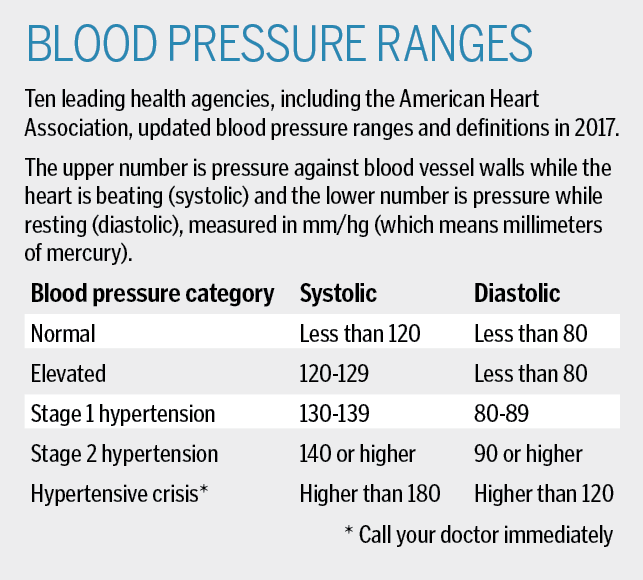
In 2017, the marker for detecting, managing and treating hypertension was lowered from 140/90 to 130/80. That swept many millions more people into a newly expanded group that ought to be testing and managing their blood pressure.

The new guideline stemmed from numerous clinical studies that showed that achieving lowered blood pressure goals significantly reduced the rate of “heart events” and death, according to the American Heart Association.

But because doctor’s offices tend to give people the willies and cause what’s known as White Coat Syndrome (anxiety that produces high blood-pressure readings), testing yourself in the comfort of your home will give you more meaningful results, Segal said.

Today’s over-the-counter arm cuffs are reliable and affordable, Segal said. He doesn’t recommend finger or watch-style wrist blood pressure readers, which are not accurate enough, he said.

When to test? Other than waiting half an hour or more after coffee — that’s a guaranteed spike — there’s no wrong answer.

“I always say the best time is whenever you can,” Nazir said.

Many people check right after waking in the morning but before eating or drinking anything. Then they become dismayed to discover that, despite still feeling groggy, their blood pressure is surprisingly high.

That’s thanks to your body’s natural release of the stress hormone cortisol, which helps you rev up in the morning and typically drives a blood-pressure spike, Nazir said.

Be aware of that dynamic, Segal and Nazir both said, but don’t let it alarm you. Test at various times during the day and you’ll likely be surprised at how much blood pressure varies. At night, when your day is winding down, you might just be surprised and comforted to see how low it goes.

More information is always better, Nazir said. Whenever you test, do it three times. Your digital reader can probably calculate the average for you.

“The important thing is the average,” Segal said.

A Healthy Diet Can Benefit Blood Vessels, Study Shows

You’re surely well aware of the fact that your regular eating habits can affect your body in all kinds of fascinating ways. For example, what you eat can impact how well your blood circulates throughout your body as well as impact your blood pressure. On top of that, a recent study has found that a healthy diet can also benefit your blood vessels.

In the study that was recently published in Nature Metabolism, researchers examined how diet could benefit overall health by reducing molecular signatures that potentially trigger diseases, such as “vascular defects and endothelial cell (EC) dysfunction.” More specifically, it assessed to what extent the ECs that line the inside of blood vessels and  “control the transport of nutrients, metabolites, oxygen and carbon dioxide between the blood and organs” were impacted by obesity.

Comparing the effects of a healthy diet to the relatively unhealthy Western diet in mice, those behind the study found that “obesity induces organ-specific changes in ECs,” and healthier eating habits can lead to an improvement in the molecular health of some blood vessels. For instance, while blood vessels in the liver showed a significant improvement—to the point where they saw an almost complete recovery, blood vessels in the kidneys didn’t experience the same positive result. Instead, the blood vessels in the kidneys retained molecular signatures that were related to disease.

When it comes to how diet can affect blood vessels in such a way, “the answer is a complex one,” Blanca Garcia, RDN, a nutrition specialist at HealthCanal, tells Eat This, Not That!

“Having a healthy diet allows the body to obtain high-quality nutrients and can help all the body’s cells get the correct amount of nutrients it needs to continue regenerating,” says Garcia. “This also includes blood vessels, as they are made up of cells themselves—and to stay healthy, the nutrients passing through need to be balanced.”

A Healthy Diet Can Benefit Blood Vessels, Study Shows

woman eating salmon and quinoa

On the other hand, Garcia explains that a diet that is “undesirable for the body,” comprised of significant amounts of processed foods, few fruits and vegetables, and an “overall imbalanced intake of nutrients,” has a high probability of potentially leading to obesity.

“Obesity often complicates the organ systems and contributes to chronic conditions,” says Garcia. “Overall, an undesirable diet can prevent the blood vessels from obtaining the right amount of good-quality nutrients.”

Additionally, Garcia notes that how you nourish your body can impact your propensity for illness, either helping to prevent it or leading to disease.

“The body needs a constant influx of good-quality nutrients,” says Garcia. “The moment that starts to change, the body needs to prioritize and decide which system needs the little good quality nutrients it does get.” Garcia claims that “oftentimes, some organ systems become affected” as a result of this change.