
There is a worrying amount of fraud in medical research

IN 2011 BEN MOL, a professor of obstetrics and gynaecology at Monash University, in Melbourne, came across a retraction notice for a study on uterine fibroids and infertility published by a researcher in Egypt. The journal which had published it was retracting it because it contained identical numbers to those in an earlier Spanish study—except that that one had been on uterine polyps. The author, it turned out, had simply copied parts of the polyp paper and changed the disease.

“From that moment I was alert,” says Dr Mol. And his alertness was not merely as a reader of published papers. He was also, at the time, an editor of the European Journal of Obstetrics and Gynaecology, and frequently also a peer reviewer for papers submitted to other journals. Sure enough, two papers containing apparently fabricated data soon landed on his desk. He rejected them. But, a year later, he came across them again, except with the fishy data changed, published in another journal.

Since then, he has teamed up with other researchers to investigate groups of papers by authors he has spotted as data fabricators. Wherever he saw smoke, he found fire. There were tables on patients’ characteristics that contained only even numbers. There were values that were clinically unlikely. There was an implausible 40:60 sex ratio of babies when the mothers-to-be had, purportedly, been selected at random. Eye-popping speeds of completing clinical trials were common.

The fabrication of unreality

Dr Mol and his colleagues have sent their concerns about more than 750 papers to the journals that published them. But, all too often, either nothing seems to happen or investigations take years. Only 80 of the studies they have flagged have so far been retracted. Worse, many have been included in systematic reviews—the sort of research round-ups that inform clinical practice.

Millions of patients may, as a consequence, be receiving wrong treatments. One example concerns steroid injections given to women undergoing elective Caesarean sections to deliver their babies. These injections are intended to prevent breathing problems in newborns. There is a worry that they might cause damage to a baby’s brain, but the practice was supported by a review, published in 2018, by Cochrane, a charity for the promotion of evidence-based medicine. However, when Dr Mol and his colleagues looked at this review, they found it included three studies that they had noted as unreliable. A revised review, published in 2021, which excluded these three, found the benefits of the drugs for such cases to be uncertain.

There is a worrying amount of fraud in medical research

Partly or entirely fabricated papers are being found in ever-larger numbers, thanks to sleuths like Dr Mol. Retraction Watch, an online database, lists nearly 19,000 papers on biomedical-science topics that have been retracted (see chart 1). In 2022 there were about 2,600 retractions in this area—more than twice the number in 2018. Some were the results of honest mistakes, but misconduct of one sort or another is involved in the vast majority of them (see chart 2).

John Carlisle, a British anaesthetist and journal editor, has uncovered hundreds of problematic papers. He reckons “almost all [clinical] guidelines will be affected in some way by false data that is currently unrecognised”. Fabricated studies also send those who try to build on them down blind alleys, wasting millions of dollars.

Yet journals can take years to retract, if they ever do so. Going by these numbers, roughly one in 1,000 papers gets retracted. That does not sound too bad. However, Ivan Oransky, one of Retraction Watch’s founders, reckons, based on various studies of the matter and reports from sleuths, that something more like one in 50 papers has results which are unreliable because of fabrication, plagiarism or serious errors.

Most fabricated papers come from one of two sources. Some, particularly those claiming to report clinical trials, are the products of prolific individual fraudsters or groups of fraudsters. Those uncovered by Dr Mol fall into this category. Others, more often purporting to be about basic science, such as molecular biology, are written, for a fee, by outfits known as “paper mills”. Frequently, these are fabricated by copying published papers and substituting the gene or disease a legitimate paper refers to with another.

According to the Retraction Watch database, the 200 authors with the most retractions account for over a quarter of all 19,000 retractions. Many of the most prolific fraudsters are senior scientists at big universities or hospitals. Few have spoken openly about their motives for making up research. But the confessions of those who have speak volumes about what may push others down the same path.

Cheats ever prosper

Scientific research is a hard slog, and the results are often disappointingly equivocal answers to a researcher’s bold hypothesis. Diederik Stapel, once a psychology professor at Tilburg University in the Netherlands, had 58 papers retracted after revelations that he fabricated studies. He did so, he said in his confessional memoir, “Faking Science”, because they otherwise failed to provide a solution that was “simple, clear, beautiful and elegant”. Like many similar fabulists, however, he was also driven by career incentives. The aphorism “publish or perish” reflects an academic truth. A long publication list is crucial for promotion, or for switching institutions to get a better job. But journals prefer studies that show strong, positive results—meaning much of a researcher’s effort is, in terms of career advancement, wasted.

Publishing lots of studies has enabled some fraudsters to be perceived as leading experts in their fields, with the perks of professional prestige which go with that—at least until things unravel. As Dorothy Bishop, a retired experimental psychologist from Oxford University who volunteers her time identifying problematic studies observes, such fraudsters often run research groups or have collaborative networks with other research centres. When the fabrication is discovered, those colleagues are affected by the aftermath. “Quite often”, she says, “junior people get their careers completely derailed by this.”

It is a particular problem in China. Unrealistic publication quotas are often needed to obtain the best jobs in hospitals, and those who publish in top journals also get big cash bonuses. Not surprisingly, China is thus a country that has developed a thriving paper-mill industry. Indeed, almost all retractions linked to paper mills list Chinese authors. Of papers submitted to journals, about a fifth have at least one contributor from a Chinese institution, yet this fifth accounts for nearly half of papers subsequently retracted.

A review of submissions to two journals specifically aimed at by paper mills does, however, show that the problem stretches way beyond China. It found that the fakes had authors from more than 70 countries. And, though those from middle income countries (China included, see chart 3) are the most numerous, some of the most consequential fabrications of clinical trials which have come to light were concocted in America, Canada, Europe and Japan.

How much cheating is never caught is anyone’s guess. As Dr Bishop notes, “The only ones we know about are the ones that are not very good at it. If somebody is very good at fraud, you’re not going to detect it.” And it is not just a few bad apples. In 2009 PLOS ONE published a round-up of 18 surveys of scientists, mostly in America, that had asked about fraud. Though only 2{bf0515afdcaddba073662ceb89fbb62b6b1bf123143c0e06b788e1946e8c353f} of respondents admitted falsifying data themselves, 14{bf0515afdcaddba073662ceb89fbb62b6b1bf123143c0e06b788e1946e8c353f} said they knew someone who had. Similarly, a third of those asked confessed to other questionable research practices, such as dropping inconvenient data points based on “gut feeling”, or making important changes to a study’s protocol while it was in progress. But they pointed the finger at 72{bf0515afdcaddba073662ceb89fbb62b6b1bf123143c0e06b788e1946e8c353f} of their colleagues.

America is not exceptional in this. In a survey of academics in Britain, published in 2016, nearly one in five reported having fabricated data. And in a recent survey of researchers in the Netherlands, 10{bf0515afdcaddba073662ceb89fbb62b6b1bf123143c0e06b788e1946e8c353f} of those in the life and medical sciences admitted they had falsified or fabricated data.

Many fake papers are me-too studies, supporting treatments already backed by other work. For the most part, these are unlikely to sway clinical practice. But some fraudsters have been the inspiration for specific medical interventions which have turned out to be useless, or even harmful.

For example, critically ill patients undergoing surgery were once sometimes given starch infusions to boost their blood pressure. This was based in part on seven now discredited studies by Joachim Boldt, a German anaesthesiologist. A revised round-up of the evidence published in the Journal of the American Medical Association, in 2013, after his fabrications were discovered, concluded that giving starch infusions in these circumstances caused kidney damage and sometimes killed people.

Likewise, for more than a decade cardiac patients in Europe were given beta-blockers before surgery, with the intention of reducing heart attacks and strokes—a practice that rested on a study from 2009 which was eventually determined to have been based, at least in part, on fabricated data. By one estimate, this approach may have caused 10,000 deaths a year in Britain alone. And a systematic review showing that infusion of a high-dose sugar solution reduces mortality after head injury was retracted after an investigation failed to find evidence that any of the trials included in it, which were all ascribed to the same researcher, had actually taken place.

Bricks without straw

Spotting fabricated papers often starts with catching one by chance and then looking at others by the same hand, as Dr Mol did. “A lot of the problems are only apparent when you look across publications by an author. So if you had one paper, you wouldn’t necessarily identify them,” says Alison Avenell of the University of Aberdeen, who is part of a team that has raised concerns about hundreds of clinical trials published by several research groups. Common patterns in dodgy papers, she opines, include unusually big effects of the reported treatments, peculiar drop-out rates among participants, or the same data appearing in different trial reports. “You see things that are virtually statistically impossible,” she says.

Dr Carlisle and others have devised various statistical checks to catch unusual numbers in single papers. As an editor of Anaesthesia, he used such checks on all 526 clinical-trial studies submitted to the journal between 2017 and 2020. When he looked at papers for which the authors had not submitted individual patients’ underlying numbers, he found that 2{bf0515afdcaddba073662ceb89fbb62b6b1bf123143c0e06b788e1946e8c353f} included false data. This jumped to 44{bf0515afdcaddba073662ceb89fbb62b6b1bf123143c0e06b788e1946e8c353f} for those for which he could also examine such individual numbers, including 26{bf0515afdcaddba073662ceb89fbb62b6b1bf123143c0e06b788e1946e8c353f} which he judged as “fatally flawed”.

Doing checks like these routinely could stop a lot of fake papers being published. Yet, though reviewers who vet journal papers for publication “get all of these supplemental files and links to data sets”, says Lisa Bero, of Cochrane, “most of them don’t look at it.” Moreover, though authors often say that the backup data for their papers will be made available on request, a study conducted in 2022 reported that 93{bf0515afdcaddba073662ceb89fbb62b6b1bf123143c0e06b788e1946e8c353f} fail to provide them when so requested by other researchers. “You ask for the original data and then, my goodness, you realise we live in a dangerous world,” says Ian Roberts of the London School of Hygiene and Tropical Medicine. Floods, earthquakes, termites, stolen laptops—he has seen all sorts of excuses for lost data.

Blots on the landscape

Cochrane maintains a database of retracted studies, and its systematic reviews are revised as needed. But that is rare for these types of reviews, partly because retracted papers are often not flagged prominently as such in online libraries and so continue to be cited as if they were valid research. Indifference plays a role too, with many researchers reluctant to set things straight even when told their reviews included fabricated studies. The attitude is, “it was right at the time”, says Jack Wilkinson, a biostatistician at Manchester University.

For example, Dr Avenell and her colleagues assessed the impact of 27 retracted clinical-trial papers, covering several medical conditions. These papers were included in 88 systematic reviews and clinical guidelines. The researchers reckoned that in half of those the conclusions were likely to change if the retracted trials were removed. They notified the authors of all the reviews about the retractions. Only half of them bothered to reply. A year later, in 39 of the 44 reviews that would have been affected, no action was undertaken.

Similarly depressing discoveries have been made in recent years for paper-mill articles. Though lots of these are so sloppy that any serious researcher would consider them a joke, and they are thus often published in obscure periodicals which would print anything for a fee, some look solid enough to be accepted by leading scientific journals. These are now discovering they have published hundreds of them. One analysis of 53,000 papers submitted to journals in a variety of disciplines, spanning six publishers, flagged between 2{bf0515afdcaddba073662ceb89fbb62b6b1bf123143c0e06b788e1946e8c353f} and 46{bf0515afdcaddba073662ceb89fbb62b6b1bf123143c0e06b788e1946e8c353f} of them as suspicious.

Molecular-biology articles, those paper-mill specialities, often include pictures of Western blots—a laboratory technique used to study proteins. Such images can be found, for example, in papers that investigate how a given drug affects human cells. No two Western blots should look the same, so a sharp pair of eyes can spot duplicates. Elisabeth Bik, a Dutch microbiologist turned full-time detective hunting for fabricated papers, has an exceptional talent for doing just that. Using her “pattern-matching eyes and lots of caffeine”, as she put it in a recent opinion piece, she has analysed more than 100,000 papers, and found blot-based evidence of error or cheating in 6,500 of them.

Studies with falsified Western blots may seem less consequential than fabricated clinical trials. But consider a recent controversy concerning a series of influential papers on the causes of Alzheimer’s disease of which the lead author is Sylvain Lesné of the University of Minnesota (which is investigating the matter).

Dr Bik and others have recently found what they say is evidence of image-manipulation, including of pictures of blots, in these studies. And other scientists have tried and failed to replicate the results of a landmark study Dr Lesné published in Nature in 2006, which appeared to provide crucial evidence concerning a hypothesis that links the disease with so-called amyloid plaques in the brain, and which is one of the most cited papers in Alzheimer’s research. This particular article may have sent an entire line of scientific inquiry into that hypothesis in the wrong direction, by pointing a finger at one particular form of amyloid beta, the plaque-forming protein. In July 2022 Nature published an expression of concern, while it investigates.

Similar patterns are emerging in genetics. In a study published last year Jennifer Byrne, a cancer researcher at the University of Sydney, led a team that screened nearly 12,000 papers using Seek & Blastn, a piece of software they developed themselves, to check details of substances called nucleotide-sequence reagents (NSRs).

NSRs are short pieces of DNA or RNA that form part of many studies of genes. They are intended to bind to specific bits of natural genetic material. Seek & Blastn extracts the sequences of these reagents from papers and compares them with those in Blastn, a public sequence database, to check whether they match their supposed genetic targets. The team found that 6{bf0515afdcaddba073662ceb89fbb62b6b1bf123143c0e06b788e1946e8c353f} of papers contained errors suggestive of paper-mill production.

The consequences of fake genetic studies such as these could be as far-reaching as those involving dodgy Western blots. Dr Byrne and her co-authors estimate that as many as 100,000 published papers about human genes may emanate from paper mills, and that a quarter of these are such that they “may misinform the future development of human therapies”.

Disciplining the discipline

It is often asserted that science is self-correcting. And it is true that, if a claimed result is important enough, an inability to replicate it or of subsequent work to conform to it will eventually be noticed. In the short term, though, it is easy to hide in the shadows. Even co-authors of a data-fabricating scientist—those, in other words, who are closest to him or her—may not notice what the culprit is up to. In complex studies of a particular disease, several types of researchers will be involved, who are, by definition, not experts in each other’s fields. As Dr Bishop observes, “You just tend to take on trust the bits of data that somebody else has given you.”

Moreover, even after a published paper is flagged as containing fabricated data, self-correction often fails to kick in. There is a “massive variation” in how journals and publishers react when alerted to problems, says Dr Wilkinson—whether they investigate at all, how long it takes to reach a decision, and what they do after that.

Dr Avenell avers that in her experience it usually takes two to three years to get an expression of concern or a retraction published. “The only way we get retractions is to repeatedly badger the journals over and over and over again”, she says. “If you just send them a one-off email with details of all of your concerns, it’s very unlikely that anybody is ever going to do anything.” Dr Bero says that many Cochrane reviewers think it a waste of time to alert journal editors about problematic studies they have identified, so they don’t bother. “Many of our authors have written to editors and just gotten no response, or the editor doesn’t do anything to retract the article or doesn’t investigate at all,” she observes.

One problem is that journals rarely have staff, such as statisticians, with the expertise needed to deal with such matters. Publishers, for their part, make profits from publishing more, not from investigating potential retractions. They also fear being sued by belligerent fraudsters. They therefore often pass the ball to the institutions that employ the suspected miscreants.

In America, institutions accepting federal grant money (which is almost all of the serious ones) are required to follow government rules which say that they should investigate allegations of research misconduct within 60 days. But many take more than a year or two, says C.K. Gunsalus, an ethicist at the University of Illinois, who has conducted such investigations.

Just do it

In some cases, there are good reasons for delay. The difficulty of finding experts competent to conduct complex analyses is one. Another is that an investigation of one paper may turn up further suspicious publications. All too often, though, “there is very little sense of urgency”, says Dr Gunsalus. The goal is to decide whether a researcher should be fired, rather than a desire to protect the integrity of the scientific literature. Until an employment decision is made, the university usually stays mum.

Even in America, the quality of such investigations often leaves a lot to be desired, says Dr Gunsalus. And many places have no relevant regulations. In Western countries people fired for research misconduct have sometimes gone on to do the same thing elsewhere, says Dr Bishop. And in their list of concerns with 172 papers published by a group led by Zatolleh Asemi at the Kashan University of Medical Sciences, in Iran, Andrew Grey of the University of Auckland, in New Zealand, and his colleagues note that five of the seven vice-chancellors at his university are co-authors of at least one affected submission.

Nor do universities provide incentives for whistle-blowers to act, though that can stop fabricated studies being produced in the first place. Their rules usually say lots about the consequences of spurious allegations, but little or nothing about any duty to raise the alarm about fraud.

Few whistle-blowers have Dr Bik’s perseverance. After she raised concerns about more than 60 papers by Didier Raoult, a now-retired professor at a university hospital in Marseille, she received online threats and her home address was posted on Twitter by one of his colleagues. Dr Raoult also filed a legal complaint against her for attempted blackmail and harassment, an action the French National Centre for Scientific Research, a government agency, condemned as “judicialisation of scientific controversy and criticism”. In 2021 she won the John Maddox prize—awarded jointly by Sense about Science, a British charity, and Nature, of which Maddox was, for many years, editor—for “courage and integrity in standing up for sound science and evidence”.

There are some signs of hope. Besides scanning retraction databases for new additions, and redoing the analyses that include them, Cochrane has also started to check papers for integrity. A recent Cochrane review of research on drugs intended to prevent pre-term labour excluded 44 studies on such grounds, which was one in four of those on the starting list.

In a similar vein, Britain’s National Institute of Health and Care Research pays for INSPECT-SR, a project run by Dr Wilkinson that is developing integrity-checking tools for systematic reviews like those conducted by Cochrane. STM, a publishing-industry association, is working on a similar system to detect fabrications in submitted papers. The idea, says Joris van Rossum, who leads this work, is that the system will give editors signals about suspicious features commonly used by paper mills, such as duplicated images, the same paper being submitted simultaneously to several journals, authors with no record of having expertise in the subject, and so on.

Both Dr Wilkinson and Dr van Rossum worry about an arms race between fabricators and those employed to catch them. Such fears are amplified by the growing sophistication of artificial-intelligence (AI) tools like ChatGPT. In a recent study for which this was asked to generate 50 medical-research abstracts, both human reviewers and an AI-output detector failed to identify a third of the bot’s papers as such.

Trust. But verify

In the end, however, keeping fakes out of the scientific record depends on the willingness of publishers to stump up more resources. Statistical checks of clinical-trial papers often involve laborious manual work, such as typing up specific data in spreadsheets. This would require journals to hire dedicated staff, cutting into profits.

Many academics who have spent years trying to get fabricated papers retracted are pessimistic that better ways to detect fraud will, alone, make a big difference. Dr Roberts and Dr Mol want journals to be regulated in the way that social media and the news business are in some countries, with standards on what they publish. Peter Wilmshurst, a British cardiologist who has raised the alarm about numerous cases of research misconduct in his field, thinks there should be criminal penalties for those who fabricate data. Dr Gunsalus wants universities to make public the reports from their research-fraud investigations. And everyone agrees that publish or perish is a recipe for disaster.

None of these solutions will be quick or straightforward. But it is now clear that choosing to look the other way is causing palpable harm to patients. As Stuart Richie of King’s College, London, notes in his book, “Science Fictions”: “For the sake of the science, it might be time for scientists to start trusting each other a little less.” ■

Who are the leading innovators in ultrasonic stimulation devices for the medical devices industry?

The medical devices industry continues to be a hotbed of innovation, with activity driven by increased need for homecare, preventative treatments, early diagnosis, reducing patient recovery times and improving outcomes, as well as a growing importance in technologies, such as machine learning, augmented reality, 5G and digitalization. In the last three years alone, there have been over 450,000 patents filed and granted in the medical devices industry. , according to GlobalData’s report on Innovation in Medical Devices: Ultrasonic stimulation devices.

However, not all innovations are equal and nor do they follow a constant upward trend. Instead, their evolution takes the form of an S-shaped curve that reflects their typical lifecycle from early emergence to accelerating adoption, before finally stabilising and reaching maturity. 

Identifying where a particular innovation is on this journey, especially those that are in the emerging and accelerating stages, is essential for understanding their current level of adoption and the likely future trajectory and impact they will have. 

150+ innovations will shape the medical devices industry 

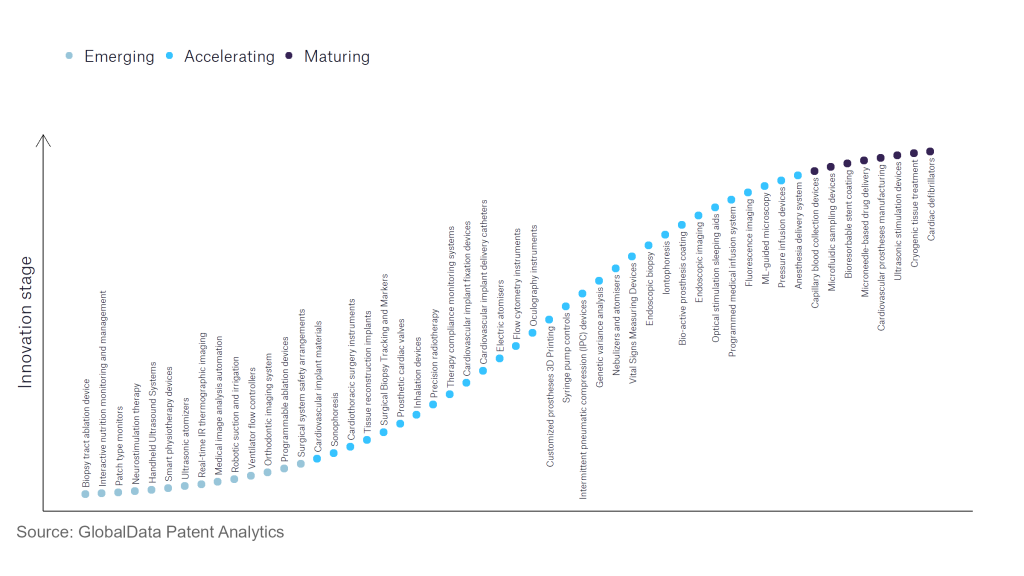
According to GlobalData’s Technology Foresights, which plots the S-curve for the medical devices industry using innovation intensity models built on over 550,000 patents, there are 150+ innovation areas that will shape the future of the industry. 

Within the emerging innovation stage, neurostimulation therapy, smart physiotherapy devices, and real-time IR thermographic imaging are disruptive technologies that are in the early stages of application and should be tracked closely. Precision radiotherapy, electric atomisers, and bio-active prosthesis coating are some of the accelerating innovation areas, where adoption has been steadily increasing. Among maturing innovation areas are bioresorbable stent coating and cryogenic tissue treatment, which are now well established in the industry. 

Innovation S-curve for the medical devices industry 

Who are the leading innovators in ultrasonic stimulation devices for the medical devices industry?

Ultrasonic stimulation device is a key innovation area in the medical devices industry 

Ultrasonic stimulation devices deliver non-invasive pulsed ultrasonic waves to specific areas in the brain to either inhibit or excite neural activity. The devices provide high spatial resolution and can potentially target different sites of the peripheral and central nervous system. It is an emerging therapeutic technique for an array of psychiatric, developmental and neurological disorders, gradually replacing the traditional electric and magnetic stimulation methods.  

GlobalData’s analysis also uncovers the companies at the forefront of each innovation area and assesses the potential reach and impact of their patenting activity across different applications and geographies.  According to GlobalData, there are 40+ companies, spanning technology vendors, established medical devices companies, and up-and-coming start-ups engaged in the development and application of ultrasonic stimulation devices. 

Key players in ultrasonic stimulation devices – a disruptive innovation in the medical devices industry  

‘Application diversity’ measures the number of different applications identified for each relevant patent and broadly splits companies into either ‘niche’ or ‘diversified’ innovators. 

‘Geographic reach’ refers to the number of different countries each relevant patent is registered in and reflects the breadth of geographic application intended, ranging from ‘global’ to ‘local’. 

Medtronic is one of the leading patent filers in the field of ultrasonic stimulation devices. Some other key patent filers in the field include Merz Pharma and Highland Instruments. 

In terms of application diversity, Thermalin leads the pack, followed by Merz Pharma and Autonomix Medical. By means of geographic reach, Autonomix Medical holds the top position, followed by Medical Energetics and Cerevast Medical in the second and third spots, respectively. 

Ultrasonic stimulation devices have become crucial neuromodulation therapeutic tools for patients with brain disorders. The technology has drawn considerable attention for its advantages, such as deeper penetration and no tissue heating. The rapidly ageing population with brain disorders and limited availability of effective surgical and medication alternatives is likely to drive the overall growth of this market. 

To further understand the key themes and technologies disrupting the medical devices industry, access GlobalData’s latest thematic research report on Medical Devices. 


Meihua International Medical Technologies Co., Ltd. Enters Into Cooperation Agreements with Hainan’s Qionghai City and Hainan Free Trade Port Boao Hope City to Build Technology Park and Medical Research and Development Center

YANGZHOU, China, Feb. 21, 2023 /PRNewswire/ — Meihua International Medical Technologies Co., Ltd. (“MHUA” or the “Company”) (NASDAQ: MHUA), a reputable manufacturer and provider of Class I, II and III disposable medical devices with operating subsidiaries in China, today announced the Company, via its subsidiary company Hainan Guoxie Medical Technology Co. (“Hainan Guoxie”), has entered into cooperation agreement (the “Qionghai Agreement”) with Qionghai City of Hainan Province to build technology park project. Hainan Guoxie also entered into cooperation agreement (the “Hope City Agreement”) with Hainan Free Trade Port Boao Hope City (“Hope City”) to build MHUA a medical research and development center in the Hope City.

Pursuant to the Qionghai Agreement, Hainan Guoxie plans to invest in the construction of a medical industrial park in Hainan Province for the will be focused on the development of minimally invasive interventional medical devices, new materials and surgical robotics technologies. Hainan Guoxie and Qionghai City government reached preliminary agreement to bid for the usage of nearly 574,080 sq ft of land around Hope City for the construction of a Contract Development and Manufacturing Organization (CDMO) medical industrial park. The Company anticipates making a more detailed public announcement of the land use right purchase information in about one month’s time.

Pursuant to the Hope City Agreement, the planned MHUA medical R&D center will carry out the research and development of stem cell to human targeted therapies and rehabilitation training projects.

Presently, Hope City is the only special medical parkin China, which was approved by China State Council in 2013 and offers a series of special policies such as “licensed medical treatment, licensed research, licensed operation and licensed international medical technology exchange,” and is a key project for the construction of the Hainan Free Trade Port. At present, there are 20 medical institutions involved in more than 10 projects under construction or planned in the pipeline, with 51 medical academicians forming the expert advisory team. In addition, Hope City has established cooperation with 30 of the top international pharmaceutical and medical devices enterprises, serving as one of the main channels for the importation of innovative products into China. The volume of licensed medicines and medical devices imported has exceeded 200 categories, effectively facilitating the advancement of medical technology, devices and medicine development in China to catch up with the international market.

MHUA’s project is highly valued by the local government of Hope City, who recently paid a special visit to the Company’s headquarters. Mr. Liu Yongjun, chairman of MHUA, commented: “Hainan has many advantageous conditions as China’s national free trade port, which will provide many convenience for MHUA’s products exporting to foreign markets, new product research and development, and taxation, among other things. It is a great honor for us that Qionghai City and Hope City selected the Company as one of the contracted companies to promote medical industry projects locally. MHUA will strive to improve the level of intelligence, information technology, digitalization and innovation, and accelerate the transformation and upgrade of our business, in order to promote the Company’s high-quality development and create sustainable value for our shareholders.”

About Meihua International Medical Technologies Co., Ltd.

Meihua International Medical Technologies is a reputable manufacturer and provider of Class I, II and III disposable medical devices with operating subsidiaries in China. The Company manufactures and sells Class I disposable medical devices, such as eye drop bottles, medicine bottles and anal bags, and Class II and III disposable medical devices, such as identification tape, gynecological examination kits, inspection kits, surgical kits, medical brushes, medical dressing, masks, disposable infusion pumps, electronic pumps and puncture kits, which products are sold under its own brands and also sourced and distributed from other manufacturers. The Company has received international “CE” certification and ISO 13485 system certification and has also registered with the FDA (registration number: 3006554788) for more than 20 products. The Company has served hospitals, pharmacies, medical institutions and medical equipment companies for over 30 years, providing more than 800 types of products for domestic sales, as well as 120 products which are exported to more than 30 countries internationally across Europe, North America, South America, Asia, Africa and Oceania. For more information, please visit www.meihuamed.com.

Forward-Looking Statements

This press release contains forward-looking statements as defined by the Private Securities Litigation Reform Act of 1995. Forward-looking statements include statements concerning plans, objectives, goals, strategies, future events or performance, and underlying assumptions and other statements that are other than statements of historical facts. When the Company uses words such as “may,” “will,” “intend,” “should,” “believe,” “expect,” “anticipate,” “project,” “estimate” or similar expressions that do not relate solely to historical matters, it is making forward-looking statements. Forward-looking statements are not guarantees of future performance and involve risks and uncertainties that may cause the actual results to differ materially from the Company’s expectations discussed in the forward-looking statements. These statements are subject to uncertainties and risks including, but not limited to, the following: the Company’s ability to achieve its goals and strategies, and its ability to fully execute on the planned agreement, the Company’s future business development and plans of future business development, including its ability to successfully develop robotic assisted surgery systems and obtain licensure and certification for such systems, financial conditions and results of operations, product and service demand and acceptance, reputation and brand, the impact of competition and pricing, changes in technology, government regulations, fluctuations in general economic and business conditions in China, and assumptions underlying or related to any of the foregoing and other risks contained in reports filed by the Company with the U.S. Securities and Exchange Commission (“SEC”). For these reasons, among others, investors are cautioned not to place undue reliance upon any forward-looking statements in this press release. Additional factors are discussed in the Company’s filings with the SEC, including under the section entitled “Risk Factors” in its annual report on Form 20-F, as filed with the SEC on July 29, 2022, as well as its current reports on Form 6-K and other filings, all of which are available for review at www.sec.gov. The Company undertakes no obligation to publicly revise these forward-looking statements to reflect events or circumstances that arise after the date hereof.

For more information, please contact:

Janice Wang
Wealth Financial Services LLC
Phone:
+86 13811768599
+1 628 283 9214
Email: services@wealthfsllc.com


Cision

Cision

View original content:https://www.prnewswire.com/news-releases/meihua-international-medical-technologies-co-ltd-enters-into-cooperation-agreements-with-hainans-qionghai-city-and-hainan-free-trade-port-boao-hope-city-to-build-technology-park-and-medical-research-and-development-center-301751576.html

SOURCE Meihua International Medical Technologies Co., Ltd.

European Union-funded medical sterilization equipment and training boosts health protection – Lao People’s Democratic Republic (the)

This week, more than US$160 000 of WHO-procured hospital sterilization equipment will be dispatched to healthcare facilities across the country, as part of ongoing efforts by the Ministry of Health, WHO and the European Union (EU) to tackle COVID-19 and other infectious diseases, and strengthen the health system’s capacity for future health threats including antimicrobial resistance.

The donation – a mixture of 12 units of 150L and 200L autoclaves used for industrial-scale sterilisation of medical equipment – have been provided to healthcare facilities across the country. The units will greatly expand the ability of provincial hospitals to conduct high-volume, high-temperature sterilisation of surgical and medical devices.

The donation accompanies an EU-funded, WHO-delivered infection prevention and control training for 243 nurses, doctors and midwifes in central, provincial and district hospitals in Luang Prabang, Oudomxay, Champasack, Xieng Khouang, Xekong and Vientiane provinces, and Vientiane Capital.

“Improving the quality and safety of healthcare services for our people is our Ministry’s key focus,” said Dr. Bounfeng Phoummalaysith, Minister of Health. “This generous EU assistance will enhance infection prevention and control, an essential part of improving the quality of healthcare, and strengthen our health system now and in the future.”

“This timely donation and support from the European Union is greatly appreciated, it will improve patient safety by reducing the incidence of healthcare associated infections,” said the Ministry of Health’s Dr. Somchan Thounsavath, Deputy Director General, Department of Healthcare and Rehabilitation.

“Providing the greatest level of quality care, and health for all, is our top priority, and this contribution allows us to better protect healthcare workers, patients, and communities.”

The autoclaves, providing 2,000L of sterilization capacity in total, have been supported by training for health care workers on strengthening infection prevention knowledge, skills, monitoring, evaluation, and developing tailored plans to address gaps in infection prevention and control in each facility. Under the leadership of the Nursing and Midwifery Division, Department and Healthcare and Rehabilitation-Ministry of Health, WHO provided the training, as well as supporting assessments.

“The European Union is proud to help reinforce the healthcare system in Lao PDR’ and assist health workers be better equipped with knowledge and equipment,” said Ina Marčiulionytė, the EU Ambassador to Lao PDR.

“Together with our partners at WHO and the Government of Lao PDR, we will continue working to make sure citizens all over Lao PDR receive improved access to healthcare and support during the COVID-19 pandemic. The EU, with the rest of Team Europe, remain committed to support the country in building back better and stronger.”

Amid the COVID-19 pandemic, infection prevention and control has been crucial in reducing the spread of the virus in medical facilities, as well as other diseases. Hundreds of millions of people are affected globally every year by avoidable infections in health care, often related to poor sterilization or hygiene practises or equipment.

“While no one should catch an infection while receiving health care. It does happen, but we can stop it with the right tools and skills,” said WHO Representative Dr. Ying-Ru Lo. “Infection prevention and control measures are one of the most effective ways to prevent infections including antimicrobial resistant germs in health facilities, improve the quality and safety of healthcare services.”

“The EU’s significant contribution has and will help curve the spread of COVID-19 and other diseases, particularly for vulnerable people in health facilities, and directly save lives. We greatly appreciate their generous contribution to improving health.”

This support is part of wider collaboration between the EU and WHO to support health in Lao PDR. The recent donation is part of several million dollars of COVID-19-addressing activities to improve health and wellbeing for people and communities, including support for laboratories and disease surveillance, health emergency response, improvements in clinical management, infection prevention and control, improving water, sanitation and hygiene, and logistics strengthening.

FAU, DELRAY MEDICAL CENTER, INSIGHTEC TEAM UP ON GROUNDBREAKING ALZHEIMER’S STUDY

First Individual in Florida Dealt with with Non-invasive Concentrated Ultrasound Technological innovation

BOCA RATON, Fla., Feb. 20, 2023 /PRNewswire/ — Delray Clinical Centre is the 1st clinic in Florida to handle an Alzheimer’s condition client working with non-invasive focused ultrasound technological innovation as component of a groundbreaking analyze currently being carried out in collaboration with Florida Atlantic University’s Institute for Human Overall health and Ailment Intervention (I-Health).

In the Food and drug administration-authorised scientific demo, targeted ultrasound engineering is applied to disrupt the blood-brain barrier in taking part Alzheimer’s patients. Alzheimer’s may possibly be brought on by a buildup of certain proteins in the mind. Specifically guided by magnetic-resonance imaging, ultrasound waves are directed at precise spots of the patient’s mind to build a momentary opening in the blood-mind barrier where by the protein buildup may well be minimized. The Delray Health-related Centre affected individual enrolled in the clinical trial gained the to start with of a few treatment options at the hospital on Feb. 15.

“Delray Medical Center is very pleased and fired up to be a leader in this effort to determine the protection and efficacy of this perhaps revolutionary procedure for Alzheimer’s sufferers,” explained Lloyd Zucker, M.D., FAANS, a board-certified neurosurgeon and health care director of neurosurgery at Delray Professional medical Centre. “The review will aid determine whether or not the use of this non-invasive centered ultrasound technological know-how can lead to cognitive enhancement in people with Alzheimer’s disorder.”

An estimated 6.5 million Us citizens ages 65 and older are dwelling with Alzheimer’s disorder, which is the sixth major result in of death for those age 65 and higher than in the U.S., according to the Alzheimer’s Affiliation. Florida has the second maximum incidence of Alzheimer’s in the state, with an approximated 580,000 conditions.

“By developing the Florida Alzheimer’s Heart of Excellence previous calendar year, Florida Gov. Ron DeSantis has placed Alzheimer’s disease as a precedence health and fitness problem in Florida, which will profit the additional than 580,000 folks now living with Alzheimer’s as very well as their families,” explained FAU President Stacy Volnick. “We are psyched to collaborate with Delray Clinical Heart, Insightec and others on this groundbreaking technology that will generate the upcoming technology of affected person care for Alzheimer’s disease and other neurodegenerative disorders.”

FAU’s Gregg Fields, Ph.D., executive director of I-Overall health and a professor of chemistry and biochemistry in FAU’s Charles E. Schmidt Higher education of Science, is the software director for the undertaking.

“Drug passage as a result of the blood-brain barrier is probably a person of the greatest troubles in neurology,” claimed Fields. “The remedy of the initial client in Florida with the non-invasive centered ultrasound engineering signifies a important progression for opportunity drug shipping and procedure of Alzheimer’s sickness and other neurological issues. In tandem, we are also doing work on non-invasive, blood-based mostly monitoring to decide if treatments are effective.”

The scientific trial, identified as ExAblate Blood-Brain Barrier (BBB) Disruption for the Therapy of Alzheimer’s Sickness, is made to evaluate the protection and efficacy of Insightec’s ExAblate Model 4000 Variety 2. Process as a resource for disrupting the blood-brain barrier in probable Alzheimer’s individuals.

“Insightec is fully commited to operating with our associates to help travel innovation,” mentioned Maurice Ferre, M.D., chairman and CEO from Insightec. “By giving our healthcare technologies to hospitals and universities across the state of Florida, we are building a cross-sector community with advanced abilities to accelerate investigate for opportunity procedure options for brain illnesses.”

The examine, portion of Florida’s Mind Condition initiative, is remaining conducted at up to 8 internet sites in the country. Sufferers who satisfy the specific study requirements obtain a few targeted ultrasound treatment options, two months aside, and will be adopted for 5 years following the closing course of action.

“These days marks a historic milestone in the fight towards Alzheimer’s as we begin trials in Florida working with Insightec’s reducing-edge focused ultrasound technologies,” reported Jonathan Weiss, chairman of the Alzheimer’s Disorder Advisory Committee and vice president of strategic innovation at Insightec. “Thanks to Gov. DeSantis’ visionary leadership, the Florida legislature’s aid, and the unparalleled partnership amongst Florida’s academic powerhouses, well being methods and non-public marketplace, we are happy to launch this pioneering research system aimed at treating and finally acquiring a overcome for Alzheimer’s. This accomplishment alerts a new era in professional medical research, featuring hope to thousands and thousands of people and people impacted by this devastating illness.”

The Insightec know-how has previously been demonstrated to be efficient in managing people with Parkinson’s ailment and important tremor, a neurological ailment that will cause involuntary trembling of the head and fingers, protecting against people with the affliction from doing basic tasks, these types of as ingesting from a glass or tying shoelaces.

“I have used a great deal of my profession doing work and hoping for developments in Alzheimer’s study, so I am very energized for what this suggests for the hundreds of 1000’s of Floridians living with Alzheimer’s and their caregivers,” explained Michelle Branham, Division of Elder Affairs secretary. “Our governor has been a steadfast supporter of the Mind State software and proceeds to champion Alzheimer’s initiatives and increasing budget recommendations to make sure Florida continues to be a leader in analysis, assistance and treatment method. This profitable remedy is a historic and pivotal second for our state and its dedication to a fortified composition to support Alzheimer’s and other dementias. I am extremely happy to be a lover in the Brain Point out Plan.”

To obtain out additional about Delray Healthcare Center’s targeted ultrasound method, take a look at www.delraymedicalctr.com/providers/neurosciences/concentrated-ultrasound.

About Florida Atlantic University:

Florida Atlantic College, established in 1961, formally opened its doors in 1964 as the fifth general public college in Florida. Now, the University serves additional than 30,000 undergraduate and graduate pupils throughout 6 campuses positioned alongside the southeast Florida coastline. In modern years, the College has doubled its analysis expenditures and outpaced its peers in college student achievement costs. By the coexistence of access and excellence, FAU embodies an ground breaking model wherever common accomplishment gaps vanish. FAU is designated a Hispanic-serving establishment, rated as a top community college by U.S. Information & Entire world Report and a Superior Research Action establishment by the Carnegie Basis for the Improvement of Training. For a lot more information, stop by www.fau.edu.

About Delray Health care Middle:

Delray Health care Centre, component of the Palm Beach front Health Community, is a 536-bed acute treatment medical center, spanning 30 acres, employing about 1,700 staff, 700 doctors, serving southern Palm Seashore County for above 40 decades. As each a group medical center and state-specified Amount I Trauma Heart Delray Health care Center provides several specialised services like point out-of-the artwork cardiac and vascular facilities, orthopedics, neurosciences, unexpected emergency treatment, and fat-reduction surgical treatment.

Pinecrest Rehabilitation and Outpatient Healthcare facility at Delray Clinical Center is the only state specified mind and spinal wire harm rehabilitation method in the county by the State of Florida. Delray Medical Heart is also residence to Reasonable Oaks Pavilion, a 53-mattress adult psychiatry device. For more info about our products and services, visit our web-site at www.delraymedicalctr.com.

This information launch was issued on behalf of Newswise(TM). For additional facts, take a look at http://www.newswise.com. 

Media Contacts: Gisele Galoustian
Senior Media Relations Director, Analysis and Wellness
[email protected]
Cellular: 561-985-4615

Andrew Lofholm
Communications Supervisor
[email protected]
Mobile: 561-450-0921

Resource Florida Atlantic College

Charlie’s Closet a lifeline for those who need medical equipment

Which is Charlie’s Closet, the nonprofit healthcare equipment clearinghouse less than the umbrella of Guilford Interfaith Volunteers (GIV) which is been having donations of clean up, carefully used health care tools and creating it offered on financial loan to whoever needs it, for just one greenback, for the final 25 a long time.

There has yet to be a silver anniversary celebration. They are way too fast paced, it looks.

Previous 7 days, director Tony Sicignano and his crew completed delivery their fifth truckload of crutches, canes, walkers, and bandages to St. Michael’s Ukrainian Church in New Haven for the war energy. They did the same for earthquake-ravaged Haiti in 2010, as well as for Tibet and Jamaica. Sicignano explained he expects that Turkey and Syria will shortly be included to the record.

They’ve come via closer to home as properly.
 
Throughout the pandemic, they presented clinic beds and wheelchairs for people wanting to pull their family out of nursing properties, in accordance to Sicignano. 

With an normal of 20 to 40 requests a day for devices, “we’re extra well-known than at any time,” Sicignano reported.

That is backed up by Christi Burton, director of GIV, which Meals on Wheels, Helpful Visiting, and Guilford Food stuff Lender. 

“It’s possibly the busiest of all our providers mainly because not lots of other organizations can do what they do,” she mentioned. 

It all begun in 1998 when Guilford’s Charlie McGowan came by the office environment of the Guilford Interfaith Ministries in research of an electrical stair raise for a neighbor diagnosed with ALS.

When the staff identified a stair carry at an auction residence, it strike them, volunteer Gwen Fletcher explained to the New Haven Sign up in 2018.

“If one particular person desperately necessary gear and did not know the place to go, how a lot of much more were being there?”

From then on, “people have been coming in,” claimed Sicignano, seated on a shower chair amid stacks of mattresses, collections of canes, and teams of walkers in the comfortable light of the sawdust-smelling barn.

“These are folks who come across by themselves at a specially hard time in their lives, simply because their insurance policies enterprise won’t address the price for equipment, Medicare will refuse to shell out, or they just do not have insurance plan or the wherewithal to purchase it,” he mentioned. 

There are specified procedures governing Charlie’s Closet. Most of them incorporate the phrase “no.”

There are no money requirements. No geographic constraints. No crimson tape. No concerns asked. 

Then there is the value of the health-related tools. It has not budged from 1998. From a hospital bed to a wheelchair to a cane, the cost is one dollar.

A couple factors have transformed above the several years. 

There are the pieces of products that Charlie’s Closet lends out every single yr. It’s risen from 2,100 in 2009 to 5,800 in 2017. More than the earlier few a long time, it is stayed continual, with figures ranging from 6,000 to 7,000 items, in accordance to Sicignano. 

That’s arguably no ponder, with older People in america 1 of the fastest escalating demographics, according to the Administration for Neighborhood Residing and, as the AARP.org claimed in November 2022, “77 per cent of grown ups 50 and more mature want[ing] to remain in their properties for the extended term.” 

That implies, Sicignano explained, “more hip surgeries, knee surgeries, and other surgical procedures. That means additional persons will need more gear.”

A further alter is the protocols for cleaning gear instituted all through the pandemic. “It adjusted dramatically,” mentioned Sicignano, incorporating that they proceed to use a a few-section alternative that they spray on every little thing. 

Maybe a lot more significant is the need of generating appointments. 

“That was out of requirement,” he claimed. “We experienced to preserve men and women staggered likely in. Prior to that, you arrived in whenever you required to.” 

That has led to an unforeseen reward. 

“Now we have a couple minutes the place people could come in and we could speak to them about their demands,” he explained. 

That indicates volunteers like Pam Rowling, a retired occupational therapist, and physical therapist Ellyn Higgins can advise individuals on the suitable kind of devices. 

“We also have a social worker, a nurse, a radiation therapist,” Sicignano explained. “I’m blessed with these volunteers with previous expertise who can sit and converse to the individual, even if it is just for two minutes, telling them ‘I realize what you’re looking for, allow me suggest this.’”

There are two ladies who are retired lawyers. “One of them just cleans and the other responses telephones,” she explained. 

Then there is Joe Secki of Killingworth. “He came in one particular day and claimed ‘I’m retired’ and I stated how handy are you and he advised me he was very qualified,” Sicignano recalled. “He has a wonderful personality, nothing at all frustrates him, he just arrives in and says ‘what do you will need set.’”

The biggest problem “is when someone comes in and I really do not have that gear,” he stated, incorporating that the most requested things are wheelchairs, transportation chairs, commodes, and shower chairs. 

“That’s the toughest portion, and it is also tough when a person will come in and they’re acquiring to assist a child for the reason that we really do not normally get pediatric things.”

That claimed, “I’ve had people today call me and say ‘I want this’ and I tell them I really don’t have it, and five minutes afterwards, anyone phone calls up and suggests ‘hey, I bought this merchandise I don’t have to have anymore,’ and it is what the preceding individual was seeking for,” he claimed.

“And it constantly often astounds me when that happens and it occurs much more than you think it would,” he stated. 

“You could say this was the do the job of God, or kismet. I cannot reveal it. All I know is I’m so satisfied when it occurs.”  

Charlie’s Closet is found on 310 State Avenue, Unit 200, Guilford and is open from 9:00 am to 12 noon Monday by means of Friday. To make appointment for gear donations and decide on-ups (appointments only), call 203-453-8359. 

For more information, check out https://givct.org/charlies-closet/.

Lisa Reisman might be achieved at lisareisman27@gmail.com.