Researchers discover therapeutic target to aid in glaucoma treatment

Researchers discover therapeutic target to aid in glaucoma treatment
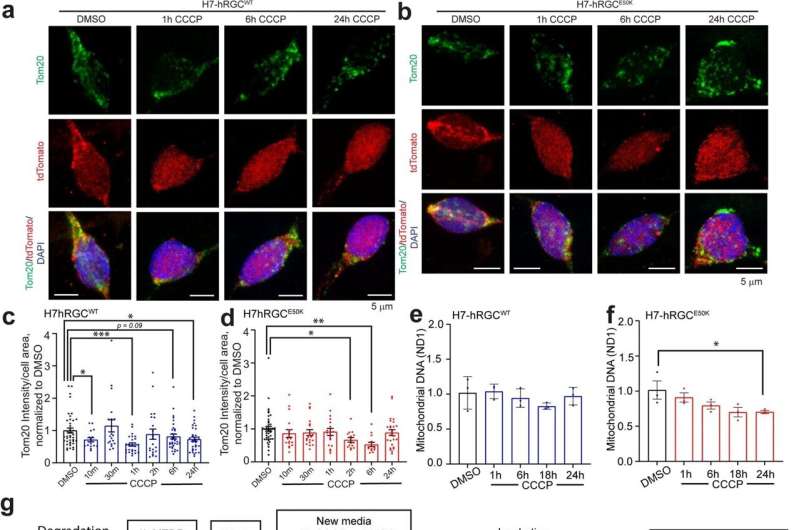
hRGCs maintain mitochondrial mass by simultaneous degradation and biogenesis of mitochondria under damage. a, b Representative confocal immunofluorescence images of H7-hRGCs against mitochondrial Tom20, tdTomato, and DAPI after indicated 10 μM CCCP treatment timepoints. Scale bars are 5 μm. c, d Quantification of Tom20 intensity per cell area from sum projections of confocal z-stacks, normalized to corresponding DMSO. n = 14–42 cells per condition. e, f Mitochondrial DNA copy number analyzed by qPCR for mitochondrial ND1 gene relative to nuclear RNase P. Results shown as ΔΔCt fold changes relative to DMSO control for different times points of 10 μM CCCP treatment. n = 3, 3 technical repeats averaged for each biological repeat. g Schematic of MTDR flow experiments for tracking degrading versus newly synthesized mitochondria. h Mitochondrial mass in single cells at different CCCP (10 μM) treatment time points for degradation or m different timepoints post CCCP (10 μM) wash for biogenesis were measured by flow cytometer, and the average fluorescence intensity normalized to DMSO was plotted. n = 3. i, k Representative western blot images of LC3B and actin from i hRGCWT and k hRGCE50K treated with CCCP (10 μM) for the indicated timepoints. j, l Quantification of the ratio of LC3B-II to corresponding LC3B-I for each condition. n = 3. ٭p-value < 0.05, ٭٭p-value < 0.01, ٭٭٭p-value < 0.001, ٭٭٭٭p-value < 0.0001. Unpaired student’s t-test between independent datasets. Error bars are SEM. Credit: Communications Biology (2023). DOI: 10.1038/s42003-023-04576-w

Indiana University School of Medicine researchers have identified a new therapeutic target that could lead to more effective treatment of glaucoma.

Glaucoma is a neurodegenerative disease that causes vision loss and blindness due to a damaged optic nerve. More than 200,000 people are affected by glaucoma in the United States each year. Unfortunately, there is currently no treatment. In a newly published paper in Communications Biology, researchers found neurons use mitochondria for a steady source of energy, and restoring mitochondrial homeostasis in the diseased neurons can protect the optic nerve cells from being damaged.

“Age-related neurodegenerative disease, which includes glaucoma, Parkinson’s disease, and amyotrophic lateral sclerosis (ALS), is the biggest global health problem,” said Arupratan Das, Ph.D., assistant professor of ophthalmology and principal investigator of the study.

“The fundamental mechanisms that we discovered can be used to protect neurons in glaucoma and be tested for the other diseases. We have identified a critical step of complex mitochondrial homeostasis process, which rejuvenates the dying neuron, similar to giving a lifeline to a dying person.”

The research team, led by Michelle Surma and Kavitha Anbarasu from the Department of Ophthalmology, used induced pluripotent stem cells (iPSCs) from patients with and without glaucoma as well as clustered regularly interspaced short palindromic repeats (CRISPR) engineered human embryonic stem cells with glaucoma mutation.

Using stem cell differentiated retinal ganglion cells (hRGCs) of the optic nerve, electron microscopy and metabolic analysis, researchers identified glaucomatous retinal ganglion cells suffer mitochondrial deficiency with more metabolic burden on each mitochondrion. This leads to mitochondrial damage and degeneration. Mitochondria are the tube like structures in cells which produce adenosine triphosphate, cell’s energy source.

However, the process could be reversed by enhancing mitochondrial biogenesis by a pharmacological agent. The team showed retinal ganglion cells are highly efficient in degrading bad mitochondria, but at the same time producing more to maintain homeostasis.

“Finding that retinal ganglion cells with glaucoma produce more adenosine triphosphate even with less mitochondria was astonishing,” Das said. “However, when triggered to produce more mitochondria, the adenosine triphosphate production load was distributed among more mitochondrion which restored the organelle physiology. It is similar to a situation where a heavy stone is carried by fewer people versus a greater number of people—each person will have less pain and injury, just like each mitochondrion will have less difficulty and damage.”

In the future, Das would like to test if these mechanisms protect the optic nerve in animal models under injury before testing in humans to hopefully lead to new clinical interventions.

More information:
Michelle Surma et al, Enhanced mitochondrial biogenesis promotes neuroprotection in human pluripotent stem cell derived retinal ganglion cells, Communications Biology (2023). DOI: 10.1038/s42003-023-04576-w

Provided by
Indiana University School of Medicine


Citation:
Researchers discover therapeutic target to aid in glaucoma treatment (2023, March 10)
retrieved 11 March 2023
from https://medicalxpress.com/news/2023-03-therapeutic-aid-glaucoma-treatment.html

This document is subject to copyright. Apart from any fair dealing for the purpose of private study or research, no
part may be reproduced without the written permission. The content is provided for information purposes only.

Yale researchers discover loophole in FDA medical device regulation

Scientists at the Yale College of Medication and Harvard Professional medical University located that a loophole in current regulation has permitted suppliers to acquire U.S. Food and Drug Administration acceptance for unsafe healthcare units.


Stephanie Hu

1:50 am, Jan 26, 2023


Yale researchers discover loophole in FDA medical device regulation

U.S. Food items and Drug Administration

A recent examine led by scientists at the Yale University of Medicine and Harvard Medical Faculty located that a loophole in present regulation has permitted makers to receive U.S. Foods and Drug Administration acceptance for unsafe professional medical devices. 

This get the job done was led by Kushal Kadakia, very first writer and M.D. prospect at Harvard Clinical School, and Harlan Krumholz ’80, senior creator, Harold H. Hines, Jr. Professor of Medicine and director of the Heart for Results Research and Analysis. Their study located empirical evidence that professional medical gadgets approved primarily based on a formerly-recalled product through the 510(k) regulatory pathway were noticeably much more probably to be topic to a Class I Remember, the FDA’s most extreme designation for recollects.

“The 510(k) pathway does not have to have healthcare units to endure new testing as very long as they can present they are substantially connected to previous permitted units, regarded as predicates,” Kadakia mentioned.

This pathway expedites the acceptance of medical gadgets that may perhaps only have small changes from previously permitted iterations and are getting applied for the very same intent. In point, more than 95 p.c of new products are cleared by the Fda via this pathway.

But thanks to a loophole in the regulation, the predicates by themselves may possibly not really be protected for human use. 

“The way the law is prepared, if the Fda pulled it off the sector, it just can’t be made use of as a predicate, but if the company pulled it off the market, you retain the ability to reintroduce a new one that is substantially equal and still be utilised for that unsafe goal,” Krumholz claimed. 

The study centered on health care units that were being subject to a Course I Remember. This type of recall is issued when a health-related device has a realistic probability of creating extreme adverse well being consequences up to and together with demise.

Former studies had furnished circumstance experiments demonstrating damage brought about by products accepted using recalled predicates. Kadakia labored on two these scientific tests of a catheter and rest apnea device that had been later subject to Class I Remembers. This new examine is special, having said that, in its scope.

“We were being equipped to go throughout various years and identify all the equipment that had these remembers, as a substitute of picking out a single or two,” Krumholz reported. “We have been capable to appear at a extensive group and give a much more representative look at.” 

This tactic was designed possible by modern improvements in device discovering and details science. Since the FDA’s database only has conclusion letters, which listing the reasoning powering an authorization, it can be tough to figure out what devices have been authorized utilizing a certain machine as a predicate. With no the use of new computational tools, it would have been time-consuming to map the lineages of healthcare devices. On the other hand, the researchers were ready to build these lineages in partnership with an AI business and then manually verify the AI database’s outcomes.

The researchers identified a 6.4 situations maximize in recall fees for healthcare equipment permitted making use of recalled predicates when in comparison to non-recalled predicates. Supplied that each unit can have tens of hundreds of units and are applied all through the health care process, these recollects can have widespread consequences.

The Security of Untested and New Devices Act of 2012 was a prior try to rectify this difficulty, but failed to secure adequate votes. The researchers hope this novel analyze may reinvigorate the United States Congress to at the very least start off dialogue of the 510(k) pathway once more.

“The recalled predicate loophole is not an mysterious amount in Washington,” Kadakia reported. “We have now delivered empirical proof in a systematic way of how this loophole is becoming made use of to induce hurt.” 

The research authors also acknowledge that far more do the job can be accomplished working with these new computational methods. 

“We constrained it to a a single generation evaluation, but it would be exciting to glance at the small children of youngsters of recalled predicates and so on,” claimed César Caraballo, a postdoctoral affiliate at Yale Faculty of Medication. 

Krumholz hopes that extra evidence would reinforce Congress’s capability to enact wise and empirically audio legislation. This is in particular significant as health-related gadgets acquire far much less investigation interest than medication since they are embedded all through the health-related system instead of at the point of treatment, Kadakia spelled out. 

“If we had been ready to add exceptional device identifiers to declare forms, we could quantify the amount of money of spending that was licensed through the predicate recall loophole,” Kadakia claimed. “We could also figure out if the explanations for the new remembers and the recalls of the predicates are very similar.”

In the fiscal year 2022, 149 health care device solutions had been subject to Class I recalls.

Harvard Medical Researchers Discover Surprising Protective Properties of Pain

Harvard Medical Researchers Discover Surprising Protective Properties of Pain

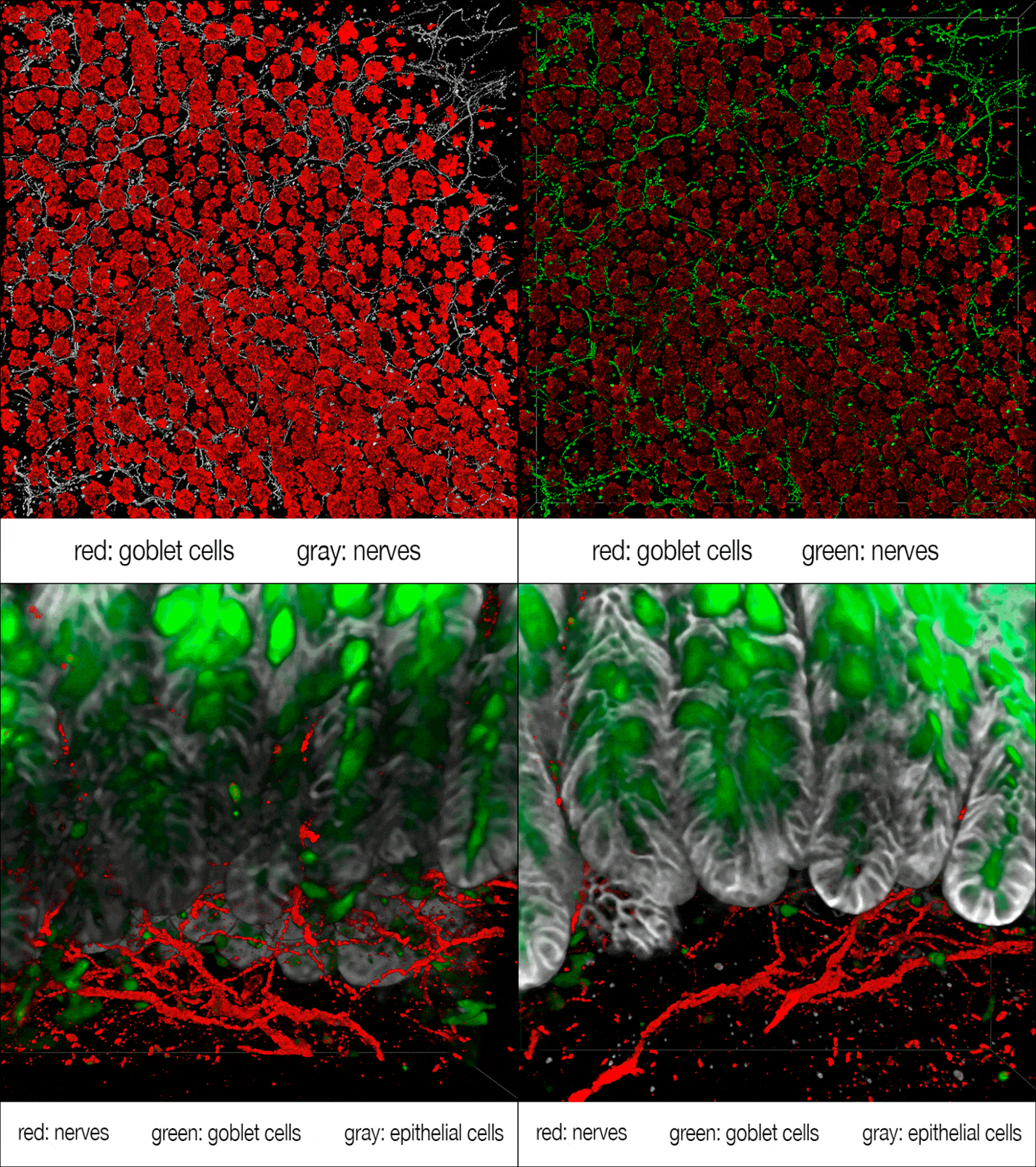
Harvard Medical School researchers have analyzed the molecular crosstalk among discomfort fibers in the gut and goblet cells that line the walls of the intestine. The operate exhibits that chemical signals from ache neurons induce goblet cells to launch protecting mucus that coats the intestine and shields it from damage. The results demonstrate that intestinal discomfort is not a mere detection-and-signaling process, but plays a direct protecting position in the intestine. Credit: Chiu Lab/Harvard Health care University

What if suffering is extra than just a mere alarm bell?

New analysis in mice illuminates how suffering neurons protect the gut from injury.

Discomfort is a single of evolution’s most productive mechanisms for detecting injuries and letting us know that one thing is improper. It acts as a warning procedure, telling us to cease and shell out consideration to our physique.

But what if suffering is additional than just a mere alarm sign? What if ache is in alone a sort of security?

A new review led by scientists at Harvard Healthcare School suggests that may possibly properly be the situation in mice.

The astonishing study reveals that ache neurons in the mouse gut regulate the existence of protective mucus beneath typical disorders and promote intestinal cells to launch more mucus throughout states of swelling. The review was posted on Oct 14 in the journal Mobile.

The operate describes the steps of a elaborate signaling cascade, demonstrating that pain neurons have interaction in immediate crosstalk with mucus-made up of gut cells, regarded as goblet cells.

Goblet cells occur from pluripotent stem cells and get their identify from their cup-like overall look that resembles a goblet. Their principal function is to secrete mucin and create a protecting mucus layer. Goblet cells are also considered to have a part in the regulation of the immune process.


“It turns out that soreness may possibly secure us in more direct strategies than its traditional occupation to detect probable hurt and dispatch alerts to the brain. Our perform displays how agony-mediating nerves in the gut talk to nearby epithelial cells that line the intestines,” stated research senior investigator Isaac Chiu. “This means that the anxious program has a key job in the gut over and above just providing us an uncomfortable sensation and that it’s a important participant in gut barrier maintenance and a protective mechanism all through swelling.” Chiu is an associate professor of immunobiology in the Blavatnik Institute at HMS. 

A immediate dialogue

Our intestines and airways are studded with goblet cells. Named for their cup-like overall look, goblet cells contain gel-like mucus created of proteins and sugars that functions as protecting coating that shields the floor of organs from abrasion and destruction. The new investigate found that intestinal goblet cells release protecting mucus when triggered by direct conversation with soreness-sensing neurons in the gut.

In a set of experiments, the scientists observed that mice missing ache neurons made a lot less protective mucus and experienced variations in their intestinal microbial composition — an imbalance in helpful and harmful microbes regarded as dysbiosis.

To explain just how this protective crosstalk happens, the experts analyzed the behavior of goblet cells in the presence and in the absence of soreness neurons.

They observed that the surfaces of goblet cells have a style of receptor, identified as RAMP1, that ensures the cells can reply to adjacent discomfort neurons, which are activated by dietary and microbial alerts, as effectively as mechanical pressure, chemical irritation or drastic changes in temperature.

The experiments further more showed that these receptors hook up with a chemical termed CGRP, released by nearby soreness neurons, when the neurons are stimulated. These RAMP1 receptors, the scientists discovered, are also existing in each human and mouse goblet cells, thus rendering them responsive to suffering indicators.

Experiments even further confirmed that the presence of particular gut microbes activated the launch of CGRP to maintain gut homeostasis.

“This getting tells us that these nerves are triggered not only by acute inflammation, but also at baseline,” Chiu explained. “Just owning common intestine microbes close to appears to tickle the nerves and results in the goblet cells to release mucus.”

This responses loop, Chiu reported, guarantees that microbes signal to neurons, neurons control the mucus, and the mucus retains gut microbes balanced.

In addition to microbial presence, nutritional things also played a position in activating suffering receptors, the review confirmed. When scientists gave mice capsaicin, the major ingredient in chili peppers recognised for its ability to bring about powerful, acute suffering, the mice’s soreness neurons bought swiftly activated, creating goblet cells to release plentiful quantities of protecting mucus.

By distinction, mice lacking possibly soreness neurons or goblet cell receptors for CGRP had been far more vulnerable to colitis, a form of intestine irritation. The finding could reveal why people today with intestine dysbiosis may possibly be more inclined to colitis.

When scientists gave suffering-signaling CGRP to animals missing pain neurons, the mice professional speedy advancement in mucus manufacturing. The remedy protected mice versus colitis even in the absence of soreness neurons.

The locating demonstrates that CGRP is a critical instigator of the signaling cascade that potential customers to the secretion of protective mucus.

“Pain is a widespread symptom of long-term inflammatory problems of the gut, these types of as colitis, but our study shows that acute pain performs a immediate protecting part as properly,” said review to start with author Daping Yang, a postdoctoral researcher in the Chiu Lab.

A achievable downside to suppressing suffering

The team’s experiments confirmed that mice lacking discomfort receptors also had even worse injury from colitis when it happened.

Specified that pain medicines are normally employed to address individuals with colitis, it may perhaps be essential to take into consideration the feasible detrimental repercussions of blocking suffering, the scientists explained.

“In persons with swelling of the intestine, 1 of the big indicators is discomfort, so you could assume that we’d want to address and block the ache to alleviate suffering,” Chiu mentioned. “But some part of this agony signal could be specifically protective as a neural reflex, which raises essential issues about how to diligently manage soreness in a way that does not lead to other harms.”

In addition, a course of frequent migraine medications that suppress the secretion of CGRP may possibly destruction gut barrier tissues by interfering with this protecting suffering signaling, the researchers mentioned.

“Given that CGRP is a mediator of goblet mobile function and mucus generation, if we are chronically blocking this protective system in people today with migraine and if they are taking these medicines extended-phrase, what takes place?” Chiu reported. “Are the medication heading to interfere with the mucosal lining and people’s microbiomes?”

Goblet cells have many other features in the gut. They give a passage for antigens — proteins found on viruses and bacteria that initiate a protective immune reaction by the overall body — and they develop antimicrobial chemical compounds that guard the gut from pathogens.

“One query that arises from our existing perform is whether soreness fibers also regulate these other capabilities of goblet cells,” Yang mentioned.

An additional line of inquiry, Yang added, would be to explore disruptions in the CGRP signaling pathway and establish whether malfunctions are at enjoy in patients with genetic predisposition to inflammatory bowel disease.

Reference: “Nociceptor neurons immediate goblet cells by using a CGRP-RAMP1 axis to generate mucus creation and gut barrier protection” by Daping Yang, Amanda Jacobson, Kimberly A. Meerschaert, Joseph Pleasure Sifakis, Meng Wu, Xi Chen, Tiandi Yang, Youlian Zhou, Praju Vikas Anekal, Rachel A. Rucker, Deepika Sharma, Alexandra Sontheimer-Phelps, Glendon S. Wu, Liwen Deng, Michael D. Anderson, Samantha Choi, Dylan Neel, Nicole Lee, Dennis L. Kasper, Bana Jabri, Jun R. Huh, Malin Johansson, Jay R. Thiagarajah, Samantha J. Riesenfeld and Isaac M. Chiu, 14 Oct 2022, Cell.
DOI: 10.1016/j.cell.2022.09.024

Co-authors bundled Amanda Jacobson, Kimberly Meerschaert, Joseph Sifakis, Meng Wu, Xi Chen, Tiandi Yang, Youlian Zhou, Praju Vikas Anekal, Rachel Rucker, Deepika Sharma, Alexandra Sontheimer-Phelps, Glendon Wu, Liwen Deng, Michael Anderson, Samantha Choi, Dylan Neel, Nicole Lee, Dennis Kasper, Bana Jabri, Jun Huh, Malin Johansson, Jay Thiagarajah, and Samantha Riesenfeld.

The work was supported by the Countrywide Institutes of Overall health (grants R01DK127257, R35GM142683, P30DK034854, and T32DK007447) the Food items Allergy Science Initiative the Kenneth Rainin Basis and the Digestive Illnesses Investigation Main Centre beneath grant P30 DK42086 at the