WHO highlights oral health neglect affecting nearly half of the world’s population

A new Global Oral Health Status Report published today by the World Health Organization (WHO) provides the first-ever comprehensive picture of oral disease burden with data profiles for 194 countries, giving unique insights into key areas and markers of oral health that are relevant for decision-makers.

The report shows that almost half of the world’s population (45{bf0515afdcaddba073662ceb89fbb62b6b1bf123143c0e06b788e1946e8c353f} or 3.5 billion people) suffer from oral diseases, with 3 out of every 4 affected people living in low- and middle-income countries. Global cases of oral diseases have increased by 1 billion over the last 30 years—a clear indication that many people do not have access to prevention and treatment of oral diseases.

“Oral health has long been neglected in global health, but many oral diseases can be prevented and treated with the cost-effective measures outlined in this report,” said WHO Director-General, Dr Tedros Adhanom Ghebreyesus. “WHO is committed to providing guidance and support to countries so that all people, wherever they live and whatever their income, have the knowledge and tools needed to look after their teeth and mouths, and to access services for prevention and care when they need them.”

Rapid increase of oral diseases

The most common oral diseases are dental caries (tooth decay), severe gum disease, tooth loss and oral cancers.  Untreated dental caries is the single most common condition globally, affecting an estimated 2.5 billion people. Severe gum disease  ̶  a major cause of total tooth loss  ̶  is estimated to affect 1 billion people worldwide.  About 380 000 new cases of oral cancers are diagnosed every year.

The report underscores the glaring inequalities in access to oral health services, with a huge burden of oral diseases and conditions affecting the most vulnerable and disadvantaged populations. People on low incomes, people living with disabilities, older people living alone or in care homes, those living in remote and rural communities and people from minority groups carry a higher burden of oral diseases.

This pattern of inequalities is similar to other noncommunicable diseases such as cancers, cardiovascular diseases, diabetes, and mental disorders. Risk factors common to noncommunicable diseases such as high sugar intake, all forms of tobacco use, and harmful use of alcohol all contribute to the global oral health crisis.

Barriers to delivering oral health services

Only a small percentage of the global population is covered by essential oral health services, and those with the greatest need often have the least access to services. The key barriers to delivering access to oral health services for all include:

  1. Oral health care requires high out-of-pocket expenditures. This often leads to catastrophic costs and significant financial burden for families and communities.
  2. The provision of oral health services largely relies on highly specialized providers using expensive high-tech equipment and materials, and these services are not well integrated with primary health care models.
  3. Poor information and surveillance systems, combined with low priority for public oral health research are major bottlenecks to developing more effective oral health interventions and policies.

Opportunities to improve global oral health

The report showcases many promising opportunities to improve the state of global oral health including:

  • adopting a public health approach by addressing common risk factors through promoting a well-balanced diet low in sugars, stopping use of all forms of tobacco, reducing alcohol consumption and improving access to effective and affordable fluoride toothpaste.
  • planning oral health services as part of national health and improving integration of oral health services in primary health care as part of universal health coverage.
  • redefining oral health workforce models to respond to population needs and expanding competencies of non-dental healthcare workers to expand oral health service coverage; and
  • strengthening information systems by collecting and integrating oral health data into national health monitoring systems.

“Placing people at the heart of oral health services is critical if we are to achieve the vision of universal health coverage for all individuals and communities by 2030,” said Dr Bente Mikkelsen, WHO Director for Noncommunicable Diseases.

She added: “This report acts as a starting point by providing baseline information to help countries monitor progress of implementation, while also providing timely and relevant feedback to decision-makers at the national level. Together, we can change the current situation of oral health neglect.”


Note to editors

To watch the launch event on Friday, 18 November from 14.00 – 15:30 CET, please register at  https://who.zoom.us/webinar/register/WN_hDqiDjW9TBm4fSVljj3zQw.

The Global Oral Health Status Report uses the latest available data from the Global Burden of Disease (GBD) project, the International Agency for Research on Cancer (IARC) and global WHO surveys. The report is directed at policymakers, practitioners, researchers, development agencies and members of the private sector and civil society. 

In 2022, the World Health Assembly adopted a global strategy on oral health with a vision of universal health coverage for oral health for all individuals and communities by 2030. A detailed action plan is under development to help countries translate the global strategy into practice. This includes a monitoring framework for tracking progress, with measurable targets to be achieved by 2030.
Why did a rural Nevada county turn down money to create a public health department?

ELKO, Nev. — When Elko County commissioners rejected a $500,000 grant from the Centers for Disease Control and Prevention that could have helped the county create a health department or health district, Kayla Hopkins pleaded with them to reconsider.

Hopkins, who has lived for nearly nine years in the sprawling rural county that forms the northeastern corner of Nevada, told the board how she struggled through postpartum depression and needed mental health resources.

“I was unable to get the help that I needed,” Hopkins said during a public meeting in late 2021, adding that she fell into what could be considered a mental breakdown. She said she was sent by air ambulance more than 300 miles away to Carson City, where she received care in a psychiatric facility for 10 days.

“I was away from my family,” Hopkins said. “I was away from my support system here, and I still struggle with mental health, and I still cannot get the help that I need because we just don’t have it here.”

Pleas from Hopkins and others weren’t enough to sway the elected commissioners. Neither were 11 letters from local health leaders urging the board to take the infusion of public health funding. Four of the county’s five commissioners, citing concerns about government overreach and their lack of trust in federal agencies, voted against pursuing the grant. Nearly a year later, as the pandemic grinds toward a third year and with the arrival of monkeypox, the county still is without a public health department to respond.

And the same mistrust of agencies administering grants for public health persists elsewhere.

Elko County, home to about 54,000 people, wasn’t alone in rejecting federal aid aimed at bolstering public health in the past year. Experts say they were surprised and concerned to see the rare local or state leader, swayed by political partisanship, dismiss funding opportunities for historically limited public health systems.

As many conservative leaders and their constituents railed against measures meant to combat Covid — things like masking policies and promoting vaccines — the pandemic revealed long-standing fissures in the country’s public health infrastructure, particularly in rural and underserved communities.

“Partisan politics has poisoned the well to a point that we’re willing to sacrifice the health of our citizens,” said Brian Castrucci, president and CEO of the de Beaumont Foundation, a national nonprofit that advocates for public health policy. “Is the political grandstanding worth it?”

Over the past two years, officials in Idaho, Iowa, and New Hampshire rejected Covid relief money, their decisions often accompanied by political pronouncements about federal government overreach. And officials representing local governments across the country, including Cochise and Pinal counties in Arizona, echoed those moves. A survey of local governments in 15 states conducted by the National League of Cities found more than 200 small governments declined pandemic relief funds, a small percentage of the money available to small governments.

Elko commissioners turned down a workforce grant funded by the CDC, money intended to “establish, expand, and sustain a public health workforce, including school nurses.” The funding would have flowed through the state to the county, allowing it to hire two employees dedicated to public health services for two years.

County workers in charge of researching the grant and pitching it to the board said the idea was to conduct a study in those two years that would help them determine how much it would cost to create a local health department or a health district, involving neighboring counties.

Elko County has not had a public health department since budget woes pushed officials to dissolve it more than 15 years ago.

Adriane Casalotti, chief of government and public affairs for the National Association of County and City Health Officials, said communities across the country have generally clamored for increased funding during the pandemic, which strained already underfunded and understaffed public health infrastructure.

“That being said,” Casalotti said, “in recent months, I’d say, we’ve heard of a handful of health departments that either would not apply for or couldn’t accept … specific grants,” involving Covid vaccines.

At an Elko County commission meeting in late 2021, then-transit management coordinator Abigail Wheeler pitched the grant to the board and a roomful of residents eager to air their grievances about the CDC and levy claims of federal government overreach, overspending, and corruption regarding the pandemic response.

Wheeler began by asking county commissioners to keep an open mind.

Why did a rural Nevada county turn down money to create a public health department?
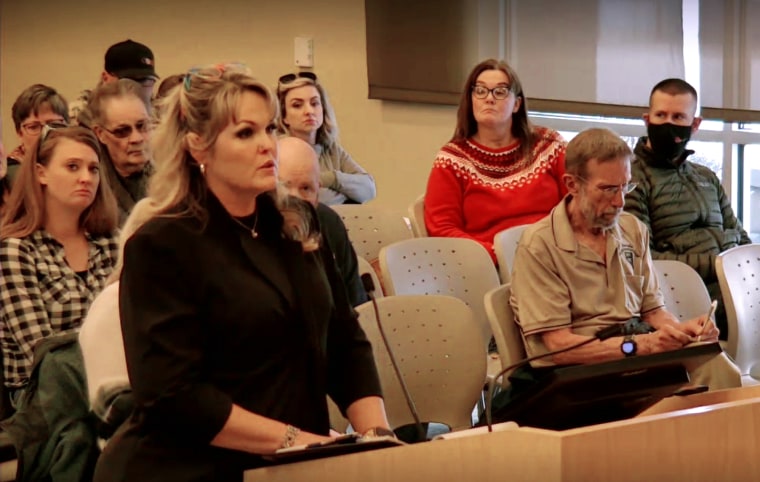
Abigail Wheeler presented a grant from the Centers for Disease Control and Prevention to the Elko County, Nev., commission last year, telling it the funding could help the town create a health department or district and give Elko more local control over public health. The commission disagreed.Elko County via Kaiser Health News

“I am very aware that this is basically the worst timing that this grant could come forward because there’s a lot of distaste over public health because of what’s happened with Covid and our whole community, our whole country, and worldwide,” she said. “We have been beat to death, the fallout of the Covid pandemic.”

Wheeler, now the grants and contracts manager for the county, began by reminding the commissioners that creating a local health department or district was a goal that predated the pandemic and the polarization it triggered.

A 2019 meeting with the state Department of Health and Human Services underscored the need for more local public health infrastructure.

“They’re thinking about things like tuberculosis and measles and restaurant inspections,” Wheeler said. “They’re not thinking about Covid. And they’re saying to themselves, ‘We can’t get to you if you had a TB case. We’re 370 miles away from Elko County.’”

Elko is like a landlocked island, Wheeler said during an interview with KHN. Though smaller in population compared with Clark or Washoe counties in Nevada, Elko spans more than 17,000 square miles, making it the fourth-largest county by area in the contiguous U.S. and the second-largest in Nevada.

“We have to be our own cavalry,” Wheeler said.

Commissioners and community members who opposed the grant said Elko didn’t need more public health resources or a health district or department. They said they were concerned about giving up local autonomy and growing bureaucracy. They also expressed mistrust of the CDC.

“You’re 100{bf0515afdcaddba073662ceb89fbb62b6b1bf123143c0e06b788e1946e8c353f} factual that the timing couldn’t be worse,” said Jon Karr, then the chairman of the commission, during the meeting. Although he said he did not buy into all the conspiracy theories about the CDC that others touted, he added that he did not think CDC officials should be trusted.

Commissioner Rex Steninger said he voted against the grant because he feared the commission would be “subservient” to the new entity. “Grants always have strings attached,” he wrote in an emailed response to questions from KHN. “We do not want the CDC tenacles [sic] reaching in to Elko County.”

Wheeler pointed to the fractured local public health system during the meeting, saying creating a health district or department could help reduce bureaucracy and give the county more control over decisions in state officials’ hands. She said it’s evident the county needs more resources, citing public health response duties she took on in her position as transit manager.

“We’re not public health experts, we’re just people who are willing to step up to the plate and take this on,” Wheeler said, referring to other county employees who helped with the public health response to Covid.

Wheeler was disappointed the county board turned down the grant opportunity, she told KHN in October. She said she would still like to see public health become a function of the county someday.

Since speaking at the meeting nearly a year ago, Hopkins said she found the mental health services she needed locally. But not everyone is as lucky as she is to find the help they need close to home, she said. The county’s decision to reject the CDC grant makes her sad, she said, but she accepts it was the commission’s decision to make.

Other local leaders saw the need for increased public health resources amid the pandemic. The Elko City Council wrote a letter of support for the CDC grant the day before the commission rejected it. “We know for sure it’s not something that the city wants to tackle by ourselves,” said Curtis Calder, city manager. “But if our regional partners want to do it as a partnership, we stand at the ready to assist where we can.”

Other rural Nevada counties have collaborated with the University of Nevada-Reno School of Medicine to create the Central Nevada Health District, serving four counties and a small city near Reno. “If we won’t step up and help ourselves and our constituents, we can’t complain when the State doesn’t provide what we need or expect,” wrote Dr. J.J. Goicoechea, a commissioner in neighboring Eureka County and the interim state veterinarian, in an emailed response to KHN.

Casalotti said there are advantages to having local health departments staffed and run by people who live in the community as opposed to a state government hundreds of miles away.

“One of the things that we’re hopeful that people can learn from the pandemic is that you don’t want to have to build the plane while flying it,” she said. “At some point, you need to take the leap because the next crisis is just around the corner.”

But polarization remains an obstacle, Castrucci said.

“This has become a holy war, this has become a war of right and wrong,” he said. “I don’t know how to get through that to a place where we are prioritizing the health of our nation.”

KHN (Kaiser Health News) is a national newsroom that produces in-depth journalism about health issues. Together with Policy Analysis and Polling, KHN is one of the three major operating programs at KFF (Kaiser Family Foundation). KFF is an endowed nonprofit organization providing information on health issues to the nation.

Follow NBC HEALTH on Twitter & Facebook.

Fairview, Sanford health care systems plan to merge

Updated: 6:15 p.m.

Nearly a decade after unsuccessfully attempting a merger, South Dakota-based Sanford Health and Minnesota’s Fairview Health Services said Tuesday they’re again in talks to combine.

The two regional health care giants say they intend to complete a merger next year. The new entity would be called Sanford Health and be run by Sanford’s current CEO. The deal would include the University of Minnesota hospitals, which Fairview purchased in 1997.

“The synergies between the two organizations are going to allow us to marshal the collective resources of both organizations together to better serve our patients and help us deliver on a promise of world-class care to every single patient,” said Sanford Health President and CEO Bill Gassen in an interview with MPR News.

Financial details and any cost-cutting plans tied to the proposed merger were not immediately disclosed.

In 2013, the two health systems pursued a similar merger, but talks broke down amid an onslaught of public criticism. Some state lawmakers pursued legislation that would’ve blocked Sanford from controlling the University of Minnesota hospitals.

Then-Attorney General Lori Swanson raised concerns about a merger because of the role that tax breaks and donations from Minnesota and Minnesotans played in Fairview’s development.

Before you keep reading, take a moment to donate to MPR News. Your financial support ensures that factual and trusted news and context remain accessible to all.

Current Minnesota Attorney General Keith Ellison said late Tuesday his office is investigating the proposed transaction.

If approved this time around, the deal would create a massive health care system stretching across the rural and urban Upper Midwest.

Sioux Falls-based Sanford operates in six states, including Minnesota, and describes itself as the nation’s largest rural health care system, including 47 medical centers and about 45,000 employees.

“Because they’re contiguous, it allows us to be able to coordinate care back and forth,” said Fairview CEO James Hereford. “But frankly, any issues about anti-competitiveness, there’s just no basis for that.”

Sanford Health is named for St. Paul native and University of Minnesota graduate T. Denny Sanford, a philanthropist who made his fortune in the subprime, high-interest credit card business. The Sioux Valley Hospital and Health System was renamed Sanford Health in 2007 after Sanford donated $400 million to the Sioux Falls-based care system.

Minneapolis-based Fairview has 11 hospitals, including the University of Minnesota Medical Center, and about 31,000 employees.

Fairview has been struggling financially for several years. It reported an operating loss in 2021 of $132.6 million on top of a $209 million loss in 2020. In financial statements, the system has pointed to the COVID-19 crisis as contributing to its financial woes, driving up operating costs while driving down the number of nonelective procedures.

Ownership and control of the U’s medical center — the state’s top teaching hospital — is likely to be an issue closely examined by Minnesota lawmakers as it was in 2013. The center would no longer be Minnesota owned.

The University of Minnesota is still weighing the merger possibilities and has questions about the commitment to medical training and research, said Myron Frans, the U’s senior vice president for finance and operations and a former Minnesota budget commissioner.

“We’ve been talking to them, but we have many, many really hard and reasonable questions to ask about how would this merger affect the University of Minnesota,” he told MPR News. “Anything beyond that is still … a source of conjecture on our part.”

The Minnesota Nurses Association late Tuesday said its members will “strongly oppose” the proposed merger because it would “put corporate expansion ahead of patient care.”

MPR News reporters Matt Sepic and Tim Nelson contributed to this report.

Poll: Many Americans Don’t Believe Systemic Racism Exists | Healthiest Communities Health News

In spite of the disproportionate toll the COVID-19 pandemic and its financial fallout have experienced on communities of colour, more than 40{bf0515afdcaddba073662ceb89fbb62b6b1bf123143c0e06b788e1946e8c353f} of People in america are unconvinced that systemic racism exists in the U.S., according to new study results from U.S. News & Entire world Report and The Harris Poll.

Amongst countless numbers of individuals surveyed, almost a quarter documented they did not believe there is systemic racism in The usa, though yet another 17{bf0515afdcaddba073662ceb89fbb62b6b1bf123143c0e06b788e1946e8c353f} stated they have been not sure. At 47{bf0515afdcaddba073662ceb89fbb62b6b1bf123143c0e06b788e1946e8c353f}, almost 50 {bf0515afdcaddba073662ceb89fbb62b6b1bf123143c0e06b788e1946e8c353f} of white Us citizens remained unconvinced, even though persons of color have been much far more possible to affirm that systemic racism exists in the region. Additional than 80{bf0515afdcaddba073662ceb89fbb62b6b1bf123143c0e06b788e1946e8c353f} of Black or African American respondents consider it does, as nicely as a lot more than 70{bf0515afdcaddba073662ceb89fbb62b6b1bf123143c0e06b788e1946e8c353f} of Asian or Pacific Islander respondents and almost 70{bf0515afdcaddba073662ceb89fbb62b6b1bf123143c0e06b788e1946e8c353f} of Hispanics.

The study was conducted on the web inside of the U.S. by The Harris Poll from Oct. 21 to Oct. 30 amongst a nationally representative sample of 4,085 U.S. grownups, with a margin of mistake of ±1.91{bf0515afdcaddba073662ceb89fbb62b6b1bf123143c0e06b788e1946e8c353f}. Its results occur as the country proceeds to grapple with racial and ethnic disparities in foundational parts like work, poverty, housing and well being treatment, and amid a world pandemic that authorities believe that has strike minority communities more durable in huge aspect owing to systemic inequities in individuals very same kinds of spots.

“The stark disparity of the COVID-19 pandemic and the uprising in response to the murder of George Floyd undeniably exposed the racial inequities in the nation’s economic, wellness treatment, and legal justice systems and establishments, and ignited a crystal clear need for racial justice,” claims Marc Morial, president and CEO of civil legal rights organization the National City League.

Even as a the greater part of People imagine systemic racism exists in the country, the U.S. Information/Harris Poll survey outcomes mirror differences in viewpoint among racial and ethnic groups pertaining to its function in generating disparities and the want for it to be tackled. Between Black or African American respondents, for instance, 80{bf0515afdcaddba073662ceb89fbb62b6b1bf123143c0e06b788e1946e8c353f} strongly or relatively agree that systemic racism is responsible for disparities in regions this kind of as well being and funds, compared with just 62{bf0515afdcaddba073662ceb89fbb62b6b1bf123143c0e06b788e1946e8c353f} of whites. Overall, 66{bf0515afdcaddba073662ceb89fbb62b6b1bf123143c0e06b788e1946e8c353f} of respondents strongly or fairly agree that systemic racism is dependable for such challenges.

Half of Black or African American respondents surveyed also claimed that they “strongly agree” it’s crucial for modern society to handle the impacts of discriminatory practices, this sort of as redlining or voter suppression, that disadvantage some People. That compares with 36{bf0515afdcaddba073662ceb89fbb62b6b1bf123143c0e06b788e1946e8c353f} of whites and 37{bf0515afdcaddba073662ceb89fbb62b6b1bf123143c0e06b788e1946e8c353f} of respondents all round.

Diversified sights also have been apparent on study questions concerning economic and place of work disparities. In accordance to a 2021 report by consulting agency McKinsey & Co., the median yearly wage for Black staff is approximately 30{bf0515afdcaddba073662ceb89fbb62b6b1bf123143c0e06b788e1946e8c353f} lessen – or about $10,000 significantly less – than the wage for white staff, with occupational disparities in Black illustration and shell out primary to an yearly wage hole of all around $220 billion.

Yet even though two-thirds of respondents to the U.S. News/Harris Poll survey disagreed strongly or rather with the idea that wage gaps are not a issue in the U.S., Black respondents at 43{bf0515afdcaddba073662ceb89fbb62b6b1bf123143c0e06b788e1946e8c353f} had been more likely to strongly disagree, compared with 32{bf0515afdcaddba073662ceb89fbb62b6b1bf123143c0e06b788e1946e8c353f} of whites and the same or similar shares of Asians or Pacific Islanders and Hispanics.

Likewise, even though 64{bf0515afdcaddba073662ceb89fbb62b6b1bf123143c0e06b788e1946e8c353f} of all adults surveyed disagreed with the assertion that “workplace discrimination is not a trouble in the U.S.,” 43{bf0515afdcaddba073662ceb89fbb62b6b1bf123143c0e06b788e1946e8c353f} of Black respondents strongly disagreed, when compared with just 27{bf0515afdcaddba073662ceb89fbb62b6b1bf123143c0e06b788e1946e8c353f} of whites, 29{bf0515afdcaddba073662ceb89fbb62b6b1bf123143c0e06b788e1946e8c353f} of Hispanics and 34{bf0515afdcaddba073662ceb89fbb62b6b1bf123143c0e06b788e1946e8c353f} of Asians or Pacific Islanders.

In the meantime, only about 1-fifth to one-quarter of respondents total noted they assumed corporations experienced place in a “very fantastic effort” around the earlier two a long time to progress racial fairness by way of rising awareness about racial bias and microaggressions, recruiting and retaining minority talent, minimizing shell out disparities, or escalating racial variety in managerial or other management roles.

In Could, an analysis from company knowledge company Equilar observed that just 15{bf0515afdcaddba073662ceb89fbb62b6b1bf123143c0e06b788e1946e8c353f} of board seats for businesses bundled in the Russell 3000 index – which measures the efficiency of the 3,000 biggest publicly held corporations by marketplace capitalization in the U.S. – ended up held by ethnically diverse directors at the stop of 2021.

More than 50 {bf0515afdcaddba073662ceb89fbb62b6b1bf123143c0e06b788e1946e8c353f} of respondents general to the U.S. News/Harris Poll study explained they think organization alternatively than the federal government was more very likely to make a constructive affect in their neighborhood, even as 53{bf0515afdcaddba073662ceb89fbb62b6b1bf123143c0e06b788e1946e8c353f} of individuals of color considered the government as much more most likely to have a optimistic effects compared to 42{bf0515afdcaddba073662ceb89fbb62b6b1bf123143c0e06b788e1946e8c353f} of white respondents.

At the same time, the two whites and persons of shade experienced less believe in in govt at any amount to make meaningful improvements in advancing equity than they did in institutions these kinds of as compact firms, nonprofits, and academic and health care entities. Amid folks of coloration, 73{bf0515afdcaddba073662ceb89fbb62b6b1bf123143c0e06b788e1946e8c353f} of respondents reliable smaller businesses to some degree to progress equity – the greatest level of assist supplied to a array of establishments that also provided companies and spiritual groups – as did 78{bf0515afdcaddba073662ceb89fbb62b6b1bf123143c0e06b788e1946e8c353f} of whites.

As to what improvements respondents would like to see, groups differed on what situation – if solved straight away – would have an quick good effects on their neighborhood. Although inexpensive health and fitness treatment was outlined among the the major three issues by just about every racial or ethnic group, it was the No. 1 problem for whites and Asian or Pacific Islander respondents. Among both Black and Hispanic respondents, criminal offense and gun violence had been shown as No. 1, adopted by very affordable overall health treatment for Black respondents and housing insecurity and affordability between Hispanics.

In more polling done by The Harris Poll immediately after this past Election Working day, the economy topped worries between both white respondents and people of color: 88{bf0515afdcaddba073662ceb89fbb62b6b1bf123143c0e06b788e1946e8c353f} of whites and 81{bf0515afdcaddba073662ceb89fbb62b6b1bf123143c0e06b788e1946e8c353f} of persons of color explained they were being really or fairly concerned about the economic climate and inflation, with 85{bf0515afdcaddba073662ceb89fbb62b6b1bf123143c0e06b788e1946e8c353f} of whites and 78{bf0515afdcaddba073662ceb89fbb62b6b1bf123143c0e06b788e1946e8c353f} of individuals of color stating the same about a prospective U.S. economic recession. Notably, 81{bf0515afdcaddba073662ceb89fbb62b6b1bf123143c0e06b788e1946e8c353f} of whites expressed concern about criminal offense premiums in the U.S., in contrast with 76{bf0515afdcaddba073662ceb89fbb62b6b1bf123143c0e06b788e1946e8c353f} of men and women of coloration.

Public health experts are losing their jobs at a critical time


KHN
 — 

As covid-19 raged, roughly 4,000 highly skilled epidemiologists, interaction experts, and community overall health nurses have been hired by a nonprofit tied to the Centers for Sickness Manage and Prevention to plug the holes at battered general public overall health departments on the front traces.

But around the previous couple months, the the greater part of the CDC Foundation’s contracts for individuals general public wellbeing workers at regional and state departments have ended as the team has spent practically all of its just about $289 million in covid reduction funding. The CDC Basis, an impartial nonprofit that supports the CDC’s perform, anticipates that no extra than about 800 of its 4,000 hires will ultimately personnel these jurisdictions, spokesperson Pierce Nelson said.

That has left several neighborhood and state health and fitness departments going through staffing shortages as the nation eyes a doable winter uptick in covid situations and grapples with the ongoing risk of monkeypox, exploding caseloads of sexually transmitted infections, and other general public health and fitness issues.

The public well being workforce in the U.S. has been underfunded for a long time — just prior to the begin of the pandemic, only 28{bf0515afdcaddba073662ceb89fbb62b6b1bf123143c0e06b788e1946e8c353f} of community well being departments experienced an epidemiologist or statistician, a 2020 Related Push-KHN investigation identified. Then, immediately after the pandemic commenced, general public overall health officers left in droves as they had been lambasted for instituting covid principles, blamed for the financial downturn, and grappled with burnout.

And even if funding had been out there to retain all 4,000 basis workforce, that would not have fulfilled community well being staffing desires, in accordance to new research in the Journal of Public Overall health Management and Exercise. The study says at least 80,000 new staff are demanded for condition and neighborhood community wellbeing departments to put into action the minimum amount deal of public wellness services.

Having said that, the funding for the basis careers was constantly time-minimal due to the fact it was supposed to assistance the emergency reaction to covid. And while the American public’s covid worries have waned, public wellness specialists alert this is yet an additional example of the failure to adequately fund the general public health sector with once-a-year, guaranteed cash — leaving the region not able to protect against and effectively combat outbreaks.

“So the increase-and-the-bust cycle proceeds irrespective of dropping a million American lives to covid,” reported Brian Castrucci, who co-authored the report and heads the de Beaumont Basis, which advocates for raising assist for the nation’s community overall health. “How quite a few American deaths is it heading to get right up until we take care of this challenge?”

As opposed to the hundreds of inexperienced call tracers hired to abide by up with covid people to stem the unfold amid the surge, this CDC Foundation workforce ordinarily experienced community well being know-how that also could fill preexisting gaps. The foundation’s head, Dr. Judy Monroe, said local and state officials loved the foundation’s potential to lower as a result of selecting pink tape, telling her “it was like the cavalry showed up.”

In Chicago, CDC Basis staff members made up about as a great deal as a tenth of the city’s general public wellbeing workforce, stated Dr. Allison Arwady, commissioner of the city’s community wellbeing department. Despite the fact that she acquired 26 of people 66 workers extended into December, she claimed it’ll hurt to get rid of the rest. They’ve contributed to everything from general public health nursing to communicating the newest direction about the pandemic to Chicagoans.

Cayenne Levorse, a CDC Basis chief who served organize the foundation’s response in Ohio until eventually her deal finished in October, said her 20 workforce experienced to established down not only covid tasks but also helping community well being departments monitor most cancers clusters, rural overall health disparities, and environmental overall health difficulties.

“Those jobs are just sitting there, all that work still left unfinished,” she explained.

Five persons hired for CDC Foundation covid contracts informed KHN they were underneath the perception their contracts would most likely be extended or they would be hired by nearby or state governments acquiring a flood of covid pounds. Only one particular of them had a agreement as of Nov. 8.

Senior epidemiologist Katie Schenk, who has a doctorate in general public wellness, did covid surveillance for the CDC Basis at the Illinois and Washington, D.C., overall health departments. Both contracts ran out, and she was still left without having a work this summer season.

“How do you demonstrate that there is no funding for work in our area when there is clearly so a great deal operate to be completed?” she asked. “It’s to the detriment of the general public wellbeing procedure, which is shedding employees like there’s no tomorrow.”

Someday in November, condition and neighborhood health and fitness officers are anticipating $3 billion in covid reduction dollars qualified at buttressing the community wellbeing workforce. But that funding is coming after most of the CDC Basis contracts have expired and individuals staff have moved on with their lives.

Even though that sum is considerable and will assistance near the 80,000-employee hole, a lot of general public well being officials and industry experts pressured that the money is brief-term and slated to final 5 a long time — which can make positions more durable to fill as candidates seek out job steadiness. It also is divided among the 50 states, U.S. territories, and various large health and fitness departments. And some point out and area officials, this kind of as people in Missouri and Michigan, have refused to shell out covid dollars on community health departments amid the backlash versus the pandemic reaction.

Condition and neighborhood governments often have caps on using the services of complete-time staff members even if federal income is obtainable to do so, Monroe reported. Some localities have shell out freezes or are not willing to invest extra on health officers than on other governing administration employees, producing remarkably competent personnel these as epidemiologists more durable to use, she mentioned. And the CDC Basis salaries and advantages were being occasionally better than what is accessible at community and point out-stage work opportunities, Monroe explained. A lot of of the foundation workers could experience a shell out slash if they preferred to remain on with the community departments.

“You certainly do not go into general public wellbeing to get prosperous,” explained epidemiologist Susan Knoll, who took a personal-sector task as a overall health advisor just after doing work for the CDC Foundation in Ohio. “You get a grant-funded career. And then you’re always on the lookout for a different career.”

Which is “the actuality of how we fund general public health and fitness in this nation,” reported Chrissie Juliano, govt director of the Significant Cities Health Coalition.

“We ramp up, and we ramp down, and we do not consider about routine perform,” she said. “We ought to not as a subject be losing experienced folks who are committed to functioning in public health and fitness. All those are the persons who require to be saved.”

At the very least 38,000 public wellness careers at the point out and community degree ended up misplaced from the 2008 recession via 2019. Then covid strike, and 1 in 5 Us residents misplaced a area general public wellbeing leader amid the political backlash of the initially many years of the pandemic, a 2021 AP-KHN investigation located.

Some of the remaining workforce is eyeing the doorway. The director of North Carolina’s Granville Vance Public Well being office, Lisa Macon Harrison, claimed that even following instituting adaptable advantages, she’s viewing 15{bf0515afdcaddba073662ceb89fbb62b6b1bf123143c0e06b788e1946e8c353f} to 20{bf0515afdcaddba073662ceb89fbb62b6b1bf123143c0e06b788e1946e8c353f} turnover, which she blames on burnout.

Levorse noted that epidemiologists and other staffers with state-of-the-art levels have student loans to pay back off and worry about getting rid of well being insurance plan every time a grant operates out.

The deficiency of a constant resource of funds from yr to yr is jeopardizing health and fitness division systems, Chicago’s Arwady mentioned. She estimates the town will get rid of 86{bf0515afdcaddba073662ceb89fbb62b6b1bf123143c0e06b788e1946e8c353f} of its latest grant funding in two years, placing wastewater monitoring, some of her department’s IT personnel, and community-primarily based outreach on the attainable chopping block.

“We’re not heading to be in a position to do fifty percent a dozen factors that the city of Chicago clearly expects we need to be ready to do. Forget about ‘Can I bring vaccine to your residence?’ It is ‘Can I even stand up, like, a vaccine clinic in your neighborhood?’” she stated. “It’s that degree of how much backwards I’m worried we’re likely to slide.”

Harrison stated she’s seen this all in advance of: A flood of funding for pandemic preparedness came following 9/11, and then the income for staffing went away, leaving departments flat-footed for covid.

Castrucci, of the de Beaumont Basis, rued how the recent funding composition guarantees that the community health sector, which exists to avoid outbreaks and disease, will not be presented the staff to do so right until an crisis arrives.

“You’re mainly indicating, ‘We will wait around for the fireplace to burn right up until we employ the firefighters,’” he mentioned.

Research on long-term effects underway

In October 2021, Da’Vion Miller was found unconscious in the bathroom of his home in Detroit a week after receiving his first dose of Pfizer’s Covid vaccine.

He had known something was wrong: Then 22, he had started experiencing chest pain two days after getting vaccinated, followed by fatigue, shortness of breath and dizziness. 

Research on long-term effects underway

Miller was rushed to Henry Ford West Bloomfield Hospital, where he was diagnosed with myocarditis, an inflammation of the heart muscle, and pericarditis, an inflammation of the outer lining of the heart. His doctor advised him not to receive a second dose of either the Pfizer or the Moderna vaccines.

“I was like, that’s crazy,” Miller said, noting that he knows the heart inflammation condition following vaccination is extremely rare.

Da’Vion Miller
Da’Vion Miller.Courtesy Da’Vion Miller

Miller is one of a very small group of people in the United States who have experienced myocarditis following vaccination with the Pfizer-BioNTech or the Moderna Covid vaccines based on mRNA technology.

Myocarditis is a condition that has long been linked to a number of viral infections, including influenza, coxsackieviruses, as well as Covid. It has also been observed as an infrequent but worrisome side effect of the mRNA Covid vaccines.

Are there long-term risks of myocarditis?

Of the hundreds of millions of Covid vaccine doses given in the U.S. since late 2020, there have been around 1,000 reports of vaccine-related myocarditis or pericarditis in children under age 18, primarily young males, according to the Centers for Disease Control and Prevention. Most of those who developed the condition have fully recovered, although research so far has only looked at how well they’re doing after several months. Some doctors wonder if it can cause permanent damage to the heart.

Now, the first research in the U.S. is underway, tracking adverse health effects — if any — that may appear in the years following a diagnosis of vaccine-associated heart problems. Moderna has already launched two trials, the most recent in September. Pfizer confirmed that at least one of its trials, which will include up to 500 teens and young adults under age 21, is slated to begin in the next couple of months.

The Food and Drug Administration has required that the drugmakers conduct several studies assessing the potential long-term impacts of myocarditis, as part of its approval of the mRNA Covid vaccines in the U.S. Early findings from the research could be published as early as next year, sources told NBC News.

Some of the trials will follow those who developed the condition for as long as five years, according to the FDA’s approval letters. The trials will be monitoring for myocarditis and subclinical myocarditis, which doesn’t cause symptoms.

The FDA declined to comment on Pfizer’s and Moderna’s studies because they are ongoing, but an agency official said the chance of having myocarditis occur following vaccination is “very low.”

The condition does not lead to cardiac-related death, the official said, as claimed by Florida’s surgeon general last month who cited an unpublished analysis of state data.

“There is no evidence of increased risk of deaths following mRNA vaccines compared to individuals who did not get vaccinated,” the official said. “In fact, evidence from well-conducted, peer-reviewed, published studies suggests that the risk of death is higher for unvaccinated individuals for nearly every age group.”

What is known about myocarditis and vaccines?

The vast majority of cases occur in young men, ages 16 to 24, according to the CDC. The agency did not have data available on the total number of cases in young adults 24 and younger, but it estimates there have been 52.4 cases and 56.3 cases per million doses of Pfizer’s and Moderna’s vaccines, respectively.

Symptoms of myocarditis include:

  • Chest pain
  • Shortness of breath
  • Feelings of having a fast-beating, fluttering or pounding heart

A study by Canadian researchers published Monday in the Journal of the American College of Cardiology found that men younger than 40 who got the Moderna vaccine had the highest risk of heart issues, usually within 21 days after the second dose. The study was observational, meaning it doesn’t prove cause and effect but it is one of only a few studies to compare the risk of myocarditis between the Pfizer and the Moderna vaccines.

Last month, Kaiser Permanente scientists found that incidences of myocarditis following a booster dose of either the Pfizer or the Moderna vaccine were higher than after the first dose, but still lower than after the second. 

More news on Covid and heart risks

  • A report from the CDC in April found heart issues were more common after a Covid infection, compared with cardiac issues after vaccination.
  • After a Covid infection, heart risks remain elevated for up to a year.
  • Video: CDC says waiting longer between Covid vaccine doses could reduce myocarditis risk.

There has not been a similar reporting pattern observed after receiving the Johnson & Johnson vaccine. Novavax has said no heart inflammation concerns were raised during clinical trials of its vaccine.

Vaccine-associated myocarditis is usually milder than the viral type and most people with the condition make a full recovery, said Dr. Nicola Klein, a vaccine expert at Kaiser Permanente.

In some cases, people who’ve developed myocarditis after a viral infection can suffer scarring along the heart’s tissue, reducing its ability to pump blood and circulate oxygen around the body, said Dr. Leslie Cooper, the chair of the department of cardiology at the Mayo Clinic in Rochester, Minnesota. Cooper joined an expert advisory panel formed by Moderna to monitor its Covid vaccine safety.

It’s unknown how many people with vaccine-associated myocarditis will experience this scarring, he said, noting that about 20{bf0515afdcaddba073662ceb89fbb62b6b1bf123143c0e06b788e1946e8c353f} of people with myocarditis linked to viruses go on to experience heart failure.

“It could be 2{bf0515afdcaddba073662ceb89fbb62b6b1bf123143c0e06b788e1946e8c353f}. It could be 0{bf0515afdcaddba073662ceb89fbb62b6b1bf123143c0e06b788e1946e8c353f}. It could be 20{bf0515afdcaddba073662ceb89fbb62b6b1bf123143c0e06b788e1946e8c353f},” he said, referring to the percentage of people with vaccine-associated myocarditis who could experience long-term heart consequences. “We don’t know the answer.”

The CDC recently published a study in The Lancet that looked at health outcomes in more than 500 teens and young adults at least 90 days after the onset of myocarditis following an mRNA vaccination.

Most got better at least three months after symptoms. Other findings from the CDC report included:

  • About a quarter of the patients in the study were prescribed daily medication related to myocarditis at their last health care provider follow-up.
  • A little more than 100 of the patients had not been cleared for physical activity.
  • In addition, 81 patients had an abnormality on their cardiac MRI — although that doesn’t necessarily mean that they are at risk for any adverse health problems.

The CDC will follow the patients who had not fully recovered for 12 months, said Ian Kracalik, the study’s lead author and CDC epidemiologist.

Are some patients at higher risk for heart issues, such as arrhythmias? Dr. Dongngan Truong, a pediatrician at the University of Utah Health, said Pfizer researchers will be trying to determine the factors.

Pfizer, in collaboration with the Pediatric Heart Network, will be monitoring participants for five years, according to Truong, a co-lead on the Pfizer study. The Pfizer study will include people who were previously hospitalized with vaccine-associated myocarditis, and it will also follow those who were more recently diagnosed. 

The team will also compare the patients to a subset of patients with multisystem inflammatory syndrome in children, also known as MIS-C, which is associated with a Covid infection. 

Truong said that monitoring what happens to younger people and children after Covid infections is “especially important” to get a clearer understanding of the risks of the illness, compared to any possible side effects of the vaccines.

The Pfizer study, which will take place in the U.S. and Canada, has not begun enrollment yet, although the research team has already identified more than 250 patients with myocarditis, she said.

The first findings could be released sometime next year, Truong said.

Scientists still don’t have a clear explanation yet for why the vaccines cause the condition, according to Dr. Paul Burton, Moderna’s chief medical officer. He expects the virus’s spike protein, once produced in the cell after vaccination, may generate a reaction in the body that can cause inflammation in the heart.

“We don’t understand yet and there’s no good mechanism to explain it,” he said.

The two myocarditis studies Moderna has started, one of which is in collaboration with the American College of Cardiology, are using public and private data of tens of millions of people who received the company’s vaccine and how they fared, Burton said. 

“Did they get myocarditis? When did it occur? How was it treated? How severe was it?” he said.

Moderna is also conducting two additional studies with the European Medicines Agency that will span five different countries. The drugmaker will assess outcomes for a year or more, Burton said, with data expected to be made public around next summer. 

He said he doesn’t expect “big surprises.”

In recent weeks, multiple new versions of the omicron variant, including BQ.1 and BQ.1.1, have begun circulating widely in the U.S., increasing the risk of reinfections, particularly for those who haven’t yet received a booster dose.

“The emerging new variants that we see on the landscape are very, very infectious, and really have a high risk,” Burton said. “The benefit ratio of getting vaccinated outweighs the risks of getting vaccinated. And that is absolutely true for myocarditis.”

Klein, of Kaiser Permanente, agreed, saying the overall risk of vaccine-associated myocarditis is “very low.”

A year later, Miller is still experiencing symptoms, including chest pain. While there is comfort in knowing his situation is rare, he said, he’s been in and out of the hospital since his diagnosis, which he said has been difficult for him. 

“It’s been a scary experience,” he said.

Follow NBC HEALTH on Twitter & Facebook.