Global Refurbished Medical Devices Market Report to 2027: Featuring Auxo Medical, Canon Medical Systems, GE Healthcare and Siemens Healthineers Among Others – ResearchAndMarkets.com

DUBLIN–(BUSINESS WIRE)–The “Refurbished Medical Devices: Technologies and Global Markets” report has been added to ResearchAndMarkets.com’s offering.

This report incorporates an in-depth analysis of the refurbished medical device market, including market estimates and trends through 2020. Major players, competitive intelligence, market dynamics and regional opportunities are discussed in detail.

The report examines recent developments and product portfolios of major players. The report presents a market analysis and estimates the compound annual growth rate (CAGR) for refurbished medical devices.

The scope of the report extends to only those medical device technologies that can be refurbished and generate the most revenues. Devices that cannot be refurbished and are recycled, and other small surgical instruments that are refurbished, are outside the scope of this report.

This report segments the global market by these geographic regions: North America, Europe, Asia and the Rest of the World. For market estimates, data is provided for 2020 as the base year, 2021, and forecast through year-end 2027.

Companies Mentioned

  • Auxo Medical LLC
  • Avante Health Solutions
  • Block Imaging International Inc.
  • Canon Medical Systems Corp.
  • Everx Pvt. Ltd
  • GE Healthcare
  • Hilditch Group Ltd.
  • Integrity Medical Systems Inc.
  • Koninklijke Philips Nv
  • Lbn Medical
  • Master Medical Equipment
  • Radiology Oncology Systems Inc.
  • Siemens Healthineers
  • Soma Technology International

Report Includes

  • 56 data tables and 25 additional tables
  • A comprehensive overview and up-to-date analysis of the current and future global markets for refurbished medical devices/instruments
  • Analyses of the global market trends, with market revenue data for 2021, estimates for 2022 and 2023, and projections of compound annual growth rates (CAGRs) through 2027
  • Market outlook and estimation of the actual market size for refurbished medical devices, revenue forecast, and corresponding market share analysis based on device type, application, and region
  • Highlights of the current state and future market potential of refurbished instruments, along with a detailed analysis of the competitive environment
  • Identification of the key growth driving factors and constraints that will shape the market for refurbished medical devices as the basis for projecting demand over the next five years (2022-2027)
  • Coverage of regulations and guidelines on refurbished devices followed in the U.S and Europe
  • Holistic review of the impact of COVID-19 on refurbished instruments, with pandemic implications on the demand and supply, pricing analysis, and various government strategic decisions to boost the marketplace
  • Analysis of the vendor landscape for refurbished medical devices market, and company value share analysis based on their segmental revenues

Major factors driving the market include cost benefits provided by the refurbished devices, the growing elderly population in many countries, declining healthcare margins and expenditures, and environmental advantages. Challenges in the market include the lack of uniform regulations, and restrictions in the Indian and Chinese markets.

The COVID-19 pandemic’s impact on the global economy cannot be ignored. Lockdowns and the cessation of many non-essential medical treatments had a negative impact on the revenues of makes of refurbished medical devices. The industry is slowly rebounding from the impact, and the market for refurbished medical devices is expected to grow at a steady pace during the forecast period.

The circular economy is a major consideration by many of the top original equipment manufacturers (OEMs) such as Philips Healthcare and GE Healthcare, for their increased focus on refurbished devices. Environmentally conscious end users also prefer refurbished systems.

Key Topics Covered:

Chapter 1 Introduction

Chapter 2 Summary and Highlights

Chapter 3 Market Overview

3.1 Introduction

3.2 Definition

3.3 Drivers, Restraints and Opportunities

3.3.1 Drivers

3.3.2 Restraints

3.3.3 Opportunities

3.3.4 Threats

3.3.5 Challenges

3.4 Regulations for Refurbished Medical Devices

3.4.1 Overview

3.4.2 Europe

3.4.3 U.S.

3.4.4 Japan

Chapter 4 Impact of Covid-19 Pandemic

4.1 Introduction

4.1.1 Supply Chain Disruption

4.1.2 Impact of Covid-19 in the U.S.

Chapter 5 Global Market for Medical Devices

5.1 Overview

5.2 Medical Imaging Equipment

5.3 Operating Room Equipment

5.4 Patient Monitors

5.5 Cardiology Equipment

5.6 Urology Instruments

5.7 Neurology Devices

5.8 Icu Equipment

5.9 Endoscopes

5.10 Dental Devices

5.11 Other Instruments

5.12 Global Market for Refurbished Medical Devices by End-user

Chapter 6 Global Market for Medical Devices by Region

Chapter 7 Competitive Landscape

Chapter 8 Company Profiles

Chapter 9 Appendix: Acronyms

For more information about this report visit https://www.researchandmarkets.com/r/2l2p0h

How CESI Is Helping Develop the Next Generation of Medical Devices | Hartford HealthCare

<< Back How CESI Is Helping Develop the Next Generation of Medical Devices | Hartford HealthCare

December 05, 2022

When Zoll, a global maker of medical devices used to treat patients with serious heart conditions, had an idea for how to build a better defibrillator, they turned to the experts at Hartford HealthCare’s Center for Education, Simulation and Innovation (CESI).&#13
&#13
“They brought in a half-gallon milk carton with markings on the sides to show us what the new defibrillator could look like,’’ said Stephen Donahue, co-founder and director of operations for CESI, describing Zoll’s low-tech prototype.&#13
&#13
The idea was to build a hospital defibrillator that was much simpler to use and provided guidance to inexperienced users, while enabling doctors and nurses familiar with the device to grab it and go if a patient’s heart stops.&#13
&#13
The new defibrillator, now on the market, is just one example of how CESI is fueling life-saving innovation by providing an incubator for the development and testing of medical devices and therapies.&#13
&#13
> Learn much more about Hartford Healthcare’s Middle for Education, Simulation and Innovation (CESI)&#13
&#13
“People appear to us at all stages,’’ stated Steven Shichman, MD, a surgeon and CESI’s govt director. Sometimes they want to kick the tires on an plan, operate it by practitioners. Occasionally, we test a prototype so they can discover out how it performs in the real globe.”&#13
&#13
For example, a company was developing packaging for instruments made use of in working room and intensive care units. To make sure the packaging was straightforward to open up, CESI invited suppliers and nurses to test it in a simulated OR. Organization engineers watched from a remote site so they could identify challenges they may perhaps not have anticipated. HHC end users also provided opinions for how to make the item improved.&#13
&#13
Not too long ago, just one of the world’s most significant health care system organizations accomplished the the vast majority of the Foodstuff and Drug Administration testing of a new robotic surgical platform working with CESI’s state-of-the-artwork labs.&#13
&#13
CESI has been instrumental to HHC’s innovation efforts. This 7 days HHC is celebrating “Innovation Week,” which celebrates how the process is establishing innovative applications, functioning with pioneering partners and advancing new methods to make health care additional accessible, economical, equitable and outstanding for the individuals and communities it serves.&#13
&#13
> Linked: Connecticut Innovations and Hartford Healthcare Announce Partnership&#13
&#13
In its 53,000-square-foot building across the street from Hartford Hospital, CESI homes large-fidelity simulation rooms that appear and feel exactly like genuine operating rooms, ICUs and labor and shipping and delivery rooms. Mannequins can simulate every thing from childbirth to a coronary heart assault. All health care suppliers and product sales reps from health care device corporations can also practice on cadavers and inanimate tissue styles.&#13
&#13
Contracts with some of the world’s major professional medical system companies and the U.S. armed service provide in more than enough profits to assistance CESI’s most important mission to assistance coach all providers in HHC to offer safer and larger excellent treatment to our individuals.&#13
&#13
“We’re not a believe tank,” Shichman stated. “We’re built and staffed to be a resource for the [medical device] market so they can acquire new merchandise.”&#13
&#13
Here’s a enjoyment actuality: CESI’s simulation rooms are so sensible that they have been used as film sets. If you are viewing holiday getaway flicks, examine out “Next Cease, Christmas” on the Hallmark Channel. The clinic scenes ended up filmed at CESI.&#13
&#13
> Want much more health and fitness news? Textual content MoreLife to 31996 to indicator up for textual content alerts

Palo Alto Networks Announces Medical IoT Security to Protect Connected Devices Critical to Patient Care

SANTA CLARA, Calif., Dec. 5, 2022 /PRNewswire/ — As healthcare providers use digital devices such as diagnostic and monitoring systems, ambulance equipment, and surgical robots to improve patient care, the security of those devices is as important as their primary function. Today, Palo Alto Networks (NASDAQ: PANW) announced Medical IoT Security — the most comprehensive Zero Trust security solution for medical devices — enabling healthcare organizations to deploy and manage new connected technologies quickly and securely. Zero Trust is a strategic approach to cybersecurity that secures an organization by eliminating implicit trust by continuously verifying every user and device.

“The proliferation of connected medical devices in the healthcare industry brings a wealth of benefits, but these devices are often not well secured. For example, according to Unit 42, an alarming 75{bf0515afdcaddba073662ceb89fbb62b6b1bf123143c0e06b788e1946e8c353f} of smart infusion pumps examined on the networks of hospitals and healthcare organizations had known security gaps,” said Anand Oswal, senior vice president of products, network security at Palo Alto Networks. “This makes security devices an attractive target for cyberattackers, potentially exposing patient data and ultimately putting patients at risk.”

While a Zero Trust approach is critical to help protect medical devices against today’s innovative cyberthreats, it can be hard to implement in practice. Through automated device discovery, contextual segmentation, least privilege policy recommendations and one-click enforcement of policies, Palo Alto Networks Medical IoT Security delivers a Zero Trust approach in a seamless, simplified manner. Medical IoT Security also provides best-in-class threat protection through seamless integration with Palo Alto Networks cloud-delivered security services, such as Advanced Threat Prevention and Advanced URL Filtering.

The new Palo Alto Networks Medical IoT Security uses machine learning (ML) to enable healthcare organizations to:

  • Create device rules with automated security responses: Easily create rules that monitor devices for behavioral anomalies and automatically trigger appropriate responses. For example, if a medical device that typically only sends small amounts of data unexpectedly begins to use a lot of bandwidth, the device can be cut off from the internet and security teams can be alerted.
  • Automate Zero Trust policy recommendations and enforcement: Enforce recommended least-privileged access policies for medical devices with one click using Palo Alto Networks Next-Generation Firewalls or supported network enforcement technologies. This eliminates error-prone and time-consuming manual policy creation and scales easily across a set of devices with the same profile.
  • Understand device vulnerabilities and risk posture: Access each medical device’s Software Bill of Materials (SBOM) and map them to Common Vulnerability Exposures (CVEs). This mapping helps identify the software libraries used on medical devices and any associated vulnerabilities. Get immediate insights into the risk posture of each device, including end-of-life status, recall notification, default password alert and unauthorized external website communication.
  • Improve compliance: Easily understand medical device vulnerabilities, patch status and security settings, and then get recommendations to bring devices into compliance with rules and guidelines, such as the Health Insurance Portability Accountability Act (HIPAA), General Data Protection Regulation (GDPR), and similar laws and regulations.
  • Verify network segmentation: Visualize the entire map of connected devices and ensure each device is placed in its designated network segment. Proper network segmentation can ensure a device only communicates with authorized systems.
  • Simplify operations: Two distinct dashboards allow IT and biomedical engineering teams to each see the information critical to their roles. Integration with existing healthcare information management systems, like AIMS and Epic Systems, helps automate workflows.

Healthcare organizations are using Palo Alto Networks products to secure the devices that deliver cutting-edge care to millions of patients all over the world.

“Establishing and maintaining acute situational awareness of the Internet of Medical Things (IoMT) environment is paramount to establishing an effective enterprise cybersecurity program. The ability to accurately detect, identify and respond to cyber threats is critical to ensuring minimal operational impact to clinical operations during a cyber event,” said Tony Lakin, CISO, Moffitt Cancer Center. “Palo Alto Networks IoT capability seamlessly integrates with our continuous monitoring processes and threat-hunting operations. The platform consistently provides my teams with actionable information to allow them to proactively manage the threat surface of our medical device portfolio.”

“With thousands of devices to manage, healthcare environments are extremely complex and require intelligent security solutions capable of doing more. Palo Alto Networks understands this requirement and is leveraging machine learning (ML) for Medical IoT security. Adding intelligence will enable providers to improve operational efficiency, which will enhance patient and practitioner experience and alleviate the burden of an ongoing IT skills shortage,” said Bob Laliberte, principal analyst, ESG.

“Healthcare providers continue to be high-value targets for attackers. This reality, combined with the diversity of medical IoT devices and their inherent vulnerabilities, points to a real need for device security that is purpose-built for healthcare use cases. The ability to defend against threats targeting critical care devices while maintaining operational availability and strengthening the alignment of device governance responsibilities between IT and Biomed engineering teams is quickly becoming a necessity for the protection of patient data and lives,” said Ed Lee, research director, IoT and Intelligent Edge Security, IDC.

More Information

  • Learn more about Medical IoT Security here.
  • Read the Medical IoT Security announcement blog here.
  • Register to attend the Palo Alto Networks Ignite Conference on December 12th – 15th, 2022, here.
  • Follow Palo Alto Networks on Twitter, LinkedIn, Facebook and Instagram.

Availability

Medical IoT Security will be available in January 2023.

About Palo Alto Networks

Palo Alto Networks is the world’s cybersecurity leader. We innovate to outpace cyberthreats, so organizations can embrace technology with confidence. We provide next-gen cybersecurity to thousands of customers globally, across all sectors. Our best-in-class cybersecurity platforms and services are backed by industry-leading threat intelligence and strengthened by state-of-the-art automation. Whether deploying our products to enable the Zero Trust Enterprise, responding to a security incident, or partnering to deliver better security outcomes through a world-class partner ecosystem, we’re committed to helping ensure each day is safer than the one before. It’s what makes us the cybersecurity partner of choice.

At Palo Alto Networks, we’re committed to bringing together the very best people in service of our mission, so we’re also proud to be the cybersecurity workplace of choice, recognized among Newsweek’s Most Loved Workplaces (2021), Comparably Best Companies for Diversity (2021), and HRC Best Places for LGBTQ Equality (2022). For more information, visit www.paloaltonetworks.com.

Palo Alto Networks and the Palo Alto Networks logo are registered trademarks of Palo Alto Networks, Inc. in the United States and in jurisdictions throughout the world. All other trademarks, trade names, or service marks used or mentioned herein belong to their respective owners. Any unreleased services or features (and any services or features not generally available to customers) referenced in this or other press releases or public statements are not currently available (or are not yet generally available to customers) and may not be delivered when expected or at all. Customers who purchase Palo Alto Networks applications should make their purchase decisions based on services and features currently generally available.

SOURCE Palo Alto Networks, Inc.

Switzerland eyes allowing FDA-approved medical devices onto its market

Swiss Liberal Councilor Damian Müller (Source: Swiss Federal Assembly)wiss

The Swiss parliament has asked the country’s Federal Council to adapt its laws to allow medical devices that have been vetted by non-European regulators, such as the US Food and Drug Administration (FDA) to be marketed in Switzerland. Currently, only EU-certified products are allowed on the country’s internal market based on a mutual recognition agreement between Switzerland and the EU.
 
On 28 November, the lower house of the Swiss Federal Assembly, also known as the National Council, approved a motion that mandates the Swiss Federal Council to develop regulations to allow medical devices approved by non-EU regulators into the country. The motion had already been approved by the upper house, also known as the Council of States, on 30 May.
 
The Federal Council now must adapt its national law and present an implementation proposal to allow non-EU regulated medical devices for use in Switzerland, which could open the door to allowing FDA-approved devices onto the market.
 
The motion was first introduced into the Swiss parliament by Liberal Councilor Damian Müller in May 2020. He argued that the EU Medical Device Regulation (MDR), Switzerland’s own legal requirements for medical devices and the country’s limited resources have created serious hurdles for medtech manufacturers that could deprive patients of treatments.
 
Peter Biedermann, managing director of the lobby group Swiss Medtech, called the decision “forward-thinking” in a press release.
 
“It is a response to circumstances that could no longer be ignored,” he said. “Specifically, problems with the implementation of the new European medical device regulation and the negative consequences concerning availability, product range, and quality of medical devices throughout Europe.
 
“As innovations are increasingly being introduced first to the market in the USA, new products reach Europe with a delay, at best,” he added.
 
By allowing products into the Swiss market that had already been vetted in the US, proponents argue that manufacturers will have easier access to the Swiss market, while the public can have confidence in the safety and efficacy of the products that have been reviewed by US regulators.
 
“The problems associated with the implementation of the new European Medical Device Regulation (MDR) are becoming increasingly apparent – throughout Europe,” Sandra Rickenbacher-Läuchli, legal counsel at Swiss Medtech told Focus. “The additional administrative workload leads to cost increases for medtech companies and ties up a lot of research and development capacities at the expense of innovations.”
 
The group says more than 1,000 of the approximately 5,000 foreign medtech manufacturers have already stopped supplying products to Switzerland. The lobby group Medtech Europe also says that according to its survey, half of medtech manufacturers in Europe say they plan to reduce their portfolio due to the added burdens from the MDR.
 
“Due to its size, Switzerland is – like other countries – not in a position to supply itself with all the medical devices it needs and is therefore dependent on imports,” said Rickenbacher-Läuchli. “At the moment, only medical devices with an EU certificate are allowed on the Swiss market.”
 
Rickenbacher-Läuchli did not address whether there are potential local legal hurdles the Swiss government may face trying to implement the decision and whether it would apply not just to FDA-approved products but also those that have been cleared or otherwise authorized by the agency. She said that for now, the Swiss government has two years to implement the proposal which will be written by the responsible administrative bodies. The issue will be examined by stakeholders in more detail in the coming months, she added. It also remains to be seen whether the proposal applies to any other foreign regulators besides FDA.
 
Rickenbacher-Läuchli added that Swiss Medtech plans to stay engaged to bring the industry perspective to policymakers as they go through the implementation process.

How RGB-IR Cameras can enhance medical devices

Diagnostic and therapeutic accuracy has significantly increased as a result of the usage of cameras in the medical device industry. Camera-enabled medical devices, such as retina scanners, automated blood analyzers, digital microscopes, and skin scanners, have greatly decreased medical personnel’s workload and improved the overall patient experience.

Advances in embedded vision and camera technology have largely contributed to this transformation, with new cameras supporting many current medical applications. RGB-IR cameras have been a game changer due to their ability to record IR and visible light data with the same camera without color corruption.

This article discusses how RGB-IR cameras, which can capture images that adhere to the stringent requirements of current medical procedures, improve the performance of medical devices.

RGB-IR cameras and their growing popularity in the medical industry

Before examining how RGB-IR cameras benefit medical and life science applications, it is important to comprehend what they are and how they operate.

Sensors that collect visible and infrared light in the same frame are used in camera modules. This frequently resulted in a deterioration in image quality due to a process known as color corruption. This occurs when the IR data interpolates with the color (or RGB) data and affects the color fidelity of the resulting image.

Two approaches have commonly been employed to address this challenge:

  1. Capture RGB and IR data with two cameras
  2. Using an IR cut filter during the day to prevent IR light from falling on the sensor

In the first case, the system gets bulkier and more difficult to manage. However, the IR-cut filter solves this problem.

The IR cut filter is attached to the lens and is controlled by a mechanical switch. However, this causes wear and tear, dramatically reducing the camera system’s lifetime.

RGB-IR cameras help in this situation.

Technology

Sensors with distinct RGB and IR pixels are used in RGB-IR cameras. Unlike regular camera sensors with the Bayer BGGR pattern, RGB-IR cameras use a new form of CFA (Color Filter Array) with an extra set of pixels that permits only IR light to pass through.

The CFA configuration of an RGB-IR sensor is as follows:

How RGB-IR Cameras can enhance medical devices

Figure 1. Bayer pattern. Image Credit: e-con Systems

RGB-IR filter pattern.

Figure 2. RGB-IR filter pattern. Image Credit: e-con Systems

This innovative technique allows for the separation of RGB and IR data from the camera output. Numerous medical applications benefit from this, including ophthalmology, fluorescence-guided surgery, and remote patient monitoring.

The following are some of the major advantages RGB-IR cameras provide:

  • Increased imaging capability in day and night conditions for continuous 24/7 image and video capture.
  • Smaller form factor due to eliminating the need for two separate cameras to gather RGB and IR data.
  • Improved camera lifetime due to non-mechanical switching between visible and IR imaging. This would also mean that the medical equipment linked with the camera would have a longer lifespan.
  • A distinct IR channel that helps measure the amount of IR light in the RGB component for intelligent color adjustment.

Designing an embedded camera for RGB-IR imaging

As RGB IR imaging necessitates a distinct CFA, the camera system must be precisely developed. This implies that different camera components, such as the sensor, optics, and ISP, must be capable of receiving and processing images suitable for RGB-IR imaging.

The essential parameters to consider when assessing a camera for RGB-IR imaging in terms of its component features are discussed in this section.

Sensor

The camera sensor must include a pixel array that includes both RGB and IR pixels. Various sensor manufacturers, including onsemi and OmniVision, provide RGB IR sensors with specialized RGB and IR pixels.

The pixel pattern of a sensor with RGB-IR capabilities is shown below:

Pixel array of an RGB-IR sensor.

Figure 3. Pixel array of an RGB-IR sensor. Image Credit: e-con Systems

Optics

Most off-the-shelf lenses on the market include an IR-cut filter to restrict IR light from entering during the day. This is because most cameras still employ mechanical switches to shift between day and night settings.

However, RGB-IR imaging requires a lens with a dual bandpass filter. This ensures that light from the visible and NIR spectrums falls on the sensor.

The transmission diagram for a dual bandpass filter is provided below:
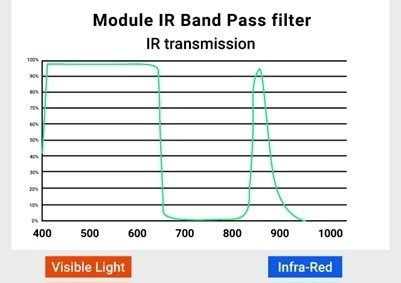
Transmission diagram of a dual bandpass filter.

Figure 4. Transmission diagram of a dual bandpass filter. Image Credit: e-con Systems

ISP

The Image Signal Processor (ISP) is one of the most significant components in an RGB-IR camera since extracting the RGB and IR frames from the data given by the sensor requires considerable ISP-side acumen.

e-con Systems, for example, does this through its proprietary algorithm. The company’s engineers also used their ISP expertise to devise an algorithm to remove IR interference from the RGB channels to achieve the correct colors.

One of its other distinguishing features is the ability to tune the ISP to produce processed RGB and IR frames based on the needs of the host platform.
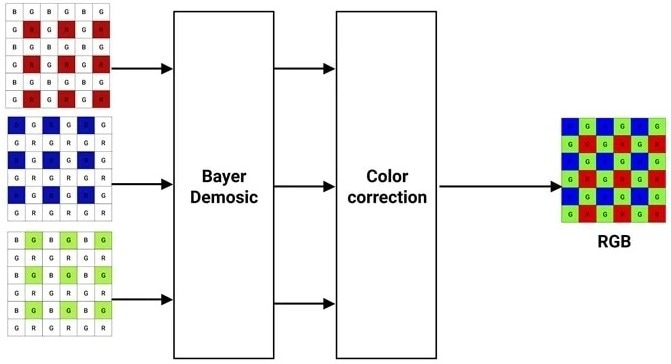
How RGB-IR Cameras can enhance medical devices

Figure 5. RGB window imaging processing. Image Credit: e-con Systems
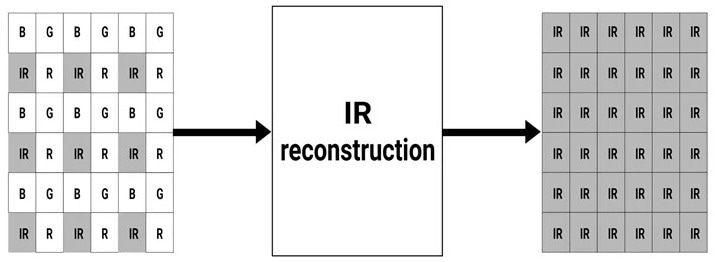
How RGB-IR Cameras can enhance medical devices

Figure 6. IR window imaging processing. Image Credit: e-con Systems

Key medical applications where RGB-IR cameras are making a wave of change

Some of the benefits of RGB-IR cameras have already been discussed. The following section details how they impact some of the most popular camera-enabled medical applications.

Remote patient monitoring

Remote Patient Monitoring (RPM) devices have benefited the medical industry by minimizing the need for in-person patient monitoring. Using artificial intelligence, RPM systems are now powerful enough to detect patient falls and movements autonomously. These life-changing devices require cameras to collect images and videos to make all of this feasible.

One of the major features of a remote patient monitoring system is that it must be operational around the clock to enable ongoing patient monitoring. This necessitates that the camera functions flawlessly during the day and night. This is where RGB-IR cameras come in.

They allow the RPM device to take images utilizing IR imaging even at night without requiring two separate cameras or a mechanical switch to activate an IR cut filter.
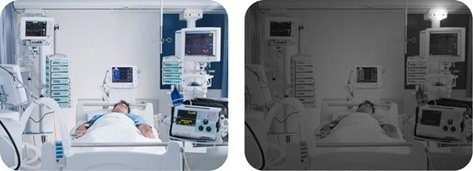
(Left) RGB image during daytime and (Right) IR image during night-time.

Figure 7. (Left) RGB image during daytime and (Right) IR image during night-time. Image Credit: e-con Systems

Image-guided surgery

In surgeries such as laparoscopic cholecystectomy, colorectal surgeries to evaluate bowel viability in hernia cases, mapping of sentinel lymph nodes, etc., fluorescence-guided surgical techniques such as Indocyanine Green (ICG) surgery are used (source: sciencedirect.com).

The dye can become fluorescent when subjected to a wavelength of 750 to 800 nm, which is how ICG surgery works. As a result, the camera utilized must be capable of capturing images in the Near-Infrared (NIR) spectrum.

But why not observe the organs with an RGB camera and an IR light source simultaneously?

The difficulty here is the low spectral resolution. To better grasp this, consider cancer diagnosis as an example application.

In this case, capturing the fluorescent image with a standard RGB camera may not provide enough detail. On the other hand, the IR capabilities of an RGB-IR camera can be utilized to efficiently enhance the cancer diagnosis procedure. At the same time, the RGB data can be used to evaluate any anomalies discovered using the IR output. All of this may be accomplished with a single-camera system.
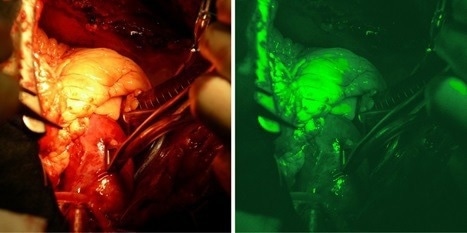
(Left) RGB image during ICG Surgery and (Right) IR image during ICG Surgery.

Figure 8. (Left) RGB image during ICG Surgery and (Right) IR image during ICG Surgery. Image Credit: e-con Systems

Ophthalmology

The quality of images provided by camera modules inside ophthalmic devices such as fundus cameras and retina scanners substantially influences diagnosis accuracy.

IR imaging is required in these devices to observe sub-retinal characteristics because the deposits appear bright and thicker compared to the optic nerve heads, retinal vessels, and choroidal vessels found in darker regions. Visible light imaging, on the other hand, is essential to ensure that the camera gets the required details of the eye.

This necessitates the use of a single camera that is capable of both visible and IR imaging. As a result, RGB-IR cameras are ideal for such applications. Medical professionals can now efficiently detect and treat eye problems using these new-generation embedded cameras, which provide visible and IR images from the same camera.

Final words

As detailed above, RGB-IR cameras have numerous advantages and are well-suited for various medical applications requiring concurrent RGB and IR imaging. At the same time, specialized NIR cameras are favored for applications that require exceptionally high NIR sensitivity and performance. Before proceeding with camera integration into the device, it is advised that users consult with an imaging professional such as e-con Systems.

About e-con Systems

e-con Systems™ is a leading OEM camera manufacturer with 18+ years of experience and expertise in embedded vision. It focuses on delivering vision and camera solutions to industries such as medical, retail, and industrial. The company’s wide portfolio of products includes MIPI camera modules, USB 3.1 Gen 1 cameras, GMSL cameras, stereo cameras, etc. It has built over 250+ product-based solutions and shipped millions of cameras around the globe. What sets the company apart is its deep expertise in building customized product designs while ensuring rapid prototyping and custom modifications in hardware and software. e-con Systems™ has close partnerships with Sony, ON Semiconductor®, Omnivision, NVIDIA, Xilinx, Socionext™, Cypress, Connect Tech, Toradex, Variscite, Toshiba, Diamond Systems, Avermedia and Texas Instruments.

Giving sight to medical applications:

e-con Systems™ offers end-to-end camera solutions to meet the needs of the medical and healthcare industry. It has a strong foothold in the medical device industry – having empowered clients to integrate unique camera solutions for medical and life science applications in ophthalmology, dentistry, dermatology, laboratory equipment, microscopy, assistive technology, point-of-care technology etc. e-con Systems also has a solid track record of working with the medical device industry leaders such as Thermofisher, Idexx, Perkin Elmer, Amwell, Welch Allyn, Seegene and others.”


Sponsored Content Policy: News-Medical.net publishes articles and related content that may be derived from sources where we have existing commercial relationships, provided such content adds value to the core editorial ethos of News-Medical.Net which is to educate and inform site visitors interested in medical research, science, medical devices and treatments.

Despite successes, lack of regulation raises concerns over medical devices

Janice Berger isn’t a big fan of bowling shoes.

“Oh my gosh, who knows whose dirty feet have been in those shoes,” Berger said.

But sporting a pair at Signature Lanes in Elkhart, Berger is just glad to be able to lace them up on her own. It wasn’t long ago the senior from Goshen couldn’t put on her own shoes. Much less bowl.

Chronic pain has kept Berger from bowling for the last seven years.

“I couldn’t bowl, I couldn’t ride my bike,” Berger said. “I couldn’t enjoy my grandchildren. So it is frustrating when you are so tired of pain there is absolutely no joy in your life.”

She has diabetic neuropathy; nerve damage in her feet caused by diabetes. It affects 28{bf0515afdcaddba073662ceb89fbb62b6b1bf123143c0e06b788e1946e8c353f} of all diabetic patients according to the National Library of Medicine.

Berger was at the point she was willing to do anything to stop the pain.

“I just thought, I’m going to start with a podiatrist and work my way up to God if that’s what it takes,” Berger said.

You couldn’t see it even while Berger grabbed a bowling ball, rolled it down the lane, or watched her first gutter ball in years; but sitting in the base of her spine is a Nevro HFX. A spinal cord stimulator stopping the pain. She had it implanted in November, 2021 after trying medications, therapy, and other methods that never worked.

“Last time I talked to her, she told me she had 100{bf0515afdcaddba073662ceb89fbb62b6b1bf123143c0e06b788e1946e8c353f} relief. She was smiling the whole time. She was extremely happy,” said interventional pain specialist Dr. Jerry Grewal.

Dr. Grewal implanted Berger’s Nevro HFX, which is the first time it’s been used for diabetic neuropathy.

“Hopefully patients will improve, their quality of life will get better, their pain will decrease, and they can be less reliant on medications,” Dr. Grewal said. “And hopefully they don’t have to be on opiates long term.”

Jeanne Lenzer, author of The Danger Within Us: America’s Untested, Unregulated Medical Device Industry and One Man’s Battle to Survive It, worries some patients don’t consider that medical devices have their own side effects which can be serious.

She’s spent years studying the medical device industry.

“It’s a wild west out there,” Lenzer said. “Devices are the wild west.”

About one in ten Americans will have a medical device implanted in their lifetime. But less than half a percent of these devices have been tested in rigorous clinical trials, according to the American Medical Association Journal of Ethics.

There are at least 500 FDA consumer complaints over the last five years following a Nevro Senza device implant. Reported issues include infections, sepsis, shocking sensations, and numbness.

In these cases, no issues were found with the device. But it’s the manufacturer itself investigating whether the device is at fault.

“We’ve [implanted], between the trials and everything else, almost 100,000 of these devices. And we very carefully track any reports of adverse events. We’re required to,” Nevro chief medical officer Dr. David Caraway said.

Dr. Caraway points to an 18-month trial showing Nevro’s spinal cord stimulators leading to pain relief for nearly three quarters of patients.

“We’re really focused on evidence building and providing the safest and most effective therapies that are out there,” Dr. Caraway said.

And the Nevro HFX went through the FDA’s more stringent pre-market approval process.

But 82{bf0515afdcaddba073662ceb89fbb62b6b1bf123143c0e06b788e1946e8c353f} of devices go through 510(k) approval, which requires no clinical data. According to a study published in the Journal of the American Medical Association, 510(K)-approved devices make up 97{bf0515afdcaddba073662ceb89fbb62b6b1bf123143c0e06b788e1946e8c353f} of medical device recalls.

“A lot of people think that the FDA actually tests things. They don’t do any testing at all,” Lenzer said. “What they do is they ask the manufacturer to provide their information. And that’s what they go on.”

Patients considering a medical device can look up reported issues on the FDA database. Lenzer recommends researching complaints, considering possible side effects, and weighing them against the intended benefit. Patients should also ask their medical provider how often they’ve implanted the device.

So far, Berger hasn’t had any issues.

“It’s a dream come true,” Berger said.

And even if it’s not helping her score on the lanes, she is just glad to be back in the game.