A new law is making it easier for researchers to study cannabis.
Researchers previously faced barriers like lengthy study approval procedures and inadequate supply of high-potency products.
Experts hope new research on the medical use of cannabis might convince authorities to remove the drug from Schedule I designation.
A new Medical Marijuana Research Law is making it easier for researchers to study cannabis. The law is expected to expedite study approvals for scientists and allow for higher-potency cannabis in clinical trials.
Cannabis is still classified as a Schedule I drug, which is defined as having “no currently accepted medical use and a high potential for abuse.” Other drugs or substances in this category include heroin, LSD, and ecstasy.
So far, 37 states have legalized cannabis for medical purposes, but the Schedule I classification imposes strict limits on cannabis research. Prior to the new law, scientists could not study the effects of high-potency products, and the process of obtaining study permits could take months.
The Drug Enforcement Administration (DEA), which is responsible for reviewing cannabis research applications, was free to take as long it wanted to issue a decision, according to David A. Gorelick, MD, PhD, DLFAPA, a distinguished life fellow of the American Psychiatric Association.
The new law removes some of these restrictions, stipulating that the U.S. attorney general must approve or deny a researcher’s application within 60 days.
“Right now, research is considered somewhat cumbersome,” Gorelick told Verywell. “The [law] has the most promise in the future to kind of unblock the cannabis medical drug-related development process.”
What Else Could This Law Change for Cannabis Research?
Among other changes, the law relaxes the rules on cannabis growers who supply the drug for scientific research.
In the past, the maximum grade for research-use Delta-9-tetrahydrocannabinol (THC), the main psychoactive ingredient in cannabis, was lower than what people used legally and illegally, Gorelick explained.
“The complaint from researchers was that the cannabis they had to use for their own research was not representative of what people were actually using,” he said.
Gorelick said he expects higher-quality cannabis to be used in more rigorous clinical research studies in the near future. If researchers can prove that cannabis has legitimate medical use, they might be able to convince authorities to remove cannabis from its Schedule I designation.
The difficult task is that researchers need to get more granular in their studies and test if cannabis can be used to treat a specific condition or disease, according to Larry Walker, PhD, MS, a pharmaceutical researcher at the University of Mississippi.
Currently, in states where medical cannabis is legal, a healthcare provider could issue a permit for patients with conditions such as severe chronic pain, cancer, HIV/AIDS, epilepsy, and multiple sclerosis.
“The capsule form that’s available for prescription is Schedule III,” Walker said.
If the Food and Drug Administration (FDA) agrees that cannabis has legitimate medical use, he added, the drug could be given a Schedule II or an even lower designation.
For now, the law symbolizes the biggest breakthrough in research access.
“This is giving a nudge that [study reviewers] have to respond more quickly and they have to acknowledge that there may be legitimate drug development purposes that shouldn’t be thwarted.” Walker said.
What This Means For You
A new law is making it easier for scientists to research cannabis for medical use in the United States. But the drug is still on a Schedule I designation along with other substances like LSD, ecstasy, and heroin.
Verywell Health uses only high-quality sources, including peer-reviewed studies, to support the facts within our articles. Read our editorial process to learn more about how we fact-check and keep our content accurate, reliable, and trustworthy.
LONDON — The British newspapers are calling it the “winter of discontent.”
Huge strikes are creating chaos in hospitals and standstills at transit hubs, as walkouts by firefighters, baggage handlers, paramedics, driving examiners, immigration officers, bus drivers, construction workers, mail carriers and railway conductors mount. The public has been warned to avoid train travel on Christmas Eve.
Most worrisome for the government — and the public — is that nurses have just gone on strike, too. Teachers are threatening work stoppages early in the new year.
Workers in wide swaths of the public sector are in open revolt against 12 years of “austerity budgets” by the Conservative Party and the soaring costs of living in 2022. Energy prices are so high here that the government stepped in to cap and subsidize home heating bills so that people wouldn’t freeze in their flats.
This follows the immolation of the previous Tory government, that of Liz Truss, the shortest-serving prime minister in modern British history. She had called for sweeping tax cuts but offered no way to pay for them, sending markets reeling and Truss to early retirement.
How Liz Truss became the shortest-serving prime minister in U.K. history
The British government is now preparing to mobilize 1,200 army troops to drive ambulances over the holidays. Civil servants from other agencies will be brought in to check passports at border crossings, if necessary.
During the worst years of the coronavirus pandemic, millions of ordinary Britons, alongside Prime Minister Boris Johnson (also gone), stood on their doorsteps during harsh lockdowns to bang pots and pans and clap their hands for National Health Service workers, hailing them as front-line heroes.
Now the nurses are saying they need more than applause. They are burned out, overworked and underpaid, they say, and want a real raise to keep up with inflation, which has topped 10 percent.
“They’re taking advantage of us,” said Rachel Ambrose, 40, a mental health nurse who works with children and teenagers in Oxford. “We don’t seek an extravagant lifestyle. We’re nurses. We just want to pay our bills. We want heat.”
Ambrose said that the nurses are “fired up, we’re angry, we’re determined,” and that these strikes “will continue because they are ignoring us.”
She pointed to staffing shortages at the NHS that undermine patient care and have nurses at a breaking point. Sick days have soared since the pandemic — and so have nurses leaving the profession or moving abroad.
U.K. nurses, struggling to pay bills, say strike is for future of health care
Britain’s public health system is short 50,000 nurses. Half of all new hires today come from overseas because the U.K. either can’t train enough at home or pays too little to attract new workers. Brexit also has stemmed the “free movement” flow of nurses from Eastern Europe to Britain.
The government says the average nurse’s salary is now 35,600 pounds ($43,300). New nurses are paid less; experienced nurses with specialized skills are paid more; overtime also boosts salaries.
Nurses earn higher wages in the United States, Canada, Australia, Ireland, Germany and Spain. British nurses, though, are paid more than their counterparts in France and Italy.
After one of the worst weeks of strikes in recent British history, Prime Minister Rishi Sunak’s new government is still refusing to sit at the table with the unions, calling the salary increases “unaffordable” and warning that the government must hold the line on wages to keep inflation in check.
The government supports a modest pay raise for ambulance crews and nurses — as recommended by independent pay-review bodies — of about 4.75 percent. The nurses union is demanding a 19 percent increase.
Sunak’s spokesperson on Monday told reporters that “it would be irresponsible to push ahead with double-digit pay awards.”
Britain’s trains grind to a halt in biggest rail strike in 30 years
But Sunak and his government ministers are learning that it is one thing to fight the railway workers and their “union bosses,” as the government brands them, and quite another to fight the nurses. The railway strikes create frustrating snarls for urban commuters and holiday travelers — which are highlighted by the anti-union tabloids. The nurses, on the other hand, are revered. A YouGov poll this month found that 64 percent of Britons backed the nurses’ strike.
On Monday, Sunak called an emergency cabinet meeting to shape plans to keep the country’s vital national services going, with the army on standby.
Some 10,000 ambulance workers in England and Wales are set to go on strike Wednesday. Members of the Royal College of Nurses union walked out Thursday and are headed to the picket lines again Tuesday.
Nurses who work in emergency rooms have stayed on the job, but hospitals are struggling to maintain staffing for basic care. Many routine procedures, exams, non-emergency surgeries and other treatments have been delayed.
Some victims of heart attack or stroke are waiting almost an hour on average for ambulances — compared with the 18-minute target.
At neighborhood doctor’s offices, where most patients see their general practitioner and nurses, the staffs describe a system in crisis because of chronic underfunding and worker shortages.
Anthony Johnson, 29, a cardiac nurse in Leeds, is among those supporting the decision by the Royal College of Nursing to walk out for the first time in its 106-year history.
“We have not had pay rises that meet inflation. That’s why you see nurses going to food banks and the number of vacancies have drastically increased,” he said. “We have horrendous nurse-to-patient ratios. Our clinical guidelines are one nurse to eight patients, but we never generally meet that. The reality is, it’s one nurse to 13 patients, so it’s constantly unsafe and puts patients at risk.”
He likes working in Britain and will stay. But many are looking abroad, he warned.
“We’re training nurses for export, usually to Canada, Australia and New Zealand … where nurses can make an extra 10,000 pounds [$12,200],” Johnson said. “Rather than investing in our staff, the U.K. government is stealing nurses from other parts of the world. They are cutting pay and letting that happen.”
Julia Patterson, founder of Every Doctor, a campaign group representing 1,200 U.K. physicians, said her doctors are “really supportive and will pull together to keep patients safe in the absence of nurses. They will have to work incredibly hard, but they support their colleagues doing this.”
She noted that doctors, too, are being balloted to see if they might strike in the new year.
“People are dying because of a failure in public health,” Patterson said.
The products featured in this article have been independently reviewed. When you buy something through the retail links on this page, we may earn commission at no cost to you, the reader. The Sports Illustrated editorial team is not involved in the creation of this content. Learn more here.
Whether you’re a regular at the gym or just diving headfirst into the world of fitness, trying to get a supplement stack right—much less understand what it is—can be intimidating. A supplement stack is simply a combination of two or more products taken together strategically to provide synergistic results. Some common fitness goals that stacks are used for include muscle growth, fat loss, increased cardiovascular endurance and improved sports performance. Using a supplement stack can be a way to reach your goals faster.
In this review, we’re going to breakdown our picks for the best supplement stacks from the brands we trust. We’ll talk about the individual supplements included in each stack, explain what goals the stack will help you achieve and cover important factors like dosages, price and any safety concerns you might have.
Safety Note: Before considering the use of supplements or a supplement stack you should be at least 18 years of age, consult a physician prior to use, consider any pre-existing conditions and always follow the recommended dosages on the supplement labels.
This content is meant to be informative, but should not be taken as medical advice. It is not intended for use as diagnosis, prevention or treatment of health problems. Always speak with your doctor before starting any new supplement or exercise regimen.
Our Picks for the Best Supplement Stack:
XWerks
Key Supplements and Dosages:
Xwerks is a nutrition company that specializes in scientifically formulated supplements crafted for elite athletes. The combination of supplements in this stack creates a classic anabolic muscle building stack for men that has all the ingredients needed (plus some) to have success in the weight room.
The protein supplement Grow, the creatine supplement Lift and the stress management supplement Ashwa can be taken on a daily basis. The other products, Ignite and Motion, should be taken only on training days. Be sure to follow the recommended serving sizes on the back of the supplement labels to prevent any unwanted side effects.
Safety Notes:
This supplement stack is designed specifically for men. If you are a woman, you are completely fine taking Xwerks Grow, Ignite, Motion and Lift, but I would consult with your doctor before adding Ashwa into your supplement regimen.
Pros:
Designed to boost athletic performance
High-quality whey protein isolate from grass-fed cows
Motion supplement helps optimize muscle glycogen levels and electrolyte balance
Cons:
There are other pre-workout supplements available at comparable price points with higher dosages of the active ingredients
Slightly more expensive than comparable products (especially for creatine)
KOS
Key Supplements and Dosages:
KOS Organic Plant Protein (Protein Powder): 20 grams of organic pea, quinoa, pumpkin, chia and flax protein; supports muscle growth and recovery
KOS Greens Blend (Greens Powder): 250 milligram of organic algae superfoods blend, four grams of organic alkalizing greens blend, 3.25 grams of organic fruit and veggie blend, two grams of organic digestive prebiotic blend; provides vitamin and mineral micronutrients and digestive gut support
KOS Reds Blend (Reds Powder): 5.8 grams of organic red superfoods blend, 900 milligrams of digestion support blend, 1.6 grams of organic berry superfood blend; naturally energizing with antioxidants; nutrient blends support immunity
KOS produces plant-based nutrition supplements for people with vegan and vegetarian dietary preferences. The PowerPlant Bundle is geared toward overall health and wellness. While this supplement stack might not have you hitting your new rep max in the gym, these products will provide a number of nutritional and digestive benefits. One major benefit from these plant forward supplements is the dietary fiber from the protein and greens powder which helps promote a healthy gut microbiome, keeps you regular and reduces cravings.
Safety Notes:
These products are generally safe to use on a regular basis, though we recommend talking with your healthcare provider before adding any new supplements into your diet.
Pros:
Responsibly sourced, non-GMO and free of artificial ingredients
Good for vegan and vegetarian diets
Green and Red blends supply micronutrients
Subscribers save 15 percent
Cons:
Not meant to boost athletic performance in the gym
Transparent Labs
Key Supplements and Dosages:
Transparent Labs 100{bf0515afdcaddba073662ceb89fbb62b6b1bf123143c0e06b788e1946e8c353f} Grass Fed Whey Protein Isolate (Protein Powder): 28 grams of grass-fed whey protein isolate per serving; supports muscle growth and recovery
Transparent Labs Bulk Pre-Workout (Pre-Workout): Six grams of citrulline malate, four grams of beta alanine, four grams of BCAAs, 2.5 grams of betaine, 1.3 grams of taurine, one gram of L-tyrosine, 300 milligrams of alpha-GPC, 180 milligrams of caffeine, 50 milligrams of theobromine, 25 milligrams of Astragin; formulated to boost energy and reduce muscle fatigue
Transparent Labs Creatine HMB (Creatine): Five grams of creatine monohydrate, 1.5 grams of beta-hydroxy methylbutyrate, five milligrams of BioPerine; supports lean muscle growth and improves muscle size and strength
Transparent Labs is a supplement company that aims to be as forthright as possible with their products, ingredients and testing. All of their products contain no artificial colors, sweeteners or preservatives, and they always avoid proprietary blends. Transparent Labs also has a wide array of delicious flavors for all of their products.
This four-supplement stack is ideal for beginners who have been consistently going to the gym and want to begin maximizing their gains and performance. It includes a pre-workout, protein powder and creatine, which are the three core supplements I believe are best for building muscle.
Safety Notes:
All the products on this list can be taken daily with the exception of the BULK pre-workout, which should only be used on training days.
Pros:
Basic stack that’s easy for beginners to implement
High-quality, grass-fed whey protein isolate
Pre-workout formula contains quality ingredients at optimal dosages
Only 10 percent off for buying the complete stack, which is a relatively small discount
Gainful
Key Supplements and Dosages:
Personalized Protein Powder (Protein Powder): 19-27 grams of protein per serving, depending on your formula; supports muscle growth and recovery
Personalized Hydration (Intra-Workout Hydration): Personalized hydration ingredients include stevia leaf extract, cane sugar, calcium citrate, magnesium glycinate, sodium citrate, potassium citrate, L-theanine and natural caffeine; caffeine boosts energy and electrolytes improve hydration
Personalized Pre-Workout (Pre-Workout): Personalized pre-workout formula may contain stevia leaf extract, BCAA blend, L-theanine, natural caffeine, L-citrulline, beta-alanine and creatine; caffeine boosts energy, other ingredients reduce muscle fatigue and improve muscle recovery
Personalized Performance Boosts (Wellness and Recovery): Fiber, collagen and creatine can be added to your other products; fiber improves digestive health, collagen improves skin and nail health, creatine increases muscle size and strength
Gainful is a subscription-based service with on-staff registered dieticians who formulate supplements to fit your dietary needs and wellness goals. A major benefit of the subscription service is free access to a registered dietician. Although the subscription is pricey, this service alone is likely worth the extra cost of the supplements. The high-quality ingredients, personalized supplement formulations and access to a dietician are all key components to help build lean muscle mass.
Gainful protein powders contain all nine essential amino acids and anywhere from 19-27 grams of protein per serving, depending on your formula. The protein powders available include whey or plant-based protein formulations (based on your dietary preferences) and never contain gluten, soy, fillers or artificial colors, dyes or sweeteners.
Safety Notes:
Check to make sure your products don’t contain duplicate ingredients. For example, if the pre-workout and hydration supplements both contain caffeine, then you want to be careful how much caffeine you’re consuming per day. Also, the pre-workout supplement should only be taken on training days.
Pros:
Personalized range of products for your personal health and fitness goals
Subscription includes free access to a registered dietician
High quality ingredients with no artificial sweeteners, colors or flavors
Cons:
Products can contain duplicate ingredients (ex: creatine or caffeine)
Fairly expensive subscription based service
Transparent Labs
Key Supplements and Dosages:
Transparent Labs 100{bf0515afdcaddba073662ceb89fbb62b6b1bf123143c0e06b788e1946e8c353f} Grass Fed Whey Protein Isolate (Protein Powder): 28 grams of grass-fed whey protein isolate per serving; supports muscle growth and recovery
Transparent Labs Lean Pre-Workout (Pre-Workout): Six grams of citrulline malate, two grams of beta alanine, 2.5 grams of BCAAs, 1.5 grams of betaine, 180 milligrams of caffeine, 50 milligrams of theobromine, 630 milligrams of acetyl L-carnitine, 500 milligrams of choline bitartrate, 360 milligrams of L-theanine; caffeine boosts energy, other ingredients reduce muscle fatigue and support fat loss
Transparent Labs Creatine HMB (Creatine): Five grams of creatine monohydrate, 1.5 grams of beta-hydroxy methylbutyrate, five milligrams of BioPerine; increases muscle strength and supports growth of lean muscle mass
Transparent Labs Fat Burner (Fat-Burner): 500 milligrams Forslean, 400 milligrams of green tea extract, 300 milligrams of 5-HTP, 300 milligrams of L-tyrosine, 240 milligrams of L-theanine, 240 milligrams of caffeine anhydrous, 100 milligrams of cayenne pepper extract, 50 milligrams of Synephrine HCl; suppresses appetite and metabolizes fatty acids for energy
This is the second Transparent Labs stack on our list, and it targets fat burning instead of muscle gain. The difference between the muscle building and fat burning stacks is swapping out the pre-workout Bulk for the pre-workout Lean and the Growth supplement for a Thermogenic Fat Burner. This stack was created with specific ingredients included to maintain as much muscle mass as possible while in a caloric deficit to lose body fat.
Safety Notes:
In this stack, both the Fat Burner and pre-workout Lean contain a significant amount of caffeine. If you’re using both supplements in one day, then I would avoid caffeine in other beverages such as coffee, tea or soda. It’s important to always follow the dose advised by the supplement label, but this is especially true in the case of fat burners. Lastly, Transparent Labs Lean pre-workout should only be consumed on training days.
Pros:
Ideal stack to maintain muscle mass while burning fat
High-quality, grass-fed whey protein isolate
Top tier pre-workout formula with ingredients that should aid in fat loss (ex: carnitine)
Great flavor options available
Cons:
One of the more expensive stacks on our list
Only 10 percent off for buying the complete stack
Kaged Muscle
Key Supplements and Dosages:
Kaged Whey Protein Isolate (Protein Powder): 25 grams of whey protein isolate per serving; supports muscle growth and recovery
Kaged Pre-Kaged (Pre-Workout): 6.5 grams of L-citrulline, 6.5 grams of BCAAs, 2.5 grams of betaine, 1.6 grams of beta-alanine, 1.5 grams of creatine HCl, two grams of taurine, 1.85 grams of L-tyrosine, 274 milligrams of caffeine, hydration blend of coconut water powder, micronutrient-rich fruit and vegetable blend; caffeine boosts energy, other ingredients provide nutrients and reduce muscle fatigue
Kaged Creatine HCl (Creatine): 750 milligrams of Creatine Hydrochloride; increases muscle strength and supports growth of lean muscle mass
Kaged Hydra-Charge (Intra-Workout Hydration): Electrolyte blend of calcium, phosphorus, magnesium, sodium and potassium; one gram of taurine; hydration blend of coconut water powder; micronutrient rich fruit and vegetable blend; provides nutrients and hydrates with electrolytes
Kaged Muscle is a sports nutrition supplement company for both health and fitness enthusiasts. Their Go-To-Stack is recommended for anyone ready to improve their fitness routine, build muscle and enhance athletic performance. The stack contains the three supplements that will cover all your bases, and that I always like to see in any muscle building stack: a pre-workout, protein and creatine. The fourth supplement is an intra-workout hydration powder that should be helpful for anyone who sweats a lot during their workout sessions.
Safety Notes:
All the products on this list can be taken daily with the exception of the Pre-Kaged pre-workout, which should be used only on training days.
Pros:
Budget-friendly muscle building stack
High quality whey protein isolate
Includes a top tier pre-workout formula with scientifically dosed ingredients
Cons:
Creatine is underdosed, so you would need to take multiple scoops (though the pre-workout also contains creatine)
Hydra-Charge would be better if it had a slightly higher concentration of the mineral electrolytes
Jacked Factory
Key Supplements and Dosages:
Build XT (Energy and Endurance Complex): One gram of Peak O2 Mushroom Complex, 150 milligrams of ElevATP, 25 milligrams of AstraGin; formulated to boost energy and enhance endurance
Build PM (Recovery and Sleep Aid): 500 milligrams of tart cherry, 250 milligrams of ashwagandha root extract, 200 milligrams of L-theanine, 100 milligrams of rutaecarpine, five milligrams of melatonin, five milligrams of BioPerine; reduces muscle soreness and may enhance sleep and alleviate stress
Growth Surge (Post-Workout): Three grams of creatine monohydrate, 2.5 grams of betaine, 100 milligrams of L-carnitine, five milligrams of BioPerine; supports fat loss and growth of lean muscle mass
Authentic Whey (Protein Powder): 24 grams of whey protein concentrate and whey protein isolate per serving; supports muscle growth and recovery
Creatine Monohydrate (Creatine): Five grams of creatine monohydrate; increases muscle strength and supports growth of lean muscle mass
Jacked Factory is a well known supplement company with a reputation for developing high quality, scientifically dosed dietary supplements. Their products are manufactured in the U.S., and they have fully transparent labels, research backed ingredients and no fillers or dyes. Their Build 24/7 stack contains the products Build-XT, Build-PM and Growth Surge, but we also included their Authentic Whey and Creatine Monohydrate products.
These supplements are formulated to help you build lean muscle naturally and quickly increase blood flow, strength and stamina in the gym. They’re also designed to maximize post-workout recovery and enhance sleep (where a lot of physical recovery happens). It’s a great group of products to use in a cutting phase because it focuses on maintaining lean muscle while reducing body fat.
Safety Notes:
Always follow the recommended dosages on the supplement labels, and talk with your healthcare provider before adding any new supplements into your diet.
Pros:
Cons:
A pre-workout is likely superior in performance compared to Build XT
The protein and creatine need to be added to this stack
Carnitine for fat burning in Growth Surge is underdosed
Amazon
Key Supplements and Dosages:
Cira Bright Whey Protein (Protein Powder): 25 grams of whey protein isolate and whey protein concentrate; supports muscle growth and recovery
Cira Flare Shape Support (Fat Burner): 500 milligrams of L-carnitine, 300 milligrams of ashwagandha, 150 milligrams of EGCG from green tea extract, 150 milligrams of caffeine, 75 milligrams of L-theanine, 25 milligrams of cayenne pepper extract, five milligrams of BioPerine; caffeine boosts energy, other ingredients support fat loss
Cira Creatine Monohydrate (Creatine): Five grams of creatine monohydrate; increases muscle strength and supports growth of lean muscle mass
Cira Nutrition is a relatively new supplement company that’s marketed to women (they have very bright pastel packaging). The Cira stack is a combination of protein powder, creatine and a fat burner. This is a great stack for women who have weight loss goals and want to preserve as much lean muscle mass as possible. The combination of the protein and creatine should help retain lean muscle mass, while the Flare Shape Support and Symmetry Hormone Balance should help with fat loss and weight management.
Safety Notes:
All of these products can be taken on a daily basis. Always follow the recommended dosages on the supplement labels, especially with fat burners. Avoid taking the Flare Shape Support before bed because of the added caffeine.
Pros:
Ideal for women with weight loss goals
Flare Shape Support can double as a pre-workout because of caffeine
Protein and creatine should help build and retain lean muscle mass
Cons:
Whey protein powder only comes in three flavors
Creatine supplement is unflavored, which may be a turn-off for some
BioSteel
Key Supplements and Dosages:
BioSteel 100{bf0515afdcaddba073662ceb89fbb62b6b1bf123143c0e06b788e1946e8c353f} Whey Protein (Protein Powder): 24 grams of a blend of whey protein isolate, whey protein concentrate and whey protein hydrolysate; supports muscle growth and recovery
BioSteel Sports Greens (Greens Powder): 2.76 grams of Land and Sea Greens, one gram of Antioxidant Blend, 1.8 grams of High Performance Recovery Complex, 55 milligrams of Digestive and Absorption Blend; provides vitamin and mineral micronutrients, digestive gut support, antioxidants and muscle recovery
BioSteel Plant Amino Power BCAA+ (Intra-Workout BCAAs): Three grams of BCAAs, 1.5 grams of L-glutamine; improves muscle recovery and repair
BioSteel Sport Beets Pre-Workout (Pre-Workout): Two grams of L-carnitine, 400 milligrams of L-arginine, 2.5 grams of L-citrulline, 1.5 grams of beet root powder; formulated to boost energy and reduce muscle fatigue
BioSteel is a sports nutrition supplement company that initially achieved a strong reputation for their zero sugar hydration supplements. They have since expanded into other supplements, including protein, greens powders, BCAAs and pre-workout powders. All of BioSteel’s products are NSF certified safe for sport which makes this brand a great choice for athletes.
This stack is a great option for athletes who are training and competing multiple times per week. The protein and BCAAs will help with muscle repair and recovery, the Sports Greens are a great way to ensure you’re getting your recommended daily micronutrients and the caffeine-free pre-workout provides a pre-workout energy boost without the jitters.
Safety Notes:
All of these products can be taken on a daily basis. Always follow the recommended dosages on the supplement labels, and talk with your healthcare provider before adding any new supplements into your diet.
Pros:
All BioSteel products are NSF Certified Safe for Sport
Stimulant-free pre-workout powder (no caffeine)
Protein powder is a combination of whey protein concentrate, isolate and hydrolysate for superior bioavailability
Cons:
BioSteel uses proprietary blends for some of their products, meaning you don’t know the exact dosage of certain ingredients
This stack does not contain any creatine, which is a key supplement for building muscle
Naked Nutrition
Key Supplements and Dosages:
Naked Mass Weight Gainer (Protein Powder Mass Gainer): 50 grams of protein and 252 grams of carbohydrates per serving; may increase body weight, supports muscle growth and recovery
Naked Energy (Pre-Workout): Two grams of beta-alanine, one gram of creatine monohydrate, one gram of L-arginine, 200 milligrams of natural caffeine; boosts energy and reduces muscle fatigue
Naked Creatine (Creatine): Five grams of creatine monohydrate; increases muscle strength and supports growth of lean muscle mass
Naked BCAAs (Intra-Workout BCAAs): Five grams of BCAAs; supports muscle recovery and repair
Naked Nutrition is a health and wellness supplement company established in 2014. As the word naked implies, this company prides themselves on their two- or three-ingredient formulas that contain no additives or artificial sweeteners, colors or flavors.
Naked Nutrition has a number of different supplement stacks available that they call supplement bundles. The bundles all contain a number of different supplements, and come with a discounted price. You can opt for one of the bundles or separately purchase the products in this list for a bulking stack that I think is unmatched in quality. All of the products are great for people looking to bulk up and put on some size in the gym.
Safety Notes:
All of these products can be taken on a daily basis except for the Naked Energy, which should only be used on training days. Always follow the recommended dosages on the supplement labels, and talk with your healthcare provider before adding any new supplements into your diet.
Pros:
Naked Nutrition products are always free from artificial sweeteners, colors and flavors
All products are tested for heavy metals, and the batch results are available on the website
Naked Mass contains 50 grams of protein and 252 grams of carbohydrates per serving to help those trying to gain weight
The protein in Naked Mass is a combination of whey protein concentrate (rapid digesting) and casein (slow digesting)
Cons:
Naked Energy has a significant amount of caffeine, but overall is an underdosed pre-workout powder
This stack is not meant for consumers looking to lose weight
What Is a Supplement Stack?
Before we define what a supplement stack is, let’s talk about the purpose of using supplements in the first place. Supplements were originally designed to fill in any of the nutritional gaps found in your daily diet. However, as the supplement industry evolved, companies began creating products designed to achieve specific fitness related goals, including increased muscle mass, weight loss and improved athletic performance. The next logical step was packaging a bunch of supplements together to be used in combination with one another, and thus the supplement stack was born.
Supplement stacks take advantage of the synergistic effects of various products when used in conjunction with one another. An example of a generic supplement stack would likely focus on four unique components: overall health, pre-workout, intra-workout and post-workout. The initial supplements would be beneficial for overall health, and would include the usual suspects like vitamins, minerals and possibly fish oil. The second component would be a pre-workout supplement that would likely contain a stimulant such as caffeine and a nitric oxide booster like L-citrulline. The next part of the stack would be centered on intra-workout fuel and recovery, and would likely include electrolytes for hydration or some branched chain amino acids (BCAAs) and essential amino acids (EAAs). Finally, there’s usually a heavy emphasis on post-workout recovery. This portion of the stack usually includes a protein powder and creatine to rebuild and recover the muscles.
Hopefully, this example shows you how these products can be used together effectively to help streamline your fitness journey. The products used in isolation would provide some benefits, but when used collectively, a well thought out supplement stack can optimize your results.
Benefits of Using a Supplement Stack
There are definitely a significant amount of benefits that come along with the use of a well-designed supplement stack. The primary ones are time and energy. Using our example supplement stack consisting of pre-workout, intra-workout and post-workout products, consider what would happen if you used the individual products by themselves. If you only used the pre-workout supplement to push yourself harder in the gym, but failed to recover effectively with the protein and creatine, then you likely wouldn’t be able to bring the same intensity the following day. The same could be said for using the post-workout supplements without the pre-workout and intra-workout products. Without those, you might not be able to push yourself hard enough in the gym to even warrant the use of protein powder for recovery. This is why, when used correctly, the combination of certain supplements can help you achieve your goals much faster. The supplement stack can produce an almost magical effect, allowing you to train harder, recover faster and perform better.
Other benefits of stacking supplements come down to overall convenience and value. Using supplement stacks, especially ones created by the same company, usually ensures that the supplements you’re taking don’t contain overlapping ingredients. This can actually be quite common, and a great example of this is the ingredient creatine. Because creatine doesn’t have any immediate effects, it can be taken any time throughout the day. This is why supplements such as pre-workout or protein powders will often contain creatine for convenience. So, if you randomly selected some products off the shelf at a local supplement store and didn’t take the time to read the supplement labels, you could end up in a situation where your pre-workout contains creatine, your protein powder has creatine and you’re taking a standalone creatine supplement because you heard you needed it. This would obviously be a waste of money, but could also be dangerous if you are unknowingly ingesting more than the recommended daily dosages.
How to Choose the Best Supplement Stack For You
Health & Fitness Goals
The supplement stack you choose needs to be aligned with your personal goals, and your goals need to be realistic. A common pitfall when curating your own supplement stack is trying to accomplish too many things at one time and therefore combining supplements that have antagonistic effects. A classic example is trying to simultaneously build muscle and lose fat by combining a detox pill with products designed to help you build muscle. The detox pills cause the excretion of water, nutrients and amino acids, which are all things your body needs to build muscle. In an attempt to expedite your progress, you are unknowingly inhibiting it. This is another reason why using a supplement stack created by a single company may be superior to creating your own stack from scratch.
Ingredients
There are so many different ingredients in stacks because individual supplements often contain multiple ingredients. The most common ingredients found in supplement stacks are: protein powder, creatine, glutamine, BCAAs, fat burners, vitamins and minerals, electrolytes, probiotics, fiber, greens powders and pre-workouts (which often contain caffeine, L-citrulline, citrulline malate and beta-alanine). When choosing your supplement stack, consider which ingredients will be the most effective at helping you achieve your goals. Also, think about which ingredients you want to avoid due to dietary restrictions, medications or health conditions.
Reviews
Whenever you purchase a product, it’s important to check out the reviews and see what others think of the product. When looking to purchase a supplement stack, see what people think of the stack as a whole, and then search the individual products as well. The reviews can provide some great insight regarding the effectiveness of the products, the best flavor to choose, how well a product mixes in water and if the company has good customer service.
Cost
Supplement stacks come in a wide range of price points, primarily due to the number of supplements in the stack. In many cases, supplement stacks are discounted slightly since you’re buying a bundle of different products. However, before spending hundreds of dollars to purchase these products, remember that optimizing your lifestyle and diet will have a much greater long term impact than supplements alone.
How We Chose the Best Supplement Stacks
Our search for the best supplement stacks began by looking for the best supplement companies—those that prioritize quality, transparency and the customer experience. Then, we chose stacks that incorporated the best products, had great reviews and would help achieve a diversity of health and fitness goals.
Supplement Stacks FAQs
Does supplement stacking work?
Yes, supplement stacks work as long as they are taken routinely and as advised by the supplement label. However, if you have trouble nailing down a routine for using these products on a consistent basis, then sporadic use won’t produce the results you’re likely looking for.
When should you take a supplement stack?
You really only want to use a supplement stack when you have the time to commit to both your goal and the use of the products on a regular basis. They really do need to be used consistently in order for you to see results. As with all supplements, you should always follow the directions for the product to understand how and when to use them effectively.
Is it better to take supplements all at once or spread out?
Supplements should be taken at the appropriate time. For example, a caffeinated pre-workout is ideal before a morning training session, but would be a poor supplement choice in the evening before bed. Other supplements, when taken together, may have inhibitory effects, meaning that they interfere with one another if taken together. For the best results, always read the supplement facts label to learn the optimal way to take each supplement.
Final Thoughts
Always remember that supplements are never meant to be a replacement for healthy habits. If you have your nutrition, exercise and sleep hygiene dialed in, then these supplement stacks can help push you to the next level to achieve your health and fitness goals.
Prices are accurate and items in stock as of publish time.
LONDON, Dec 19 (Reuters) – Nicola Osypka’s German company has been selling medical devices used in surgery on newborn babies in Europe for decades, but new European Union rules have forced her to make tough decisions.
Under the regulations designed to prevent another health scandal, such as the one in 2010 involving ruptured breast implants made by Poly Implant Prothese, companies must apply for new certificates for their medical equipment.
But Osypka says the small firm founded in 1977 by her father Peter cannot afford the process and it has withdrawn five lines of devices sold in the EU, some for more than 30 years.
“A law created to stop one criminal company’s actions 10 years ago now endangers patients’ lives, including children, and European manufacturing sites,” said Osypka.
“Is that what the EU wants for its citizens?”
Osypka AG is one of eight companies Reuters has spoken to, including Swedish medical equipment maker Getinge (GETIb.ST), that are withdrawing devices from the EU market, or have stopped making them due to the cost it takes to comply with the rules.
While some companies say the products they have cut have no impact on patients or profits, others say some of withdrawn devices are essential, and doctors agree.
Under the EU’s Medical Devices Regulation (MDR), which came into effect in May 2021, all medical devices, from implants and prosthetics to blood glucose meters and catheters, must meet stricter safety criteria, sometimes with new clinical trials.
The eight manufacturers all said the requirements were stretching the time it takes to get a certificate for a product line to as much as two-and-a-half years, compared with a few months under the old system.
Costs have also surged, by anywhere from three to 10 times, the companies said. As a result, some are simply allowing their product certifications to lapse, which means hospitals in the EU can no longer use their devices.
The EU Commission, in response to Reuters’ questions, said it was concerned about the pace of the implementation of the new rules and would do all it could to ensure patients have access to the medical devices they need.
DISRUPTION FOR DOCTORS
Reuters also spoke to two medical associations, three doctors and two regulatory experts and, like the companies, they said the new rules were causing widespread disruption and shortages of crucial equipment.
The doctors, in Austria, Belgium and Germany, said in some cases they were unable to provide their standard quality of care because devices for routine procedures were no longer available.
The Standing Committee of European Doctors (CPME), a group of national medical associations, told Reuters that hospitals in Austria and Denmark have reported shortages of critical devices.
France’s national medical regulator (ANSM) told Reuters that the country’s health system was being affected by shortages of various types of devices, partly because of the new law.
Nicola Osypka, a molecular biologist, said she sat down with staff to run the numbers on their niche products, such as a miniscule catheter used to keep newborns with non-functioning heart valves alive until surgery can be performed.
“These types of products are totally beneficial for these patients, but we cannot afford the half a million euros it takes to conduct a clinical study, even though these products have been on the market for 30 or 40 years,” she said.
Just as painful is the fact Osypka cannot afford costs estimated at one million euros ($1.1 million) to prepare the application for an innovative product that has already been through clinical trials.
The company’s new stent for babies was developed over eight years and doctors successfully used it on 19 babies during the trial in Germany, according to the results seen by Reuters.
John O’Dea, chief executive of Palliare, a small Irish medical equipment manufacturer, is so keen to get his firm’s new laparoscopic device for surgery in the abdomen or pelvis onto the market, he has swallowed the costs.
The process has taken a year and a half so far and O’Dea estimates the total cost will come to about 100,000 euros, for equipment approved two years ago by the U.S. Food and Drug Administration.
Under the old system, it took about 15,000 euros and a few months to get a similar device approved, he said.
SYSTEM OVERLOAD
The costly approval process is the latest blow to the world’s second-biggest medical device market, worth more than $150 billion, which is already reeling from soaring energy bills and unpredictable supply chains following pandemic lockdowns.
An EU Commission spokesperson said in an emailed statement that there were currently not enough agencies, known as notified bodies, to do the work of recertifying products, though device makers had also not prepared sufficiently for the change.
Brussels has authorised 36 agencies and is considering 20 more applications, the spokesperson said.
Tom Melvin, an associate professor of medical device regulatory affairs at Trinity College Dublin, said there were nearly 100 such agencies a decade ago under the old system.
In a major concession, the EU Health Commissioner proposed on Dec. 9 to delay the May 2024 deadline for companies to comply with the new law to 2028 to prevent shortages.
The extension will require an amendment to the law to be approved by the European Council and Parliament, which would not happen until next year.
While a delay would mean some devices will not be cut in the short term, it would not address the logjams and high costs putting firms off going through the process, executives such as Frank Matzek, vice president of regulatory and governmental affairs at Biotronik, a cardiac devices maker in Berlin, said.
EU Commission data released this month shows the scale of the problem.
Under the old system, there are about 25,000 certificates. So far, manufacturers have submitted applications under the new system for about 8,000, but less than 2,000 have been approved.
Certificates cover multiple devices, and in some cases whole product lines, making it hard to estimate the number of products potentially affected. Industry experts say about 500,000 different devices are sold in the EU.
GOING BACKWARDS
Even large companies with deeper pockets and more experience of handling tough global regulations say they have been astonished by the new system’s complexity and expense.
Getinge, which makes products for surgery, intensive care and sterilization, has new certificates for about 20{bf0515afdcaddba073662ceb89fbb62b6b1bf123143c0e06b788e1946e8c353f} of its portfolio and feels it is on track to meet the deadline, said Mikael Johansson, an executive overseeing MDR implementation.
But that work started in 2018, required a full review of the company’s portfolio and resulted in the removal of about a third of Getinge’s products from its range of hundreds of devices.
He said the cull was “healthy” in that it removed products with little effect on profit, but recertification of the rest has been more demanding and taken much longer than expected.
But as some companies press ahead, others are letting certifications lapse.
Andreas Kohl, who runs stent and catheter manufacturer AndraTec in Germany, said he plans to drop two or three devices because he cannot afford to apply for all six of his products currently sold in the EU.
Balton in Poland told customers in October it would ditch over a dozen products, including catheters and stents used for coronary angioplasties and pacing electrodes, due to the costs and other difficulties of complying with the new law, according to an email seen by Reuters.
The company did not respond to requests for comment.
Doctors say the starkest example of the impact of the company decisions has been on devices for rare conditions, such as catheters used on newborns with heart problems.
Marc Gewillig, director of paediatric cardiology at the University Hospital Leuven, a teaching hospital in Belgium, said he has lost access to nearly a dozen devices needed for procedures, forcing him to improvise on three babies.
For one procedure, he said he had to use a catheter to access the atrial septum in the heart through the groin, instead of through the umbilical cord with a balloon catheter.
The procedure is usually carried out within five minutes of birth, but without the preferred device, he must transfer the baby to another part of the hospital, delaying it by 30 minutes.
“Those are minutes in a child with little oxygen going to its brain,” he said. “We’re going back in medicine by 20 to 30 years.”
($1 = 0.9405 euros)
Reporting by Maggie Fick; Additional reporting by Tassilo Hummel in Paris; Editing by Josephine Mason and David Clarke
The end of the year is a time for holiday parties, family gatherings, and plenty of celebratory feasting. But it’s also a time fraught with unhealthy messages surrounding diet and health. From joking with coworkers about “earning” that office banquet to commercials about New Year’s resolutions and an aunt commenting on your weight at Christmas dinner, it can have a serious impact on your physical and mental wellbeing.
“The holiday season really starts with Halloween, if we’re talking about food,” says Gabbie Ricky, a dietician at Children’s Health Andrews Institute Sports Performance. “There’s a lot of positive marketing toward all the holiday foods and flavors, but then there’s always this underlying fear of falling off the wagon over the holiday season or falling off track.”
All that end-of-year eating can lead people to “push off” healthy habits and goals until the new year, Ricky says, which only feeds the guilt you feel during the holiday season itself. It’s cyclical, she says, and it’s a toxic approach to health.
“I think a lot of people struggle with the ‘all or nothing’ mindset. With their health, healthy eating, fitness, it’s either they’re all in or they’re not in at all,” she says. “So, a healthy way to reframe that that I like to encourage is instead of ‘all or nothing,’ ‘all or something.’”
We talked to Ricky about navigating food and diet culture during the holidays, its dangers, and how to combat it.
This interview has been edited for length and clarity.
What’s one thing about holiday diet culture that people might not expect?
The marketing has gotten sneakier. I feel like diet culture is just more deeply embedded into things that we might not think about. And it’s talked about under the guise of “wellness.”
Can you talk about how that marketing has gotten sneakier?
Food systems or food programs that label themselves as a lifestyle program. Not a diet, but then they do have a “good” and “bad” list of foods—that’s a red flag, in my opinion. Or a tiered system of ranking foods, like a red food, a yellow food, and a green food. Anything that sorts foods into buckets of good and bad is, in my opinion as a dietitian, is not healthy.
Gabbie Ricky Courtesy of at Children’s Health Andrews Institute Sports Performance
And why is that?
I’ve seen it create a lot of food fear, a lot of anxiety around food. People develop very disordered eating habits that just affect their overall quality of life and their mental health and mental wellbeing because they’re stressed about, “is this a green food? Or is this a yellow food?” Or, “oh, no, that’s bad. I can’t eat that.” But then they see everybody else enjoying themselves eating that. And then they start to feel a little bit guilty or maybe a little bit ashamed.
How do conversations around eating during the holidays lead to guilt?
Those types of unwanted comments about food and body size and shape, specifically—that can come up in a lot of ways, which I’m sure we’ve probably all experienced on our own. Or maybe we’ve contributed to it without knowing just because that’s how it is. Comments like “Is that all you’re eating?” or “You’re going back for more?” … Or you see a family member or a friend you haven’t seen in a long time, and it’s like, “Oh, you look really good, did you lose weight?” Like equating being in a smaller body to looking good. When in reality, we don’t know why they’re the size that they are.
“Definitely don’t starve yourself just because you’re anticipating to eat a big meal later in the day.”
Gabbie Ricky
What advice would you give someone dealing with these harmful comments?
Sometimes the best thing you can do is to just literally remove yourself from the situation. You don’t need to have a response. Whether it’s directed at you or not, just leave that situation and join another conversation, a better one. And then, also, you can set some healthy boundaries with that person if you feel comfortable. Liiterally you can tell them, “I’m not comfortable talking to you this.” Just saying that, and if they don’t respect it, then you can remove yourself from the situation.
How does disordered eating manifest during the holidays and then post-holidays?
It shows up in feeling like you have to earn the food or burn it off. And then also physically restricting yourself, like only allowing a tiny sliver of something, and then measuring out your food, weighing your Thanksgiving meal, being so strict that it’s just impeding on your experience.
Obviously, all those things are bad. But why?
A lot of times people will, kind of “yo-yo” diet, or go back and forth from periods of over-restricting to overeating, right? But that has damaging effects to your physical health. There’s evidence that after over-restricting—or just really forced starving, because you’re not eating enough—your body can hold on to fat a little bit more. Then it just feeds into this cycle of feeling like you have to work that off by over-restricting or over-exercising. And then, because you feel restricted, you give into the temptation of having the foods that you enjoy again, and then you overdo it because you over-restricted.
What advice would you give for healthy holiday season eating behaviors?
Definitely don’t starve yourself just because you’re anticipating to eat a big meal later in the day. It’s counterintuitive. So again, eat something with protein and fiber. For breakfast, eat something with protein, and fiber for lunch, and then fully allow yourself to enjoy that dinner. And then move on. There’s really no secret. I guess the key here in the holiday season is don’t do anything drastic. Whether it’s like drastically going on a fad diet or drastically overeating and binging everything, just try to stay on a cycle. And humans are creatures of habit. Our bodies are the same way. And if we can feed it at regular intervals, and fully allow yourself to enjoy the foods, you’ll be better off.
How can people unlearn those habits and that culture?
You can start with food neutrality, which literally is just removing that morality that society has put over food. And by that, I just mean no food is good. No food is bad. Unless you’re clinically allergic to it, then, of course, it’s bad. But, just learning to remove those two words from your vocabulary when you’re describing food is extremely powerful in the shift that it can create in your mind.
How do you start to shift that mindset to food neutrality?
In your eating habits, allow yourself to reincorporate those foods that maybe you thought were bad. Just the habit of you getting into them again or allowing yourself to eat them again. And then the way that you think about it, that’s a lot already for some people, just depending on how deep these disordered thoughts and patterns are. So yeah, just allowing yourself to incorporate those foods into your life. Foods that you once thought were bad.
Are there things about diet culture during the holidays or after during New Year’s I haven’t asked?
I feel like we’ve touched on it on this already, but just like understanding that in health, wellness, diet, fitness, none of those things are one size fits all. So just being cognizant of that. And if you’ve had success with something, [not] trying to push that on somebody else, or just understanding that and embracing that, really, all of this should be very individualized to the person.
Get the AtHome Newsletter
Enjoy Dallas’ best trends, hot properties, and tips from local designers to help you nest in style delivered weekly.
Author
Catherine Wendlandt
View Profile
Catherine Wendlandt is the online associate editor for D Magazine’s Living and Home and Garden blogs, where she covers all…
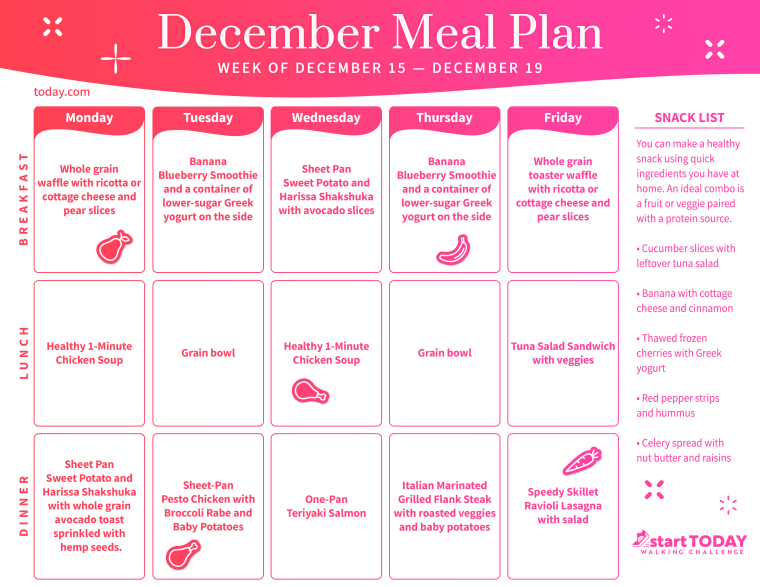
You asked, we answered! Hundreds of Start TODAY members told us they wanted more healthy, balanced meal ideas to help them reach their health goals. This dietitian-designed meal plan gives you the flexibility to enjoy the holidays — all while learning the building blocks of healthy eating. After all, all that walking works up an appetite!
Meal planning isn’t as daunting as it sounds. Spend just 10 or 15 minutes mapping out your meals, jot down what you need and head to the store. That’s it. And since the holidays are busy enough, we’ve also got suggestions for streamlining meal prep — and, best of all, you can even take the weekends off if you’re dining out or celebrating with family.
With the holidays nearing, this week’s theme is save time. To accomplish this goal, we mainly recommend throw-together breakfasts and lunches. Lunches utilize our formula for easy meal prep–making a grain, veggies, and simple protein ahead of time to mix-and-match during the week. For dinner, we’ve rounded up several sheet pan meals because what saves more time than limiting cleanup to one pan? More time-savers include jarred sauce and seasonings and freezer staples like frozen veggies. Plus, we’ve suggested numerous hacks to make the prep time quicker and easier.
December 19, 2022: What to eat this week
Breakfast
Keep mornings hassle-free with these throw-together options and leftovers.
Whole Grain Toaster Waffle
Spread with ricotta or cottage cheese and top with pear slices and cinnamon.
Kristen Little
Serve with avocado slices.
Courtesy of Gaby Dalkin
Use unsweetened almond milk (or your milk of choice) and have a container of lower-sugar Greek yogurt on the side.
Lunch
Start off the week by batch-roasting veggies and cooking a whole grain and protein. You’ll use these in your grain bowls. You can save time by using frozen veggies and whole grains, which we recommend for easy meal prep. Hassle-free protein options include store-bought rotisserie chicken and pre-seasoned tofu.
Nathan Congleton/TODAY
Use rotisserie chicken and mirepoix mix to reduce prep and save time. To make this heartier, add cooked microwavable or frozen brown rice–basic ingredients we recommend having on hand–to the finished soup.
Grain Bowl
Add cooked veggies, protein, and your whole grain of choice to a bowl. Season with an easy seasoning, such as pesto or lower-sodium soy sauce.
Tuna Salad Sandwich
Have on a whole grain English muffin or bread with lettuce and tomato and serve with veggies on the side. Feel free to swap another protein (such as leftover chicken or mashed chickpeas) for the tuna.
Try this idea:
Laura Vitale
Dinner
Sheet pan dinners are one of the ways we’re saving you time this week. You can make all five easy meals or make enough of one dish to serve as leftovers and save time on another night. (Note: To keep things healthy, we recommend having steak no more than twice per week.) If you loved recipes from our previous weeks, feel free to swap those in, including any suggested side dishes.
Kristen Little
We appreciate a meal that’s just as good for dinner as it is for breakfast. Making shakshuka on a sheet pan instead of the traditional cast iron skillet means you can have enough for breakfast (or another meal) later in the week. Serve with whole grain avocado toast sprinkled with hemp seeds.
Casey Barber/Good Food Stories LLC
This meal is a multi-tasking hero! You’ll cook the protein, carbs, and veggies on a sheet pan to make quick work of prep and cleanup. Plus, it’s full of flavor thanks to one of our favorite fast seasonings: pesto.
JSHealth
Here’s another one-pan wonder. Everything you need for a healthy dinner is arranged on a sheet pan, allowing for just ten minutes of prep time and speedy clean up. And the easy-to-make teriyaki seasoning has nearly half the added sugar as the bottled variety.
Matt Abdoo
Here’s a healthy way to enjoy steak: Choose a lean cut, like flank steak, and serve it with roasted vegetables and baby potatoes (also known as creamer potatoes). Most grocery stores sell pre-prepped baby potatoes, which can streamline prep time on busy nights.
Dylan James Ho and Jeni Afuso
The name says it all, and we think you’ll appreciate a speedy meal any day of the week, but especially during the holiday season. You can save even more time by using jarred marinara instead of making your own sauce. Try adding baby spinach to the mixture to boost the veggie content and serve with a mixed green salad on the side.
Snacks
Snacks that contain whole food sources of protein and fiber offer a winning formula that keeps you full for hours. Here are a few ideas:
Cucumber slices with leftover tuna salad
Banana split and toped with cottage cheese and cinnamon
Frozen cherries (thawed) with Greek yogurt
Red pepper strips and hummus
Celery spread with nut or nutless butter and topped with raisins

:max_bytes(150000):strip_icc()/Claire_KVphoto-04695bccffaf4b739bb0db5c53fab0f4.JPG "New Law Weeds Out Some Blockers to Medical Cannabis Research")