Baxter Hillrom Recalls WatchCare Incontinence Management System (IMS) for Risk of RF Interference with Nearby Medical Equipment

The FDA has identified this as a Class I recall, the most serious type of recall. Use of these devices may cause serious injuries or death.

Recalled Product 

  • Product Name: WatchCare Incontinence Management System (IMS) 
  • Product Models: 
    • P7900B Centrella Bed with WatchCare
    • P00697901: Hospital Bed Accessory, WatchCare System for VersaCare Bed Rev. A-J
    • P00697902: Hospital Bed Accessory, WatchCare System for VersaCare Bed Rev. K
    • P00697903: Hospital Bed Accessory, WatchCare System for Progressa Bed
    • P00697905: Hospital Bed Accessory WatchCare System for Centrella Bed
  • Distribution Dates: August 1, 2018 to September 1, 2022
  • Devices Recalled in the U.S.: 8,550
  • Date Initiated by Firm: September 30, 2022

Device Use

The WatchCare Incontinence Management System (IMS) includes specific Centrella, Progressa, and VersaCare hospital beds and disposable incontinence pads. It is designed to discreetly alert the caregiver of an incontinence event. The system is usually used in critical care and medical/surgical settings as well as in other clinical areas. 

Reason for Recall 

Baxter Hillrom is recalling the WatchCare IMS after receiving reports that the radiofrequency emissions (RF) from WatchCare devices may interfere with other medical devices, including equipment that is critical to the health and wellbeing of patients, such as:

  • Infusion pumps 
  • Insulin pumps
  • Blood glucose sensors
  • Fetal monitors / dopplers
  • Telemetry devices
  • Bladder scanners

Other third-party medical devices may also be affected. The RF interference from WatchCare may cause erroneous readings or malfunctions of these other devices on both patients and staff, which could lead to inappropriate medical treatments or lack of treatment. If WatchCare RF emissions affect a medically necessary device such as a blood glucose sensor, insulin pump, fetal monitor, or general infusion pump, among others, this issue could lead to serious injury or death.

Baxter reported 96 complaints of interference. To date, interferences in all cases but two occurred at distances less than 1 meter. There is insufficient data about distance on the remaining two reported interferences. There have been no reports of serious injuries or deaths related to this issue. 

Who May be Affected 

  • People who receive care in hospital beds with the WatchCare IMS accessory installed.
  • Health care personnel who care for patients in hospital beds with the WatchCare IMS accessory installed. 

What to Do 

On September 30, 2022, Baxter Hillrom sent customers an Urgent Medical Device Correction letter. An updated letter was sent on October 21, 2022, which recommended the following actions for clinicians, biomedical engineers, and other end users: 

  • Immediately locate all affected devices and remove them from clinical care areas (where possible) until the WatchCare functionality is disabled. Affected devices are those Centrella, Progressa and Versacare beds which have WatchCare functionality. Baxter will contact you to arrange for the WatchCare to be disabled, and their technical support can assist and provide alternative actions until the features are disabled. 
  • Be aware that RF emissions from functioning WatchCare devices may impact other devices including, but not limited to, telemetry devices, bladder scanners, fetal monitors/dopplers, infusion pumps, insulin pumps, and blood glucose sensors. 
    • Double check all unexpected or atypical results and monitor infusions closely. 
  • Use standard, non-RF based incontinence management pads until the issue is resolved.
  • Share this notice with all potential users and staff in your organization. 
  • Complete the response form (attached to the letter) and return to Hillrom-FA2022043@sedgwick.com within two weeks to acknowledge receipt and understanding.
  • Report any irregular activity or product complaints connected to the use of the WatchCare System to Baxter at 1-800-445-3720.
  • For distributors: Share with end users, complete the response form and return to Hillrom-FA2022043@sedgwick.com within two weeks. Electronic copies of the notification and response form can also be provided by reaching out to this address. 

Baxter will contact all impacted customers to arrange for WatchCare functionality to be switched off. 
The company will also provide a follow-up when more information is available. 

Contact Information 

Customers with technical questions about this recall should contact Baxter Hillrom Technical Support at 1-800-445-3720 or technical.support@hillrom.com.

Additional Resources: 

How do I report a problem?

Health care professionals and consumers may report adverse reactions or quality problems they experienced using these devices to MedWatch: The FDA Safety Information and Adverse Event Reporting Program using an online form, regular mail, or FAX.
 

Spartan Medical donates 700 medical-grade survival blankets and other medical supplies to Ukraine people

“Send blankets . . . or we’ll freeze to death” was Kyiv mayor Vitali Klitschko’s blunt assessment of the coming winter

ROCKVILLE, Md., Nov. 23, 2022 /PRNewswire/ — Spartan Medical Inc., a veteran-owned medical solutions company, today announced it has donated 700 Siren Survival Wraps and additional medical supplies to help Ukrainian civilians endure the alarmingly cold months ahead.

Spartan Medical donates 700 medical-grade survival blankets and other medical supplies to Ukraine people

Spartan Medical logo (PRNewsfoto/Spartan Medical Inc.)

“These Siren Survival Wraps will directly assist Ukrainians in enduring the approaching harsh winter.”

As Ukrainian forces have halted and opposed the invading Russian military, Russia has expanded its military strategy to attack critical infrastructure and dismantle Ukrainian cities’ life-support systems such as water, sewage, and electricity.

The average daily high temperature in Kyiv during the winter months is just above freezing. Accordingly, it is critical that medical facilities and first responders can maintain the core body temperature of at-risk populations under these conditions. Siren Survival Wraps are derived from a proprietary, post-surgery normothermia system. With the help of these wraps, clinicians and first responders will have the medical-grade tools needed to reduce the risk of life-threatening hypothermia.

“Spartan Medical has the technologies and expertise to help the Ukrainian people, and we are determined to make a difference,” stated Vince Proffitt, Founder and President of Spartan Medical. “These Siren Survival Wraps will directly assist Ukrainians in enduring the approaching harsh winter.”

Spartan Medical and the Proffitt Brothers Foundation, the charitable arm of Spartan Medical Inc., are working with the James Hollister Wellness Foundation based in Rockville, Maryland to deliver these supplies to Ukraine. The James Hollister Wellness Foundation provides life-saving medications and medical supplies to low-income and displaced individuals around the world.

“We’ve been providing medicine and medical supplies to Ukraine for months now, but the coming winter has drastically changed the requests we are receiving,” explained Matthew Hollister, Chairman and CEO, James Hollister Wellness Foundation. “For the Ukrainian soldiers battling for their home country, it has always been a life-or-death situation. But now, for the Ukrainian civilians, it’s a life-or-death situation just to battle the weather. The supplies from Spartan Medical Inc. could not have come at a better time to save the lives of those most affected by the attacks on Ukraine’s infrastructure.”

In addition to the Siren Survival Wraps, Spartan will also provide over one hundred thousand individual medical supplies, including the recently launched SURE Fire single-use retractor, a pre-packaged, sterile, surgery-ready system ideally suited to the demanding medical conditions in Ukraine (designed for the flexibility required in austere environments and front-line operations).

“Because of our medical and clinical expertise and our ability to manage complex logistics, today we assist the James Hollister Wellness Foundation in getting these products to the place of greatest need,” adds Proffitt.

About Spartan Medical:

Spartan Medical is a veteran-owned-and-operated government contractor for the U.S. Department of Veterans Affairs (VA), the U.S. Department of Defense (DoD), and other local, state, and federal agencies. We provide some of the most advanced medical technologies & biologics, licensed medical staff, and best-in-class operations management expertise to our clients both domestic and abroad. Our executive team have all held leadership positions in both the public and private sector and our core strength is solving complex problems through creative thinking, innovative solutions, and highly skilled flexible teams. Spartan Medical maintains its vanguard position by providing medical facilities with best-in-class solutions that improve patient care and outcomes, especially for America’s military and veteran communities.

About The James Hollister Wellness Foundation:

The James Hollister Wellness Foundation is a non-profit organization with a mission to save excess inventory in hospitals, pharmacies, and nursing care networks from being needlessly wasted. Founded in 2015 to honor the memory our co-founder’s late father, the medication and medical devices collected by the James Hollister Wellness is sent to low-income citizens in developing nations who do not have easy access to healthcare. Our non-profit organization works with charity groups, church groups, and service organizations that operate in countries, supplying them with the necessary medications needed to conduct their service work so that they can personally work with low-income individuals and tend to their healthcare needs.

Media Contact:
Nick Goebel
Director of Public Relations and Government Affairs, Spartan Medical
NickGoebel@SpartanMedical.com
248-767-6276

Cision

Cision

View original content to download multimedia:https://www.prnewswire.com/news-releases/spartan-medical-donates-700-medical-grade-survival-blankets-and-other-medical-supplies-to-ukraine-people-301685446.html

SOURCE Spartan Medical Inc.

Middle East and Africa Medical Equipment Maintenance Market is Expected to Reach USD 1,710.43 Million with is Growing at a CAGR of 7.9{bf0515afdcaddba073662ceb89fbb62b6b1bf123143c0e06b788e1946e8c353f}by 2029

“ Middle East and Africa Medical Equipment Maintenance Market” the new research report added in Data Bridge Market Research’s reports database. This Research Report spread across 220 No of Tables, And 60 No of Figures summarizing Top companies, with tables and figures. Insulin market report presents the best market and business solutions to Insulin industry in this rapidly revolutionizing market place to thrive in the market. This Insulin market research report is a careful investigation of current scenario of the market and future estimations which spans several market dynamics.

Middle East & Africa medical equipment maintenance market is expected to gain market growth in the forecast period of 2022 to 2029. Data Bridge Market Research analyses that the market is growing with a CAGR of 7.9{bf0515afdcaddba073662ceb89fbb62b6b1bf123143c0e06b788e1946e8c353f} in the forecast period of 2022 to 2029 and expected to reach USD 1,710.43 million by 2029. Technological advancement in delivering effective healthcare services can boost the market of maintenance market.

To bestow clients with the most excellent results, Middle East and Africa Medical Equipment Maintenance Market survey report has been generated by using integrated approaches and latest technology. The industry report supports to establish and optimize each stage in the lifecycle of industrial process that includes engagement, acquisition, retention, and monetization. In this report, trends of HEALTHCARE industry are formulated on macro level which helps clients and the businesses figure out market place and possible future issues. Middle East and Africa Medical Equipment Maintenance Market report provides key measurements, status of the manufacturers while proving as a noteworthy source of direction for the businesses and organizations.

Download the Free PDF Sample Report (Including FULL TOC, Graphs, and Tables) of this report @ https://www.databridgemarketresearch.com/request-a-sample/?dbmr=middle-east-and-africa-medical-equipment-maintenance-market

Key Market Competitors Covered in the Report

Siemens Healthcare GmbH

General Electric Company

Cook Medical LLC

B.Braun Melsungen AG

Cardinal Health

Koninklijke Philips N.V.

Drägerwerk AG & Co. KGaA

Stryker

Boston Scientific Corporation

Hitachi, Ltd.

Agfa-Gevaert Group

Agiliti Health, Inc.

Alpha Source, Inc.

Aramark

Atlantis Worldwide

CANON MEDICAL SYSTEMS CORPORATION

Carestream Health

ERD

FUJIFILM Europe GmbH

Hoya Corporation

InterMed Group, Inc.

KARL STORZ

Medtronic

Olympus Corporation

Richard Wolf GmBH

SAMSUNGHEALTHCARE.COM

Shimadzu Corporation

Smith-Nephew

Terumo Corporation

Zimmer Biomet

Market Overview:

Medical equipment maintenance involves activities which relates to providing adequate level of service in order to maintain the medical equipment. The main objective in doing so is to reduce the down time of medical devices in the facility, this can lead to optimum productivity, saves cost and provide better healthcare services to its consumers. There are two types of medical equipment maintenance techniques which are quite popular and it is categorized as preventive maintenance and corrective maintenance. Preventive maintenance is a method of service in which it proactively initiate tasks of maintenance plans to prevent equipment failures from occurring, it’s also predicts the failure of equipment there by it is also called predictive maintenance. The main objective of preventive maintenance is to minimize the consequence of failure or determining the risk of the failure. It is an established procedure or routine of periodically inspecting equipment, noticing small issues and fixing them before become a major problems. On the other hand, Corrective maintenance is done after the failure has occurred. This done on an immediate bases in order to reduce the downtime of the equipment.

Rising prevalence of chronic diseases across the region is the major driving factor in the market. Lack of infrastructure in healthcare services can prove to be a challenge however emergence of time-efficient solutions & various standards can prove to be an opportunity. The restraint is higher cost associated with the maintenance of the medical equipment. Also challenges faced due to the impact of Covid-19 on the supply chain of the raw materials are the restraining factors.

This Medical equipment maintenance market report provides details of market share, new developments, and product pipeline analysis, impact of domestic and localised market players, analyses opportunities in terms of emerging revenue pockets, changes in market regulations, product approvals, strategic decisions, product launches, geographic expansions, and technological innovations in the market. To understand the analysis and the market scenario contact us for an Analyst Brief, our team will help you create a revenue impact solution to achieve your desired goal.
Middle East and Africa Medical Equipment Maintenance Market is Expected to Reach USD 1,710.43 Million with is Growing at a CAGR of 7.9{bf0515afdcaddba073662ceb89fbb62b6b1bf123143c0e06b788e1946e8c353f}by 2029

View Detailed [email protected] https://www.databridgemarketresearch.com/request-a-sample/?dbmr=middle-east-and-africa-medical-equipment-maintenance-market

Middle East & Africa Medical Equipment Maintenance Market Scope and Market Size

Middle East & Africa medical equipment maintenance market is segmented on the basis of device type, service type, service providers, level of maintenance, end user. The growth among segments helps you analyse niche pockets of growth and strategies to approach the market and determine your core application areas and the difference in your target markets.

On the basis of device type, the Middle East & Africa medical equipment maintenance market is segmented into imaging equipment, endoscopic devices, surgical instruments, electro medical equipment, other medical equipment. In 2022, imaging equipment held larger share in medical equipment maintenance market owing to factors growing inclination of hospitals and heath firms towards the automation and digitization of radiology and increasing adoption of minimally invasive procedures including diagnostic imaging systems in hospitals and clinics to improve the quality of patient care with minimal invasive marks.

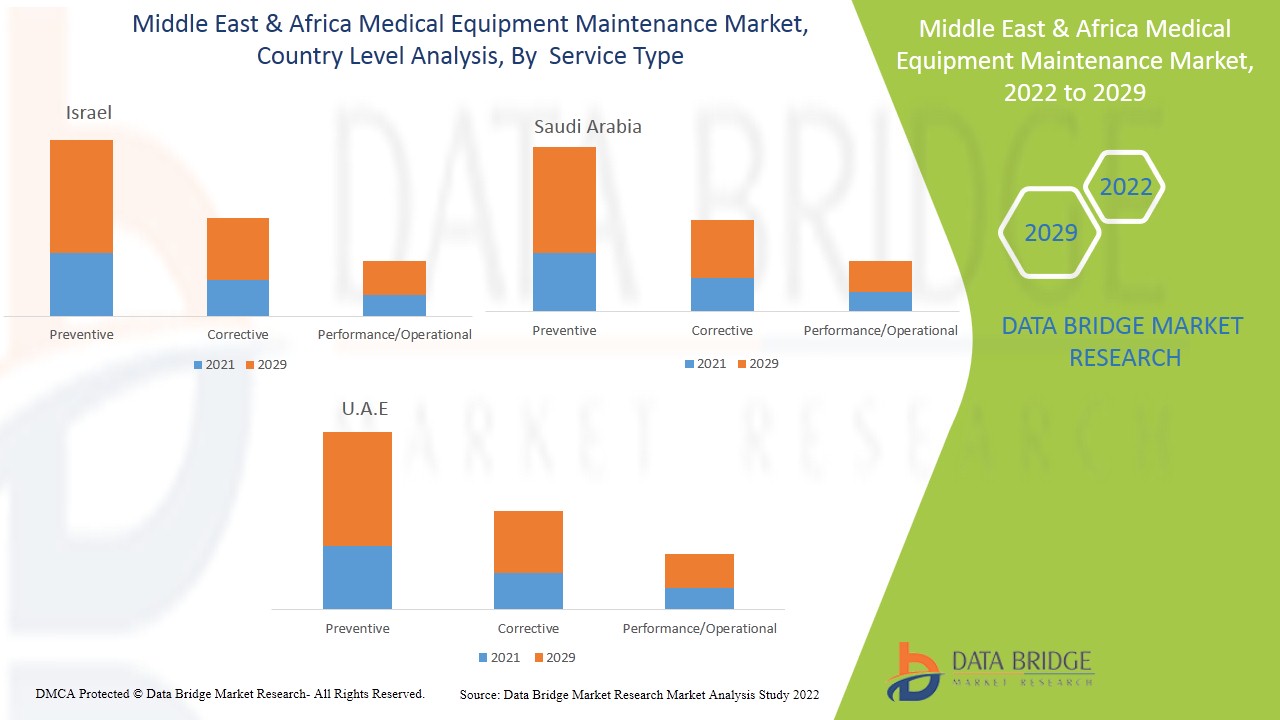
On the basis of service type, the Middle East & Africa medical equipment maintenance market has been segmented into performance/operational, preventive, corrective. In 2022, preventive segment held larger share in the medical equipment maintenance market due to factors such as growing demands for improving customer experience for medical equipment services, boosting the operation, economic performance of customer service and improved internalization, outsourcing or re-internalization policy of customer service can fuel the growth of maintenance services. The main objective of these service is to improve quality of service, speed at which the service is offered, dependability, flexibility and cost offered by services.

On the basis of service providers, the Middle East & Africa medical equipment maintenance market has been segmented into external service providers, in-house service providers. In 2022, in-house service providers segment held larger share in the medical equipment maintenance market due to factors such as the increasing cases of chronic disorders is boosting the demand for medical equipment’s. Due to this rising demands for the lifesaving medical equipment’s and medical engineering products, there is a difficulty faced by the organizations to keep in pace with the demand. Services providers plays an important role in keeping the organization functional. As these services providers can ensure uniformity, accuracy, consistency, and accountability of the medical equipment’s.

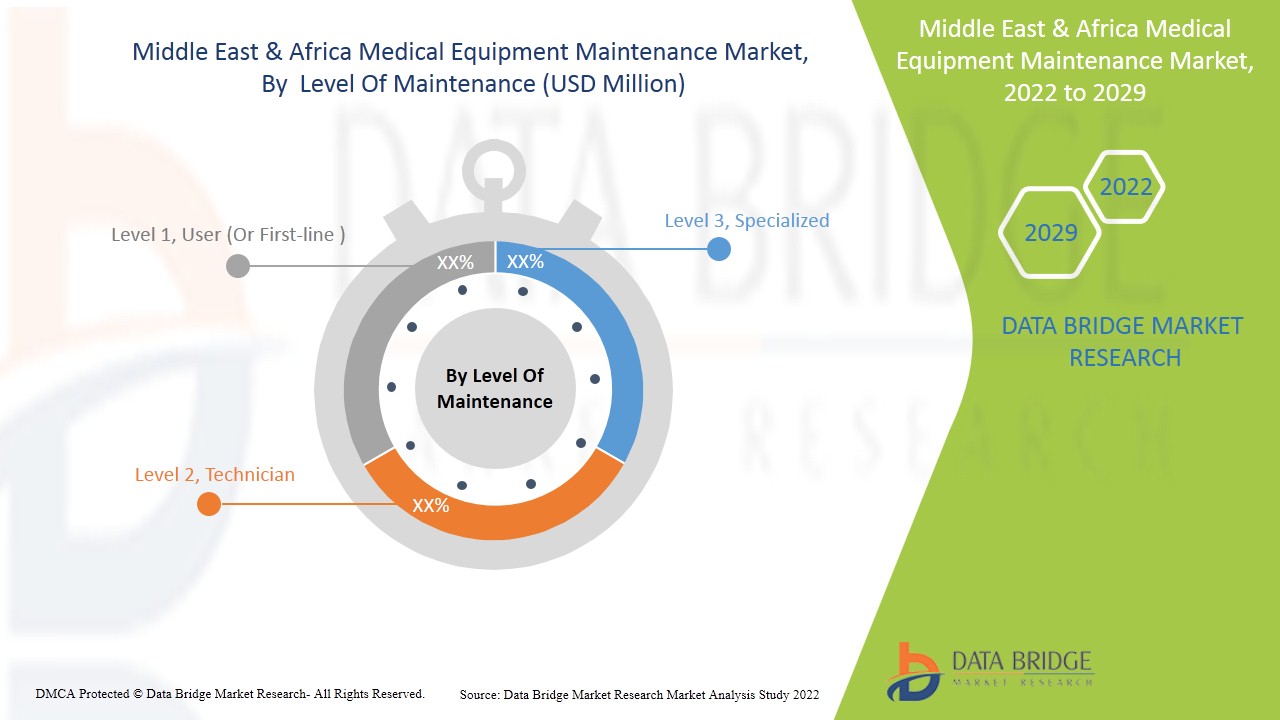
On the basis of level of maintenance, the Middle East & Africa medical equipment maintenance market has been segmented into level 1 user (or first-line), level 2 technician, level 3 specialized. In 2022, level 3 specialized segment held larger share in the medical equipment maintenance market due to factors such as the rise of pandemic across globe, it has significantly boosted the patients opting for medical treatment, in order to provide services to these patients the medical equipment’s are running over time. This leads to failure of equipment’s, depending on the nature of failure maintenance services can be offered.

On the basis of end user, the Middle East & Africa medical equipment maintenance market has been segmented into hospitals, clinics, laboratory, other health care centers. In 2022, Hospitals segment held larger share in the medical equipment maintenance market due to factors such as the growing demands for medical equipment’s such as orthopedic implants and prosthetics, cardiovascular devices, neurovascular devices, general equipment & supplies, patient monitoring equipment, ophthalmic devices in hospitals, which needs to be regularly maintained in order to maintain its efficiency and productivity in order to maintain the service offered to its seekers.
Middle East and Africa Medical Equipment Maintenance Market

The complete Report is available (Including the full TOC, Tables, and Figures, Graphs as well as Chart) @ https://www.databridgemarketresearch.com/toc/?dbmr=middle-east-and-africa-medical-equipment-maintenance-market

Middle East & Africa Medical Equipment Maintenance Market Country Level Analysis

Middle East & Africa medical equipment maintenance market is analysed and market size information is provided by device type, service type, service providers, level of maintenance, end user.

The countries covered in Middle East & Africa medical equipment maintenance market report are Israel, Saudi Arabia, U.A.E., South Africa, Egypt, Qatar, Kuwait, Oman, Bahrain, and Rest of Middle East & Africa.

Israel is dominating country in this region due to rapidly growing healthcare infrastructure and government initiatives. Saudi Arabia stands second in this region due to increasing health awareness and medical equipment usage. U.A.E. is third dominating country due to growing technological trend in healthcare sector.

Israel is dominating country in this region due to rapidly growing healthcare infrastructure and government initiatives. Also there is increasing automation and digitization of radiology and adoption of minimally invasive procedures including diagnostic imaging systems in hospitals to improve the quality of patient care with minimal invasive marks. This demand for medical equipment’s can boost the market of maintenance market.

The country section of the report also provides individual market impacting factors and changes in regulation in the market domestically that impacts the current and future trends of the market. Data points such as new sales, replacement sales, country demographics, regulatory acts and import-export tariffs are some of the major pointers used to forecast the market scenario for individual countries. Also, presence and availability of Middle East & Africa brands and their challenges faced due to large or scarce competition from local and domestic brands, impact of sales channels are considered while providing forecast analysis of the country data.

Rising Demand of Middle East & Africa Medical Equipment Maintenance.

Medical equipment maintenance market also provides you with detailed market analysis for every country growth in industry with sales, components sales, impact of technological development medical equipment maintenance and changes in regulatory scenarios with their support for the medical equipment maintenance market. The data is available for historic period 2011 to 2020.

Competitive Landscape and Middle East & Africa Medical Equipment Maintenance Market Share Analysis

Middle East & Africa medical equipment maintenance market competitive landscape provides details by competitor. Details included are company overview, company financials, revenue generated, market potential, investment in research and development, new market initiatives, Middle East & Africa presence, production sites and facilities, company strengths and weaknesses, product launch, product trials pipelines, product approvals, patents, product width and breadth, application dominance, technology lifeline curve. The above data points provided are only related to the companies’ focus related to Middle East & Africa medical equipment maintenance market.

Queries Resolved In This Report:
1. Which will be the specialties at which Market players profiling with intensive designs, financials, and furthermore, ongoing headways should set nearness?
2. Which will be the foreseen development rates for your own economy out and out and furthermore for each portion inside?
3. Which will be the application and sorts and estimate joined intently by makers?
4. Which will be the dangers which will attack growth?
5. The length of the global market opportunity?
6. How Market share advance vacillations their value from various assembling brands?

Highlights of this Study Market Research Report:
1. To strategically profile key players and comprehensively analyze their market position in terms of ranking and core competencies, and detail the competitive landscape for market leaders
2. To describe and forecast the market, in terms of value, for various segments, by region North America, Europe, Asia Pacific (APAC), and Rest of the World (RoW)
3. Key parameters which are driving this market and restraining its growth
4. What all challenges manufacturers will face as well as new opportunities and threats faced by them.
5. Learn about the market strategies that are being adopted by your competitors and leading organizations

Explore DBMR Comprehensive Coverage on Healthcare Domain: 

https://www.databridgemarketresearch.com/reports/global-medical-equipment-maintenance-market

https://www.databridgemarketresearch.com/reports/europe-medical-equipment-maintenance-market

https://www.databridgemarketresearch.com/reports/asia-pacific-medical-equipment-maintenance-market

https://www.databridgemarketresearch.com/reports/north-america-medical-equipment-maintenance-market

About Data Bridge Market Research:

An absolute way to forecast what future holds is to comprehend the trend today!

Data Bridge Market Research set forth itself as an unconventional and neoteric Market research and consulting firm with unparalleled level of resilience and integrated approaches. We are determined to unearth the best market opportunities and foster efficient information for your business to thrive in the market. Data Bridge endeavours to provide appropriate solutions to the complex business challenges and initiates an effortless decision-making process. Data Bridge is an aftermath of sheer wisdom and experience which was formulated and framed in the year 2015 in Pune.

Data Bridge Market Research has over 500 analysts working in different industries. We have catered more than 40{bf0515afdcaddba073662ceb89fbb62b6b1bf123143c0e06b788e1946e8c353f} of the fortune 500 companies globally and have a network of more than 5000+ clientele around the globe. Data Bridge adepts in creating satisfied clients who reckon upon our services and rely on our hard work with certitude. We are content with our glorious 99.9 {bf0515afdcaddba073662ceb89fbb62b6b1bf123143c0e06b788e1946e8c353f} client satisfying rate.

Contact Us:-

Data Bridge Market Research
US: +1 888 387 2818
UK: +44 208 089 1725
Hong Kong: +852 8192 7475

Email:- [email protected]

These 14 medical device inventions are the best

Marketing images of Osso VR Phonak Audéo Fit Molli Surgical breast cancer localization system and Esper Bionics Esper Hand which were medical device innovations making it into Time magazin Best Inventions of 2022

Clockwise from top left: Osso VR, Phonak’s Audéo Fit, Molli Surgical’s breast cancer localization system, and Esper Bionics’ Esper Hand were among 14 medical device innovations to make it into Time magazine’s Best Inventions of 2022. [Images courtesy of the companies]

Fourteen medical devices ranging from patient monitoring to surgical robotics recently made it into Time magazine’s Best Inventions of 2022.

For over 20 years, Time magazine has highlighted the 100 most impactful devices and ideas around the world. The list is compiled through nominations from the publication’s editors and global correspondents, with special attention to categories such as medical innovations, green energy and electric vehicles.

Time graded each nominee on a number of key factors that include originality, efficacy, ambition and impact.

This year’s list honored 14 medical devices, mostly from startup companies. Vicarious Surgical and Osso VR are some familiar names in the medtech industry that were recognized as some of Time magazine’s Best Inventions of the year as surgical robotics and virtual reality continue to gain traction in the industry.

Other notable devices on Time magazine’s Best Inventions list include a wearable walking cane for visually-impaired people that takes into account objects at head and chest level, as well as an ultrasound sticker and a pop-up patient isolation room.

Here are the 14 medical devices and technologies, separated into type categories, that were awarded Best Invention of 2022, according to Time magazine.

Patient monitoring

Patient monitoring devices had to become more innovative during the COVID-19 pandemic. In the first few months of the COVID-19 pandemic, the FDA relaxed regulations on 21 types of remote patient monitoring devices for the duration of the pandemic to protect healthcare workers from exposure to the virus. Time magazine has named some patient monitoring systems as some of the best inventions of 2022. Ranging from wearable continuous stroke monitoring to a pop-up patient isolation room, here are five patient monitoring devices that are keeping physicians and patients safe and comfortable.

What are they and how do they work?

Click + symbol to expand.

Clinomic: Mona | Tracking ICU patient care using voice activation

Clinomic‘s Mona is a smart bedside device used in the intensive care unit that provides feedback to assist clinicians in the best treatment options for patients. This remote monitoring system allows clinicians to securely perform telemedicine through an encrypted audio-video connection, giving specialist care at the patient’s bedside. Using natural language, Mona documents patient data, including drugs administered, clinical measurements, observations, procedures and more. It is voice-activated to allow doctors to verbally note what action they are taking. The system features SmartLabs, MedicBI, SmartWorkflows, ItelliQM and SmartSummary, all of which provide meaningful information to doctors on lab values, predictions of out-of-range lab values, efficient ways to track ICU checklists and more. Mona is powered by an NVIDIA high-speed artificial intelligence chipset, artificial intelligence-powered eight microphone array, 60 GHz radar and localization chip, 5G and LTE mobile connectivity and a 180-degree 4K telemedicine camera and runs on hospital infrastructure.

Neuralert | Wearable continuous stroke monitoring

Neuralert is a non-invasive stroke monitoring system that detects and alerts hospital staff to the onset of a stroke. Worn as a wristband, the device is constantly monitoring for warning signs of a stroke by measuring arm asymmetry and models out non-stroke asymmetry that causes false alarms, such as hand dominance and cellphone usage. When Neuralert detects signs of a stroke, the device’s cloud software immediately sends an alert to hospital staff on their mobile devices to enhance care delivery. The parameter-invariant algorithm helps reduce false alarms and detect strokes with up to 97{bf0515afdcaddba073662ceb89fbb62b6b1bf123143c0e06b788e1946e8c353f} specificity, according to the company.

Xander Kardian: XK300 | Wireless, remote patient monitoring system

Xander Kardian‘s XK300 is a wireless patient monitoring system that measures motion, resting heart rate, respiratory rate and the presence detection of a patient using radar technology. The device is cleared for use in general hospitals, nursing homes and residential homes for home health monitoring. The XK300 measures nano-vibrations from inside the body and uses impulse UWB radar technology to obtain the frequencies from both macro body motion and micro nano-vibrations as a patient moves, breathes and their heart pumps. The human body can send out 15 million impulse signals per second, and the XK300 translates them into 10 data set conclusions per second and compiles it to provide a body motion index, respiratory rate and resting heart rate information. The device is attached to a wall to monitor many chronic conditions, including COVID-19, asthma, pulmonary hypertension, pulmonary embolism and more.

Biotricity: Bioheart | 24/7 heart monitoring

Biotricity‘s Bioheart is a direct-to-consumer continuous heart rhythm monitoring device. It has built-in electrodes and offers three different heart views with 48 hours of battery life on a fabric chest strap wearable. It uses powerful analytics and continuous rhythm monitoring to deliver feedback to physicians that is needed to better understand the condition of a person’s heart health. The technology syncs to a smartphone to offer real-time data that can be viewed on the Bioheart application, which includes important metrics like resting heart rate, active heart rate, live heart rhythm, heart rate variability and more.

Gama Healthcare: Rediroom | Instant patient isolation room

Gama Healthcare‘s Rediroom is an instant patient isolation room that equips hospitals to respond to infection outbreaks. The pop-up isolation room has a mobile cart that expands into a HEPA air-filtered isolation room with hands-free entry. The Rediroom is fully operational in five minutes and is a mobile solution that can be easily wheeled to a patient’s bed. It can create an isolation space anywhere in a multi-bay ward. The HEPA filters remove 99.995{bf0515afdcaddba073662ceb89fbb62b6b1bf123143c0e06b788e1946e8c353f} of particles down to 0.3 microns. Rediroom’s hands-free entry and exit reduce the risk of hand contamination with an entry kick panel below the in-built PPE station.

Withings: Body Scan | Home connected health station

Withings’ Body Scan is a connected health station that delivers precise weight, segmental body composition and heart health with vascular age. It uses advanced sensors embedded in the handle of the scale to scan the torso, arms and legs to give a precise body composition and overall fitness measurement. The vascular age feature identifies changes in overall cardiovascular health by measuring the speed at which wave heart-generated waves move along the artery. Body Scan also provides an Electrodermal Activity Score that measures skin response to sweat gland stimulation. Data from the scale is transmitted to the Withings smartphone application where health trends can be monitored.

MIT: Bioadhesive Ultrasound | Ultrasound stickers

Researchers at the Massachusetts Institute of Technology have developed a stamp-sized device that sticks to the skin to provide continuous ultrasound imaging of internal organs. The sticker can operate for 48 hours to show high-resolution images of major blood vessels and deeper organs such as the heart, lungs and stomach. The bioadhesive ultrasound stickers are connected to instruments that translate the reflected sound waves and turn them into images. A transducer is pressed against the skin and sends sound waves into the body that then echo off internal structures and back to the transducer, which translates the echoed signals into visual images. The adhesive layer is two thin layers of elastomer encapsulating a middle layer of solid hydrogel that easily transmits the sound waves.

Accessibility devices and technology

There are many devices on the market to assist people with health conditions and impairments. Recently, the White House announced that over-the-counter hearing aids would be sold at major U.S. retailers following an FDA final ruling that created a new category of OTC hearing aids. Those devices for the hearing impaired and many other accessibility devices for amputees and visually-impaired are some of Time magazine’s Best Inventions of 2022. Ranging from hearing aids to wearable walking canes, these devices improve accessibility and mobility.

What are they, and how do they work?

Click + symbol to expand.

Phonak: Audéo Fit | Hearing aids that monitor heart rate

Phonak‘s Audéo Fit hearing aids are equipped with a sensor that collects heart rate, steps and activity levels to help create a greater sense of well-being when used with the company’s myPhonak smartphone app. The wearable hearing aids also have multiple Bluetooth functions that allow the device to connect to smartphones, televisions and more.

Esper Bionics: Esper Hand | Bionic hand prosthetic

Esper Bionics‘ Esper Hand is an FDA-registered self-learning bionic hand prosthesis that has five separate movable fingers. It is powered by the company’s Esper Control and Esper Platform to accurately detect muscle activity, recognizes situations and predicts the grip that would best fit a certain scenario. Esper Hand is trained using digital signal processing, artificial intelligence, machine learning, data collection, low-power electrons and light movable machinery design so that when a user moves the Esper Hand, the human brain sends impulses to activate exact muscles in the forearm, shoulder and chest. The activation is detected with the help of wearable muscle sensors to work as an exact call-to-action for the robotic hand.

Enhanced Robotics: Sportsmate 5 | Personalized exoskeleton to assist mobility

Enhanced Robotics‘ Sportsmate 5 is an exoskeleton, wearable robot that helps a user lift their thighs up and push the body forward to make walking easier. The consumer-level powered exoskeleton is form-fitting and has two actuators at the hip to provide assistance when needed to save energy and move with ease. Sportsmate 5 improves stability by holding the user’s body and absorbing shaking to decrease strain. It uses a gait controller system, actuator system and energy system, all of which will monitor gait behavior using sensors and are processed using an artificial intelligence algorithm. The controller sends signals to the exoskeleton’s drivers to deliver the correct amount of assistance to the user.

Strap Technologies: Ara | A wearable walking cane for visually-impaired

Strap Technologies’ Ara device is an assistive technology for the blind and visually impaired. The company designed it to replace traditional canes as the wearable technology provides obstacle detection at the user’s head, chest and below waist level and alerts them through haptic feedback. The system’s obstacle detection and straight-line navigation communicate with the user through haptic feedback and a sequence of vibrations specific to certain situations. Ara also adapts to walking speed, and sensors on the device provide information and essential direction instructions that prevent unintentional veering when walking long distances. The Ara is worn on the chest and has six actuators in the device and four actuators on the strap.

Robotic surgery, virtual reality and surgical systems

Robotic-assisted surgery is one of the hottest spaces in the medical device industry, while virtual reality is gaining traction as well. Companies like Vicarious Surgical are combining the two technologies to create one of Time magazine’s Best Inventions of 2022. From surgical robotics to breast cancer localization systems, here are three inventions labeled as the best of the year by Time magazine.

What are they, and how do they work?

Click + symbol to expand.

Vicarious Surgical: Robotic system | Transporting doctors inside a patient using surgical robots

Vicarious Surgical designed its surgical robotics platform to use human-like surgical robots combined with 3D visualization to transport surgeons inside the patient to perform minimally invasive procedures. The system creates a 1.5 cm incision — smaller than a dime — to insert a camera and two robotic instruments for abdominal procedures. The surgical robot design has 360 degrees of visualization and access and robotic arms that move downward, sideways, upward and backward to give surgeons greater access to the abdomen. Vicarious Surgical’s robotic system has 28 sensors per arm and replicates a surgeon’s natural upper body movements from shoulders to elbows to wrists.

Molli Surgical: Molli breast cancer localization system | Precise localization for breast cancer surgery

Molli Surgical‘s Molli is a surgical localization device that makes breast cancer surgery simpler for patients, radiologists and surgeons. The localization marker is 3.2 mm in size and has solid magnetic technology to prevent the marker from being deactivated. Molli works with all breast sizes and dense tissue and the delivery system’s tip is extra sharp and free of burrs to provide the best possible placement. An accompanying tablet is portable and mountable on an IV pole or tabletop stand with a fully rechargeable battery that provides three real-time feedback options that measure distance, visual and auditory feedback.

Osso VR: Surgical training platform | Using virtual reality to train surgeons

Osso VR designed its surgical training technology to provide on-demand educational experiences that are repeatable and measurable to help surgeons with surgical techniques and technologies. It has visual fidelity and is available in multiple languages, including English, Japanese, Spanish, German and French. Osso VR gives medical device companies and healthcare professionals a better way to share, practice and learn new skills and procedures in virtual reality. It uses off-the-shelf technology like Oculus VR goggles to work with existing training processes to provide actionable insights and significantly improve effectiveness. The whole system has training analytics to help measure engagement and proficiency to help healthcare professionals perform their best.

Virtual Public Workshop – CDRH Industry Basics: Understanding Risk with Medical Devices – 11/15/2022

Date:
November 15, 2022
Time:
1:00 PM
– 3:00 PM
ET

Image

Virtual Public Workshop – CDRH Industry Basics: Understanding Risk with Medical Devices – 11/15/2022


The U.S. Food and Drug Administration (FDA) is announcing a virtual public workshop Understanding Risk with Medical Devices. This 2-hour workshop will expand on the basics of risk associated with medical device use by featuring Risk Basics for Medical Devices and Application of Risk Management Principles for Medical Devices. The presentations will be followed by a live question-and-answer session with stakeholders and a panel of CDRH leaders.

On This Page


Date and Time

November 15, 2022, from 1:00 PM to 3:00 PM ET by webcast only.

Workshop Summaries

Risk Basics for Medical Devices (Joseph Tartal, Deputy Director Division of Industry and Consumer Education)

Understanding risk is a necessity to bring and keep a medical device on the market. These basic concepts will start you on the journey to determine the risk of your medical device, which will increase predictability, aid in appropriate design and manufacturing, and provide clearer premarket submission regulatory expectations. This session will discuss the basics of risk and use a generic example to help establish a fundamental understanding of risk.

Application of Risk Management Principles for Medical Devices (Tonya Wilbon, Branch Chief, Postmarket and Consumer Branch, Division of Industry and Consumer Education)

Medical device manufacturers are required to make risk-based decisions and conduct risk management activities as a part of the design, manufacture, and production of medical devices or in general as part of the quality system. In addition, the regulation of medical devices incorporates risk-based decisions to assure devices are safe and effective. This session will provide an understanding of the application of risk management principles and review of risk information for medical devices.

Each session will include a presentation, followed by a moderated live question-and-answer session with a panel of CDRH leaders. Audience participants are encouraged to email or call with questions during each session.

Participants may choose one or both sessions. Each session will begin at the scheduled time.

  • 1:00 – 2:00 PM ET: Risk Basics for Medical Devices
  • 2:00 – 3:00 PM ET: Application of Risk Management Principles for Medical Devices

Webcast

On November 15, 2022, use the following link to join the workshop: https://fda.yorkcast.com/webcast/Play/4aecf454d2d54039a1d5a6a3001d78c31d

There is no fee to attend and registration is not required.

Contact

For questions regarding workshop content, please contact: The Division of Industry and Consumer Education at DICE@fda.hhs.gov.

How to Manage Risk for Medical Devices

All medical devices have risk.

“You, as the manufacturer, are responsible for determining the risk of your medical device and if that risk is acceptable,” said Joseph Tartal, FDA deputy director in the Division of Industry and Consumer Education, who presented during the agencies virtual public workshop Understanding Risk with Medical Devices, Tuesday.

To start, it helps to understand the terminology.

While “risk” has no formal across-the-board definition in FDA documents, Tartal describes risk as looking at the harm that the device can cause patients and users and their environment. That includes harm from medical device failures.

Risk in this realm does not mean financial risk, he said.

The combination of the probability of occurrence of harm and severity of that harm go into determining the risk of a medical device.

But it’s not only risk that comes into play in risk management. Benefit is new to FDA’s definition of risk when it comes to medical devices, according to Tartal.

Here too there is no formal definition for benefit, but Tartal describes the benefit as “… the positive impact or desired outcome of the use of a medical device on the health of an individual or a positive impact on patient management or public health.”

Analyzing medical device risk

To analyze risk, systematically use available information to identify hazards and estimate risk. There are different approaches for this. Tartal suggested starting here: identify possible hazards, including user error; calculate or estimate risk in normal and fault conditions; determine risk acceptability; reduce risk to an acceptable level; and evaluate changes to make sure you’re not introducing new hazards.

It is up to the manufacturers to identify possible hazards and risk associated to reduce the risk to acceptable levels, according to workshop speaker Tonya Wilbon, branch chief, Postmarket and Consumer Branch, Division of Industry and Consumer Education at FDA.

Risk occurs throughout a device’s lifecycle, she said.

FDA uses risk-based decisions for medical devices, too

FDA classifies medical devices based on risk, with class 1 medical devices being the lowest risk and class 3 being the highest, Tartal noted.

“The Office of Regulatory Affairs uses risk to schedule medical device inspections. Recall classifications are based on risk, as are enforcement actions,” Tartal said. “We even use risk analysis tools such as health hazard evaluations and health risk assessments when determining a recall’s classification.”

The International Organization for Standardization (ISO) 14971 2019 “Medical Devices Application of Risk Management to Medical Devices” is the international standard for medical devices accepted around the world and is recognized by the FDA to establish a risk management process.

Risk management technique examples

Tartal talked about three commonly use risk analysis techniques: Preliminary Hazard Analysis (PHA), Fault Tree Analysis (FTA), a top-down approach; and Failure Mode and Effects Analysis (FMEA), which looks at risk according to individual line items, single component, or single processes.

Preliminary Hazard Analysis, usually done early in a device’s development, helps identify and prioritize hazards, hazardous situations and events that can cause harm, according to Wilbon.

“For each hazard identified, you identify and document the hazardous situation, the possible harm, the severity of the harm, and the probability of the hazard and hazardous situation leading to harm,” she said.

The Preliminary Hazard Analysis also includes identifying possible risk control measures, according to Wilbon.

Those doing risk analyses might use the Fault Tree Analysis to analyze identified hazards, estimating their probability and identifying situations when they might occur.

And Failure Mode and Effects Analysis identifies and evaluates individual fault or failure modes and is a bottom-up method that starts with cause and works toward effect or how it affects device use. This technique analyzes not only device failure but also failures in manufacturing and component assembly, Wilbon said.

Enter benefit-risk analysis

Once manufacturers have made all risk reduction measures and only acceptable residual risk remains, FDA conducts a benefit-risk analysis. FDA’s benefit-risk analysis considers many factors when determining benefits and risk for Premarket Approval Application (PMA) and de Novo classification; substantial equivalence in Premarket Notifications (501(k)); Investigational Device Exemption (IDE); and product availability, compliance, and enforcement decisions, according to Wilbon.

The factors that FDA considers in each of these areas often differ. For example, medical necessity is a factor FDA considers only when doing benefit-risk analysis for availability, compliance, and enforcement decisions, while “magnitude of benefit” applies in all four categories.

“… severity of risk or harm is considered during premarket review process and when making product availability, compliance and enforcement decisions,” she said.

Wilbon used the example of a benefit-risk analysis in product availability, compliance, and enforcement for a human chorionic gonadotropin (hCG) device—essentially, an over-the-counter pregnancy test that detects hCG in urine.

She said a healthcare provider noticed a higher rate of positive results, but the positive results were not confirmed in blood samples. So, the device yielded a higher rate of false positives than expected by the manufacturer. The manufacturer identified the problem in specific lots and disclosed that the end user is not able to detect this malfunction.

FDA considered that there are other such devices on the market that don’t have the same risk and reduced the benefit due to the test’s potential inaccuracy. Considering these and other factors, FDA decided there was no need for the product to continue to be available, and FDA and the manufacturer decided to recall the device, classifying it as a class 2 recall, according to Wilbon.

“… risk management activities are essential throughout the product lifecycle and not just required during design validation,” Wilbon said. “…  manufacturers should use more than one risk management technique in their risk management process.”